ICD-10 Code Z94.5: Skin transplant status
ICD-10 Code Z94.5: Definition and clinical description ICD-10 Code Z94.5 is an I...

Last Updated: Nov 25, 2026
ICD-10 code Z66 is the billable ICD-10-CM diagnosis code for do not resuscitate (DNR) status. Coders assign it when the provider has documented the patient’s DNR status in the medical record. CMS’s FY 2027 coding guidelines list Z66 among the status codes and allow it when that status is documented at any time during the stay.
Z66 sits in Chapter 21 of ICD-10-CM and is reported only as an additional diagnosis, never as the principal one. It appears most often in hospice, palliative care and inpatient records, where code status shapes the care plan. Most Z66 denials trace back to the record: no provider documentation, an outdated or revoked order, or Z66 listed first.

ICD-10 code Z66 records a patient’s do not resuscitate status when the provider has documented it in the medical record for the stay.
Z66 is a status code reported only as an additional diagnosis, so it is never sequenced as the principal diagnosis.
Y66 is a misadventure code for care not given in error, and honoring a valid DNR is never coded Y66.
Pabau, a practice management platform, keeps encounter notes, forms and claims in one patient record, which supports accurate Z66 coding.
ICD-10 code Z66 is a valid, billable ICD-10-CM diagnosis code with the official descriptor “Do not resuscitate.” The National Center for Health Statistics (NCHS) and the Centers for Medicare and Medicaid Services (CMS) maintain the code set.
Z66 captures a documented resuscitation restriction in the encounter record. Its descriptor is unchanged for FY2027, but verify it annually against the CMS tabular list.
The CDC/NCHS ICD-10-CM web tool lists Z66 as a standalone code in Chapter 21, category Z66. It has no subcategories, no age or sex restrictions, and no laterality qualifiers. It is classified as Present on Admission (POA) exempt, meaning facilities are not required to report a POA indicator for this code on inpatient claims.
Z66 applies when the provider has documented DNR status in the medical record for the encounter being coded. The code records that status, not an act of withholding care.
Clinical situations that support ICD-10 code Z66 include:
In every scenario, Z66 rests on the provider’s documentation. If the status is verbal only, revoked, undocumented, or missing from the encounter record, the code is not supported, whatever the patient’s known wishes.
Several clinical scenarios are commonly miscoded with Z66 when a different code (or no code) is appropriate. Applying Z66 in any of these situations puts a claim at risk.
Z66 and Y66 are often confused in end-of-life coding, because both seem to describe care that was not given. Z66 is a status code, a fact about the patient. Y66 is an external cause code for a misadventure, an error during care. The decision below shows which code the record supports.
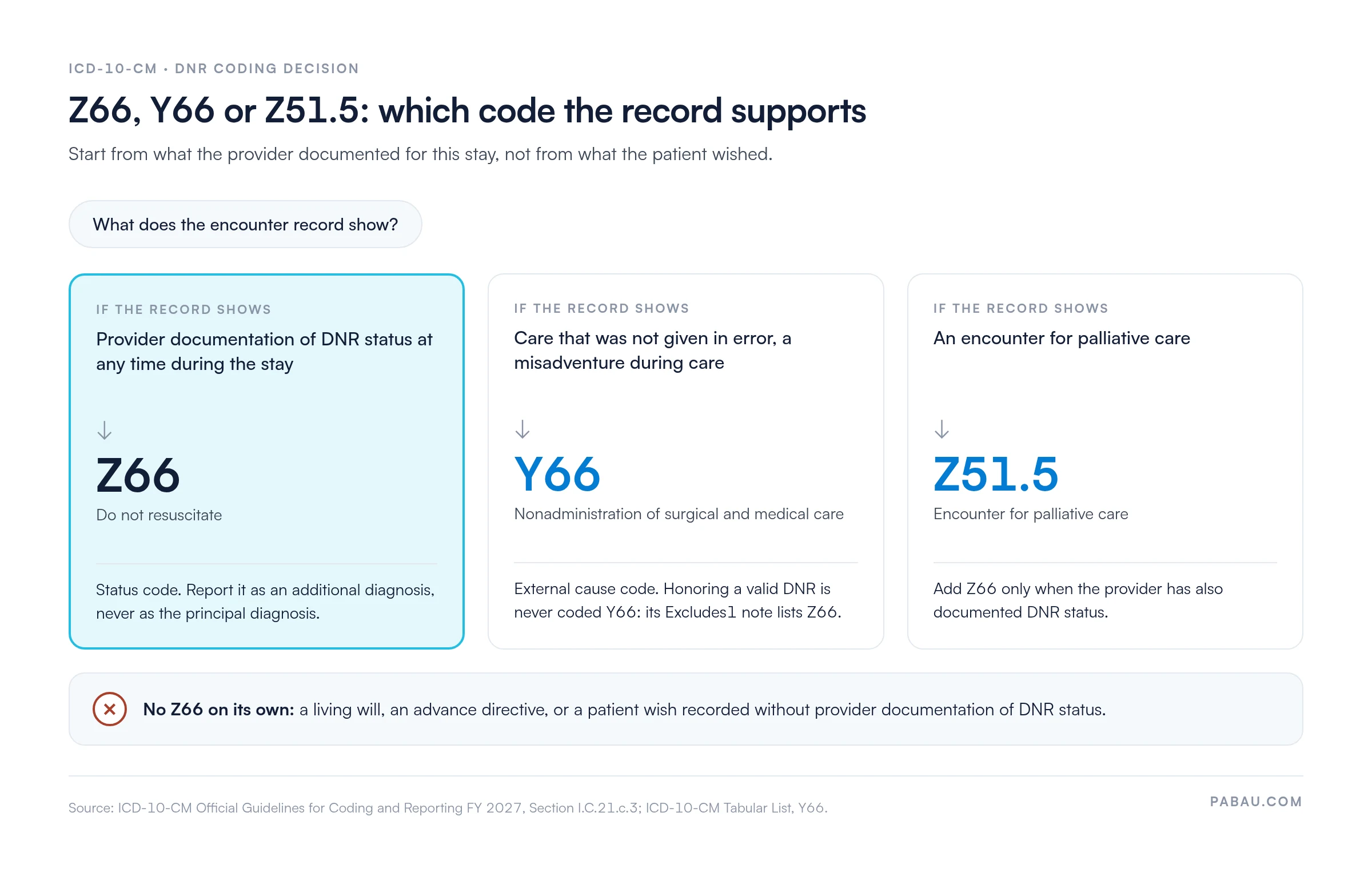
Y66 (“Nonadministration of surgical and medical care”) sits in Chapter 20 of ICD-10-CM, in the block “Misadventures to patients during surgical and medical care.” It applies when care was not given in error. Honoring a valid DNR is not a misadventure, so it is coded Z66 and never Y66.
Reporting Y66 for a patient whose DNR was followed distorts external cause data and can trigger payer queries.
Z66 rarely appears alone on a claim. The principal diagnosis is the condition or reason chiefly responsible for the encounter, and Z66 follows it. These codes come up most often alongside ICD-10 code Z66 in palliative and end-of-life encounters.
For ICD-10 code Z66, the ICD-10-CM Official Coding Guidelines require provider documentation of DNR status in the medical record. Facility and payer policy typically expects a written DNR order as well. That evidence has to sit in the encounter record being coded, not only in the chart history.
Understanding medical billing fundamentals helps practices build documentation workflows that hold up before the claim is submitted. Auditors and payers typically look for four documentation elements:
Run a documentation audit before coding high-volume DNR encounters. Check that the written order is in the encounter note (not just the history), confirm it has not been revoked, and verify the provider signature. A missing signature on a DNR order is both a coding deficiency and a patient safety flag.
Z66 is always an additional code under both inpatient UHDDS rules and outpatient coding guidelines. It cannot be sequenced as the principal diagnosis in any setting.
Under inpatient guidelines, Z66 is reportable when the provider documented DNR status at any time during the stay. Z66 is not a Complication or Comorbidity (CC) or a Major Complication or Comorbidity (MCC). It therefore generally has no impact on MS-DRG assignment.
Coders should still report it when supported, because it reflects the patient’s care context. It may feed quality reporting, case mix analysis, and care planning datasets. Verify Z66’s MS-DRG interaction against the current CMS GROUPER each fiscal year, as DRG definitions update annually.
Z66 can be reported on outpatient claims when the provider has documented DNR status and the encounter record supports it. Outpatient coders should check that the provider referenced the DNR status in the encounter note. In outpatient settings the order often lives in a separate document rather than in the visit note.
For physician office encounters, reporting Z66 on a CMS-1500 claim needs the documentation in the patient’s chart, reviewed as part of the encounter. Some commercial payers restrict additional diagnosis reporting on outpatient claims. Verify payer-specific requirements before including Z66 on outpatient professional claims.
Z66 does not require prior authorization from Medicare or most commercial payers. It is a status code, not a procedure or service, so there is no authorization trigger attached to its presence on a claim.
The documentation supporting Z66 must still be accessible for audit. Medicare’s conditions of participation also require inpatient facilities to document DNR orders clearly in the medical record.
Key payer considerations:
Z66 denials are almost always documentation-related, not code selection errors. When a claim carrying Z66 is denied or queried, the problem usually traces back to one of five root causes. Sound denial management workflows catch these before submission.
A working knowledge of medical billing denial codes helps coding teams read the remittance advice. It shows whether a Z66 denial points to missing documentation or a payer coverage issue.
Build a Z66 documentation checklist into your coding workflow for every palliative and hospice encounter. Confirm that DNR status is documented by the provider in this encounter’s record and has not been revoked. Then check that the principal diagnosis is a clinical condition, not Z66.
Advance care planning documents fall into two categories for Z66 coding. Treating one as the other is a costly error in end-of-life documentation.
A POLST (Physician Orders for Life-Sustaining Treatment) form is a physician order in most US states, not merely a patient preference document. A POLST form may specify “Do Not Attempt Resuscitation” (DNAR) or “Do Not Resuscitate (DNR).” When it is signed by a licensed provider and present in the encounter record, it generally supports Z66 coding.
The same logic applies to MOLST (Medical Orders for Life-Sustaining Treatment) in states that use that form variant.
The critical caveat: POLST legislation varies significantly by state. In a small number of states, POLST has not achieved legal status equivalent to a physician order. Coders working across multiple states should verify the POLST legislative status in each jurisdiction before treating a POLST-only record as sufficient Z66 support.
A living will, advance directive, or healthcare proxy document expresses patient preferences but is not provider documentation of DNR status. It cannot support Z66 on its own. A provider first has to turn those wishes into a documented DNR status in the encounter record. Code assignment rests on that documentation, not on the preference document behind it.
Z66 errors usually start before the claim reaches the coder. When code status lives in a scanned form, a nursing note or last year’s chart, the coder cannot confirm it from this encounter’s record.
Pabau, a practice management platform, keeps clinical notes, forms and claims in one patient record. Providers document code status in the encounter note, and coders review that note before the claim goes out. Pabau’s claims software for coding teams builds the claim from that same encounter.
US practices send claims electronically through Claim.MD, Pabau’s US clearinghouse partner, with eligibility checks and ERA remittances in the same system. The result is fewer claims returned for missing code-status documentation and less time spent chasing records after a denial.

Pabau helps practices maintain the encounter-level records that support accurate ICD-10 coding, including Z66 and other secondary status codes. See how Pabau supports your documentation workflows.

Treat Z66 as a documentation check before it becomes a coding decision. If the provider’s note for this stay records DNR status, report Z66 after the principal condition. If it does not, query the provider rather than coding from a living will or a family conversation.
Keep Y66 for its own job, care not given in error. Coding a followed DNR as Y66 reports an error that never happened.
Book a demo to see how Pabau keeps code status, encounter notes and claims in one record for your coding team.

Need a foundation in medical billing workflows? Revenue cycle management explained covers the end-to-end process from encounter to payment posting.
Dealing with complex claim denials? Clean claim requirements outlines the documentation and coding standards that prevent common payer rejections.
Looking for clearinghouse guidance? Medical claims clearinghouse guide explains how clearinghouses validate, route, and report on claims before payer adjudication.
ICD-10 code Z66 is the billable ICD-10-CM diagnosis code for “Do not resuscitate” status. It is assigned when the provider has documented DNR status in the medical record for the encounter being coded. The code is reported as an additional diagnosis, not as a presenting complaint or clinical event.
Z66 is reported only as an additional diagnosis and is never sequenced as the principal diagnosis. It is a status code under ICD-10-CM Official Coding Guidelines Section I.C.21.c.3. The principal diagnosis is the condition chiefly responsible for the encounter, and Z66 follows it.
Z66 (Chapter 21) records DNR status that the provider has documented. Y66 (Chapter 20) sits in the block “Misadventures to patients during surgical and medical care” and covers care not given in error. Honoring a valid DNR is coded Z66, never Y66, and Y66’s Excludes1 note lists Z66.
Yes, Medicare accepts Z66 as a billable additional diagnosis code when provider documentation of DNR status supports it. Z66 does not require prior authorization and does not impact MS-DRG assignment. CMS does not require a DNR order for hospice enrollment, but Z66 may appear on hospice claims when DNR status is documented.
A POLST form with a “Do Not Resuscitate” designation can support Z66 coding in most US states. In those states, POLST carries the legal weight of a physician order. However, POLST legislative status varies by state, and a living will or advance directive alone does not support Z66 without a separate physician order.
Yes, Z66 can be reported on outpatient claims when a written DNR order is documented and the encounter record supports it. Some commercial payers restrict additional diagnosis codes on outpatient professional claims, so verify payer-specific requirements before including Z66 on CMS-1500 submissions.