ICD-10 Code S56.412D: Extensor strain, left index finger
ICD-10 code S56.412D: Code definition and clinical scope ICD-10 Code S56.412D id...

Last Updated: Oct 19, 2026
Billable Code Specific Code
Z74.8 is the billable ICD-10-CM code for other problems related to care provider dependency. It covers a documented dependency on a care provider that no more specific Z74 code describes. Typical examples are medication management, transportation to appointments and meal preparation.
It sits in category Z74 within block Z69-Z76 of Chapter 21. The specific siblings are Z74.01 and Z74.09 (reduced mobility), Z74.1 (personal care), Z74.2 (no other household member) and Z74.3 (continuous supervision). Z74.8 is almost always a secondary code behind the primary diagnosis that explains the encounter.
Let Pabau's smart automation suggest the right codes, reduce claim denials, and keep your practice compliant—effortlessly.
Automate repetitive tasks and focus on what matters most—your patients.
Reduce coding errors and ensure compliance with the latest regulations.
Clean claims, fewer denials, and faster reimbursements.
Powerful insights and reporting to help your practice thrive.
HIPAA compliant SOC 2 certified GDPR-compliant Trusted by 4,000+ clinics worldwide

ICD-10 Code Z74.8 is a billable code, valid for FY2027, for care provider dependency problems that Z74.01 to Z74.3 do not capture.
Z74.8 is almost always reported as an additional code, never as a principal diagnosis except when the dependency is the sole reason for the encounter.
Documentation must include provider attestation of the specific care task the patient cannot perform alone. A functional assessment then links that need to a primary diagnosis.
The most common denial triggers are a missing or unspecified primary diagnosis, an unsigned plan of care, and incorrect sequencing that places Z74.8 first.
ICD-10 Code Z74.8 is the billable ICD-10-CM code for “Other problems related to care provider dependency.” It is assigned when a patient’s dependency on a care provider does not fit any of the specific subtypes in the Z74 category. The code has been valid since the US adopted ICD-10-CM in October 2015 and is valid for FY2027. You can check its status for any year on the CDC/NCHS ICD-10-CM web tool.
Z74.8 is the “other” bucket in the Z74 category. It covers dependency needs that a care provider must meet but that no specific sibling code describes. Those siblings cover reduced mobility (Z74.01 or Z74.09), personal care assistance (Z74.1), absence of other household members (Z74.2) and continuous supervision (Z74.3).
Situations Z74.8 typically captures:
What Z74.8 does not cover: The ICD-10-CM tabular list carries no Excludes1 or Excludes2 notes unique to Z74.8 itself. The Z74 category as a whole, though, excludes dependence on enabling machines or devices such as wheelchairs or dialysis equipment. Those belong in the Z99 category. If a patient’s primary dependency relates to a medical device, Z74.8 is the wrong code. When reduced mobility drives every care need, Z74.01 (bed confinement status) or Z74.09 (other reduced mobility) is more precise than Z74.8.
The Z74 category contains seven billable codes. Picking the wrong sibling is an easy error on home health and SNF claims, because the descriptors overlap. The diagram below shows where Z74.8 sits in that order of specificity.
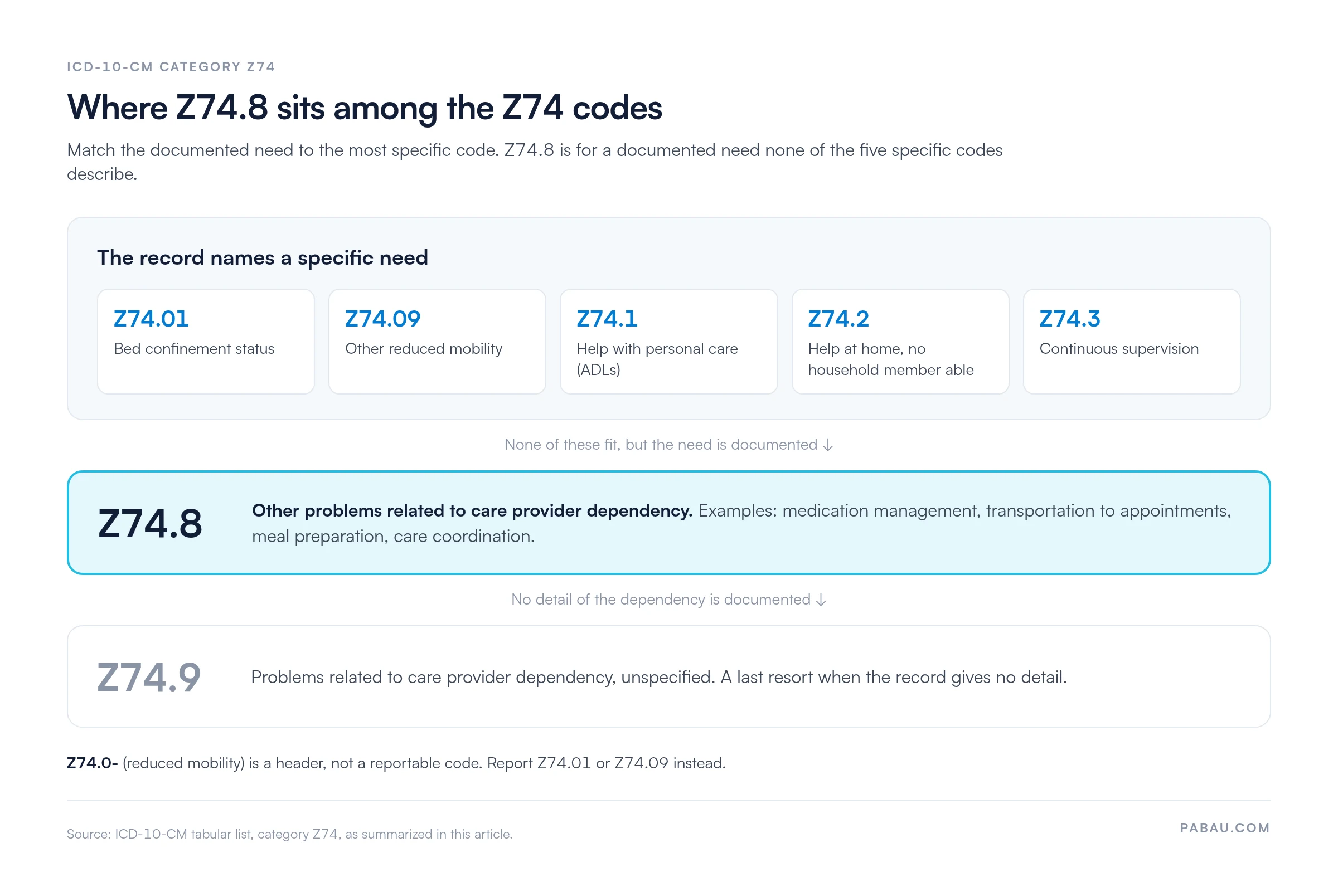
The table below gives each code’s full descriptor and the scenario it fits.
Codes outside the Z74 family that coders confuse with Z74.8: Z73.8 (Other problems related to life management difficulty) covers trouble coping with day-to-day demands. It does not describe a specific dependency on a provider. R53.81 (Other malaise) and R54 describe symptom states, not care arrangements. If the documentation describes a social or coping difficulty rather than a concrete provider dependency task, Z73.8 is typically the better fit. You can verify current code status through AAPC’s ICD-10-CM code lookup.
ICD-10 Code Z74.8 is almost always sequenced as an additional code, not a principal or primary diagnosis. The ICD-10-CM Official Guidelines for Coding and Reporting treat Z-codes for circumstances, social determinants or functional status as additional codes. The exception is an encounter where the circumstance itself is the sole reason for the visit.
When Z74.8 may stand as the primary code: A coordination visit held only for an unmet care dependency could support Z74.8 as the principal diagnosis. No active medical condition is treated at that visit. This is uncommon. Most encounters involve an underlying condition (chronic disease, post-surgical recovery, cognitive decline) that generates the care dependency, and that condition sequences first.
Z74.8 holds up on audit only when the clinical record supports every element of the code. That means showing that a dependency exists, which task the patient cannot perform, and why a care provider must fulfill it. A clean claim submission for Z74.8 requires four elements in the chart.
Run a documentation audit before you submit any Z74.8 claim. Confirm the physician note names the specific dependency task and an objective functional assessment supports it. Then check that the care plan references the code. A claim missing any one of the three is hard to defend if the payer requests records.
Medicare and Medicaid do not reimburse Z74.8 as a standalone justification for services. The code supports medical necessity for a covered service tied to a qualifying primary diagnosis. Medical billing compliance guidance from CMS and individual Medicare Administrative Contractors (MACs) is consistent on this point. Z-codes alone cannot establish homebound status or skilled care need, per the CMS ICD-10-CM coding and billing guidance.
Private insurers generally follow the same logic: Z74.8 is informational, not the trigger for coverage. Some plans require prior authorization for the home health services the code supports. Verify MAC-specific Local Coverage Determinations (LCDs) and individual plan policies before each claim, as payer acceptance varies by jurisdiction and contract.
Top Z74.8 denial reasons and how to prevent them:
Practices running volume in home health or SNF settings benefit from denial management workflows that flag Z-code sequencing errors before submission. When a claim does come back, the remittance carries a reason code. Our guide to medical billing denial codes explains what each one means.
Z74.8 is reported as a secondary diagnosis in every care setting. What changes is the instrument that records it and the form the payer sees.
When Z74.8 is on a home health claim, confirm the code also appears on the CMS-485 plan of care. Then check that OASIS-E2 item M1023 matches the claim form. A mismatch between the two is hard to defend if the claim is selected for medical review.
Practices billing Z74.8 on home health or SNF claims need diagnosis codes to travel accurately from the clinical record to the claim form. Errors at the data entry layer are among the most preventable denial causes for Z74.8 and its Z74 siblings. A typical example is a coder re-keying a secondary code into the wrong field.
Pabau, the practice management platform we build, removes that re-keying step. Its claims management software carries coded diagnoses from the patient record directly to the claim. Claims then go out electronically through Claim.MD, a clearinghouse integration.
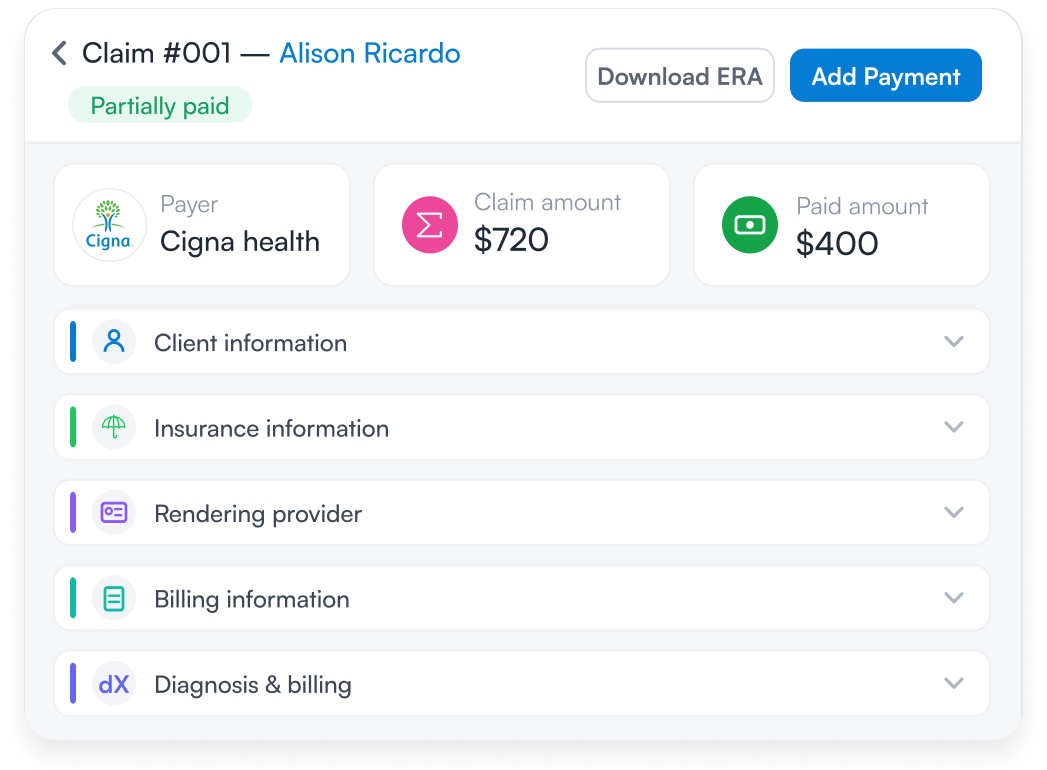
Coding feeds the wider revenue cycle management process. A Z74.8 claim that goes out with the primary diagnosis first and the dependency documented is one your billing team does not have to rework.

Pabau carries coded diagnoses from the patient record to the claim and submits it through Claim.MD, a clearinghouse integration. Your team re-keys fewer codes and spends more time on care.

ICD-10 Code Z74.8 is the right code when a documented dependency on a care provider falls outside the specific Z74 subtypes. Rule out Z74.01, Z74.09, Z74.1, Z74.2 and Z74.3 first, and save Z74.9 for records that give no detail.
When a Z74.8 claim fails, check the documentation and the sequencing before you question the code. A signed note naming the task, a functional assessment and a primary diagnosis listed first make the code defensible. On home health claims, the OASIS, the CMS-485 and the claim also have to agree.
Pabau carries coded diagnoses from the patient record to the claim, and Claim.MD, a clearinghouse integration, submits it electronically. Book a demo to see how Pabau handles Z-code billing from clinical note to submitted claim.

Want to understand how clearinghouse claims validation works? Claim.MD clearinghouse overview explains how electronic claim validation catches code errors before payer submission.
Need guidance on reducing claim rejections across your billing workflow? Superbill documentation best practices covers how accurate diagnosis capture at the point of care prevents downstream claim errors.
Want to see how a diagnosis code reaches the payer? Understanding the 837 EDI file walks through how ICD-10-CM codes travel from the practice to the payer electronically.
Does the plan need approval before home health services start? The prior authorization process lays out a step-by-step workflow for getting payer sign-off before care begins.
Worried a corrected Z74.8 claim will miss its deadline? Timely filing limits by payer lists the windows for initial claims, corrected claims and appeals.
ICD-10 Code Z74.8 is the billable diagnosis code for “Other problems related to care provider dependency.” It is used when a patient depends on a care provider for a specific task, such as medication management or transportation. The named Z74 subtypes (Z74.0- through Z74.3) do not capture that task. It is a secondary code that documents the care dependency context alongside a primary clinical diagnosis.
Yes, Z74.8 is a billable, specific ICD-10-CM code, valid for FY2027. It can be reported on claims as an additional/secondary diagnosis. It does not trigger a reimbursement payment on its own but supports the medical necessity narrative for covered services linked to a qualifying primary diagnosis.
Z74.1 (Need for assistance with personal care) specifically addresses dependency for activities of daily living such as bathing, dressing, and grooming. Z74.8 covers dependency for tasks that fall outside those ADLs, such as medication management, transportation, or care coordination. If the documented need is clearly an ADL, Z74.1 is more precise. Use Z74.8 only when the dependency does not fit Z74.1 or any other Z74 subtype.
Z74.8 is used as a primary diagnosis only when the care dependency itself is the sole reason for the encounter. No active medical condition is treated at that visit. In almost all clinical situations, an underlying condition generates the dependency. Z74.8 then sequences as an additional code after the primary ICD-10-CM diagnosis for that condition.
Yes, Z74.8 can appear as a secondary diagnosis on home health claims, including the OASIS-E2 and the CMS-485 plan of care. It does not establish homebound status or skilled care need on its own; the primary diagnosis must do that. Ensure the code appears consistently on all claim instruments and is supported by a physician-signed plan of care and a completed functional assessment.
The most frequent denials stem from incorrect sequencing, with Z74.8 listed before the primary clinical diagnosis. Others follow from an unspecified or missing primary diagnosis code, an unsigned plan of care, or no objective functional assessment in the record. Each of these is preventable with a pre-submission documentation checklist and a clearinghouse validation step.