ICD-10 code S42.134B: Nondisplaced coracoid process fracture, right shoulder, open
ICD-10 code S42.134B: Quick reference ICD-10 code S42.134B describes a nondispla...

Last Updated: Nov 3, 2026
Billable Code Specific Code
Z55.5 is the billable ICD-10-CM code for less than a high school diploma. It applies when a patient has no high school diploma or GED and the record documents it.
Its neighbors cover different problems. Z55.0 covers illiteracy and low-level literacy, Z55.4 covers educational maladjustment, and Z55.6 covers health literacy. Z55.5 is reported as a secondary diagnosis and earns no separate Medicare fee-for-service payment. Its value lies in SDOH screening and population health programs.
Let Pabau's smart automation suggest the right codes, reduce claim denials, and keep your practice compliant—effortlessly.
Automate repetitive tasks and focus on what matters most—your patients.
Reduce coding errors and ensure compliance with the latest regulations.
Clean claims, fewer denials, and faster reimbursements.
Powerful insights and reporting to help your practice thrive.
HIPAA compliant SOC 2 certified GDPR-compliant Trusted by 4,000+ clinics worldwide

Z55.5 records less than a high school diploma as a social risk factor, separate from illiteracy (Z55.0), educational maladjustment (Z55.4) and health literacy (Z55.6).
Z55.5 is reported as a secondary diagnosis and sequenced after the condition driving the encounter, per Section I.B.14 of the FY2027 guidelines.
The record must state that the patient has no high school diploma or GED, and a clinician must sign off on any patient-reported answer.
Pabau’s claims management software sends Z55.5 claims through Claim.MD to thousands of US payers and checks each claim before submission.
ICD-10 Code Z55.5 is a valid, billable ICD-10-CM diagnosis code for patients who never completed high school or earned an equivalent such as a GED.
It sits in Chapter 21 (factors influencing health status and contact with health services), inside the Z55 category for education and literacy problems. That category is one small corner of the ICD-10-CM code set.
Z55.5 was added in the FY2022 ICD-10-CM update, effective October 1, 2021, and remains active. It appears in the current FY2027 code set, published with the CMS ICD-10-CM code files. As a diagnosis code, it carries no relative value units (RVUs) of its own.
Z55.5 does not imply intellectual disability or cognitive impairment. It records educational attainment as a social risk factor and makes no judgment about the patient’s capability.
ICD-10 Code Z55.5 applies when a patient has not completed high school or earned a recognized equivalent, and the record documents it. The CDC/NCHS ICD-10-CM tool lists no Excludes notes at the Z55.5 level. The Z55 category above it excludes disorders of psychological development (F80-F89), and its neighboring codes must not be conflated with Z55.5.
Four common misapplications to avoid:
The code fits when a community health worker documents that a patient did not finish high school. That fact should also shape how medication instructions or discharge plans are delivered. It does not belong on every encounter with a lower-income patient as a reflexive add-on.
The Z55 category holds nine codes for education- and literacy-related social factors. Coders searching the AAPC ICD-10-CM code lookup often meet Z55.0, Z55.4 and Z55.6 in the same search as Z55.5, so the differences matter.
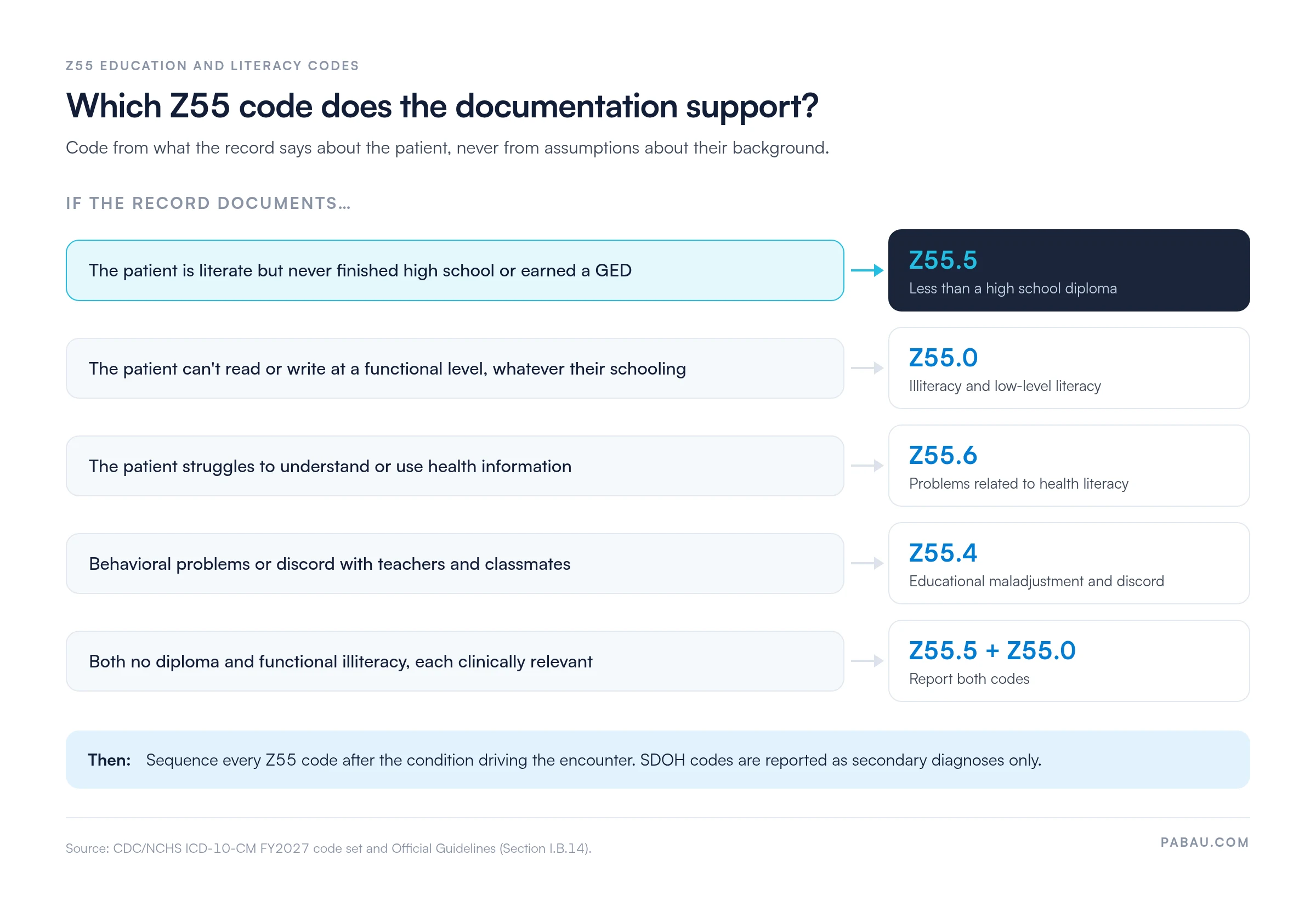
The practical test is simple. A patient who reads well but never finished 12th grade is Z55.5. A patient who cannot read the discharge instructions, whatever their schooling, is Z55.0. Both codes can appear on the same claim when both conditions are documented and clinically relevant, as the chart below maps out.
Section I.C.21.c.17 of the ICD-10-CM Official Guidelines governs SDOH documentation. The social factor must be in the medical record, but it doesn’t have to come from the patient’s provider. For Z55.5, three elements should be present.
Practices aiming for consistent SDOH capture should add a discrete educational attainment field to their intake and social history templates. Structured medical billing compliance workflows capture the documentation at the point of care, so nobody reconstructs it at coding time.
Z55.5 is reported as an additional diagnosis, sequenced after the condition driving the encounter. Section I.B.14 of the FY2027 ICD-10-CM Official Guidelines states that SDOH codes should only be reported as secondary diagnoses. So Z55.5 never stands alone as the reason for an inpatient admission or an outpatient visit.
Correct sequencing follows this pattern in sound medical billing workflows:
Z55.5 and the other Z55-Z65 codes add context for risk stratification and population health analysis. They describe the patient’s circumstances rather than the clinical reason for the visit.
Z55.5 does not generate a separate fee-for-service payment under standard Medicare billing. It carries no RVU and no standalone reimbursement in the physician fee schedule. Its value lies in population health and quality reporting, which increasingly feed value-based contract incentives.
Practices billing a mixed payer panel benefit from tools that check a claim before it reaches the payer. Real-time eligibility checks surface each payer’s requirements before submission, not after a rejection.
Z55.5 claim problems tend to come from five preventable errors. Catching them before submission beats working a denial queue afterward. Building denial management workflows into coding review stops them before the claim leaves the practice.
Run a monthly audit of claims containing Z55.5 against your ERA denial data. CARC 4 means the procedure code is inconsistent with the modifier used, or a required modifier is missing. CARC 97 means the benefit is included in the payment for another service. Both point at the service line rather than the Z-code, so separate them from sequencing, payer-policy and documentation denials.
Structured SDOH screening tools produce the documented findings that support Z55.5. The Protocol for Responding to and Assessing Patients’ Assets, Risks, and Experiences (PRAPARE) asks patients for their highest level of schooling. The CMS Accountable Health Communities Health-Related Social Needs (AHC HRSN) tool is the other common screen. Its core questions cover housing, food, transportation, utilities and safety.
When a patient reports on a PRAPARE screen that they did not finish high school, route the result through three steps before billing:
Digital intake forms with a discrete educational attainment question are the most reliable trigger for consistent Z55.5 capture.
Z55.5 rarely appears in isolation. Patients with less than a high school diploma often have overlapping social risk factors and clinical conditions that carry their own codes. The WHO ICD-10 browser shows the international Z55-Z65 block these SDOH codes come from.
In behavioral health encounters, Z55.5 often sits alongside F33.x and F41.x codes. Social-environment codes are frequent partners too. Z60.8 covers social environment problems that no other Z60 code describes.
In many practices, education history lives on a paper intake form or in a free-text note. The coder has to hunt for it, and the claim often leaves without the SDOH code or with the wrong one.
Pabau, the practice management platform we build, lets you add a discrete education question to digital intake forms. The answer lands in the patient record before the visit. Its claims management software then turns the encounter into a CMS-1500 claim, sent through Claim.MD to thousands of US payers.
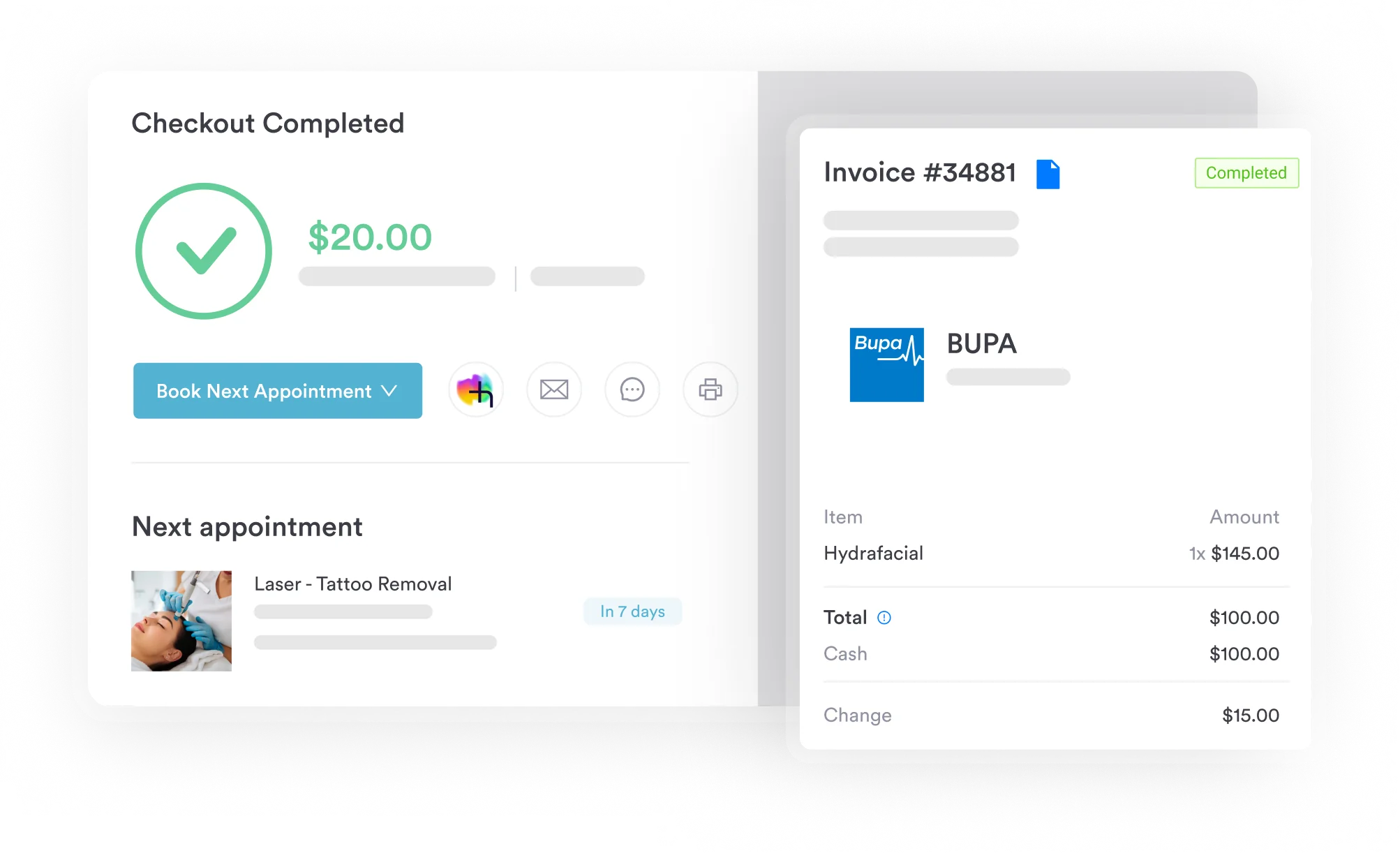
Claim validation checks every claim for missing or invalid details before it leaves Pabau. Electronic remittance advice (ERA) files flow back into the billing workflow. A rejected Z55.5 claim then shows up next to the patient record, not in a separate portal.

Pabau’s claims workflow and Claim.MD connection help practices document, code and submit SDOH Z-codes consistently across Medicare, Medicaid and commercial payers.

Z55.5 is a narrow code, and it fails in predictable ways. The documentation is vague, the code lands in the primary position, or someone assumes the payer’s policy instead of checking it.
The fix sits upstream of coding. Add one discrete education question to intake, have a clinician sign off on the answer, and sequence the code last. Do that, and Z55.5 becomes routine SDOH data your value-based contracts can use.
Pabau checks every clean claim for missing details before it leaves the practice. Book a demo to see how Pabau carries an intake answer through to a paid SDOH claim.

Need to understand denial codes on SDOH claims? Denial management in healthcare covers how to interpret CARC codes, build appeal workflows, and reduce Z-code rejections.
Want to understand how clearinghouses process SDOH claims? Medical claims clearinghouse overview explains how 837P files route through payers and where SDOH codes are validated.
Looking for the broader SDOH billing compliance picture? Revenue cycle management guide positions SDOH coding within the full patient-to-payment workflow.
ICD-10 Code Z55.5 is the diagnosis code for a patient who has not completed high school or earned a recognized equivalent such as a GED. It belongs to the Z55 category (Problems related to education and literacy) in Chapter 21 of ICD-10-CM. It is reported as an additional, secondary diagnosis.
Yes. Z55.5 is a valid, billable ICD-10-CM code in the current fiscal year (FY2027). It does not generate a separate fee-for-service payment. Claims accept it as an additional diagnosis that supports SDOH documentation and value-based care reporting.
Use Z55.5 when the patient did not complete high school but can read and function at a literate level. Use Z55.0 (Illiteracy and low-level literacy) when the patient cannot read or write at a functional level, regardless of years of schooling. Both codes can appear on the same claim when both conditions are documented and clinically relevant. Trouble understanding health information belongs under Z55.6 instead.
No. Z55.5 is reported as an additional diagnosis, sequenced after the condition driving the encounter. Section I.B.14 of the FY2027 ICD-10-CM Official Guidelines states that SDOH codes should only be reported as secondary diagnoses.
Medicare accepts Z55.5 as an additional diagnosis code but does not pay separately for it under standard fee-for-service billing. The code supports SDOH documentation at the Annual Wellness Visit and in quality and value-based care reporting.
Typical triggers are sequencing Z55.5 as the first-listed diagnosis and missing documentation that links educational attainment to the encounter. Others include payers that don’t accept SDOH Z-codes, dates of service before October 1, 2021, and patient-reported answers no clinician has signed off.