ICD-10 Code S82.63XB: Displaced lateral malleolus open fracture
ICD-10 Code S82.63XB: Code breakdown and character-by-character anatomy ICD-10 C...

Last Updated: Nov 23, 2026
Billable Code Specific Code
Z12.0 is the billable ICD-10-CM code for encounter for screening for malignant neoplasm of stomach.
It is a stomach code only. Coders sometimes confuse it with the Z12.1- intestinal tract family, which covers colon, rectum and small intestine screening. A symptom-driven upper endoscopy takes the sign or symptom code instead of Z12.0.
Let Pabau's smart automation suggest the right codes, reduce claim denials, and keep your practice compliant—effortlessly.
Automate repetitive tasks and focus on what matters most—your patients.
Reduce coding errors and ensure compliance with the latest regulations.
Clean claims, fewer denials, and faster reimbursements.
Powerful insights and reporting to help your practice thrive.
HIPAA compliant SOC 2 certified GDPR-compliant Trusted by 4,000+ clinics worldwide

Z12.0 is the billable ICD-10-CM code for a screening encounter for malignant neoplasm of the stomach in a patient with no symptoms
Z12.0 stays first-listed when a finding such as gastric intestinal metaplasia turns up, and the finding is coded after it
Z12.0 is a stomach code only, so colon, rectum and small intestine screening use the Z12.1- codes, such as Z12.11 and Z12.12
Medicare has no gastric cancer screening benefit, so check coverage and prior authorization before a screening upper endoscopy
ICD-10 Code Z12.0 is a billable ICD-10-CM diagnosis code with the official descriptor “Encounter for screening for malignant neoplasm of stomach.”
The CMS 2026 ICD-10-CM code files list it as a valid code under category Z12. The AAPC code listing for Z12.0 places it in Chapter 21 (Z00-Z99: Factors influencing health status and contact with health services).
Use Z12.0 when an asymptomatic patient has an encounter whose stated purpose is screening for stomach (gastric) cancer. For an outpatient visit ordered as screening, Z12.0 is the first-listed diagnosis. Findings discovered during the encounter are reported as additional codes, not as the reason for the visit.
Z12.0 covers an encounter whose purpose is to screen an asymptomatic patient for malignant neoplasm of the stomach. The code describes why the patient was seen, not which test was done. The ordering provider’s documentation has to state screening as the reason.
In the US, gastric cancer screening is aimed at people at increased risk rather than the general population. The AGA clinical practice update on gastric cancer screening names the groups to consider:
The same update names upper endoscopy as the best screening test, because it allows direct visualization and biopsy of the stomach lining. It also treats H. pylori eradication as an adjunct to endoscopic screening. Z12.0 pairs with the CPT code for the endoscopy or test performed at that screening visit.
Check the order before you pair Z12.0 with a standalone H. pylori test. An order written to detect the infection itself describes a different reason for the visit than a gastric cancer screen.
Z12.0 does not apply when symptoms, a known diagnosis, or a history of gastric cancer drive the encounter. It also never applies to screening of the colon, rectum or small intestine.
The Excludes1 note on category Z12 is the controlling instruction: a diagnostic examination is coded to the sign or symptom. When the order is unclear, query the ordering provider before assigning Z12.0. The map below routes each visit reason to the code that leads the claim.
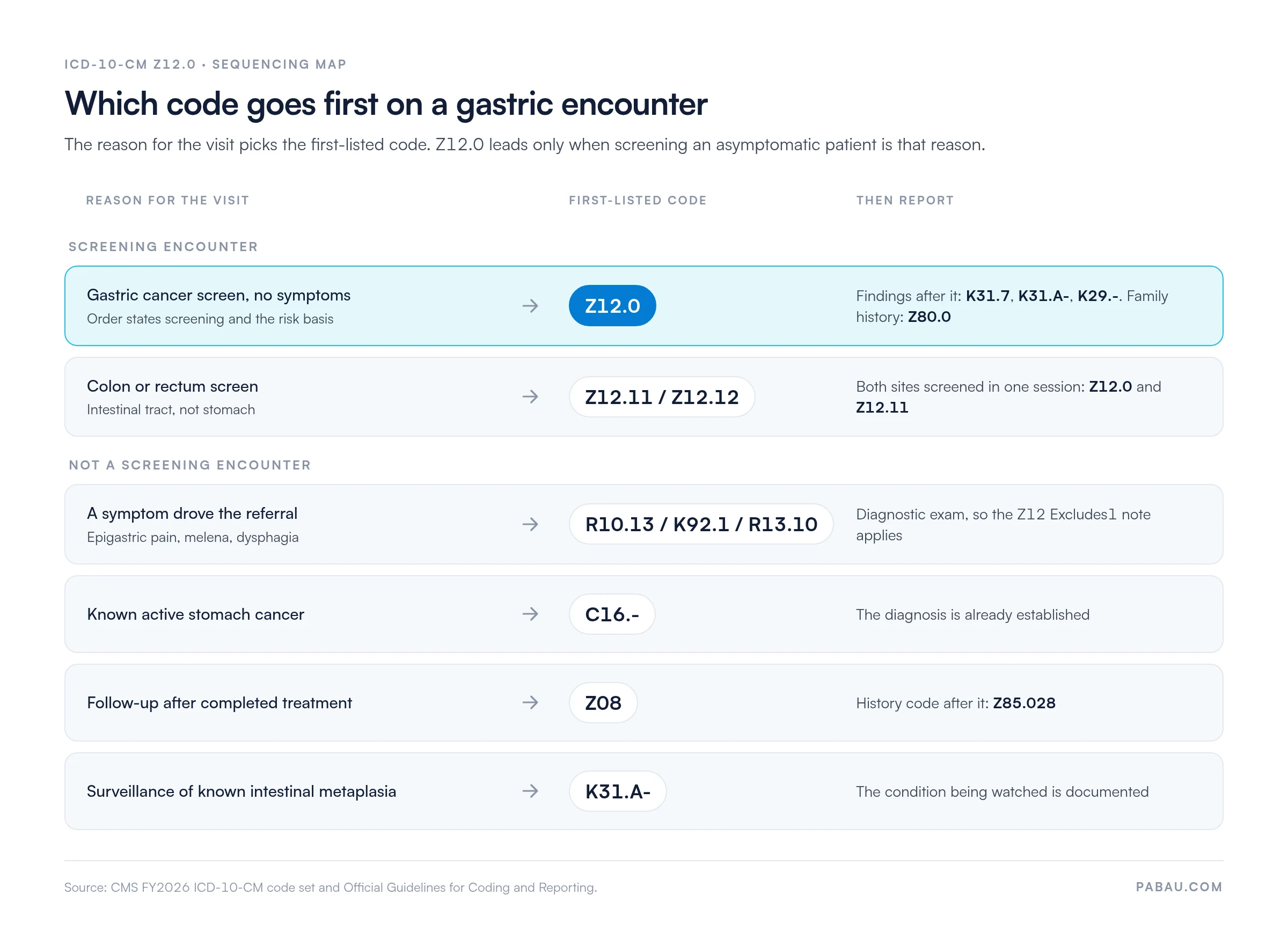
Z12.0 is the stomach screening code, and it has no intestinal subcodes. Screening of the intestinal tract has its own subcategory, Z12.1-, with four codes split by site. A colonoscopy, stool test or sigmoidoscopy ordered as cancer screening never takes Z12.0.
Practical routing rule: Match the code to the organ named in the screening order. When one session screens both the stomach and the colon, document both purposes and report Z12.0 and Z12.11 together.
Z12.0 stays first-listed when the visit was ordered as screening and a finding is discovered during it. The FY2026 ICD-10-CM Official Guidelines, Section I.C.21.c.5, let a screening code lead when screening is the reason for the visit. The condition found is then assigned as an additional diagnosis.
Switching the first-listed code to the finding after the endoscopy misstates why the patient was seen. It also breaks the link between the order and the claim.
Use this decision tree before assigning the first-listed code:
Z12.0 explains why the service was performed, and the CPT code captures what was done. The pairing depends on whether the endoscopist took tissue and which tests the order included. A screening EGD with biopsies is reported as 43239, and one without tissue sampling as 43235.
Capture the screening reason and any risk factors at the point of order, not after the procedure. A superbill that lists the order reason beside the CPT code gives the coder both halves of the pairing.
Medicare has no preventive benefit for gastric cancer screening, unlike colorectal screening. Its coverage rules for upper endoscopy, such as Palmetto GBA’s upper gastrointestinal endoscopy LCD (L34434), list clinical indications and exclude routine physical examinations. Expect a screening-only EGD billed with Z12.0 to be treated as non-covered, and tell the patient before the procedure.
The USPSTF has no recommendation on gastric cancer screening. So the ACA rule that waives cost sharing for preventive services does not reach a screening EGD. Commercial coverage depends on the plan’s medical policy, and some policies list high-risk screening as an indication.
Run insurance eligibility verification before the encounter, and confirm whether the plan needs prior authorization. Pabau, practice software with insurance billing through Claim.MD, runs eligibility checks before the visit. It also tracks the prior authorization code, dates and sessions on the case, with a warning when one is missing.
Before a screening EGD, check the patient’s plan policy for high-risk gastric cancer screening. Record the risk factor the policy names, such as country of birth or family history, in the order itself. A payer reviewer reads the order first, so the risk basis has to be there.
Z12.0 is sequenced first. Supporting codes that document risk or history follow it, and the Z12 category note tells you to add any family history code.
Never report a family history or genetic susceptibility code without matching documentation in the clinical note. A code with no support in the record creates audit exposure under medical billing compliance standards.
Z12.0 denials cluster around coverage, medical necessity and sequencing. Tracking them by their denial codes points the billing team to the step that failed.
Pabau’s claims management software submits CMS-1500/837P claims and posts ERA remittances back to the patient account. That puts each denial reason next to the claim, which speeds up denial management.
Accurate Z12.0 coding begins with the order, not the billing desk. If the documentation does not establish a screening purpose, no code assignment makes the claim defensible at audit. The record should show these elements before Z12.0 is assigned.
Today, a screening EGD often moves through separate tools for the order, the eligibility check and the claim. The risk basis sits in one place and the authorization in another, so the coder works from partial information.
In Pabau, the order, intake forms and clinical note live on the same patient record as the claim. Eligibility checks and claim submission run through Claim.MD, and secondary claims go out from the same account. Prior authorization codes and dates are tracked on the case, with a warning when one is missing.
The result is a Z12.0 claim that leaves the practice with its screening reason, risk documentation and authorization already attached. That means fewer coverage and medical necessity denials to rework.

Pabau runs eligibility checks through Claim.MD, tracks prior authorizations on the case and submits CMS-1500/837P claims, so screening EGD claims go out complete.

Z12.0 is a stomach code, and most of its errors come from treating it as an intestinal one. Pair it with an upper endoscopy or gastric test, and keep it first-listed when a finding appears. Colon and rectum screening belongs to Z12.11 and Z12.12.
Coverage is the larger risk, because Medicare and many plans do not treat a screening EGD as a preventive service. Practices that confirm the policy and record the risk basis before the visit avoid most Z12.0 denials. Book a demo to see how Pabau keeps eligibility, prior authorization and the claim on one patient record.

Coding colon screening instead? ICD-10 code Z12.11 covers screening for malignant neoplasm of the colon, including colonoscopy and stool tests.
Coding surveillance after treatment? ICD-10 code Z08 covers the follow-up exam after completed treatment for a malignant neoplasm, with the history code after it.
Struggling with claim rejections across your billing team? Revenue cycle management fundamentals covers the process from eligibility through payment posting.
Want a structured denial appeal workflow? Denial codes in medical billing maps common CARC codes to their root causes and corrective actions.
Billing the biopsy pathology? CPT code 88305 covers the Level IV surgical pathology exam billed for gastric biopsy specimens.
ICD-10 Code Z12.0 means an encounter for screening for malignant neoplasm of the stomach. It is billable and used when an asymptomatic patient is screened for gastric cancer. It sits in Chapter 21 of ICD-10-CM and is first-listed when screening is the reason for the visit.
No. Z12.0 covers the stomach only. Colon screening uses Z12.11, rectal screening uses Z12.12, and small intestine screening uses Z12.13. Use Z12.10 when intestinal screening is ordered without a documented site.
The most common pairings are CPT 43235 for a diagnostic upper endoscopy and CPT 43239 when biopsies are taken. The pathologist bills 88305 for the gastric biopsy. H. pylori breath testing (83013) or stool antigen testing (87338) may also be part of the workup.
Medicare has no gastric cancer screening benefit, and its endoscopy coverage rules list clinical indications rather than screening. Expect a screening-only EGD to be treated as non-covered. Confirm with your Medicare Administrative Contractor and tell the patient about the cost before the procedure.
The AGA’s 2024 clinical practice update names first-generation immigrants from high-incidence regions and people with a first-degree relative with gastric cancer. It also names people with certain hereditary polyposis or cancer syndromes. It recommends upper endoscopy as the screening test.
Z12.0 stays first-listed, and the finding is added as an additional code. Examples include K31.7 for a gastric polyp, K31.A- for intestinal metaplasia and K29.- for gastritis. If H. pylori is confirmed, code the related condition and then B96.81.
Category Z12 instructs you to add any family history code, so report Z80.0 when a relative had stomach cancer. Z15.0- applies to a documented genetic susceptibility. Every additional code needs support in the clinical note.
The most common reasons are a non-covered service (CO-96), missing risk documentation (CO-50) and a diagnosis inconsistent with the procedure (CO-11). Missing prior authorization (CO-197) is another. Check the plan policy and authorization before the visit to prevent most of them.