ICD-10 Code S82.63XB: Displaced lateral malleolus open fracture
ICD-10 Code S82.63XB: Code breakdown and character-by-character anatomy ICD-10 C...

Last Updated: Nov 23, 2026
Billable Code Specific Code
E87.5 is the billable ICD-10-CM code for hyperkalemia, an elevated serum potassium level that the treating physician documents as a diagnosis. It is a terminal code with no subdivision by severity, acuity or cause.
It sits in category E87, other disorders of fluid, electrolyte and acid-base balance, in Chapter 4 (E00-E89). Assignment turns on two things. The physician has to name the diagnosis beyond the lab value. An underlying cause such as CKD, AKI or a drug may also need to go first.
Let Pabau's smart automation suggest the right codes, reduce claim denials, and keep your practice compliant—effortlessly.
Automate repetitive tasks and focus on what matters most—your patients.
Reduce coding errors and ensure compliance with the latest regulations.
Clean claims, fewer denials, and faster reimbursements.
Powerful insights and reporting to help your practice thrive.
HIPAA compliant SOC 2 certified GDPR-compliant Trusted by 4,000+ clinics worldwide

E87.5 is the single billable ICD-10-CM code for hyperkalemia in all clinical settings, with no further subdivision by acuity or severity.
Coding requires physician documentation of hyperkalemia as a diagnosis, not a lab value alone. A serum potassium above 5.0 mEq/L supports but does not substitute for a clinical statement.
E87.5 is usually sequenced behind the underlying cause, such as AKI, CKD or a medication adverse effect. It becomes principal when hyperkalemia is the reason for admission.
When metabolic acidosis is documented alongside hyperkalemia, add a code from E87.20-E87.29, because E87.2 itself is no longer billable.
Pabau, a practice management platform with built-in insurance billing, sends US claims through Claim.MD and posts ERA remittances back to the patient record.
ICD-10 Code E87.5 is the billable ICD-10-CM diagnosis code for hyperkalemia, valid for all HIPAA-covered transactions.
CMS’s FY 2027 ICD-10-CM files list E87.5 as a valid code for encounters from October 1, 2026 through September 30, 2027. It is a terminal code, and the table below gathers each field a coder checks before submitting a claim.
E87.5 captures all documented hyperkalemia regardless of acuity, severity, or underlying cause. The ICD-10-CM tabular list does not subdivide by mild, moderate, or severe, and it does not distinguish between acute-onset and chronic hyperkalemia. The same code applies across all presentations, provided physician documentation supports the diagnosis.
The tabular list gives E87.5 two inclusion terms: potassium [K] excess and potassium [K] overload. Either phrase in the physician’s note points to the same code.
Clinically, hyperkalemia is generally defined as serum potassium above 5.0 mEq/L, though ICD-10-CM itself does not mandate a numeric threshold for coding. What matters is that the treating physician has documented hyperkalemia as a clinical finding that affects or is monitored during the encounter. A lab value flagged as high on a results report does not, by itself, support E87.5 coding.
Clinical presentations captured by E87.5 include:
E87.5 carries no Excludes1 note of its own in the ICD-10-CM tabular list. The E87 category above it does, and one entry matters here: familial periodic paralysis, including the hyperkalemic form, is coded to G72.3 instead. Under the CMS ICD-10-CM official guidelines, the scenarios below need coding beyond E87.5 alone.
Drug-induced hyperkalemia is a frequent audit target. When a patient on ACE inhibitors, ARBs, or potassium-sparing diuretics presents with high potassium, add the T36-T50 adverse effect code alongside E87.5. Omitting the adverse effect code can trigger a clinical edit and denial, since payers expect the drug-diagnosis relationship to be coded completely.
The E87 code block contains several closely related electrolyte and acid-base codes that coders confuse with E87.5. The comparison table below, based on the CDC/NCHS ICD-10-CM browser, shows the key differentiators.
E87.5 and E87.6 are the codes most often confused, because both involve potassium and turn up on the same BMP or CMP review. The direction of the abnormality, documented explicitly by the physician, decides which code applies. The sodium pair follows the same rule, with low sodium coded to E87.1 and high sodium to E87.0.
Hyperkalemia rarely presents in isolation. Its underlying cause drives how E87.5 is sequenced on the claim and what additional diagnosis codes are required. Acute kidney injury codes such as N17.9 and the CKD stage codes in N18 are the pairings most often seen with E87.5.
Documentation is where most E87.5 claims fail. A lab report showing elevated potassium is not a diagnosis. The physician must document hyperkalemia as a named condition that was evaluated, treated, or monitored during the encounter. Building a clean claim for E87.5 starts with five specific documentation elements.
E87.5 is most often billed alongside laboratory and evaluation and management (E/M) CPT codes. The basic metabolic panel, CPT 80048, is the most common pairing. Before submission, check that each lab line in your claims management software points to a diagnosis that supports it.
Sequencing E87.5 as principal or secondary depends entirely on the reason for the encounter, not on the severity of the potassium elevation. ICD-10-CM Official Guidelines define the principal diagnosis as the condition established after study to be chiefly responsible for occasioning the admission or encounter. The diagram below walks through the two questions that settle it.
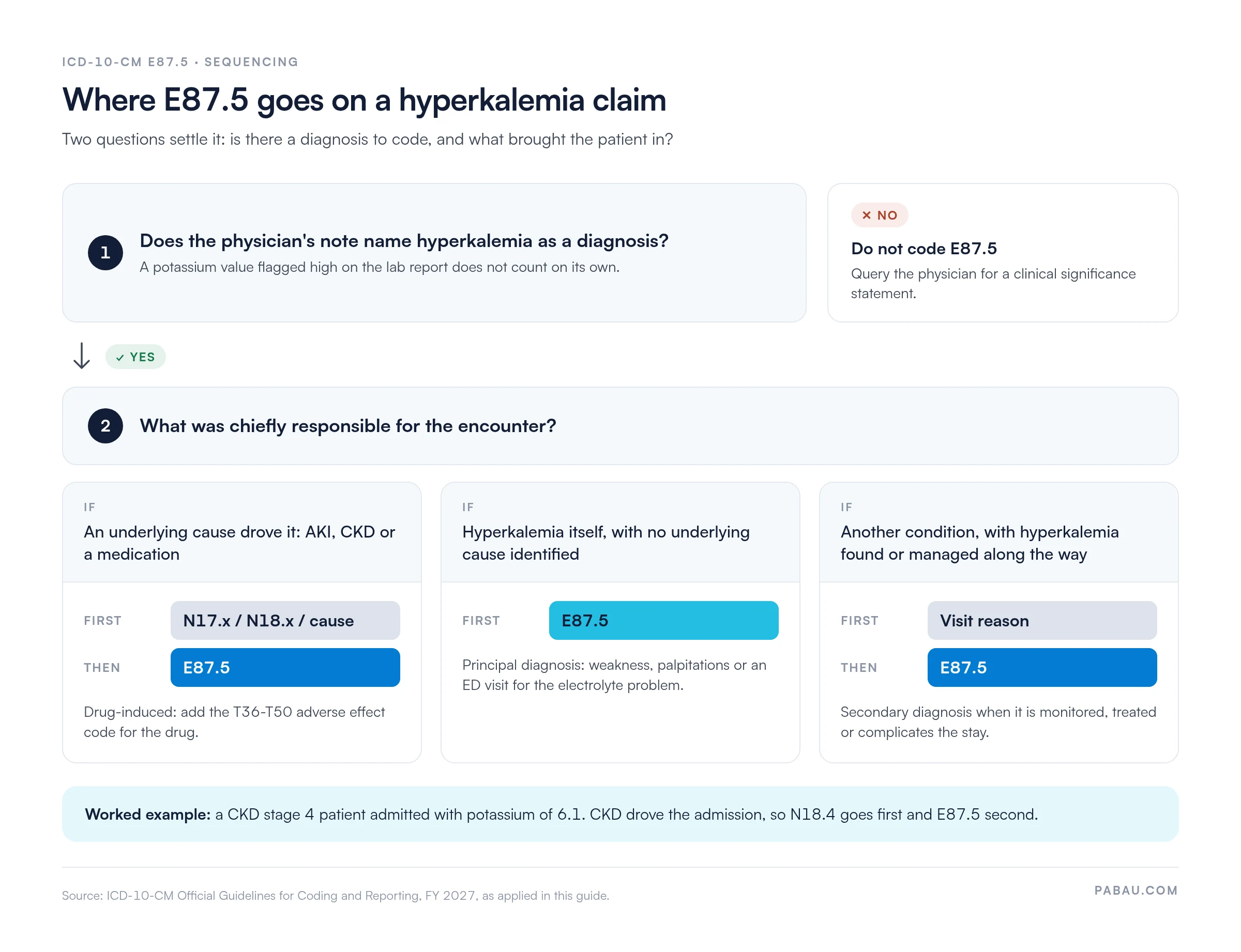
E87.5 sequences as the principal diagnosis when:
E87.5 sequences as a secondary diagnosis when:
A common sequencing mistake looks like this. A nephrologist admits a CKD stage 4 patient whose potassium is 6.1, and the coder puts E87.5 first because the value is alarming. The correct sequence is N18.4 (CKD stage 4) first, E87.5 second, because CKD is the condition chiefly responsible for the admission.
E87.5 denials cluster around four failure points, set out in the table below. Each one traces back to the note or the code order. A denial management workflow that sorts denials by root cause shows which one your practice hits most.
Reviewing the medical billing denial codes on E87.5 remittances, particularly CARC codes 4, 50, and 97, shows the payer’s specific reason. Appeals can then target the right issue.
Run a quarterly audit on all E87.5 claims submitted in the prior 90 days. Pull every claim where the potassium-related lab CPT (80048, 80051, 80053, 84132) was denied while the E&M code paid. That pattern usually points to a missing clinical significance statement in the physician note. Fixing the documentation workflow prevents the same denial on future encounters.
ICD-11 has not been mandated for US clinical billing as of FY 2027. The Centers for Medicare and Medicaid Services (CMS) continues to require ICD-10-CM for all HIPAA-covered transactions. No US implementation date for ICD-11 has been announced. Coders should continue using E87.5 for all current US claims.
That said, understanding how E87.5 maps to ICD-11 is useful preparation, particularly for practices working with international payers or preparing for a future transition. The WHO ICD-11 browser shows the following crosswalk.
ICD-11 moves to an alphanumeric stem-extension structure that allows greater post-coordination (combining a base condition code with cause, severity, and temporal extensions). For hyperkalemia, the core concept maps cleanly. Drug-induced hyperkalemia and hyperkalemia as a complication of kidney disease may be expressed through post-coordination rather than separate codes. No action is required by US coders today.
A hyperkalemia claim often carries three or four codes: the underlying cause, E87.5, a T-code for a drug, and the lab or E/M lines. Many practices key those into a separate billing system after the visit, away from the note that justifies them.
In Pabau, the physician’s note and the claim sit on the same patient record. US claims go out through Claim.MD as CMS-1500/837P submissions, with eligibility checks before the visit and ERA remittances posted back afterward. Secondary claims are sent from the same record.
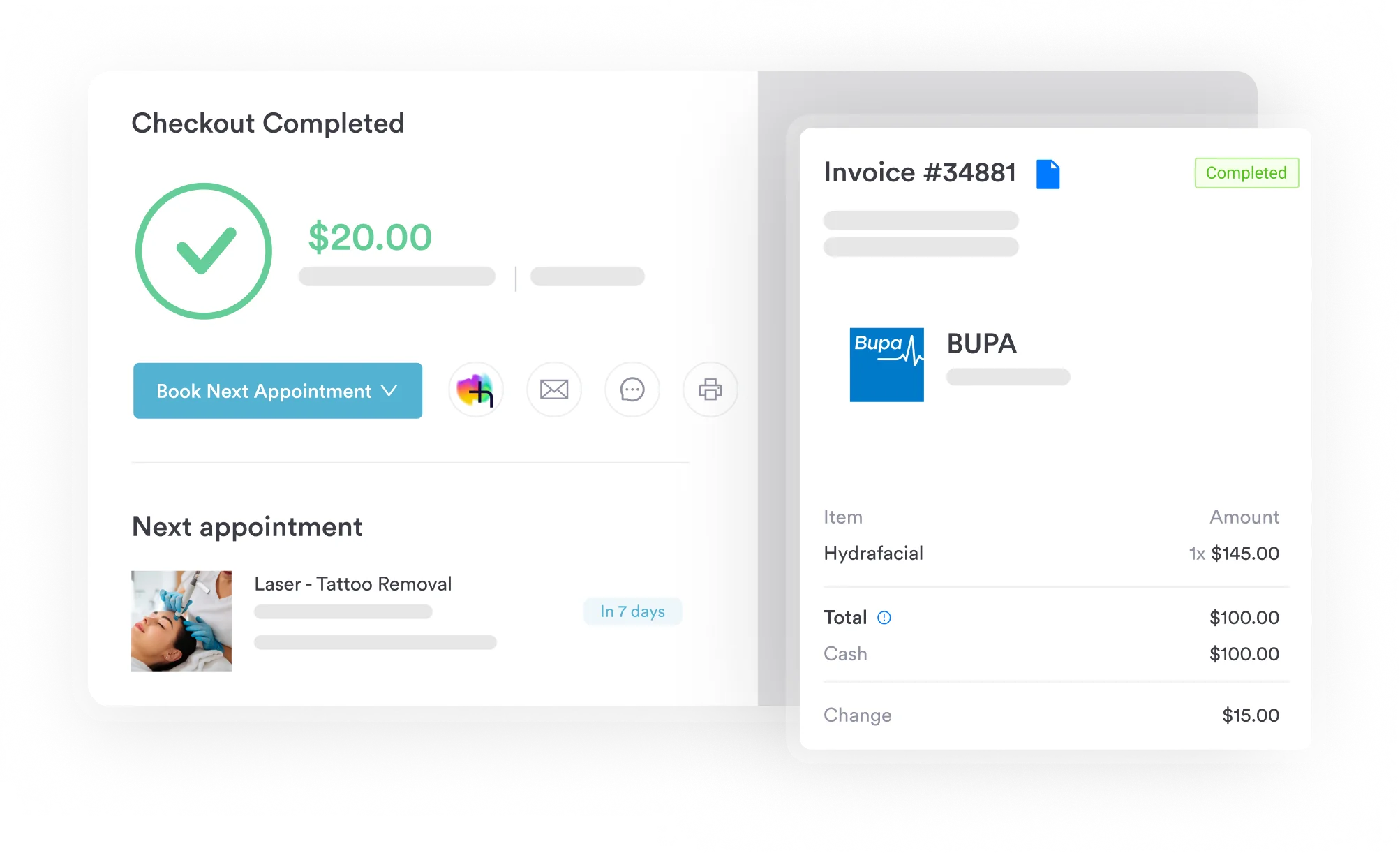
The coder reviews the documented diagnosis, the potassium value and the codes in one place before submitting. When a payer denies a lab line, the remittance lands next to the note, so the appeal starts from the documentation.

Pabau keeps the physician’s note, the codes and the Claim.MD submission on one patient record. See how practices send CMS-1500 claims, check eligibility and post ERA remittances without a second system.

Treat E87.5 as a documentation code before you treat it as a billing code. A claim holds up when the note names hyperkalemia, gives the potassium value and says what the physician did about it.
Sequencing is the judgment call. Put the underlying cause first whenever it drove the encounter, and add the T-code whenever a drug caused it. Keep principal position for visits where hyperkalemia was the reason. If a lab line keeps getting denied while the E/M pays, start with the note template.
Pabau keeps the note, the codes and the Claim.MD submission on one patient record, so the coder can check the documentation before the claim leaves. Book a demo to see how it handles multi-code hyperkalemia claims.

Need help managing claim denials for electrolyte codes? Denial management in healthcare covers the most common reasons claims are rejected and how to structure an appeals process that recovers revenue.
Looking for a complete reference on medical billing denial codes? Medical billing denial codes lists CARC and RARC codes by category with resolution guidance for each.
Coding the opposite potassium problem? ICD-10-CM code E87.6: hypokalemia covers low potassium, its documentation and how it differs from E87.5.
Is low sodium on the same panel? ICD-10 code E87.1: hypo-osmolality and hyponatremia explains when the sodium code applies and how to sequence it.
ICD-10 Code E87.5 is the billable ICD-10-CM diagnosis code for hyperkalemia, an abnormally elevated serum potassium level documented by a treating physician. It falls under Chapter 4 (Endocrine, Nutritional and Metabolic Diseases) within block E87 (Other disorders of fluid, electrolyte and acid-base balance). It is a terminal code with no further subdivision and is valid for all HIPAA-covered transactions.
Yes, E87.5 is the ICD-10-CM code for high potassium (hyperkalemia). The ICD-10 alphabetic index cross-references “high potassium” directly to E87.5. However, the code requires physician documentation of the diagnosis, not just a lab value above the reference range.
E87.5 is hyperkalemia (elevated potassium) and E87.6 is hypokalemia (low potassium). Both fall within the same E87 code block but code opposite directions of potassium imbalance. The two codes should never appear on the same claim for the same encounter, as a patient cannot have both high and low potassium simultaneously.
Yes, E87.5 can be sequenced as the principal (primary) diagnosis when hyperkalemia is chiefly responsible for the encounter and no underlying cause has been identified. When an underlying cause such as AKI, CKD, or a drug adverse effect is documented, that condition typically sequences first. E87.5 is then coded as an additional diagnosis.
No, ICD-10-CM does not mandate a specific numeric potassium threshold for E87.5. The code is supported by physician documentation of hyperkalemia as a clinical diagnosis, not the lab value alone. A serum potassium above 5.0 mEq/L may support the diagnosis clinically, but coding authority comes from the physician’s documented statement, not the lab report.
The most common E87.5 denial starts with coding from a lab result without the physician’s clinical significance statement. The second is sequencing E87.5 as principal when an underlying cause should lead. The third is a missing adverse effect T-code when the hyperkalemia is drug-induced. The fourth is an LCD mismatch, where the paired lab CPT code does not meet the payer’s coverage criteria for the documented diagnosis.