ICD-10 Code S82.63XB: Displaced lateral malleolus open fracture
ICD-10 Code S82.63XB: Code breakdown and character-by-character anatomy ICD-10 C...

Last Updated: Nov 23, 2026
Billable Code Specific Code
J30.2 is the billable ICD-10-CM code for other seasonal allergic rhinitis. It covers allergic rhinitis with a seasonal pattern when the trigger is not pollen. One example is a documented seasonal non-pollen allergen such as seasonal mold spores, where the Index supports it.
Pollen-triggered rhinitis, including hay fever and pollinosis, is coded J30.1 instead. To support J30.2, the note should name the non-pollen allergen and describe the seasonal pattern. Without that detail, the claim falls back to J30.9.
Let Pabau's smart automation suggest the right codes, reduce claim denials, and keep your practice compliant—effortlessly.
Automate repetitive tasks and focus on what matters most—your patients.
Reduce coding errors and ensure compliance with the latest regulations.
Clean claims, fewer denials, and faster reimbursements.
Powerful insights and reporting to help your practice thrive.
HIPAA compliant SOC 2 certified GDPR-compliant Trusted by 4,000+ clinics worldwide

J30.2 is a billable ICD-10-CM code for seasonal allergic rhinitis with a non-pollen trigger. It is valid for FY 2027 (October 1, 2026 to September 30, 2027).
Hay fever, pollinosis and allergic rhinitis due to pollen belong to J30.1, so a note that names pollen points away from J30.2.
A defensible J30.2 claim needs a documented seasonal pattern, a named non-pollen allergen and confirmed sensitization. Seasonal mold spores can qualify where the Alphabetic Index supports it.
J30.2 can support allergy testing (CPT 95004, 95024) and allergen immunotherapy (CPT 95115, 95117, 95165) when each claim line points to it.
In Pabau, US practices send CMS-1500 and 837P claims through Claim.MD and track prior authorizations on the patient’s case.
ICD-10 Code J30.2 is the billable ICD-10-CM code for other seasonal allergic rhinitis, meaning a seasonal pattern with a trigger other than pollen.
The FY 2027 Tabular List from CDC/NCHS lists it as “Other seasonal allergic rhinitis” in category J30, with no subcodes beneath it.
One example is a documented seasonal non-pollen allergen such as seasonal mold spores, where the Index supports it. Category J30 (Vasomotor and allergic rhinitis) sits in Chapter 10, Diseases of the respiratory system (J00-J99). Because J30.2 has no subcodes, it is billable as written.
The table below lists the attributes coders check before building a claim.
The most common mix-up is with J30.1. J30.1 is “Allergic rhinitis due to pollen,” and its inclusion terms are allergy NOS due to pollen, hay fever and pollinosis. So a seasonal note that names pollen belongs under J30.1, not J30.2. Confirm both descriptors in the CDC/NCHS ICD-10-CM browser when a note describes seasonal symptoms.
J30.2 is the residual code for seasonal allergic rhinitis. It captures IgE-mediated rhinitis that recurs in a season when the documented allergen is not pollen.
Pollen-triggered rhinitis, including hay fever and pollinosis, goes to J30.1. Rhinitis due to animal hair and dander goes to J30.81, and food-triggered rhinitis goes to J30.5. Other specified allergic rhinitis, such as a year-round non-pollen trigger, goes to J30.89. The four questions below route a rhinitis note to the right J30 code.
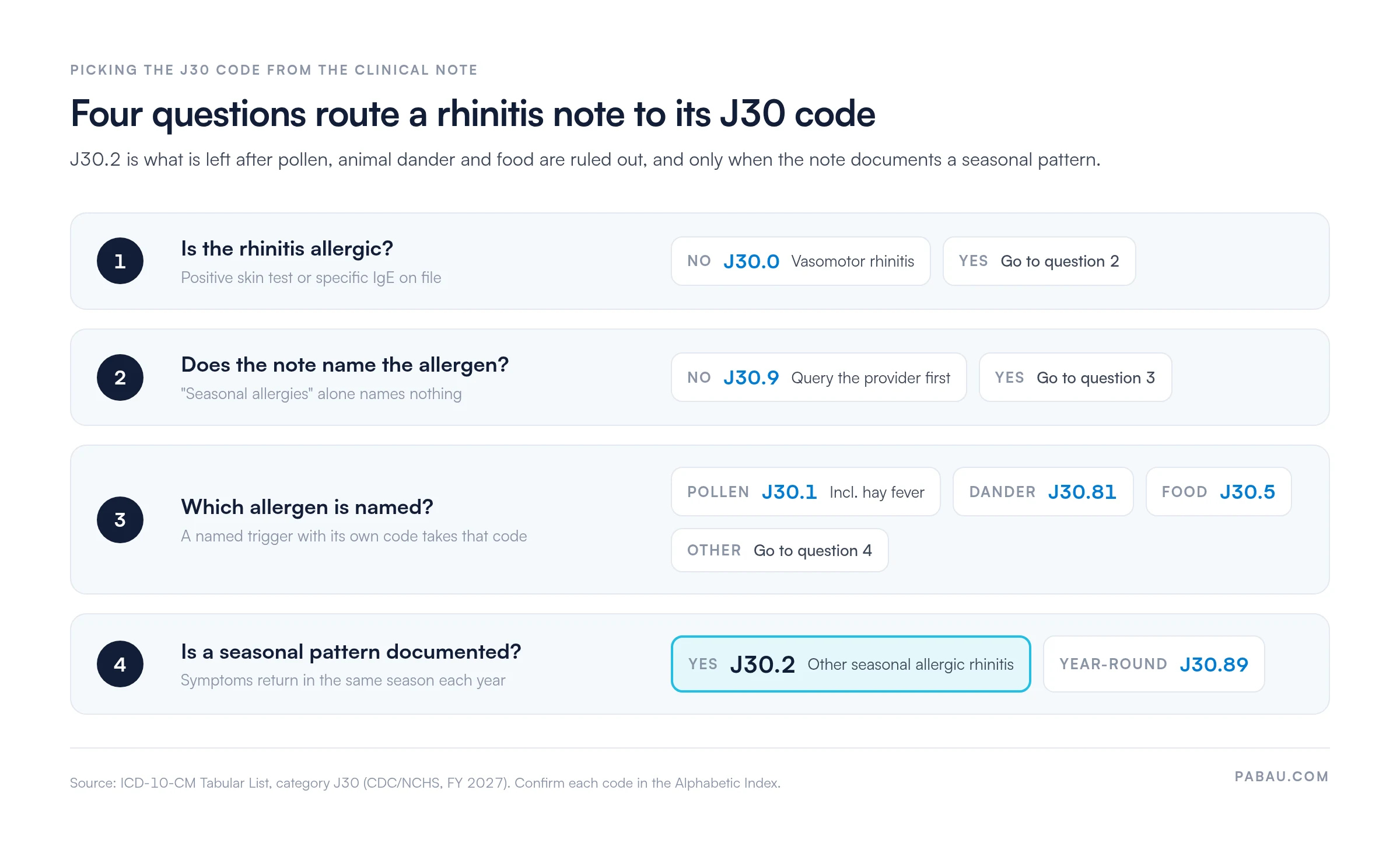
The J30 category carries an Excludes1 note for allergic rhinitis with asthma (bronchial), which points to J45.909. An Excludes1 note means the excluded condition is coded elsewhere, not under this category. Check the asthma category and current coding guidance before you report a J30 code and an asthma code on the same claim.
Sinusitis codes (J01 for acute, J32 for chronic) are a clinical distinction rather than an Excludes note. Rhinitis affects the nasal mucosa, while sinusitis involves the paranasal sinuses. Both may be reported together when both are documented and treated in the same encounter.
The J30 category holds seven billable codes. Picking the wrong sibling is the most common specificity error on rhinitis claims.
If the note names pollen, or uses the terms hay fever or pollinosis, code J30.1 even when symptoms are seasonal. J30.2 applies only when the seasonal trigger is something else. When a patient has documented seasonal reactions to both pollen and another allergen, check the Alphabetic Index and payer policy before reporting both codes.
J30.9, allergic rhinitis, unspecified is the last-resort code for allergic rhinitis. J30.2 is preferred when the note documents a seasonal pattern and names a non-pollen allergen, ideally backed by allergy testing. When the note says “seasonal allergies” but names no allergen, query the provider before you settle on a code.
Rhinitis (J30.2) and sinusitis (J01/J32) describe inflammation at different anatomical sites. A patient with congestion, facial pressure and seasonal sneezing may have both. Code J30.2 and the right sinusitis code when both conditions are documented and addressed in the treatment plan. Never substitute one for the other.
Documentation is what separates a defensible J30.2 claim from one that downcodes to J30.9 or gets recoded to J30.1 on audit. These five elements belong in the clinical note.
Getting medical billing compliance right at the documentation stage costs far less than fixing it at claims submission. A note that covers all five elements gives a payer little room to challenge medical necessity.
J30.2 can serve as the supporting diagnosis across three CPT code families. The table below maps each code to its link with J30.2.
A positive skin test (CPT 95004) or specific IgE result for a non-pollen seasonal allergen is the strongest support for J30.2. Without confirmed sensitization on file, some payers will challenge the diagnosis. In Pabau, a practice management platform with built-in US billing, practices submit these claims through Claim.MD as CMS-1500 or 837P claims.
Subcutaneous immunotherapy is billed with CPT 95115 for a single injection or CPT 95117 for two or more injections. Antigen preparation is billed separately with CPT 95165, for single or multiple antigens. Sublingual immunotherapy has no matching injection code, so check payer-specific coding before billing it.
Commercial payers often require prior authorization, usually with proof of a failed trial of first-line medication. Medicare coverage follows the Local Coverage Determination (LCD) for each MAC jurisdiction, so check the applicable LCD before submitting.
Before submitting an immunotherapy claim with J30.2, confirm the allergy test results (CPT 95004 or 95024) are in the same record. Many payer policies expect positive test results before they cover antigen preparation (CPT 95165).
Prior authorization requirements for J30.2 vary by payer type and by the services billed. Routine office visits with J30.2 as the primary diagnosis generally need no prior authorization. The complexity comes when allergy testing or immunotherapy codes appear on the same claim.
J30.2 claims fail for predictable reasons. The table below maps seven common denial triggers to their fixes. Each rejection also comes back with a payer reason code, and our guide to medical billing denial codes explains what each one means.
A few ICD-10-CM conventions decide when J30.2 is the right choice. They matter most when a note mixes seasonal and pollen language, or when rhinitis appears alongside asthma.
The AAPC Codify ICD-10-CM lookup shows the full tabular display for the J30 category, useful for confirming notes before claim submission.
Run any claim that carries J30.2 with an asthma or sinusitis code through your claim scrubber before submission. A scrubber flags Excludes1 conflicts and CPT lines with no diagnosis pointer before the payer does.
Allergy and ENT practices often bill J30.2 claims through a patchwork of an EHR, a separate billing tool and a clearinghouse portal. Each handoff is a chance to drop a diagnosis pointer or miss a prior authorization.
Pabau’s claims management software sends CMS-1500 and 837P claims through Claim.MD from the same system that holds the clinical note. Eligibility checks run before the visit, and ERA remittances come back into Pabau. Prior authorizations sit on the patient’s case with the auth code, dates and sessions, and Pabau warns the team when one is missing.
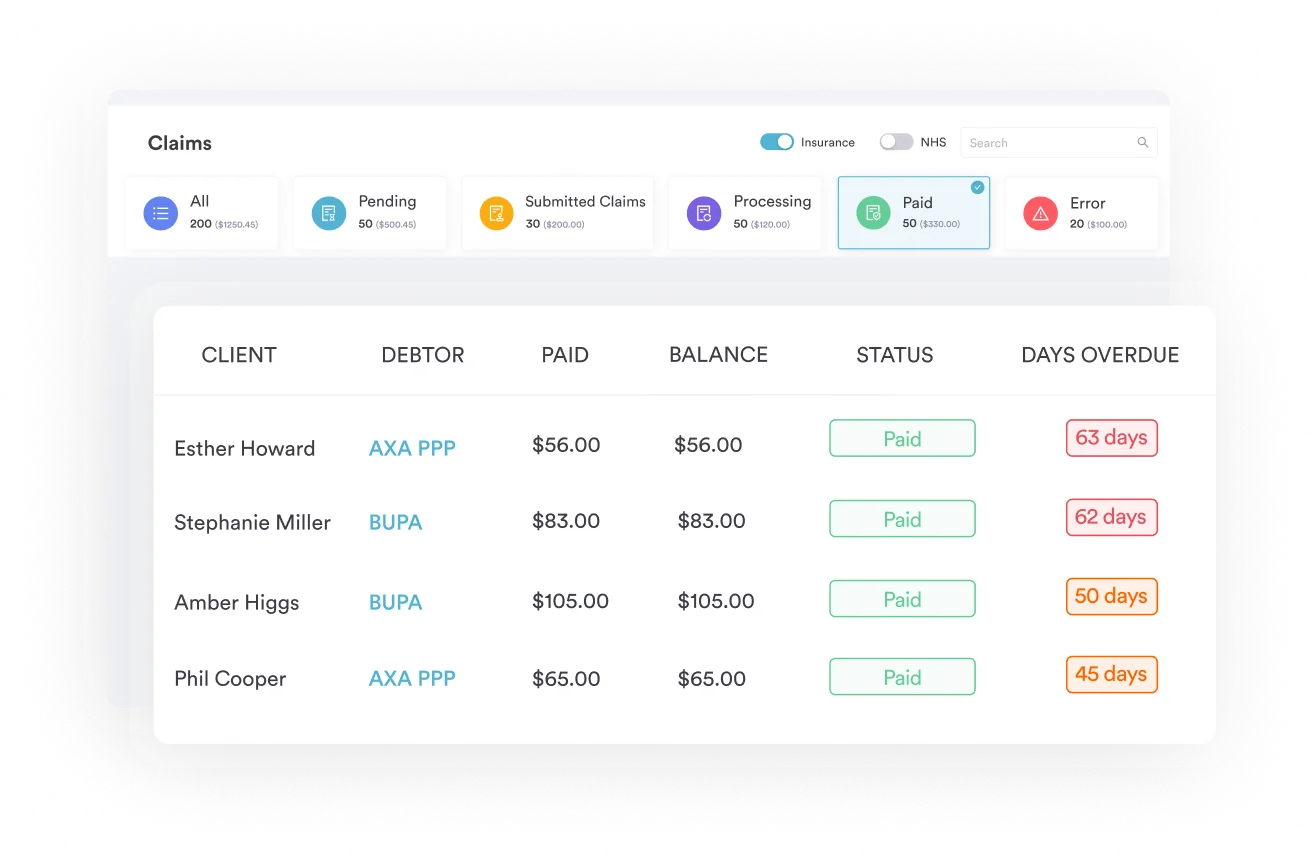
The result is fewer avoidable denials on immunotherapy claims and less time spent on appeals. A clean claim built at the documentation stage costs less than any appeal.

Pabau sends US claims through Claim.MD, checks eligibility and tracks prior authorizations on each case, so allergy and ENT practices spend less time on appeals.

J30.2 is a narrower code than many references suggest. It belongs to seasonal allergic rhinitis with a non-pollen trigger, while hay fever and other pollen-triggered rhinitis belong to J30.1. Getting that one distinction right prevents most recoding on audit. Pair it with a named allergen, a seasonal pattern and confirmed sensitization, and J30.2 claims hold up.
If your practice bills allergy testing and immunotherapy, the diagnosis pointer and prior authorization deserve the same care as the code itself. To see how Pabau handles both in an allergy or ENT practice, book a demo.

Need to understand how clearinghouse validation catches CPT-ICD mismatches? Claim.MD clearinghouse overview explains how pre-submission edits work for US allergy and ENT billing.
Billing the 837P file format for the first time? 837 EDI file guide covers the electronic claim format used by all US clearinghouses including Claim.MD.
Looking for denial code reference after a J30.2 rejection? Denial codes in medical billing maps CARC denial reason codes to resolution steps for common rhinitis claim failures.
Skin prick results unclear? CPT code 95024 covers intradermal allergy testing and the documentation payers expect with it.
Billing extract preparation for immunotherapy? CPT code 95165 explains how antigen preparation is reported and how doses are counted.
ICD-10 code J30.2 is the billable diagnosis code for other seasonal allergic rhinitis. It covers seasonal allergic rhinitis when the trigger is not pollen. One example is a documented seasonal non-pollen allergen such as seasonal mold spores, where the Index supports it. It sits in category J30 in Chapter 10 of ICD-10-CM and is valid for FY 2027.
Yes, J30.2 is a billable ICD-10-CM code with no subcodes beneath it. It may be submitted on CMS-1500 or 837P claims for any encounter where other seasonal allergic rhinitis is documented.
J30.1 is allergic rhinitis due to pollen, and its inclusion terms are hay fever and pollinosis. J30.2 is other seasonal allergic rhinitis, for a seasonal pattern with a non-pollen trigger. If the note names pollen, code J30.1.
No. Hay fever is an inclusion term under J30.1, allergic rhinitis due to pollen. Use J30.2 only when the seasonal trigger is a documented non-pollen allergen, such as seasonal mold spores where the Index supports it.
Use J30.2 when the note documents a seasonal pattern and names a non-pollen allergen. J30.9 (allergic rhinitis, unspecified) is a last-resort code for notes that do not identify the trigger. When the documentation is suggestive but incomplete, query the provider first.
Common pairings include percutaneous allergy testing (95004) and intradermal testing (95024). Immunotherapy uses 95115 for a single injection and 95117 for two or more injections. Antigen preparation uses 95165 for single or multiple antigens, and office visits use 99202-99215.
Allergic rhinitis due to animal hair and dander is J30.81, not J30.1 or J30.2. Other specified allergic rhinitis, such as a year-round non-pollen trigger, is J30.89.
Common reasons include J30.9 submitted when the note supports J30.2, and J30.2 used when the note names pollen. Others are an unnamed trigger, CPT-ICD linkage errors, missing prior authorization for immunotherapy and asthma Excludes1 conflicts. The denial table above lists a fix for each.