ICD-10 Code S82.63XB: Displaced lateral malleolus open fracture
ICD-10 Code S82.63XB: Code breakdown and character-by-character anatomy ICD-10 C...

Last Updated: Nov 23, 2026
Billable Code Specific Code
G93.41 is the billable ICD-10-CM code for metabolic encephalopathy.
It covers diffuse brain dysfunction caused by a systemic metabolic problem, including septic encephalopathy. Hepatic encephalopathy has its own code, K76.82, and toxic metabolic encephalopathy goes to G92.8, so the documented cause decides the code.
Let Pabau's smart automation suggest the right codes, reduce claim denials, and keep your practice compliant—effortlessly.
Automate repetitive tasks and focus on what matters most—your patients.
Reduce coding errors and ensure compliance with the latest regulations.
Clean claims, fewer denials, and faster reimbursements.
Powerful insights and reporting to help your practice thrive.
HIPAA compliant SOC 2 certified GDPR-compliant Trusted by 4,000+ clinics worldwide

G93.41 is the billable ICD-10-CM code for metabolic encephalopathy, and its only inclusion term is septic encephalopathy.
Hepatic encephalopathy has had its own code, K76.82, since October 1, 2022, so it no longer belongs under G93.41.
G93.41 is a major complication or comorbidity (MCC) in the FY 2027 MS-DRG v44 grouper, while G93.40 and G93.49 are CCs.
The G93.4 Excludes2 note sends alcoholic, hypertensive and toxic metabolic encephalopathy to their own codes, and each can be reported alongside G93.41 when documented.
Because the MCC attracts clinical validation reviews, the chart must name the metabolic cause and show the brain dysfunction it produced.
ICD-10 Code G93.41 is the billable ICD-10-CM code for metabolic encephalopathy, and septic encephalopathy is the one inclusion term listed under it.
The FY 2027 ICD-10-CM tabular list from CDC/NCHS files it under subcategory G93.4, Other and unspecified encephalopathy. That subcategory sits in category G93 (Other disorders of brain) within Chapter 6, Diseases of the nervous system.
That release makes G93.41 valid for discharges and dates of service from October 1, 2026. The code is complete at five characters and takes no seventh character. Check the descriptor and notes against the current tabular before each new fiscal year, because notes move between releases.
Metabolic encephalopathy is a diffuse, usually reversible disturbance of brain function caused by a problem outside the brain. Sepsis, sodium imbalance, kidney failure and other systemic derangements can all produce it. The brain tissue itself is structurally intact, so the disturbance comes from the chemistry around it.
Patients typically present with fluctuating attention, confusion, lethargy or reduced responsiveness. Symptoms tend to improve as the underlying cause is corrected, which is why the treatment plan targets the cause rather than the brain.
For coding, the distinction that matters is between a symptom and a diagnosis. “Confusion” or “altered mental status” alone points to R41.82. Its Excludes1 note says altered mental status due to a known condition is coded to that condition. G93.41 needs the provider to diagnose metabolic or septic encephalopathy in so many words.
G93.41 carries one inclusion term and inherits one Excludes2 note from its parent, G93.4. There is no Excludes1 note, no code-first note and no use-additional-code note on G93.41 or G93.4.
The toxic metabolic trap is the one coders meet most. The ICD-10-CM index sends “Encephalopathy, toxic, metabolic” to G92.8, and “Toxic metabolic encephalopathy” is an inclusion term under G92.8. So the single word “toxic” in the provider’s diagnosis moves the code out of G93.41 entirely.
Before FY 2023, ICD-10-CM had no dedicated code for hepatic encephalopathy. Since October 1, 2022, it has its own code: K76.82, Hepatic encephalopathy. The FY 2027 index sends both “Encephalopathy, hepatic (without coma)” and “Encephalopathy, portal-systemic” straight to K76.82.
Do not add G93.41 to K76.82 for the same episode just because a note also calls the encephalopathy “metabolic.” If the provider attributes the confusion to a second, separate cause, such as sepsis, query before coding both.
This choice also moves payment. In the MS-DRG v44 grouper, K76.82 is not on the CC or MCC list, while G93.41 is an MCC. Coding hepatic encephalopathy to G93.41 therefore overstates severity, and auditors look for exactly that pattern.
Several encephalopathy codes sit close together in the ICD-10-CM code set, and the provider’s wording decides between them. The table maps each common diagnostic phrase to its FY 2027 code and its MS-DRG v44 severity level.
The costly mistake runs in both directions. Defaulting to G93.40 when the provider documented a metabolic cause understates severity. Assigning G93.41 to hepatic or toxic encephalopathy overstates it, or simply picks the wrong code. Checking the wording in a fixed order, as below, avoids both errors.
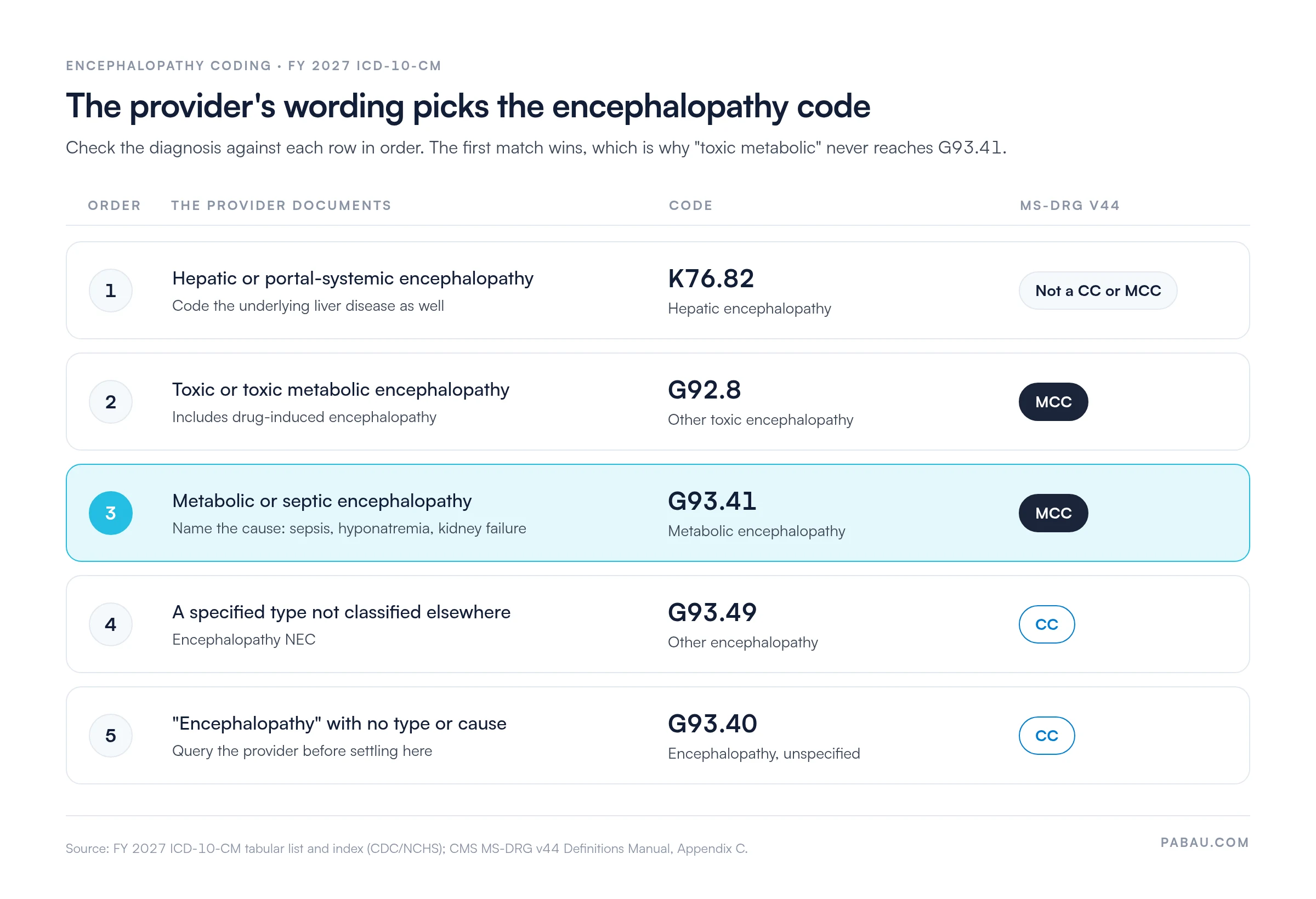
When the note says “encephalopathy” without a type, query the provider rather than guessing.
Pull discharges coded G93.40 or R41.82 where the chart also shows sepsis, significant hyponatremia or acute kidney failure. These are the likeliest G93.41 query candidates. A concurrent CDI review during the stay lets the provider clarify the diagnosis before the claim goes out.
G93.41 has no instructional note that forces a pairing. What puts the cause on the claim is the general rule to code every documented condition that affects care. Report the metabolic cause the provider names, and sequence it by the principal diagnosis rules.
In the CMS MS-DRG v44 Definitions Manual, Appendix C, which applies to FY 2027 discharges, G93.41 is listed as an MCC. Reported as a secondary diagnosis, it can move a case into the with-MCC tier of its DRG family. That tier carries a higher relative weight and higher hospital payment.
The MCC has one built-in exception. G93.41 belongs to PDX exclusion collection 0728, so it does not count as an MCC when the principal diagnosis is another G93.4- code. The same applies when the principal diagnosis is G21.0 (malignant neuroleptic syndrome), G83.5 (locked-in state) or I67.83 (posterior reversible encephalopathy syndrome).
Because G93.41 can lift a case into the with-MCC tier on its own, it draws clinical validation reviews from Medicare contractors and commercial payers. Reviewers read the whole chart to decide whether it supports the diagnosis the code reports. CDI teams should make G93.41 a query and validation priority and reserve it for charts that name a metabolic cause.
A G93.41 claim that survives clinical validation shows the same handful of elements in the record. Use this list as the minimum before the code goes on a claim.
The ACDIS/AHIMA guidelines for compliant query practice support non-leading query templates. An encephalopathy query asks the provider to state the type and cause, which turns “confused, likely metabolic” into a diagnosis that holds up on review.
G93.41 denials and downcodes cluster around a predictable set of errors. Catching them before submission is cheaper than working a denial after the fact.
Denial management workflows that track G93.41 rejections by reason code show the billing team which error keeps recurring, so it gets fixed at the source. The clean claim standards that apply to procedure codes apply equally to diagnosis code selection and sequencing.
Before billing a G93.41 claim, run a four-point check. (1) The provider named metabolic or septic encephalopathy. (2) The encephalopathy is not hepatic or toxic. (3) The cause is coded and sequenced correctly. (4) The chart shows assessment, treatment and course.
G93.41 also lands on professional claims, for hospitalist, neurology and critical care visits during the stay. Many practices still key those diagnosis codes into a billing portal by hand. They then wait weeks to learn a claim was rejected.
Pabau, a practice management platform with built-in billing, keeps that work in one place. It sends CMS-1500/837P claims electronically through Claim.MD, its US clearinghouse partner, and runs eligibility checks before the visit. ERA remittances post back with their denial reason codes, and secondary claims go out from the same record.
The outcome is a shorter loop between a coding decision and its result. When a G93.41 claim comes back denied, the remittance shows why, and the team corrects the claim instead of guessing. Pabau’s claims software for practices keeps the claim, its codes and its payment history together.

Pabau submits CMS-1500/837P claims through Claim.MD, checks eligibility before the visit and posts ERA remittances with their denial reasons. Your team sees what went wrong on a G93.41 claim and fixes it fast.

G93.41 is narrower than it used to be. Since hepatic encephalopathy moved to K76.82, the code covers metabolic and septic encephalopathy, and the word “toxic” sends a case to G92.8 instead. Coders who still treat G93.41 as a catch-all for confused patients with abnormal labs are carrying audit risk on every case.
The safest habit is to code what the provider diagnosed and query what they did not. A G93.41 backed by a named cause, a documented change from baseline and a treatment plan keeps its MCC on review. Book a demo to see how Pabau gets your G93.41 claims out clean and shows you why any come back.

Need to understand how claims reach the payer? Claim.MD clearinghouse guide explains how electronic claims are validated and transmitted to 4,000+ US payers.
Seeing recurring G93.41 rejections? Denial codes in medical billing breaks down the most common remittance advice codes and what each means for your correction workflow.
ICD-10 Code G93.41 is the billable ICD-10-CM code for metabolic encephalopathy. Its one inclusion term is septic encephalopathy. It sits in Chapter 6 (Diseases of the nervous system), category G93 (Other disorders of brain), subcategory G93.4.
Yes. G93.41 is a valid, billable ICD-10-CM code for FY 2027, which runs from October 1, 2026 to September 30, 2027. It is complete at five characters and needs no seventh character.
No. Since October 1, 2022, hepatic encephalopathy has its own code, K76.82. Code the underlying liver disease as well, such as K72.10 for chronic hepatic failure without coma. Hepatic failure with coma is coded to a with-coma code, such as K72.11, instead.
G93.41 is metabolic encephalopathy, including septic encephalopathy. G93.49 is other encephalopathy, for a specified type not classified elsewhere. In the FY 2027 MS-DRG v44 grouper, G93.41 is an MCC and G93.49 is a CC.
G93.41 inherits an Excludes2 note from G93.4 covering alcoholic encephalopathy (G31.2), encephalopathy in diseases classified elsewhere (G94), hypertensive encephalopathy (I67.4) and toxic metabolic encephalopathy (G92.8). Excludes2 means the condition is not part of G93.41, so both codes may be reported when both are present.
Yes. G93.41 is an MCC in the MS-DRG v44 grouper for FY 2027. It does not count as an MCC when the principal diagnosis is another G93.4- code, G21.0, G83.5 or I67.83.
Septic encephalopathy is an inclusion term under G93.41. Code the systemic infection first, such as A41.9. Add R65.20 when the provider documents the encephalopathy as sepsis-related organ dysfunction, then G93.41.