

ICD-10 code S61.201A: Open wound of left index finger without nail damage
ICD-10 code S61.201A covers a left index finger wound of unstated type ICD-10 co...

Last Updated: Oct 16, 2026
Billable Code Specific Code
Z08 is the billable ICD-10-CM code for encounter for follow-up examination after completed treatment for malignant neoplasm.
Let Pabau's smart automation suggest the right codes, reduce claim denials, and keep your practice compliant—effortlessly.
Automate repetitive tasks and focus on what matters most—your patients.
Reduce coding errors and ensure compliance with the latest regulations.
Clean claims, fewer denials, and faster reimbursements.
Powerful insights and reporting to help your practice thrive.
HIPAA compliant SOC 2 certified GDPR-compliant Trusted by 4,000+ clinics worldwide

ICD-10 Code Z08 is a billable ICD-10-CM code for encounters after completed malignant neoplasm treatment, valid for FY2026.
Always report companion codes: Z85.- for personal history of malignant neoplasm, and Z90.- for acquired absence of organs where applicable.
Z08 applies only after treatment is fully complete, so using it during active treatment is a common denial trigger.
Pabau’s claims management software surfaces ICD-10 code search and companion-code prompts inside the documentation workflow, before the claim leaves the practice.
ICD-10 Code Z08 is a billable ICD-10-CM code for an encounter for follow-up examination after completed treatment for malignant neoplasm. It covers the surveillance visits that continue once cancer treatment has finished. The code is specific as well as billable, so it stands alone as a reportable diagnosis without a more granular subcategory.
The code sits in the Z00-Z13 chapter, which covers people encountering health services for examinations. It is valid for dates of service on or after October 1, 2025, under the FY2026 ICD-10-CM code set. The Centers for Medicare and Medicaid Services (CMS) and the National Center for Health Statistics (NCHS) maintain that set.
You can check the official entry in the CDC/NCHS ICD-10-CM web tool, which CDC/NCHS refreshes each fiscal year. Related code references live in our ICD-10 diagnostic code library.
Z08 applies to one narrow scenario. The patient has completed treatment for a confirmed malignant neoplasm and presents for a follow-up or surveillance encounter. Completed treatment includes chemotherapy, radiation, surgery, immunotherapy, or a combination, as long as no active treatment is running at the time of the visit.
Z08 is not appropriate when active treatment is still in progress. It also does not apply when the patient presents for a new primary cancer, or when the encounter involves a benign or unspecified neoplasm.
Those scenarios take different ICD-10-CM codes. Z-codes in this range exist for health service contacts that are not tied to a current illness or injury.
Using Z08 and Z09 interchangeably is the most common error in post-treatment follow-up billing. The two codes cover distinct patient populations, and payer edits are built to catch the swap. Z08 is for malignant neoplasm follow-up. Z09 is for all other completed-treatment follow-up.
Coders apply those rules in a fixed order, and the path below follows it question by question.
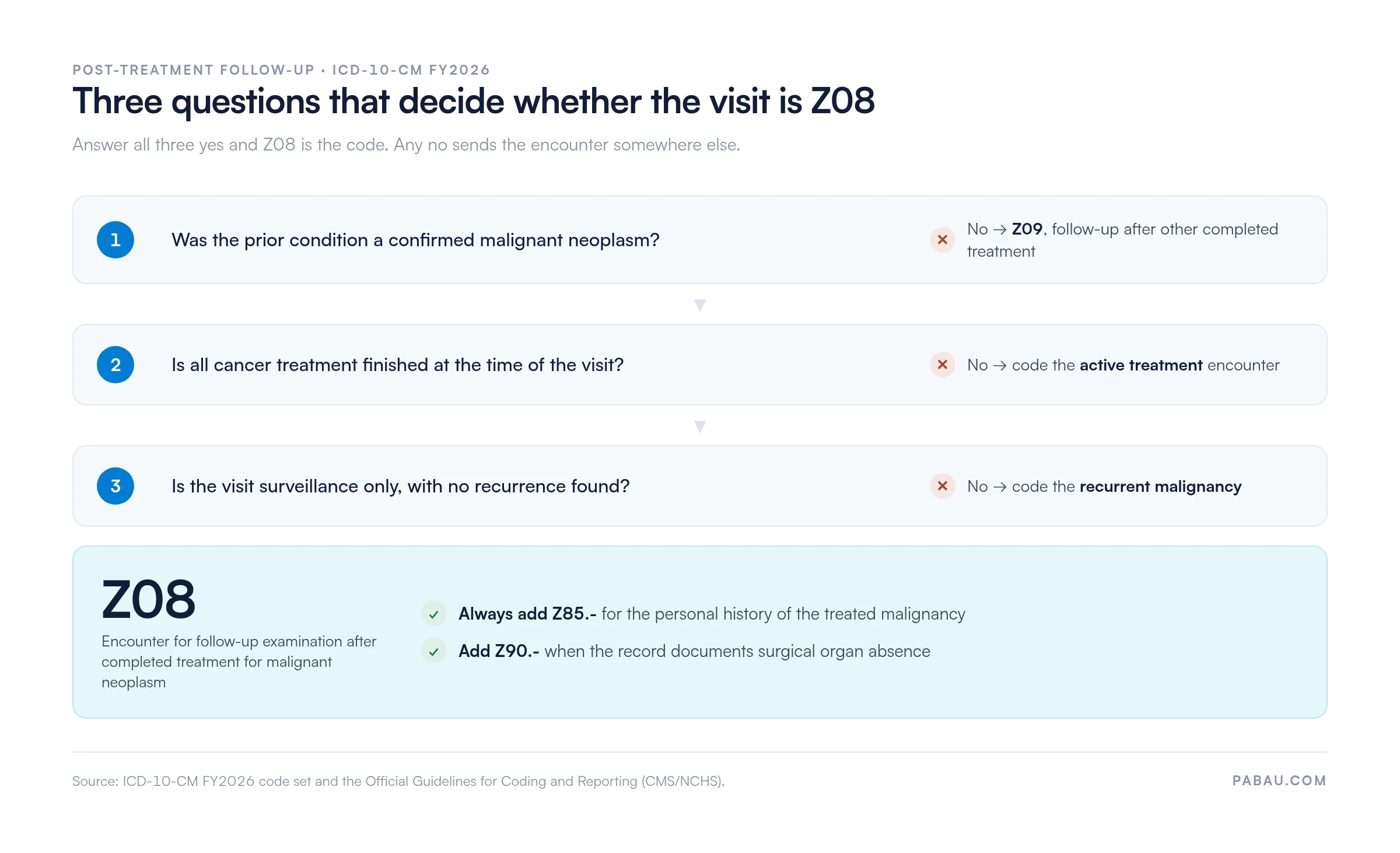
The ICD-10-CM Official Guidelines for Coding and Reporting carry two use-additional-code instructions for Z08. CMS and NCHS maintain those guidelines jointly. Skipping either instruction is a documentation problem that can prompt payer queries or an audit.
Always report a Z85.- code alongside Z08 to identify the malignancy the patient was treated for. The Z85 category breaks down by body site, so the coder picks the fourth or fifth character from the medical record.
Z85.3 covers personal history of malignant neoplasm of breast. Z85.038 covers personal history of other malignant neoplasm of the large intestine (colon).
When treatment included organ removal with curative intent, also report the applicable Z90.- code to document the surgical absence. Examples include mastectomy, nephrectomy, and colectomy. Not every Z08 encounter requires it. Report it only when the record documents organ absence that is relevant to the follow-up visit.
The AAPC’s ICD-10-CM code lookup gives searchable access to the full Z85 and Z90 subcategory lists.
Flag Z08 encounters in your workflow at the time of scheduling, not at coding. When the front desk confirms a patient’s prior cancer history and treatment status during appointment creation, the documentation trail exists before the visit begins. That single step makes Z85.- companion code selection faster and reduces the chance of submitting Z08 alone.
Medical record documentation must support Z08 on three specific points. Payers increasingly request records on post-treatment cancer surveillance claims, and thin documentation is the leading audit trigger for this code.
One practical note on phrasing. If the oncologist documents no evidence of disease, or in remission with a surveillance plan, that wording usually supports Z08. Language implying active disease management tells an auditor the encounter involved treatment.
Z08 pairs with a procedure code to complete the claim. The choice depends on the encounter: a straightforward office visit takes an E/M code, while specialty surveillance may add imaging or other procedures. The American Medical Association (AMA) publishes the CPT code set that governs this pairing.
Verify CPT-to-ICD-10 pairing against current AMA CPT guidelines and each payer’s medical necessity policy, because requirements vary by payer and specialty.
In inpatient and facility billing, Z08 contributes to MS-DRG (Medicare Severity-Diagnosis Related Group) assignment alongside the principal and secondary diagnoses. For outpatient oncology follow-up, practices usually report Z08 on professional claims (CMS-1500 or 837P). There it sits as a primary or secondary diagnosis, depending on how the encounter is structured.
Check current MS-DRG assignments against the CMS MS-DRG Definitions Manual for the applicable fiscal year, since group assignments shift with annual code updates. Practices that submit electronically route Z08 claims through a clearinghouse in the standard 837P transaction set.
Payer coverage policies for post-malignancy surveillance may sit in Local Coverage Determinations (LCDs) or National Coverage Determinations (NCDs) published by CMS. The CMS ICD code lists and the individual MAC portals are the authoritative sources for Z08 coverage under Medicare.
The FY2026 guidelines define Z08 narrowly, and its boundaries are where denials start. The errors below account for most Z08 rejections and audit findings in oncology billing. Proactive denial management means catching them before submission.
Accurate Z08 coding depends on what gets captured during the encounter. A coder reconstructing it afterward is working from whatever the note left behind. Practice management software like Pabau puts ICD-10 code search inside the clinical documentation workflow, so clinicians and coders work from one record.
Our claims software for practices then pulls that finished record into a pre-filled claim. You can build companion code prompts for Z85.- and Z90.- into the encounter template, which is where omissions usually happen.
Claims then flow to Claim.MD in the 837P format for submission to thousands of US payers. Real-time eligibility checks run before the visit. Electronic remittance advice (835 files) comes back with the denial reason codes your billing team needs to correct or appeal a Z08 claim.
Post-treatment surveillance runs for years, so the record has to hold up across dozens of visits. Pabau keeps the clinical note, the codes, and the claim record in one patient file. An audit request then becomes a search rather than a hunt through folders.
Run a monthly Z08 coding audit. Pull every claim submitted with Z08 in the primary position, then check that each carries a Z85.- code. Claims missing Z85.- are your highest audit risk. In Pabau, you can filter the claims report by primary diagnosis to build that list in minutes.

Pabau surfaces ICD-10 code search and companion-code prompts in the documentation workflow, then submits the finished claim through Claim.MD. See how it fits your oncology follow-up billing.

Z08 is an easy code to reach for and an easy one to get wrong, because the boundary is timing rather than diagnosis. The question worth asking at every surveillance visit is whether treatment has finished.
Fix the front end of the workflow and the coding follows. Capture treatment completion and the prior malignancy at scheduling, and the Z85.- companion code stops being a memory test at coding time.
The trade-off is worth remembering. A small step at intake costs seconds, while a Z08 denial costs a full rework cycle. Book a demo to see how Pabau keeps oncology surveillance visits documented and coded before the claim goes out.

Need to understand how claim denials are handled after Z08 submission? Denial codes in medical billing covers the most common CARC reason codes and how to appeal them effectively.
Want to see how a medical claims clearinghouse works in practice? Medical claims clearinghouse guide explains how 837P claims flow from practice to payer and back.
Looking for clean claim submission best practices? Clean claim checklist outlines the fields, codes, and checks that prevent first-pass rejections across all claim types.
Z08 is a billable ICD-10-CM diagnosis code for “Encounter for follow-up examination after completed treatment for malignant neoplasm.” It is used when a patient who has finished cancer treatment returns for a surveillance or monitoring visit, with no active malignancy treatment ongoing. The code is valid under the FY2026 ICD-10-CM code set (effective October 1, 2025).
The ICD-10-CM Official Guidelines require reporting Z85.- (personal history of malignant neoplasm) alongside Z08 to identify the specific prior cancer. When organ absence resulted from surgical treatment, also report the applicable Z90.- code (acquired absence of organs). Z85.- is always required. Z90.- applies only when organ absence is documented and relevant to the visit.
No. Z08 requires that treatment for the malignant neoplasm is finished. A patient still receiving maintenance or adjuvant therapy is under active treatment, so the encounter is coded to that treatment context instead. Once therapy ends and the visits become surveillance only, Z08 applies.
The medical record must document three things. First, that cancer treatment is completed rather than paused or ongoing. Second, the type and site of the prior malignancy, which supports Z85.- selection. Third, that the visit’s purpose is surveillance rather than active treatment. If recurrence is identified during the visit, code the active malignancy instead of Z08.



