ICD-10 Code Z12.0: Encounter for screening for malignant neoplasm of stomach (2026 guide)
ICD-10 Code Z12.0: Definition and billable status ICD-10 Code Z12.0 is a billabl...

Last Updated: Nov 23, 2026
Billable Code Specific Code
S82.63XB is the billable ICD-10-CM code for displaced fracture of lateral malleolus of unspecified fibula, initial encounter for open fracture type I or II.
It applies at the first active-treatment visit when the record confirms an open wound at the fracture site. The record must not name the right or left ankle. When it does, S82.61XB (right) or S82.62XB (left) applies instead. A wound documented as Gustilo-Anderson Type IIIA or higher takes character C, not B.
Let Pabau's smart automation suggest the right codes, reduce claim denials, and keep your practice compliant—effortlessly.
Automate repetitive tasks and focus on what matters most—your patients.
Reduce coding errors and ensure compliance with the latest regulations.
Clean claims, fewer denials, and faster reimbursements.
Powerful insights and reporting to help your practice thrive.
HIPAA compliant SOC 2 certified GDPR-compliant Trusted by 4,000+ clinics worldwide

S82.63XB codes a displaced open fracture of the lateral malleolus when the record does not name the side.
Use S82.61XB (right) or S82.62XB (left) whenever the medical record names the side.
The 7th character B applies only at the initial active-treatment encounter for open fractures classified Gustilo-Anderson Type I or II.
Using S82.63XB at follow-up visits or without a documented Gustilo type is a known audit trigger and denial risk.
Pabau’s claims management software helps orthopedic and sports medicine practices check S82.63XB claims against payer edits before submission.
ICD-10 Code S82.63XB is the billable code for a displaced open lateral malleolus fracture, Gustilo-Anderson Type I or II, with the side unspecified.
The CDC’s FY2026 ICD-10-CM code set lists it under subcategory S82.6 with exactly that descriptor. It applies at the initial encounter, and each of its seven characters encodes one part of that description.
Position four carries two facts at once: displacement and laterality. Within subcategory S82.6, the digits 1, 2 and 3 mean a displaced fracture of the right, left or unspecified fibula. The digits 4, 5 and 6 cover the same three sides for a nondisplaced fracture. The official full descriptor for S82.63XB is: Displaced fracture of lateral malleolus of unspecified fibula, initial encounter for open fracture type I or II.
The 7th character B marks the initial encounter for active treatment of an open fracture classified Gustilo-Anderson Type I or II. It is one of sixteen valid 7th characters for the S82.63 family, and each one carries a distinct clinical and billing meaning.
The ICD-10-CM Official Guidelines (Section I.C.19.c.1) define “initial encounter” as a visit where the patient is still receiving active treatment. Examples include surgical management, casting and wound debridement. A cast-check visit three weeks post-surgery uses character D, E, or F depending on healing status and original fracture type, not character B.
The Gustilo-Anderson classification determines whether character B or C applies. Only the treating physician can assign the type. Coders must not select B without explicit documentation of the wound characteristics.
When the operative or emergency department note lacks explicit Gustilo typing, the coder must query the provider before choosing a 7th character. Selecting B for a wound the surgeon would classify as IIIA is a coding error. In an audited claim, it can also create False Claims Act exposure.
S82.63XB sits inside a wider family of lateral malleolus fracture codes. Selecting the right code requires three confirmed data points: Laterality, displacement status, and encounter type.
Per ICD-10-CM Guideline I.B.13, coders must assign the most specific code the documentation supports. Using S82.63XB when the record clearly names the right ankle defaults to under-coding and is a correctable billing error on audit.
Query the provider immediately when laterality is absent from the chart. Payers increasingly flag unspecified-laterality fracture codes for additional documentation requests. Resolving the query at coding is faster than answering a demand letter after the claim pays.
S82.63XB captures displaced open fractures of the lateral malleolus (distal fibula) in an unspecified-laterality presentation at the initial active-treatment encounter. The ICD-10-CM Tabular List excludes these fracture types from category S82 entirely.
Omitting the external cause code does not trigger a denial with every payer, but some payers flag claims without one as incomplete. Recording the mechanism of injury at intake means the code is ready whenever a payer or state asks for it.
A fracture higher up the shaft of the fibula falls outside the malleolus codes entirely. An oblique shaft fracture of the left fibula, for example, codes to S82.432A rather than any S82.6 code.
Five documentation elements are required to assign S82.63XB correctly. Missing any one of them forces a provider query or a code change before the claim goes out.
Run those checks in the order the flow below shows, and each answer narrows the code by one character.
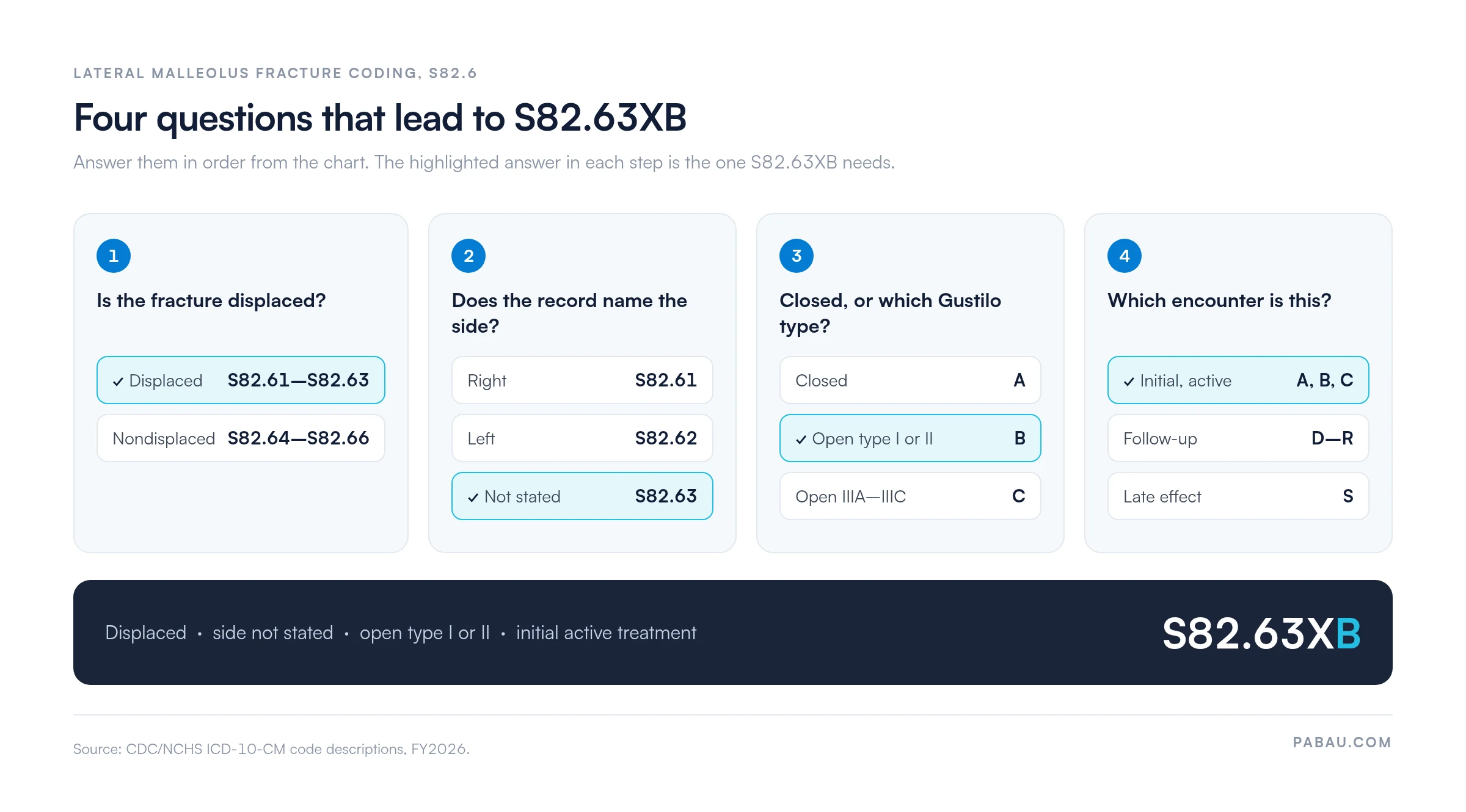
The CPT code on the claim must align with the ICD-10 descriptor. An open fracture ICD-10 code paired with a closed-treatment CPT code creates a clinical inconsistency that payers flag on edit. Claims management software with ICD-CPT crosswalk logic can help catch these mismatches before submission.
For US practices, Pabau sends electronic claims through its Claim.MD integration. The clearinghouse validates claims against payer edits before the 837P file goes out.
Medicare inpatient stays for lateral malleolus ORIF typically group to MS-DRG 492, 493 or 494 (lower extremity and humerus procedures except hip, foot and femur). The DRG depends on whether the stay carries an MCC, a CC or neither. Outpatient surgical claims bill S82.63XB on a CMS-1500 or 837P under the physician fee schedule. Confirm the place-of-service code before submission. An inpatient DRG claim and an outpatient 837P carrying the same CPT for the same date of service trigger a duplicate-claim edit.
Commercial payers often require prior authorization for ORIF procedures. Because S82.63XB is an emergency-surgery context, many payers allow retrospective authorization within 24 to 72 hours of the procedure. Document the authorization number in the claim.
Some payers also require LT (left side) or RT (right side) modifiers alongside the ICD-10 laterality character. That requirement applies even when the ICD-10 code already encodes the side, so review each payer’s modifier rules separately. Effective revenue cycle management checks modifier rules at the payer level instead of assuming ICD-10 laterality covers every contract.
S82.63XB claims deny for predictable reasons. Most denials come from one of six documentation or coding errors that denial management workflows can catch upstream.
Once active treatment ends, S82.63XB is no longer the correct code. The transition point is when the patient moves from active fracture management (surgery, casting, wound care) to healing monitoring (follow-up visits, rehabilitation, cast removal).
Applying character B at a cast-removal visit is one of the most audited fracture coding errors because it looks like upcoding even when unintentional. Practices that handle clean claim submission well build encounter-type validation into their coding checklist. The switch from B to E then happens at the right visit instead of after a denial.
An open ankle fracture claim draws on the emergency department note, the operative report and the coder’s worksheet. When the side or the Gustilo type appears in only one of them, the wrong 7th character or laterality digit can reach the claim.
In Pabau, the clinical notes, the diagnosis and the claim sit on the same patient record. Coders can read the documented side and wound type before choosing between S82.61XB, S82.62XB and S82.63XB. The claim then goes out as an 837P file through the Claim.MD integration, which checks it against payer edits first.
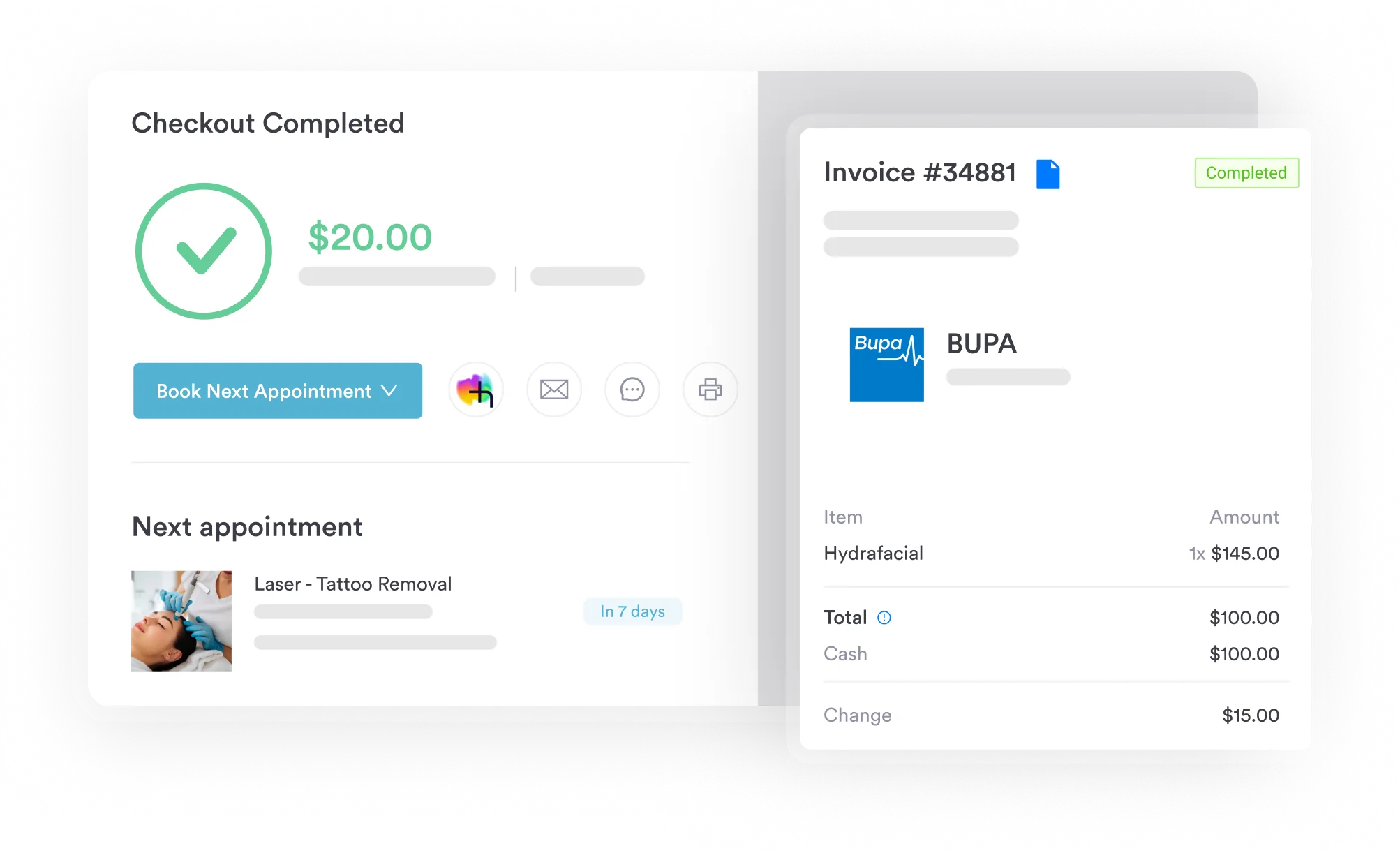
Electronic remittances return through the same connection, so a denial reason code shows up against the claim it belongs to. Your team sees which S82.63XB claims came back and why, without logging into a separate portal.

Pabau connects to the Claim.MD clearinghouse, which checks S82.63XB claims against payer edits before the 837P file leaves your practice. See how orthopedic and sports medicine practices use Pabau to cut claim denials.

Treat S82.63XB as the code of last resort. Before it goes on a claim, confirm three facts in the record: the side, the Gustilo-Anderson type and the encounter type.
If the side is named, code S82.61XB or S82.62XB. If the wound is Type IIIA or worse, switch to character C. From the first follow-up visit, move to E, H, M or Q.
Pabau’s medical billing workflow tools give practices a submission layer through the Claim.MD clearinghouse integration. It validates claims against payer edits before they reach the payer. To see how that fits your orthopedic practice, book a demo.

Need a clearinghouse that checks S82.63XB claims before submission? How Pabau uses the Claim.MD clearinghouse explains how claims are checked against payer edits and how ERA remittances surface denial reason codes.
Waiting on a payer to approve an ankle ORIF? The prior authorization process walks through each step, from the request to the approval number on the claim.
Want a checklist for clean orthopedic claim submission? Medical billing compliance covers the documentation and coding accuracy standards that reduce audit exposure across fracture and injury codes.
ICD-10 Code S82.63XB is the billable diagnosis code for a displaced open lateral malleolus fracture (type I or II), side unspecified, at the initial encounter. It encodes five clinical facts: lateral malleolus site, displaced fracture, unspecified laterality, initial active-treatment encounter, and open wound classified Gustilo-Anderson Type I or II.
Yes, S82.63XB is a valid, billable 7-character ICD-10-CM code confirmed in the CMS ICD-10-CM Tabular List. It can be used as a primary diagnosis on a CMS-1500 or 837P claim when documentation supports all five defining elements.
S82.63XA applies to a closed fracture at the initial encounter; S82.63XB applies to an open fracture (Gustilo Type I or II) at the initial encounter. The only difference is the 7th character: A for closed, B for open type I or II. Use XA when no open wound is documented and XB only when Gustilo typing confirms Type I or II.
The 7th character B represents Gustilo-Anderson Type I (wound less than 1 cm, low contamination) or Type II (wound 1 to 10 cm, moderate contamination). If the physician documents Type IIIA, IIIB, or IIIC, the correct character is C, not B.
No. S82.63XB is restricted to the initial active-treatment encounter. Cast-check visits, post-operative wound checks, and physical therapy sessions require a subsequent-encounter character. For an open type I or II fracture, that is E for routine healing, H for delayed healing, or M for non-union.
The most common denial reason is using unspecified laterality (S82.63XB) when the record names the right or left ankle. Others are assigning character B without documented Gustilo typing and coding B for a subsequent-encounter visit. Pairing an open-fracture ICD-10 code with a closed-treatment CPT code also triggers denials. Some payers also flag claims that omit the external cause code.