ICD-10 Code V47.6XXD: Passenger Collision Injury
ICD-10 Code V47.6XXD: quick reference ICD-10 Code V47.6XXD reports a car passeng...

Last Updated: Oct 8, 2026
Billable Code Specific Code
Y73.8 is the billable ICD-10-CM code for miscellaneous gastroenterology and urology devices associated with adverse incidents, not elsewhere classified. It records the device involved in an adverse event and is always reported after the code for the resulting condition.
Assignment turns on specificity. A device used to diagnose, treat, implant, or operate takes Y73.0, Y73.1, Y73.2, or Y73.3 instead. Y73.8 is reserved for named GI and urology devices that fit none of those roles.
Let Pabau's smart automation suggest the right codes, reduce claim denials, and keep your practice compliant—effortlessly.
Automate repetitive tasks and focus on what matters most—your patients.
Reduce coding errors and ensure compliance with the latest regulations.
Clean claims, fewer denials, and faster reimbursements.
Powerful insights and reporting to help your practice thrive.
HIPAA compliant SOC 2 certified GDPR-compliant Trusted by 4,000+ clinics worldwide

Y73.8 is an external cause code, so it is always reported as a secondary code and never as the principal or first-listed diagnosis.
It covers gastroenterology and urology devices that Y73.0, Y73.1, Y73.2, and Y73.3 do not classify.
On inpatient claims, Y73.8 carries its own POA indicator because Y73 is not on the CMS POA exempt list.
T-code vs Y-code confusion is a common reason claims carrying Y73.8 are denied.
Pabau’s claims management software keeps device incident notes and claims in one record, supporting clean Y73.8 submissions.
ICD-10 Code Y73.8 identifies miscellaneous gastroenterology and urology devices associated with adverse incidents, not elsewhere classified. It applies when the device does not fit the more specific Y73 subcategories for diagnostic and monitoring, therapeutic (nonsurgical) and rehabilitative, prosthetic, or surgical devices. The code belongs to Chapter 20 of ICD-10-CM (External Causes of Morbidity), within the Y70-Y82 block for medical devices associated with adverse incidents.
Because Y73.8 is an external cause code, it documents the circumstance of an adverse event rather than the resulting condition. The injury, complication, or adverse effect the patient experienced is coded first, using the appropriate T-code or other diagnosis code. Y73.8 is always secondary.
The code applies to gastroenterology and urology devices involved in an adverse incident when no more specific Y73 subcode describes the device’s role. Situations that may fall under Y73.8 include:
Y73.8 does not apply in these situations:
The Y70-Y82 block groups medical devices by clinical specialty. Y73 is the gastroenterology and urology subsection, and its fifth characters distinguish device roles. Knowing where Y73.8 sits within the full category stops coders from defaulting to the miscellaneous code when a more specific sibling applies.
Y73 has no “unspecified” code, and Y73.8 is not one. Its descriptor reads “not elsewhere classified,” which means the record names the device but no sibling code describes its role. When the record doesn’t name the device at all, query the physician before you assign any Y73 code.
A common Y73 coding error is defaulting to Y73.8 when Y73.0 or Y73.1 clearly applies. A colonoscope that malfunctions during a screening procedure is a diagnostic device (Y73.0). An electrocautery unit that causes a burn during polypectomy is a therapeutic device (Y73.1). A laparoscopic instrument that breaks during a urological procedure is coded Y73.3. Reaching for Y73.8 in any of these cases understates specificity and invites an audit finding.
Work through these questions in order before assigning Y73.8:
The flow below puts those questions on one page, with the step that comes before any of them.
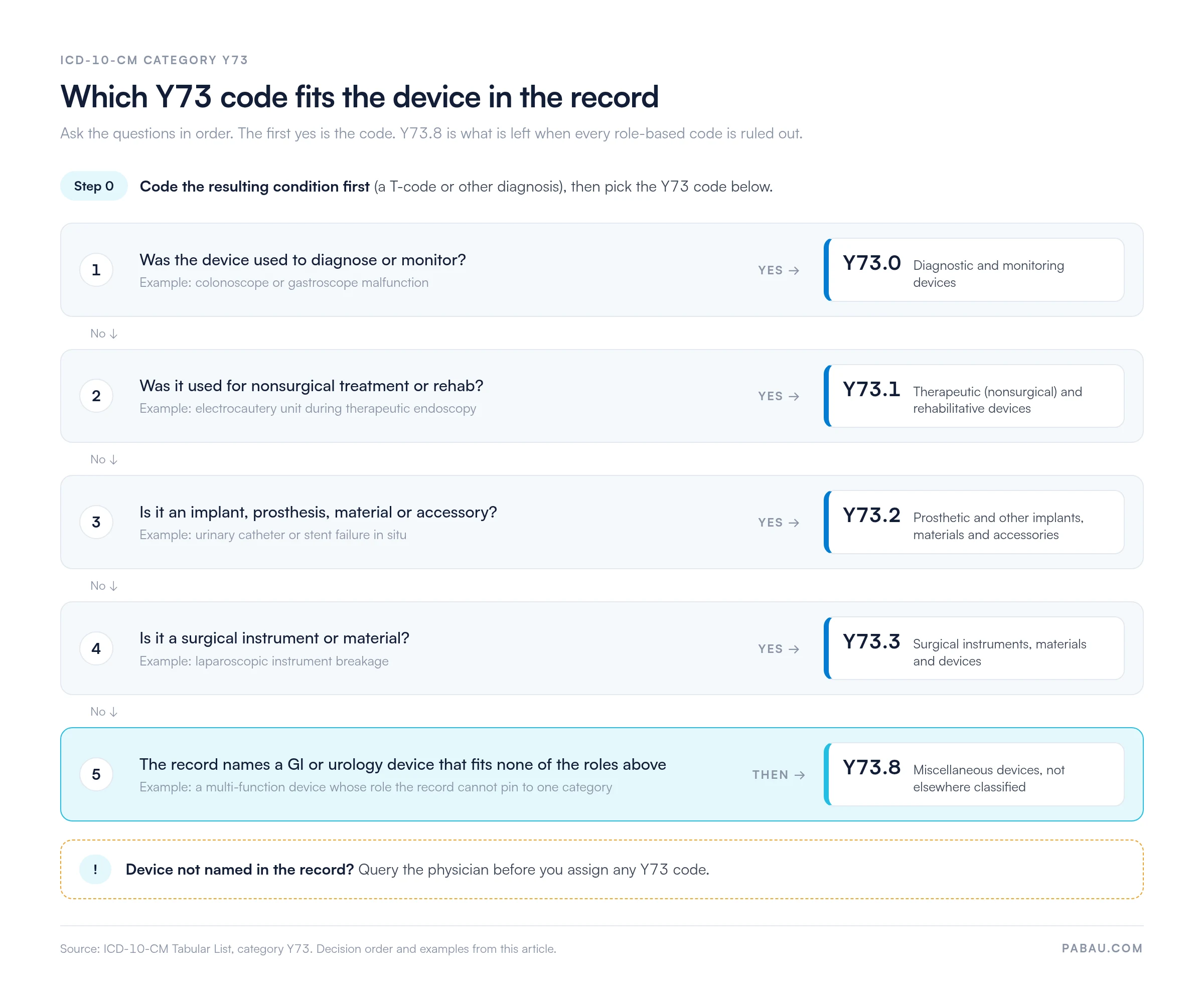
Y73.8 is the best code for multi-function devices that combine roles, such as diagnostic and irrigation functions. It also fits proprietary device systems where the record cannot place the device in one category. In those cases, Y73.8 is the accurate code for the documentation you have.
Y73.8 is never the principal or first-listed diagnosis. Per the ICD-10-CM Official Guidelines for Coding and Reporting, Chapter 20 external cause codes are assigned in addition to the code identifying the condition itself. The sequence is:
On inpatient claims, POA (present on admission) reporting applies to external cause codes, unless the code is on the CMS POA exempt list. Y73 is not on that list for FY2026 or FY2027, so Y73.8 carries its own POA indicator alongside the principal diagnosis.
Outpatient claims follow the same sequencing logic. Whether the payer accepts the external cause code at all depends on state mandates and individual payer policy.
Before assigning Y73.8, ask whether the operative note or procedure report names the device’s role. If it does, that specificity should move you to Y73.0, Y73.1, Y73.2, or Y73.3. Y73.8 is the right code when the record identifies a GI or urology device whose role no more specific category captures.
External cause codes are only as defensible as the documentation behind them. For ICD-10 Code Y73.8, the medical record must support each element of the claim before the code is assigned. A medical billing compliance framework helps practices capture these details consistently.
Required documentation elements:
HIPAA-covered entities report diagnoses with ICD-10-CM, the code set adopted for US claims. Keep the device incident documentation that supports Y73.8 in the medical record under your applicable retention rules.
There is no national requirement to report external cause codes, per the ICD-10-CM Official Guidelines. Reporting becomes mandatory only under a state-based mandate or when a specific payer requires it. Some commercial payers and state programs require external cause codes on facility claims, while others treat them as informational. The current code files and guidelines are on the CMS ICD-10 codes page.
Practical payer requirements for Y73.8 submissions:
A clean claim submission lists the condition code first and Y73.8 after it, which keeps the claim from stalling at the payer edit stage.
Y73.8 denials follow a consistent pattern, and each one has a corrective action that prevents it from recurring. Systematic denial management workflows help gastroenterology and urology practices track these patterns and fix them at the coding stage, before the denial lands.
ICD-11, developed by the World Health Organization, restructures the external cause classification. Gastroenterology and urology device incidents have an approximate ICD-11 counterpart, but its code structure and descriptors differ from ICD-10-CM.
Two facts coders need to understand about the transition:
When ICD-11 does roll out for US billing, practices should expect a crosswalk period similar to the ICD-9 to ICD-10-CM transition. CMS would provide guidance and a compliance date. Until then, Y73.8 in ICD-10-CM is the only appropriate code for these encounters.
In many practices, a device incident reaches the coder as a free-text note. The device name, the condition code, and the sequencing then get pieced together after the visit. That is where the errors in the denial table creep in.
Pabau, the practice management platform we build, keeps the clinical note, the diagnosis codes, and the claim in one patient record. Its claims management software runs validation checks every time you send a claim. The Send button stays disabled until the required details are filled in.
Validated claims go out electronically through Pabau’s Claim.MD clearinghouse connection to thousands of US payers. Claim statuses and remittances come back to the same record, so a denied Y73.8 claim gets corrected where it was coded.

Pabau keeps device incident notes, diagnosis codes, and claims in one record. Each claim is validated before it goes to US payers through Claim.MD.

Treat Y73.8 as the answer to one question: does the record name a GI or urology device whose role no Y73 sibling captures? If it does, report Y73.8 after the condition code, with its own POA indicator on an inpatient claim.
If the record can’t answer that question, send a physician query before you code. One message naming the device and its role costs far less than reworking a specificity denial.
Pabau’s billing and revenue cycle management tools keep the device note and the claim in the same record. Book a demo to see how Pabau keeps device-incident claims accurate from note to payment.

Need to understand denial patterns across your billing workflow? Denial codes in medical billing breaks down the most common CARC codes and how to respond to each.
Preparing to submit electronic claims through a clearinghouse? Pabau’s Claim.MD clearinghouse guide explains how 837P electronic claims are validated and routed to payers.
Want to understand how electronic remittance works after a claim? Electronic remittance advice (ERA) covers how 835 files map denial reason codes back to specific claim lines.
ICD-10 Code Y73.8 is the external cause code for miscellaneous gastroenterology and urology devices associated with adverse incidents, not elsewhere classified. It applies when the device can’t be classified under a more specific Y73 subcode. It documents the device circumstance of an adverse event rather than the resulting clinical condition, and it is always assigned as a secondary code.
Y73.8 is always secondary. Per the ICD-10-CM Official Guidelines Chapter 20, external cause codes are never assigned as the principal or first-listed diagnosis. The resulting condition, whether an injury, complication, or adverse effect, must be coded first.
Y73.8 is right when the record names a GI or urology device that no sibling code describes. Those siblings cover diagnostic devices (Y73.0), therapeutic devices (Y73.1), prosthetic and accessory devices (Y73.2), and surgical devices (Y73.3). If the operative or procedure note names a role that maps to one of those categories, the more specific code applies. Multi-function devices and proprietary systems without a clear functional classification are typical Y73.8 cases.
A common denial reason is T-code vs Y-code confusion. Coders either submit Y73.8 without a principal T-code for the resulting complication, or use a T-code alone and omit Y73.8. Another frequent cause is submitting Y73.8 as the first-listed code. Both errors are caught at the payer edit level and need resubmission with corrected sequencing.
No. There is no national requirement to report external cause codes, so Medicare does not require Y73.8 on professional (CMS-1500) claims. Facility claims on the UB-04 may need them under a state mandate or commercial payer policy. Check the payer’s claims processing manual for the claim type before omitting or including Y73.8.
Yes. Y73 is not on the CMS POA exempt list for FY2026 or FY2027, so Y73.8 carries its own present-on-admission indicator. The principal diagnosis it accompanies needs one too.