ICD-10 code Y83.0: Surgical operation with whole organ transplant
ICD-10 code Y83.0 names the transplant as the cause, not the problem ICD-10 code...

Last Updated: Nov 19, 2026
Billable Code Specific Code
Y79.1 is the billable ICD-10-CM code for therapeutic (nonsurgical) and rehabilitative orthopedic devices associated with adverse incidents. It records that an orthopedic device used to treat or rehabilitate a patient, without surgery, broke down or malfunctioned.
It sits in Chapter 20 of ICD-10-CM (External causes of morbidity) and is a supplemental external cause code, never a principal diagnosis. Category Y79 holds four other codes: Diagnostic and monitoring devices (Y79.0), prosthetic and other implants (Y79.2), surgical instruments and materials (Y79.3), and miscellaneous devices (Y79.8). An adverse incident with an orthopedic implant belongs to Y79.2, not Y79.1.
Let Pabau's smart automation suggest the right codes, reduce claim denials, and keep your practice compliant—effortlessly.
Automate repetitive tasks and focus on what matters most—your patients.
Reduce coding errors and ensure compliance with the latest regulations.
Clean claims, fewer denials, and faster reimbursements.
Powerful insights and reporting to help your practice thrive.
HIPAA compliant SOC 2 certified GDPR-compliant Trusted by 4,000+ clinics worldwide

ICD-10 code Y79.1 covers adverse incidents with therapeutic (nonsurgical) and rehabilitative orthopedic devices that broke down or malfunctioned.
Y79.1 is an external cause code, so it always follows a principal diagnosis that describes the resulting condition.
Category Y79 has four other codes: Y79.0 for diagnostic devices, Y79.2 for implants, Y79.3 for surgical instruments, and Y79.8 for miscellaneous devices.
An adverse incident with an orthopedic implant or prosthesis belongs to Y79.2, not Y79.1.
A later complication with no device breakdown or malfunction is coded to Y83-Y84 instead of category Y79.
ICD-10 code Y79.1 is the billable ICD-10-CM code for therapeutic (nonsurgical) and rehabilitative orthopedic devices associated with adverse incidents. It records that an orthopedic device used to treat or rehabilitate a patient, rather than one implanted or used in surgery, broke down or malfunctioned. The CDC/NCHS ICD-10-CM browser tool lists it under category Y79. It has been valid since ICD-10-CM took effect on October 1, 2015, and is unchanged in the FY2027 code set.
The fourth character is what sets Y79.1 apart from its siblings. It names the role the device was playing when it failed, and .1 means nonsurgical treatment or rehabilitation.
Chapter 20 codes describe how a condition happened, not what the condition is. The chapter note says they are used secondary to a code from another chapter that names the nature of the condition. Most often that condition comes from Chapter 19, Injury, poisoning and certain other consequences of external causes (S00-T88).
Y79.1 applies when three facts line up in the record. The code title sets the first two, and the note at the top of block Y70-Y82 sets the third.
The External Cause Index points the same way. Under Incident, adverse, device, orthopedic, the default code is Y79.8. The subterms “therapeutic” and “rehabilitative” both lead to Y79.1. A note that names the device’s treatment or rehabilitation role therefore moves the code from Y79.8 to Y79.1.
That wording matters most for physical therapy and rehabilitation practices, since rehabilitation is written into the code title. One boundary sits outside category Y79. Category Y80 covers physical medicine devices associated with adverse incidents. Check Y80 when the record describes a physical medicine device rather than an orthopedic one.
Four adjacent codes sit in category Y79. Choosing Y79.1 when one of them fits puts the wrong device role on the claim.
Block Y70-Y82 also excludes two kinds of case outright. A later complication after a device was used, with no breakdown or malfunction, goes to Y83-Y84. A misadventure to the patient during surgical or medical care goes to Y62-Y69. If the note describes a complication but never says the device failed, Y79.1 is not supported.
Taken together, these boundaries reduce to three questions asked in order, and the device’s role settles the last one.
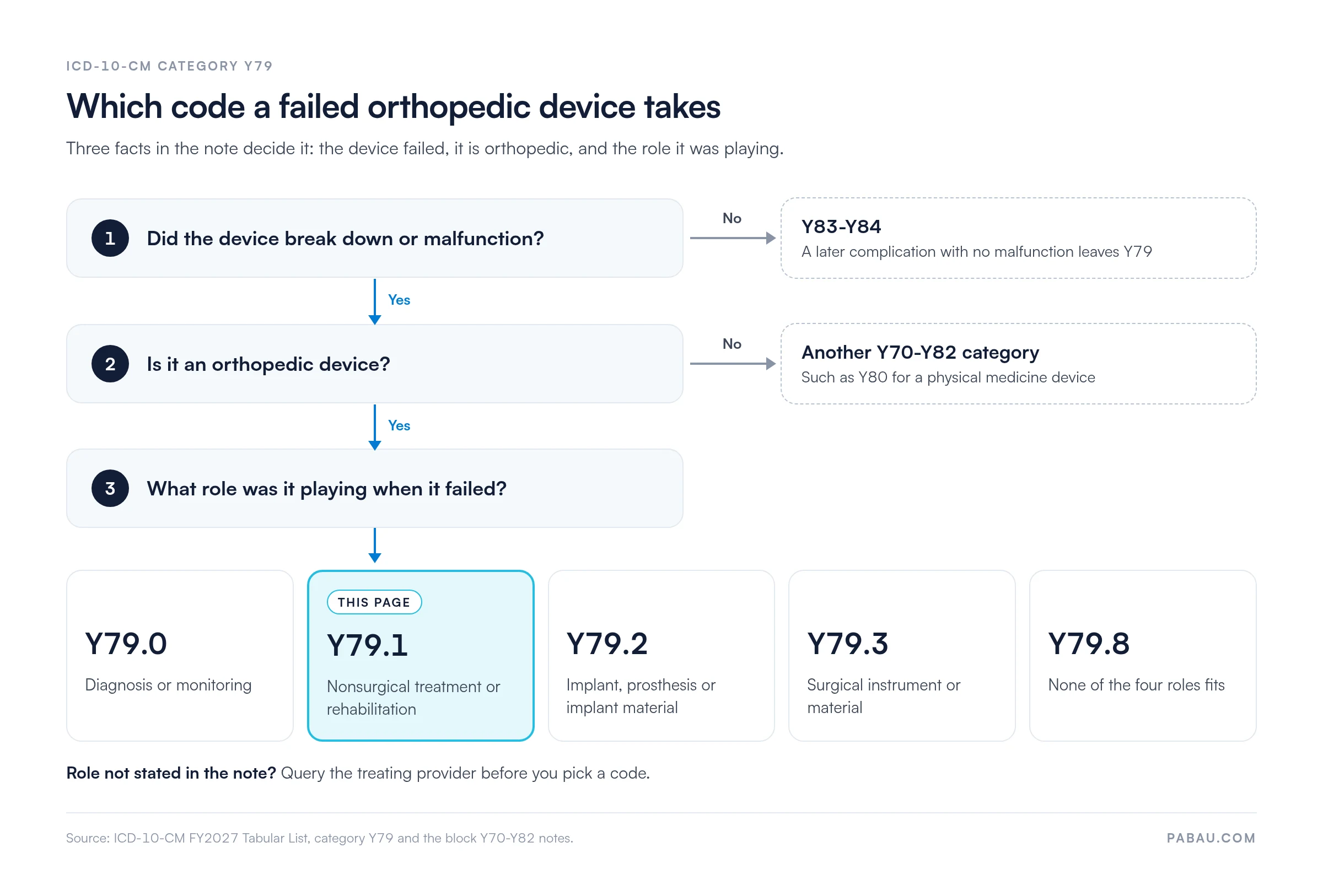
Category Y79 follows the same pattern as every device category from Y70 to Y81. The fourth character names the device’s role: .0 is diagnostic, .1 therapeutic, .2 implant, .3 surgical, and .8 miscellaneous. Learn the pattern once and it holds for cardiovascular, ophthalmic and other device categories too. Code Y70.0, for example, covers diagnostic and monitoring anesthesiology devices. In the ENT category, code Y72.1 covers therapeutic and rehabilitative otorhinolaryngological devices.
Y79.2 is the sibling most easily confused with Y79.1, because both cover devices that treat the patient. Joint prostheses, spinal implants, orthopedic bone cement and ligament prostheses are implants or implant materials. An adverse incident involving one is coded to Y79.2.
The condition code often shows which side of the line a case falls on. Complications of internal orthopedic prosthetic devices, implants and grafts sit in category T84. A T84 principal diagnosis with a documented device malfunction points to Y79.2, not Y79.1. Some notes never say whether the device was implanted, used in surgery, or applied as nonsurgical treatment. Query the treating provider before you pick a code for those.
ICD-10 code Y79.1 is never the first-listed or principal diagnosis. The ICD-10-CM Official Guidelines for Coding and Reporting state that an external cause code can never be a principal (first-listed) diagnosis.
The same guidelines set no national requirement to report external cause codes. Reporting is required only under a state-based mandate or when a particular payer asks for it. Otherwise it is voluntary, though encouraged.
When you do report Y79.1, follow this order.
The guidelines say the Alphabetic Index and the Tabular List’s inclusion and exclusion notes guide external cause code selection. For Y79.1, each of the three conditions in the coverage section above needs its own statement in the record. Strong medical billing compliance depends on that match between the note and the code.
Generic wording such as “device problem” leaves the coder choosing between Y79.1, Y79.8 and Y83-Y84 without support from the record. Where the record names the device but not its role or its failure, a physician query is the correct path.
Before you assign Y79.1, find two statements in the note: the device’s role and its failure. A note that says the device was used for treatment or rehabilitation supports the .1 code. A note that says it broke, malfunctioned or stopped working supports the adverse incident. If either is missing, send a query rather than coding from inference.
Y79.1 adds cause data to a claim. It does not establish medical necessity on its own, so coverage review centers on the principal diagnosis and the procedure billed.
Three payer-level checks matter when Y79.1 appears on a claim. Practices that connect their revenue cycle management to a clearinghouse catch these earlier in the workflow.
Most Y79.1 problems trace back to a short list of repeatable mistakes, and each has a direct correction. Practices with structured denial management workflows catch these patterns and recode before the timely filing window closes.
Review every denied claim that carried Y79.1 once a quarter, grouped by claim adjustment reason code. Sorting them against the rows in the table above shows whether the fix belongs in coding or in documentation.
The adjustment reason code on each remittance shows which row a rejected claim falls under. Our guide to denial codes in medical billing explains how to read them.
In many practices the device incident is described in a treatment note, and someone at the billing desk turns that note into codes days later. Each handoff between the two is a chance to lose the device’s role or the malfunction.
Pabau, the practice management and billing platform we build, keeps both on one patient record. Treatment notes and digital forms record the device and what went wrong, and Pabau’s claims management software builds the claim from that same record.
Claims go out through the Claim.MD clearinghouse as CMS-1500/837P claims, with eligibility checks and ERA remittances. When a Y79.1 claim comes back denied, the remittance and the note behind it sit in one place. Your team can correct and resubmit quickly.

Pabau records the device, its role and the malfunction in your treatment notes. The claim then goes out through Claim.MD from that same patient record.

Y79.1 is a narrow code. It fits only when an orthopedic device that was treating or rehabilitating the patient, without surgery, broke down or malfunctioned. An implant failure is Y79.2, a surgical instrument failure is Y79.3, and a complication with no malfunction leaves category Y79 entirely.
That makes the treatment note the deciding document. If it states the device’s role and its failure, Y79.1 follows the condition code and the claim holds up. If it doesn’t, a physician query costs less than a recoded claim. Book a demo to see how Pabau keeps device notes and insurance claims on the same patient record.

Need a broader framework for handling medical device claim denials? Denial management in healthcare covers the full workflow from root cause analysis through appeals and resubmission.
Looking for the clearinghouse integration behind clean orthopedic claims? Claim.MD clearinghouse overview explains how the integration handles 837P submission, real-time eligibility, and ERA remittance for US practices.
Want to see how external cause codes interact with the broader billing process? What is medical billing breaks down the full claim lifecycle from code assignment through payment posting.
ICD-10 code Y79.1 means an adverse incident involving a therapeutic (nonsurgical) or rehabilitative orthopedic device. It records that a device used to treat or rehabilitate the patient without surgery broke down or malfunctioned. It is a Chapter 20 external cause code and always follows a principal diagnosis.
Yes. Y79.1 is a valid, billable ICD-10-CM code in the FY2027 code set, which took effect on October 1, 2026. It can appear on a claim only as a secondary code, after the condition it explains.
Use Y79.1 when the record shows an orthopedic device was treating or rehabilitating the patient without surgery, and that it broke down or malfunctioned. Code the resulting injury or condition first. If the device was implanted, used in surgery, or diagnostic, another Y79 code applies.
The fourth character names the device’s role. Y79.0 covers diagnostic and monitoring devices, and Y79.1 covers therapeutic (nonsurgical) and rehabilitative devices. Y79.2 covers prosthetic and other implants, materials and accessory devices. Y79.3 covers surgical instruments and materials, including sutures. Y79.8 covers miscellaneous orthopedic devices not elsewhere classified.
Use Y79.2, Prosthetic and other implants, materials and accessory orthopedic devices associated with adverse incidents. Joint prostheses, orthopedic implants and implant materials belong there, not under Y79.1. Code the complication first, often from category T84, then add Y79.2.
No. The ICD-10-CM Official Guidelines state that an external cause code can never be a principal (first-listed) diagnosis. Y79.1 always follows the code for the injury or condition the device incident caused.
Not nationally. The ICD-10-CM Official Guidelines set no national requirement to report external cause codes. Reporting is required under a state-based mandate or when a particular payer asks for it, and is otherwise voluntary but encouraged.
Common causes are Y79.1 listed first, no code for the resulting condition, and no documented device breakdown or malfunction. Choosing Y79.1 when the device was an implant, a surgical instrument or a diagnostic device causes problems too. The adjustment reason code on the remittance shows which fix applies.
Yes. Y79.1 is unchanged in the FY2027 ICD-10-CM code set, effective October 1, 2026. It has carried the same descriptor since ICD-10-CM began on October 1, 2015. Confirm each annual release against the CMS ICD-10 files before the new fiscal year starts.