ICD-10 Code S42.444P: Medial epicondyle fracture, right humerus
ICD-10 Code S42.444P: full descriptor and code validity ICD-10 Code S42.444P car...

Last Updated: Oct 13, 2026
Billable Code Specific Code
Y62.3 is the billable ICD-10-CM code for failure of sterile precautions during injection or immunization. It records the breach itself, such as a contaminated needle or an unswabbed site, rather than the infection that follows.
This code is easy to misplace: it is never a principal diagnosis, and the adjacent Y62 subcodes cover other procedures. The complication code, such as T80.29XA or T88.0XXA, always comes first. The documentation must state that sterile technique was breached during the injection or immunization itself, not just that a complication followed.
Let Pabau's smart automation suggest the right codes, reduce claim denials, and keep your practice compliant—effortlessly.
Automate repetitive tasks and focus on what matters most—your patients.
Reduce coding errors and ensure compliance with the latest regulations.
Clean claims, fewer denials, and faster reimbursements.
Powerful insights and reporting to help your practice thrive.
HIPAA compliant SOC 2 certified GDPR-compliant Trusted by 4,000+ clinics worldwide

Y62.3 is a billable external cause code for a sterile breach during an injection or immunization, and it is never first-listed.
Infection after a therapeutic injection is coded T80.29XA first, and infection after a vaccine is coded T88.0XXA first.
Any sepsis, infection or organism code follows the complication code, and Y62.3 comes after them.
The record must state that sterile technique failed during that injection, because a coder can’t infer the breach from an infection.
Pabau pre-fills claims from the patient record and checks required claim fields, while your coder keeps control of sequencing.
ICD-10 code Y62.3 is the billable ICD-10-CM code for failure of sterile precautions during injection or immunization. It records how the patient came to harm: someone broke aseptic technique while giving a shot or a vaccine.
That makes it an external cause code from Chapter 20 of the ICD-10-CM code set. It explains a condition but never stands in for one. On every claim, the complication code leads and Y62.3 follows it.
Here are the attributes worth checking before you assign it.
Y62.3 covers a breach of aseptic technique at the moment an injection or vaccine is given. Typical breaches documented in the record include:
The route doesn’t change the code. Subcutaneous, intramuscular, IV push and intradermal injections all qualify, and so does routine vaccine administration.
Timing is what matters. The failure has to happen during the injection itself. A complication discovered later doesn’t prove a breach on its own.
The tabular list puts no Excludes1 note on Y62.3 itself. The Excludes1 note sits on the Y62-Y69 block and sends two situations elsewhere:
Two coding distinctions also come up often. Neither is a tabular-list exclusion, but both change the code you pick.
Y62 is the parent category for every sterile precaution failure during surgical and medical care. Each subcode maps to one procedural setting, and picking the wrong one is an easy Y62 error to make.
Y62.3 fits a discrete injection or vaccine. If a continuous IV infusion was running when the breach happened, Y62.1 is the better match. Payers compare the subcode with the procedure codes on the same claim, so a mismatch stands out.
One more boundary is worth knowing. Y62.9 still names a sterile failure, just during unspecified care. When the record describes a misadventure without saying what kind, the block’s catch-all is Y69.
Y62.3 is never the principal or first-listed diagnosis. Chapter 20 codes describe the circumstances of a condition, not the condition itself.
For an infection after a contaminated injection or vaccine, the claim lines up like this:
The diagram below shows the same order with the codes in place.
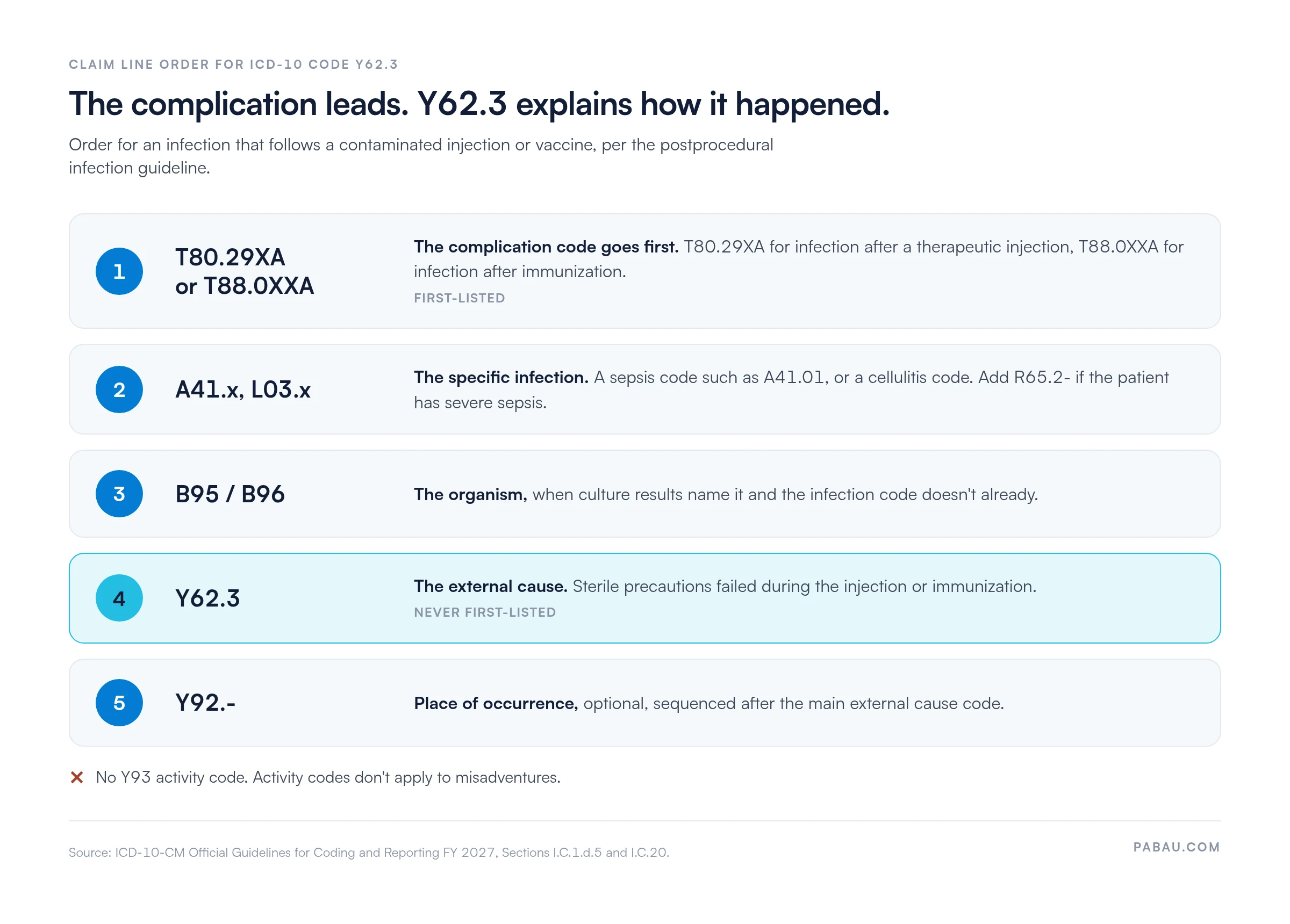
Per the CMS ICD-10-CM coding guidelines, external cause codes can be reported in any setting that allows secondary diagnoses. Inpatient claims follow UHDDS principal diagnosis rules. Outpatient claims use the first-listed diagnosis convention.
In both cases, Y62.3 follows and never leads. Putting it in position one is a sequencing error that triggers a claim edit.
The complication code goes ahead of Y62.3, and any infection codes slot in between. These are the pairings you’ll see most often with a sterile failure during injection or immunization.
Check the CDC/NCHS ICD-10-CM tool for each pairing before submission. Includes and Excludes notes interact across these ranges, and a pairing that worked last year may not today.
Before you submit T80.29XA or T88.0XXA with Y62.3, check the record for two things. First, a clinician note stating the injection technique wasn’t sterile. Second, a timeline showing the infection appeared after that injection. Missing either one turns a defensible claim into a recoverable overpayment.
Here’s how the rules play out on one encounter. Say a patient returns three days after a flu vaccine with a hot, swollen right upper arm.
The nurse’s note says the site wasn’t swabbed before the injection. The physician diagnoses cellulitis, links it to that breach, and the culture grows MSSA. The coding runs in five steps:
Sepsis doesn’t change who leads. Under the CMS and NCHS Official Guidelines, Section I.C.1.d.5.b, T80.2- or T88.0- comes first. The sepsis code (A41.x) and the organism follow, then Y62.3.
If severe sepsis is documented, add R65.2- and a code for each acute organ dysfunction. And don’t drop Y62.3 from a documented case. Without it, the encounter’s quality data loses the mechanism.
Culture results still pending at discharge? If the physician has already stated the sterile failure, assign Y62.3 now. Code the infection as documented, and don’t hold the external cause code back waiting for the lab.
Coders can’t assign Y62.3 on assumption. Under guideline I.B.16, complication coding rests on the provider’s documentation of the link between the care and the condition. An infection alone, however obvious its cause, doesn’t support the external cause code.
For Y62.3 to hold up in a medical billing compliance review, the record needs:
If the note says “injection site infection” but not how sterility failed, query the clinician before you assign Y62.3. Ask an open question about the technique, not a leading one about contamination.
Most payers accept external cause codes as additional diagnoses. Y62.3 needs no prior authorization of its own. Treating the complication might, though, since debridement, an admission or IV antibiotics can each need approval.
Y62.3 draws a predictable set of denials. Each one is cheaper to catch before submission than to fix on a corrected claim, and solid denial management workflows stop most of them early.
When a claim is denied on sequencing, resubmit with the complication code in position one and Y62.3 as a secondary code. Back it with the clinician’s query response if the original note was vague. Check the AAPC ICD-10-CM code range lookup for the current-year descriptor before you resubmit.
Run through this list on every claim that carries Y62.3. It takes two minutes and covers the denial triggers above.
It’s the same discipline behind any clean claim, applied to one tricky external cause code.
Most of the work on a Y62.3 claim is judgment: reading the note, querying the clinician and ordering the codes. The rest is admin, and that’s where retyped details and missing fields cause errors.
Pabau, the practice management platform we build, brings cleaner claims management to that admin side. It pre-fills the claim from the patient record and offers ICD-10 lookup libraries. It also checks that required claim fields are complete before the claim leaves your practice.
In the US, claims go out through Claim.MD, our clearinghouse partner, with eligibility checks and electronic remittance (ERA) flowing back into Pabau. Our Claim.MD clearinghouse guide explains how that works. Sequencing stays with your coder, who gets a cleaner place to do it.

Pabau pre-fills claims from the patient record, checks required claim fields, and submits through Claim.MD with eligibility checks and ERA. Your coders keep their focus on getting Y62.3 in the right place.

Y62.3 earns its place on a claim only when the chart can carry it. If the clinician has named the breach and tied it to the infection, code the complication first and let Y62.3 explain it. If they haven’t, query before you code.
The trade-off is a little time now or a lot of money later. A two-minute check before submission costs far less than a recovered payment after an audit.
If retyping and missing claim fields slow your billing team down, book a demo to see how Pabau pre-fills and submits claims for your practice.

Need to understand how denials are tracked and resolved? Denial management in healthcare covers the end-to-end workflow for reducing claim rejections and recoveries.
Decoding a remittance after a Y62.3 claim bounces? Denial codes in medical billing explains what each code means and how to respond.
Wondering how clean claims reduce rework on external cause codes? What makes a clean claim explains the pre-submission checks that keep Y62 codes from triggering edits.
Looking for guidance on submitting 837P claims electronically? Claim.MD clearinghouse overview details how electronic claim submission and remittance work.
Coding a different misadventure during infusion? ICD-10 code Y63.1 covers incorrect dilution of fluid used during infusion.
No. Y62.3 is a complete, billable code at four characters. Many Chapter 20 codes take an A, D or S 7th character, but the Y62 subcodes don’t. The 7th character sits on the complication code instead, such as the A in T80.29XA.
Not Y62.3, because Y62 describes misadventures to patients during their care. A staff needlestick is coded on the employee’s own record. That usually means W46.0XXA for contact with a hypodermic needle, or W46.1XXA if the needle was contaminated.
Then Y62.3 can’t be assigned. Code the complication as documented. If the provider links it to the injection without mentioning a misadventure, a Y84 code fits instead, usually Y84.8 for other medical procedures. Query the clinician if the record hints at a breach.
Leave Y62.3 off unless a sterile breach is documented. A reaction to the vaccine itself is coded as an adverse effect from T50.A-, T50.B- or T50.Z-. Other complications following immunization, not elsewhere classified, use T88.1XXA.