ICD-10 Code Y76.0: Diagnostic obstetric and gynecological devices
ICD-10 Code Y76.0: Definition and billable status ICD-10 Code Y76.0 is a valid, ...

Last Updated: Oct 23, 2026
Billable Code Specific Code
Y63.1 is the billable ICD-10-CM code for incorrect dilution of fluid used during infusion.
Let Pabau's smart automation suggest the right codes, reduce claim denials, and keep your practice compliant—effortlessly.
Automate repetitive tasks and focus on what matters most—your patients.
Reduce coding errors and ensure compliance with the latest regulations.
Clean claims, fewer denials, and faster reimbursements.
Powerful insights and reporting to help your practice thrive.
HIPAA compliant SOC 2 certified GDPR-compliant Trusted by 4,000+ clinics worldwide

Y63.1 is a billable ICD-10-CM external cause code for incorrect dilution of infusion fluid, separate from adverse-effect and poisoning codes.
It is always a secondary code. Pair it with the principal diagnosis describing the patient’s resulting condition, such as electrolyte imbalance or fluid overload.
Documentation must state that an incorrect dilution occurred during infusion, not merely a complication of infusion therapy.
Pabau’s claims management software tracks claim status and syncs payments, so a rejected infusion claim surfaces while the note is still fresh.
Y63.1 is the 2026 ICD-10-CM code for incorrect dilution of fluid used during infusion, effective October 1, 2025. It is billable and specific, and it is valid for HIPAA-covered transaction submissions.
The WHO’s ICD-10 browser places the code in the misadventures chapter. It covers events where an infusion fluid was prepared or administered at the wrong concentration during a therapeutic or diagnostic procedure.
Two adjacent categories catch the cases Y63.1 leaves behind. An adverse-effect code applies when a correctly administered drug causes an unexpected reaction. A poisoning code applies when a harmful substance is taken deliberately. Y63.1 stays with the preparation step, where the mix itself was wrong.
The decision below sorts the five outcomes a coder has to choose between, and shows which two fall outside Y63 entirely.
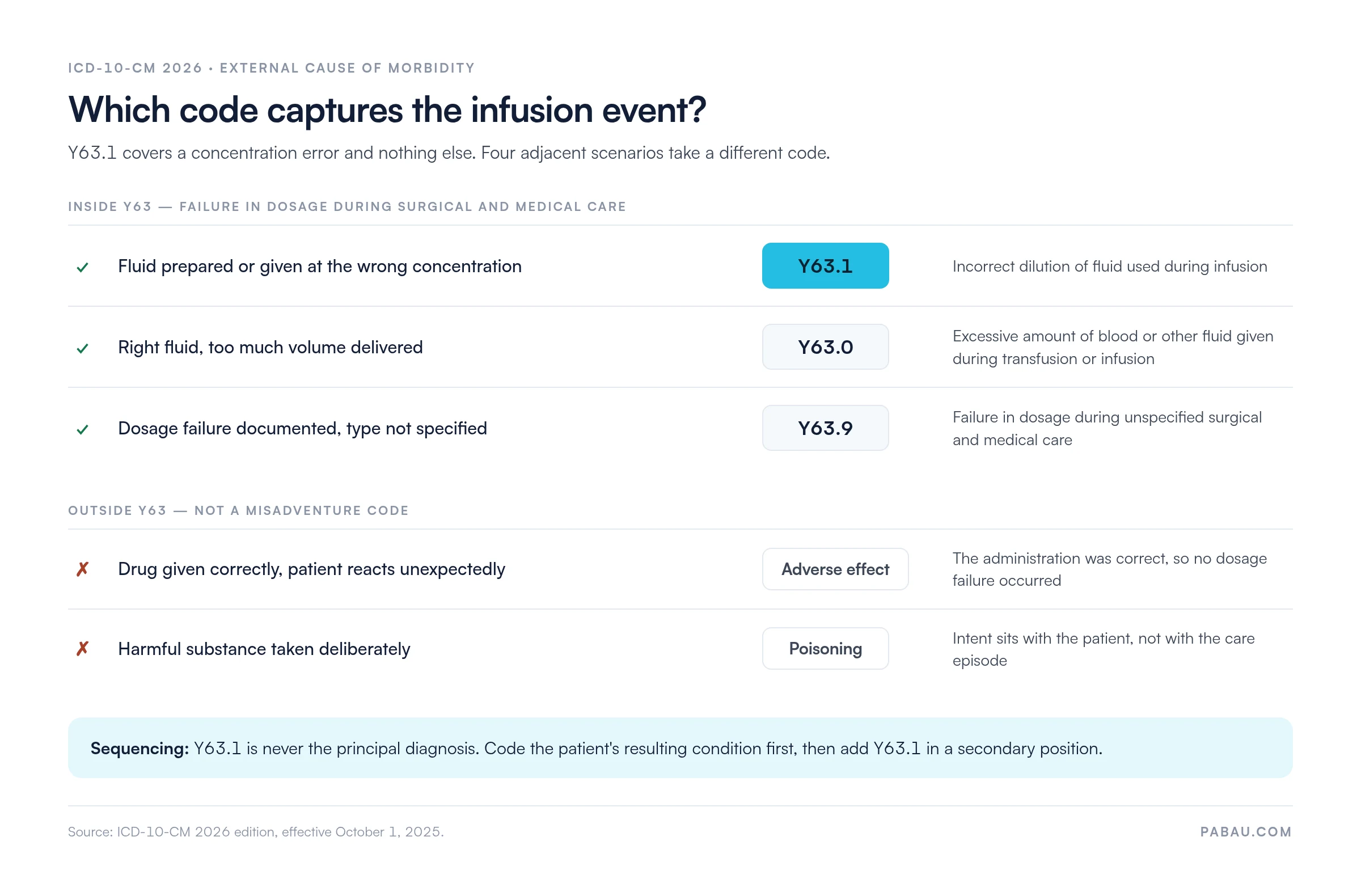
Y63.1 sits inside a defined hierarchy, and reading it upward confirms you have chosen the most specific code available. The CMS ICD-10 codes page publishes the annual update files that govern this structure.
The Y62-Y69 block covers misadventures, meaning a procedure that was right in intent but wrong in execution. That distinction matters at the category level. A misadventure code answers how the care went wrong, while a complication code answers what the patient experienced afterward.
Within the block, each category names a different failure. Y62.2 covers a breach of sterile precautions during kidney dialysis or other perfusion, rather than a dosage error.
Y63.1 applies when a patient receives an infusion fluid that was prepared at the wrong concentration. The dilution error must have occurred during preparation or administration. Three scenarios drive most assignments:
Each scenario turns on the same documented pair of facts, the intended concentration and the concentration given. Without both in the record, a coder has a complication to describe but no dilution error to code.
Flag infusion dilution errors in the encounter note immediately after the event. Record the intended concentration, the concentration administered, the volume delivered, and the patient response. Details reconstructed days later rarely carry the specificity a payer needs before it accepts Y63.1.
Y63.1 is an external cause code, so it cannot be assigned as the principal or primary diagnosis. The CDC/NCHS ICD-10-CM tool confirms that codes from the V00-Y99 chapter supplement the main diagnosis and never stand alone.
Correct sequencing means pairing Y63.1 with the principal ICD-10-CM code that describes what happened to the patient. Submitting it without that pairing will cause the claim to fail edits before a human at the payer ever reads it.
Payers sometimes require specific documentation before they accept Y63.1 on a claim. Reading the rejection against the common denial codes tells you whether the problem is the sequencing or the note behind it.
Step-by-step pairing logic:
Sequencing is a coder’s judgment call, not something a clearinghouse settles for you. Software helps after submission instead, by showing where each claim sits with the payer so a sequencing rejection surfaces within days.
Without specific documentation, Y63.1 cannot be assigned. Vague references to “infusion complication” or “fluid-related event” are insufficient. The medical record must contain all of the following to support the code:
Build these five elements into the infusion incident template rather than leaving them to free text. A coder reading the note months later needs the same facts a payer will ask for, in the same place every time.
Sibling codes under Y63 address different types of dosage failure during surgical and medical care. Choosing between them depends on the error mechanism. The AAPC ICD-10-CM lookup lets coders browse the full category alongside the clinical notes for each code.
Y63.0 and Y63.1 divide the same infusion along two axes. Y63.0 records excess volume, meaning the right fluid and too much of it. Y63.1 records the wrong concentration, whatever the volume delivered.
Temperature errors sit elsewhere in the category. Y63.5 covers inappropriate temperature in local application and packing, so a warming or cooling error during that care is coded there instead.
Sometimes the record describes a misadventure but never names the failure as a dosage problem. Y69 then carries the event as an unspecified misadventure during surgical and medical care.
The United States has not yet adopted ICD-11 for clinical claims reporting, and CMS has announced no mandatory transition date. ICD-10-CM remains the operative standard for Medicare, Medicaid, and HIPAA-covered commercial claims.
ICD-11 does carry a corresponding classification for infusion dilution misadventures within its external cause structure. When US adoption eventually happens, crosswalk mapping from CMS and NCHS will provide official guidance on translating Y63.1 claims. Until then, Y63.1 holds for the current fiscal year.
Keep your ICD-10-CM reference updated to the current fiscal year edition. The 2026 edition, effective October 1, 2025, is the current operative version. Prior-year codes submitted after October 1 trigger automatic edits. Review the annual CMS update files each September before the new edition takes effect.
Most practices learn that an external cause pairing was rejected when the remittance arrives, weeks after the encounter. By then the coder is rebuilding the story from a note written by someone who has moved on to other patients.
Practice management software like Pabau moves that discovery forward. Its claims management software routes each claim to the right insurer and pre-fills the submission from the patient record. The codes on the claim then match the codes in the note.
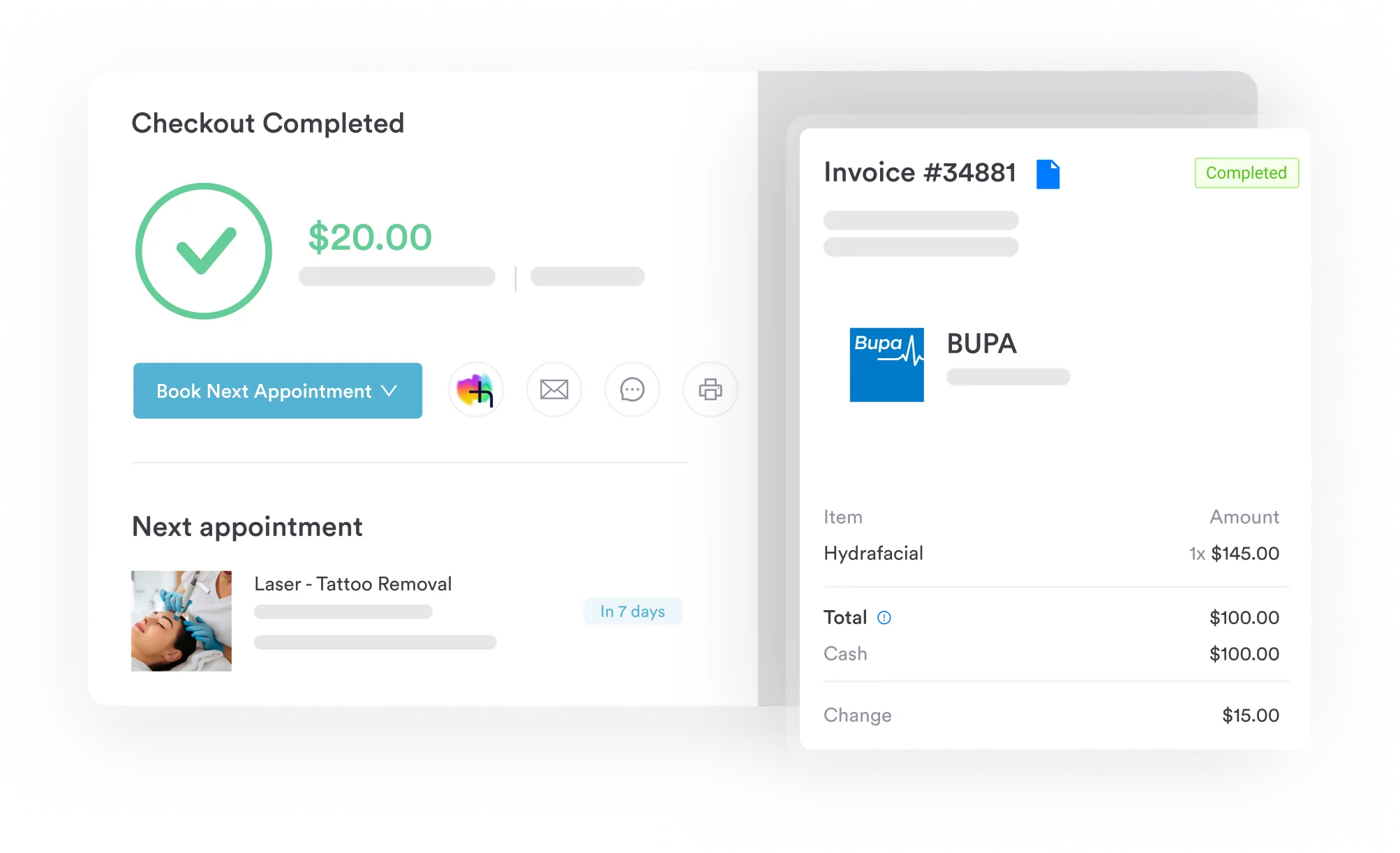
Claim status then reports back in the same place the record lives, and payments sync against the invoice once they clear. A sequencing rejection surfaces while the note is still fresh, which is when it costs least to correct.

Pabau routes claims to the right insurer, pre-fills submissions from the patient record, and reports each claim’s status back to your team. Payments sync against the invoice as they clear, so nothing sits unreconciled.

Y63.1 rewards a practice that writes down two numbers at the moment they matter, the concentration intended and the concentration given. The principal diagnosis and the payer’s decision both rest on that pair sitting in the note.
The trade-off worth remembering is specificity against effort. Y63.9 is always available and always weaker. Reaching for it turns a documented safety event into an unspecified one, and the patient safety record loses the detail that made it useful.
Build the two-number check into your infusion incident template this quarter and the coding follows on its own. Book a demo to see how Pabau tracks infusion claims from submission through to payment.

Billing the saline itself, not just the error? HCPCS code J7030 covers the normal saline infusion supply that sits alongside the diagnosis codes.
Want to understand clean claim requirements? Clean claim fundamentals explains what a compliant claim looks like before it reaches a clearinghouse.
Getting external cause codes rejected? Denial management in healthcare sets out how to work a rejection queue without letting claims age out.
Writing an infusion documentation policy? Medical billing compliance covers the standards those internal policies have to meet.
New to the claim lifecycle? What is medical billing walks through each step from encounter to payment posting.
ICD-10 code Y63.1 is the billable ICD-10-CM code for incorrect dilution of fluid used during infusion. It is an external cause of morbidity, assigned as a secondary code alongside the principal diagnosis for the resulting patient condition.
Yes, Y63.1 is a billable and specific ICD-10-CM code valid for HIPAA-covered transaction submissions as of the 2026 edition, effective October 1, 2025.
Assign Y63.1 as a secondary code whenever a dilution error during infusion causes a patient condition. Pair it with the principal ICD-10-CM code for that outcome, such as hypernatremia or hyperkalemia.
The parent code for Y63.1 is Y63, which covers failure in dosage during surgical and medical care. Y63 itself belongs to the Y62-Y69 block of misadventures to patients during surgical and medical care, within the V00-Y99 external causes chapter.
The record must state that an incorrect dilution occurred, naming the intended and administered concentrations, the infusion details, the patient’s response, and any corrective action. Vague references to infusion complications are insufficient.
Yes, Y63.1 is valid in the 2026 edition of ICD-10-CM, which became effective October 1, 2025. The code description and classification remain unchanged from prior editions.