

ICD-10 code S61.201A: Open wound of left index finger without nail damage
ICD-10 code S61.201A covers a left index finger wound of unstated type ICD-10 co...

Last Updated: Oct 16, 2026
Billable Code Specific Code
Y62.2 is the billable ICD-10-CM code for failure of sterile precautions during kidney dialysis and other perfusion. It is an external cause code, so it follows the complication the breach caused, such as an infected dialysis catheter.
Two errors recur with this code. One is assigning it as a principal diagnosis, which an external cause code can never be. The other is using it when the breach happened during a different procedure, such as a surgical operation (Y62.0) or an endoscopic examination (Y62.4). Get either wrong and the claim can draw edits or audit flags.
Let Pabau's smart automation suggest the right codes, reduce claim denials, and keep your practice compliant—effortlessly.
Automate repetitive tasks and focus on what matters most—your patients.
Reduce coding errors and ensure compliance with the latest regulations.
Clean claims, fewer denials, and faster reimbursements.
Powerful insights and reporting to help your practice thrive.
HIPAA compliant SOC 2 certified GDPR-compliant Trusted by 4,000+ clinics worldwide

Y62.2 is a billable ICD-10-CM external cause code for a sterile precaution failure during kidney dialysis or other perfusion.
It is never the principal diagnosis, so the complication it caused, such as T82.7XXA or T85.71XA, is listed first.
A sterile break during an IV infusion or a blood transfusion belongs to Y62.1, not Y62.2.
A dialysis complication with no documented misadventure takes Y84.1 instead of Y62.2.
The provider must document the breach, the dialysis or perfusion procedure, and the link to the complication.
ICD-10 code Y62.2 is the billable ICD-10-CM code for failure of sterile precautions during kidney dialysis and other perfusion. It is an external cause code, so it explains how a complication happened rather than naming the complication. The code is valid for the current fiscal year in the CDC/NCHS ICD-10-CM browser tool.
Both halves of the descriptor need support in the record. “Failure of sterile precautions” means a documented break in aseptic technique, such as an unscrubbed catheter hub or a touch-contaminated connection. “Kidney dialysis and other perfusion” limits the code to hemodialysis, peritoneal dialysis, and other perfusion procedures.
The tabular list gives no examples of “other perfusion,” and the Alphabetic Index simply sends “perfusion” to Y62.2. The procedure named in the provider’s note therefore decides the code.
The table below collects the reference data for Y62.2. Check it against the current tabular list before you submit a claim, because the code set updates every October 1.
Category Y62 splits sterile precaution failures by the procedure that was underway. Dialysis patients make the wrong sibling easy to pick, because they often have several procedures in one week. The table maps every code in the category.
Timing is what separates the dialysis codes. A breach during the dialysis session itself points to Y62.2. A breach while a dialysis catheter was being placed reads as a catheterization under Y62.6, and one during fistula surgery reads as Y62.0. Confirm the procedure in the provider’s note rather than inferring it from the patient’s diagnosis.
An injection or a vaccination given in the unit falls under Y62.3 instead. The decision path below follows a documented breach to its code.
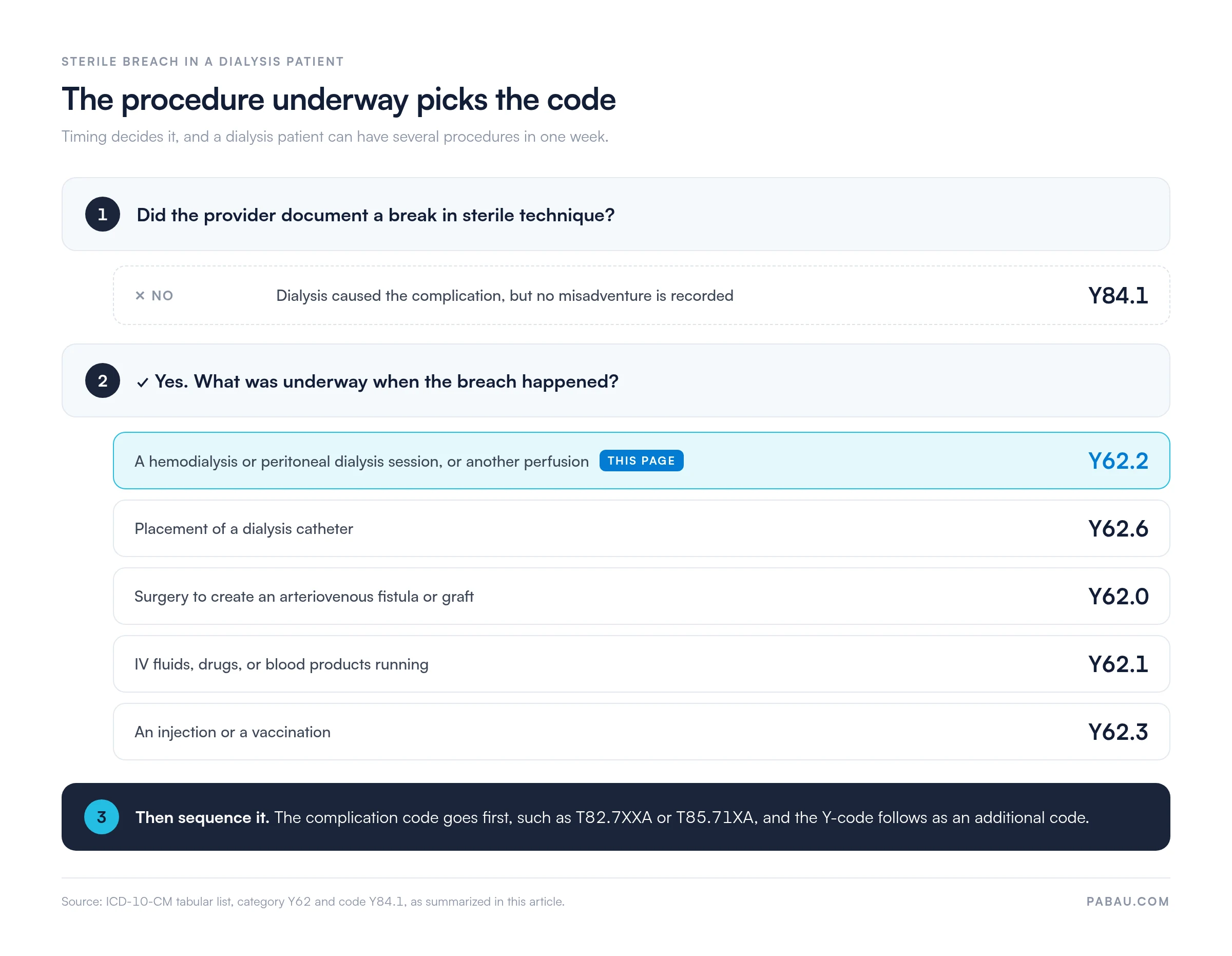
Y62.9 is a last resort. When the record clearly describes a dialysis session, assigning Y62.9 is a specificity error that invites audit questions.
Y62.2 applies when three facts are documented together. The provider records a sterile precaution failure, the failure happened during dialysis or another perfusion procedure, and a resulting complication is coded first.
Typical scenarios that meet that bar:
An infection found days later with no documented breach does not qualify. When dialysis caused a complication but no misadventure is recorded, Y84.1 describes it instead. Coders cannot infer a sterile failure from lab results or clinical signs alone.
Because Y62.2 is an external cause code, it always follows a code for the condition it caused. These are the codes most often sequenced ahead of it, with their official descriptors from the tabular list.
Each T-code above carries a “use additional code” note, so the specific infection, such as sepsis or peritonitis, is coded as well. Y62.2 then closes the sequence.
The Alphabetic Index sends infection of a vascular dialysis catheter to T82.7, while T80.211A covers central line bloodstream infections. AHA Coding Clinic has addressed hemodialysis central line infections more than once, so check its latest advice before choosing.
Section I.C.20 of the ICD-10-CM Official Guidelines governs external cause codes, including Y62.2. Four rules matter on a dialysis claim:
The CMS ICD-10-CM Official Guidelines are updated every fiscal year. Use the edition that matches the date of service.
Build the breach question into your dialysis run sheet. A yes/no field for a break in aseptic technique, plus the access type, gives the provider a prompt to document the event during the session. That one field saves a retrospective query when the infection shows up days later.
A Y62.2 claim holds up on audit when the record shows three things. Missing any one gives the payer grounds to question the code.
Clinical documentation integrity teams should direct Y62.2 queries to the attending provider, not the nursing staff. Building medical billing compliance into the note itself avoids a costly appeal later.
The Y62-Y69 block covers misadventures, which means something went wrong during the care. A misadventure the record never specifies goes to Y69. Two neighboring blocks look similar but describe different events.
The tabular notes enforce these lines. The Y62-Y69 block carries an Excludes1 note for Y83-Y84, so Y62.2 and Y84.1 are never coded together for the same event. Y70-Y82 sits under an Excludes2 note, so a device code can be added when a separate device failure also occurred.
Most payers, Medicare included, do not pay on external cause codes, so Y62.2 rarely changes the payment amount. Its value is in quality reporting and adverse event tracking. Incorrect use still generates denials and audit flags. The medical billing denial codes on the remittance show which edit fired.
The most common triggers involving Y62.2:
Denial management workflows that check sequencing before submission cut rework on these claims. Pairing that with a clean claim checklist keeps external cause codes from tripping edits.
Legacy records and retrospective studies may still carry the ICD-9-CM version. E872.2 used the same wording, “Failure of sterile precautions during kidney dialysis and other perfusion.” Its neighbors followed the same pattern, with E872.0 for surgical operations and E872.1 for infusion or transfusion.
For mapping work, check the general equivalence mappings through the ResDAC guide to ICD codes in Medicare files or the CMS GEM archive. ICD-9 E-codes have not been valid on claims since October 1, 2015.
In many practices, the breach note sits in a nursing record while the infection is coded weeks later from a hospital summary. The coder then has to reconstruct the link, and the claim waits on a query.
Pabau, the practice management platform we build, keeps the session note, the provider’s assessment, and the claim in one patient record. Custom medical forms can prompt for the access type and any break in technique during the visit. When the claim is built, the coder sees the documentation that supports Y62.2.
Claims go out through our Claim.MD integration, so clearinghouse rejections reach the billing team before the payer does. The result is fewer resubmissions and a cleaner adverse event record.

Pabau links session notes, provider documentation, and claims in one record, so external cause codes like Y62.2 go out with the evidence that supports them.

Y62.2 earns its place on a claim only when the record proves a sterile break during dialysis or perfusion. Treat the procedure as the deciding fact. If the line was infusing a drug, use Y62.1, and if no breach was recorded, use Y84.1.
The trade-off is effort at the bedside. A run sheet that asks about aseptic technique costs seconds, while a retrospective query costs days.
Claims management software that keeps notes and claims together makes that easier to sustain. Book a demo to see how Pabau helps your team document complications and send clean claims the first time.

Need a structured approach to clean claim submission? Medical billing fundamentals covers the end-to-end cycle from charge capture through payment posting.
Want to understand how remittance data feeds denial management? Electronic remittance advice explains how 835 ERA files carry CARC denial reason codes back to your billing team.
Looking for a deeper dive on clearinghouse claim validation? Claim.MD clearinghouse outlines how real-time eligibility and claim edits reduce rework before submission.
Coding a sterile breach during a vaccination instead? ICD-10 code Y62.3 covers failures of sterile precautions during an injection or immunization.
Is the misadventure in the record unspecified? ICD-10 code Y69 explains when an unspecified misadventure during care is the right external cause code.
Y62.2 is the ICD-10-CM external cause code for failure of sterile precautions during kidney dialysis and other perfusion. It explains how a complication happened, such as an infected dialysis catheter, and is never the principal diagnosis.
Yes. Y62.2 is a billable, valid ICD-10-CM code for the current fiscal year. It appears on a claim as an additional code after the complication it caused.
Y62.1 covers a sterile break during an infusion or transfusion. Y62.2 covers a sterile break during kidney dialysis or other perfusion. The procedure running when the break happened decides the code.
The complication code comes first. Common examples are T82.7XXA for an infected fistula, graft, or vascular dialysis catheter, and T85.71XA for a peritoneal dialysis catheter infection.
Use Y84.1 when dialysis caused the complication but the record describes no misadventure during the procedure. Y62.2 needs a documented break in sterile technique, and the two are never coded together.
Denials usually come from listing Y62.2 first, leaving out the complication code, or choosing it when the breach happened during a different procedure. Missing provider documentation of the breach is the other common cause.



