ICD-10 Code T31.77: Burns involving 70-79% of body surface
ICD-10 code T31.77: Quick reference and code details ICD-10 code T31.77 is the b...

Last Updated: Nov 5, 2026
Billable Code Specific Code
Y63.9 is the billable ICD-10-CM code for failure in dosage during unspecified surgical and medical care. It applies when the record documents a dosage failure during care but does not specify its type.
Y63.9 is always a supplementary external cause code, never the reason for the encounter. List the condition the dosage error caused first, then add Y63.9.
Let Pabau's smart automation suggest the right codes, reduce claim denials, and keep your practice compliant—effortlessly.
Automate repetitive tasks and focus on what matters most—your patients.
Reduce coding errors and ensure compliance with the latest regulations.
Clean claims, fewer denials, and faster reimbursements.
Powerful insights and reporting to help your practice thrive.
HIPAA compliant SOC 2 certified GDPR-compliant Trusted by 4,000+ clinics worldwide

Y63.9 covers a dosage failure during surgical or medical care when the record does not specify its type. Use a Y63.0-Y63.8 code when it does.
Y63.9 is always a secondary (external cause) code. It can never be sequenced as a principal or first-listed diagnosis.
Documentation must explicitly show that a wrong dose was given during care. Without that statement, the code cannot be assigned.
Pabau’s claims management software lets US practices submit claims electronically, track their status and manage remittances in one place.
ICD-10 Code Y63.9 is the billable external cause code for a dosage failure during care when the record does not name the type of failure. It adds context to a claim and is always reported after the code for the condition the error caused.
Check these attributes before you submit a claim that carries it.
Y63.9 documents a dosage failure that occurred during surgical or medical care, where a provider administered the wrong amount of a substance. The word “unspecified” signals that documentation cannot support assignment of a more precise Y63 subcategory code.
Clinical events that fall within Y63.9 scope include:
Two conditions must both be true for Y63.9 to apply. First, the event must be provider-initiated, so the patient did not self-administer. Second, documentation must confirm that an incorrect quantity or rate was given without identifying which Y63 subcategory applies.
If the record names the type, assign that code instead. Examples are Y63.0 for excess transfusion or infusion fluid, or Y63.1 for incorrect dilution.
Y63.9 is the “last resort” choice within the Y63 category. Before assigning it, compare the record against each of the sibling ICD-10-CM codes below. According to the CMS ICD-10-CM coding guidelines, coders should always assign the most specific code available.
If the record describes a misadventure that is not a dosage failure, look elsewhere in the Y62-Y69 block. Y69 covers an unspecified misadventure during surgical and medical care. When the record shows surgical or medical care that was never given, or was stopped early, code Y66 is the closer fit.
The Y63 category carries one Excludes2 note, and it applies to every code in the category, including Y63.9.
Excludes2: accidental overdose of drug or wrong drug given in error (T36-T50).
An Excludes2 note means the excluded condition is not part of Y63. Both codes may still be reported together when both apply to the encounter.
The AAPC’s ICD-10-CM code lookup allows coders to view the full tabular notes for Y63.9 and its siblings before making a code selection.
Misadventure, adverse effect and poisoning codes describe three different events. The choice hinges on two questions. Was the dose correct, and who gave it? The diagram below walks through both questions, plus the one that separates Y63.9 from its siblings.
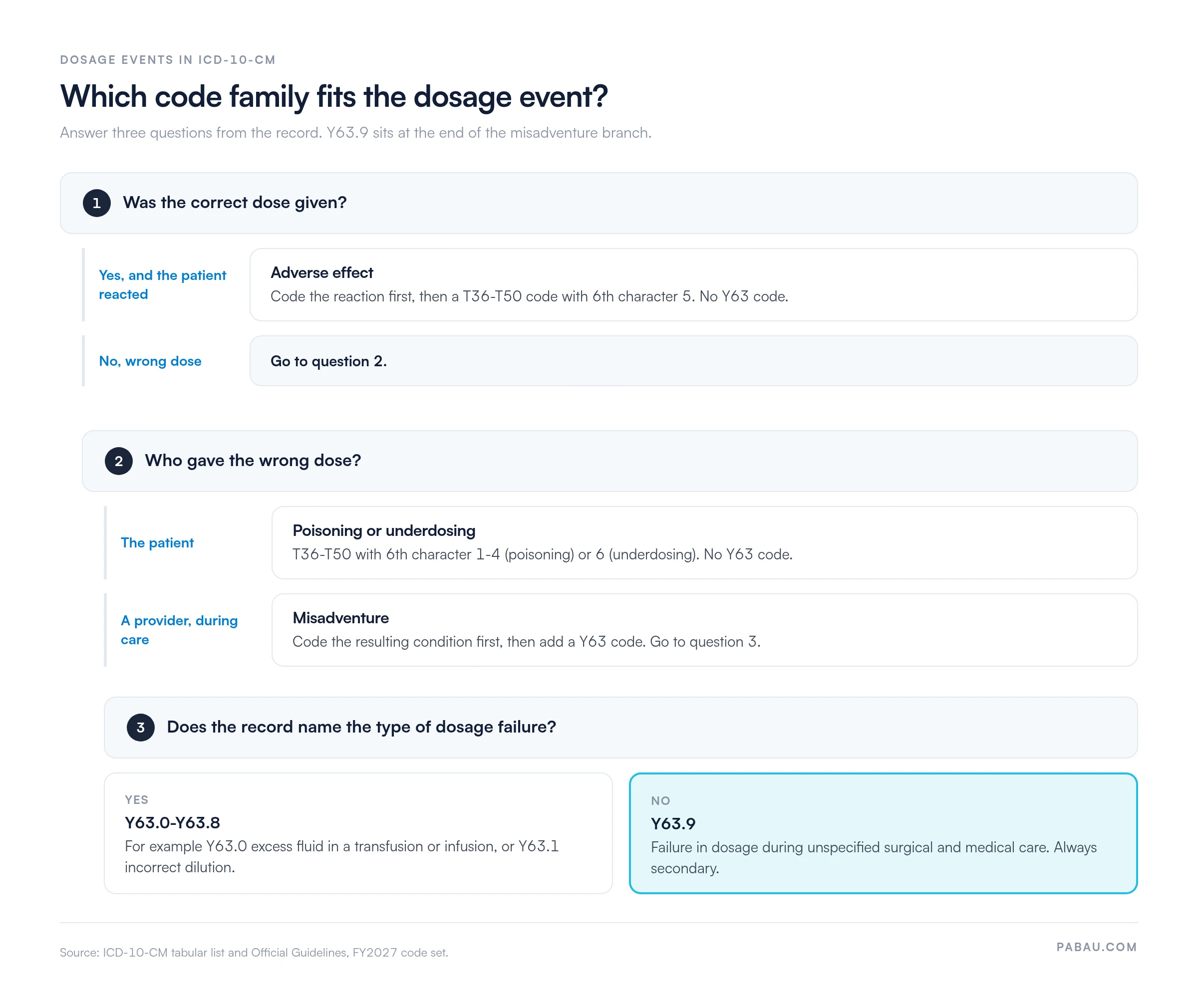
The table sets out the same scenarios side by side.
Key rule: If the clinical note says “allergic reaction to correctly prescribed morphine,” that is an adverse effect. Use the T-code with 6th character 5, not Y63.9. If it says “patient received double the ordered morphine dose due to pump programming error,” that is a misadventure. Code the resulting condition first, then add Y63.9 or a more specific Y63 code. A wrong drug given in error goes to the T36-T50 poisoning code with 6th character 1.
Per ICD-10-CM Official Guidelines Section I.C.20, Y63.9 is always a secondary code and can never stand alone. Correct sequencing keeps these encounters moving through revenue cycle management without rework.
Sequence codes in this order for a Y63.9 encounter:
Never sequence Y63.9 first, even when it is the most distinctive feature of the encounter. The condition it caused drives the principal diagnosis selection.
Run a pre-submission audit on any claim carrying Y63.9. Confirm that the principal diagnosis is a condition the dosage failure caused, not the original reason for the visit. A claim that leads with Y63.9 is likely to be rejected or flagged for edit, because external cause codes cannot be the principal diagnosis.
Y63.9 cannot be assigned from inference. The clinical record must contain explicit language before the code can be applied, and claims management software cannot substitute for clear provider documentation. Coders work from what the provider wrote.
Required documentation elements:
External cause codes are handled differently across payer types. Reporting Y63.9 without knowing a specific payer’s stance can trigger avoidable audits or denials.
Three checks help when submitting clean claims with Y63.9:
Coding guidelines leave most external cause reporting to payer and state policy, so that reference saves a lookup on every claim.
Y63.9 claims deny for predictable reasons. Recognizing the pattern and applying denial management workflows early prevents repeat errors across similar encounters.
External cause codes such as Y63.9 also support internal and state adverse-event tracking, so accurate assignment matters for reporting as well as billing.
Two reporting contexts where Y63.9 appears:
Accurate Y63.9 assignment is part of broader medical billing compliance, because the same code feeds incident tracking as well as the claim.
If your facility tracks never-event codes in a separate registry, reconcile that registry against claims data quarterly. A Y63.9 claim with no matching incident report points to missing documentation or a wrong code assignment. Both warrant immediate review.
Without a connected system, billing staff re-key codes from the provider note into a separate billing tool. They then check each claim’s status on payer portals, one encounter at a time.
Pabau, the practice management platform we build, keeps the provider note and the patient’s invoices and claims in one record. US practices submit claims electronically through our Claim.MD integration, track their status and manage remittances in one place.
Your coders still choose and sequence the codes. Pabau shortens the path from a signed note to a submitted claim, and shows you when a payer sends one back.

Pabau’s claims management workflows help practices submit claims electronically, track their status and manage remittances in one place. Your billing team spends less time chasing denials.

Reach for Y63.9 only after the record has ruled out every sibling code. A note that names the type of dosage failure tells the payer and your safety team more. Query the provider when the wording is vague.
That query can hold a claim back. The code it settles, though, stays in incident data long after the claim is paid, so the extra step is worth taking.
Pabau lets US practices submit claims electronically, track their status and manage remittances in one place. Book a demo to see how it handles external cause encounters from signed note to remittance.

Need a structured overview of the medical billing process? What is medical billing walks through how encounters move from documentation to payment, including where external cause codes fit in the workflow.
Struggling with claim denials on complex encounters? Denial management in healthcare covers the most common denial categories and the corrective actions that resolve them fastest.
Want to understand clean claim requirements before submission? Submitting clean claims details the fields, code combinations, and documentation thresholds that keep institutional and professional claims out of the reject queue.
Coding a temperature error in local care? ICD-10 Code Y63.5 covers inappropriate temperature in local application and packing, the Y63 sibling for heat and cold errors.
Is the misadventure not a dosage failure at all? ICD-10 Code Y69 explains the catch-all code for an unspecified misadventure during surgical and medical care.
ICD-10 Code Y63.9 is the billable external cause code for failure in dosage during unspecified surgical and medical care. It is assigned when a provider gives an incorrect amount of a substance and the record supports no more specific Y63 code. It belongs to Chapter 20 (External causes of morbidity) and is always reported after the condition the error caused.
Yes. Y63.9 is a valid, billable ICD-10-CM code in the FY2027 code set. It needs no seventh character, because the code is complete at four characters. It must follow a principal diagnosis code and cannot be the first-listed code on any claim.
Use Y63.9 only when documentation confirms a dosage failure during care but does not name its type clearly enough to assign Y63.0 through Y63.8. If the record states an incorrect dilution of infusion fluid, assign Y63.1. If it states an overdose of radiation, assign Y63.2. Y63.9 is a last resort, so query the provider if the note is ambiguous.
Y63.9 applies when a provider gave the wrong dose. An adverse effect T-code (6th character 5) applies when the correct dose was given and the patient had an unexpected reaction. The key distinction is whether the dose was correct. A correct dose that caused harm is an adverse effect. A wrong dose is a misadventure, coded with Y63.9 or a more specific Y63 code.
No. Per ICD-10-CM Official Guidelines Section I.C.20, external cause codes such as Y63.9 are supplementary codes that describe the circumstances of an injury or condition. They are never assigned as the principal or first-listed diagnosis. A claim with Y63.9 as the principal diagnosis is likely to be rejected or flagged for edit. External cause codes cannot be the principal diagnosis. Correct it by sequencing the resulting condition code first.
At minimum, report a principal diagnosis for the condition the dosage error caused, such as a T36-T50 poisoning or underdosing code. A place of occurrence code and a patient status code (Y99) are optional unless a payer or state requires them. Y92.230 identifies a patient room in hospital. ICD-10-CM guideline I.C.20 sets no national requirement for external cause reporting, so check each payer’s billing manual.