ICD-10 Code S53.013D: Anterior subluxation of unspecified radial head
ICD-10 Code S53.013D: Quick reference summary Use the table below as your first ...

Last Updated: Nov 6, 2026
Billable Code Specific Code
X96.1XXS is the billable ICD-10-CM code for assault by gasoline bomb, sequela. It records the cause of an injury, so it always travels with a code for the condition being treated. Use it when a patient returns for a late effect of a gasoline or petrol bomb attack. Typical examples are burn scarring, a contracture, chronic pain or PTSD.
As an external cause code, it never goes first on a claim. The residual condition leads, the original injury code with a 7th character S follows, and X96.1XXS comes last. Two placeholder Xs pad the four-character stem X96.1 before the S.
Let Pabau's smart automation suggest the right codes, reduce claim denials, and keep your practice compliant—effortlessly.
Automate repetitive tasks and focus on what matters most—your patients.
Reduce coding errors and ensure compliance with the latest regulations.
Clean claims, fewer denials, and faster reimbursements.
Powerful insights and reporting to help your practice thrive.
HIPAA compliant SOC 2 certified GDPR-compliant Trusted by 4,000+ clinics worldwide

X96.1XXS reports the cause of a late effect from a gasoline or petrol bomb assault, and it is never the first-listed code.
List the residual condition first, then the original injury code with a 7th character S, then X96.1XXS.
X96.1 is a four-character stem, so two placeholder Xs fill positions 5 and 6 before the S.
Activity (Y93) and status (Y99) codes do not apply to sequela claims, and a place code (Y92) is generally reported only at the initial encounter.
Pabau, the practice software we build, submits claims through Claim.MD, with eligibility checks and ERA remittance returned to your team.
ICD-10 code X96.1XXS reports assault by gasoline bomb at a sequela visit, when the patient is treated for a late effect of the attack. It always follows the code for the condition you treat.
Start every X96.1XXS claim with the basics below. They confirm the mechanism, the encounter type and where the code sits. Check the fiscal year as well, since the ICD-10-CM code set updates every October 1.
Each character in X96.1XXS does a job. Once you know them, you can spot a malformed code before the clearinghouse does.
The stem X96.1 has only four characters. ICD-10-CM needs the encounter character in position 7, so two Xs fill positions 5 and 6. A claim showing X96.1S or X96.1XS carries a code that is not in the tabular list, and the clearinghouse or payer will reject it.
Use S when the patient comes in for a condition that grew out of the original injury. The burn itself has already been treated. Today’s visit is about what it left behind.
The 7th character on X96.1 should match the injury code it travels with. Here is how the three options split.
No minimum time separates D from S. What decides it is whether active care for the original injury has ended. A patient can return for a sequela weeks or even years after the attack.
These visits fit X96.1XXS when the record ties the condition to the earlier attack.
A grenade is coded elsewhere too. The FY2026 External Cause Index sends a grenade used in an assault to X96.8, so a grenade-assault sequela is X96.8XXS. If the note confirms an assault but never names the means, the external cause is Y09 instead.
X96.1XXS describes how the harm happened, so it always sits behind a diagnosis. Build the claim in this order.
A patient returns 18 months after a gasoline bomb attack for revision of a forearm burn scar. The third-degree burn of the right forearm healed long ago. Code L90.5 first, then T22.311S, then X96.1XXS. Here is how those three lines stack on the claim.
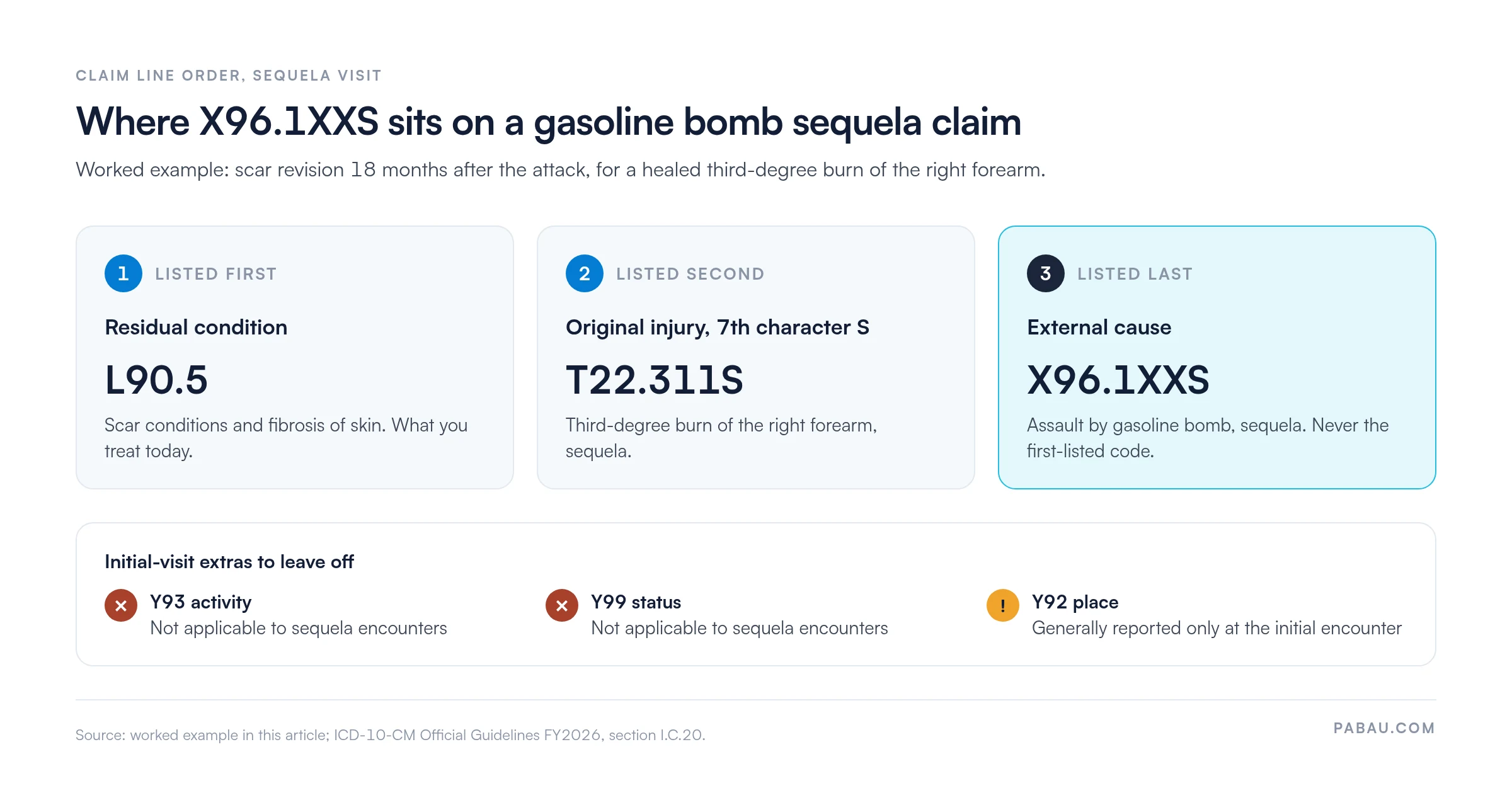
Place of occurrence codes from Y92 are generally reported only at the initial encounter. Activity codes (Y93) and external cause status codes (Y99) do not apply to sequela encounters at all. So a clean sequela claim carries no Y93 or Y99 code, and usually no Y92 code either.
Before you build the claim, open the original encounter. Its burn code gives you the site and degree for the S code, and its notes confirm that the device was a gasoline bomb.
Category X96 splits assaults by the type of explosive. Pick the code that matches the device named in the note. Falling back to X96.9 when the note says gasoline bomb loses specificity, and a payer audit can flag it.
Several neighboring codes sit outside X96 altogether. The X96 Excludes1 note sends assault by an incendiary device to X97. It also sends terrorism involving explosive material to Y38.2-. Antipersonnel bomb use in military or war goes to Y36.2-, while an accidental explosion belongs in W40. Confirm each boundary against the current CMS ICD-10 files before you bill.
The device in the note also decides whether the case stays in X96 at all. An assault committed with a paintball gun rather than an explosive takes the sequela to X95.02XS.
The note has to support each part of the code. Check for four elements before you assign it.
When any element is missing, query the provider. Do not assume assault intent without provider documentation. A written query also gives your medical billing compliance program a record of how the code was chosen.
Keep a short query template for sequela-of-assault cases. Ask the provider to confirm three points: another person acted on purpose, the device was a gasoline bomb, and active treatment has ended. One query then covers all three.
X96.1XXS rides along with the claim rather than earning payment itself. The payer adjudicates on the diagnosis and procedure codes in front of it. How much attention the external cause gets depends on who pays.
On the way back, the electronic remittance advice (ERA) shows the reason for any denial. Read it promptly to see whether the S, the sequence or the note tripped the claim. It also helps to review clean claim requirements before a batch of trauma claims goes out.
Watch for these five errors before an X96.1XXS claim goes out.
Tracking which error returns most often is part of steady denial management. That pattern shows where coder training should focus next.
Run through these six checks on every sequela claim for a gasoline bomb assault.
Sequela claims tend to slip at the handoffs. The coder reads one screen, the biller types into another, and the claim drifts away from the note.
Pabau’s claims management software starts the claim from the patient record instead. It pre-fills the claim form from the invoice. Before you send, it checks that the required claim fields are complete.
In the US, Pabau submits claims through the Claim.MD clearinghouse, which also runs eligibility checks before the visit. ERA remittance then comes back to Pabau, so your team sees each payer’s response in one place. Coding choices like the 7th character stay with your coders.

Pabau pre-fills claims from the patient record and submits them through Claim.MD, with eligibility checks and ERA remittance returned to your team.

X96.1XXS gets easier once you treat it as the last line on the claim. The residual condition explains the visit, and the S injury code links it to the burn. X96.1XXS then names the gasoline bomb behind both.
The risk sits in the note more than in the code book. If intent, the device or sequela status is unclear, query the provider before you code. That one step saves a resubmission later.
Book a demo to see how Pabau carries sequela claims from the patient record to the payer.

Need to understand how clearinghouse validation works? Claim.MD clearinghouse overview explains how electronic claims move from the practice to the payer.
Coding the PTSD behind a sequela visit? ICD-10 code F43.1 for PTSD covers the post-traumatic stress disorder codes that often lead these claims.
Working with another burn sequela? ICD-10 code T22.332S shows how a third-degree upper arm burn is coded once it has healed.
Reading denials on returned claims? What is electronic remittance advice (ERA)? walks through the remittance file that explains each payer decision.
New to the revenue cycle? Medical billing fundamentals covers the path from claim creation through remittance posting.
Yes. The FY2026 External Cause Index lists both gasoline and petrol under assault by bomb, and each leads to X96.1. A note that says petrol bomb still supports X96.1XXS on a sequela visit.
There is no national requirement to report ICD-10-CM external cause codes. Reporting becomes required when a state mandate or a payer policy calls for it. Even when it is optional, the code shows payers and registries how the injury happened.
No. Sequela visits have no time limit. A patient treated for burn scarring a decade after the attack can still carry X96.1XXS. The provider only has to link the condition to the assault.
ICD-9-CM had no sequela 7th character. Late effects of assault were reported with E969, late effects of injury purposely inflicted by other person. Use it only when you read or convert legacy records, never on a current claim.
Yes. When a provider treats PTSD linked to a gasoline bomb assault, X96.1XXS can follow the PTSD code as the external cause. The mental health diagnosis leads the claim, and the note must tie it to the attack.