

ICD-10 code S61.201A: Open wound of left index finger without nail damage
ICD-10 code S61.201A covers a left index finger wound of unstated type ICD-10 co...

Last Updated: Oct 16, 2026
Billable Code Specific Code
T22.332S is the billable ICD-10-CM code for burn of third degree of left upper arm, sequela.
The code belongs to the International Classification of Diseases, 10th Revision, Clinical Modification. The Centers for Medicare and Medicaid Services (CMS) and the National Center for Health Statistics maintain that code set jointly.
The 7th character is what separates T22.332S from its siblings. It tells the payer that the burn has healed and that the patient is back for a late effect of that injury.
Let Pabau's smart automation suggest the right codes, reduce claim denials, and keep your practice compliant—effortlessly.
Automate repetitive tasks and focus on what matters most—your patients.
Reduce coding errors and ensure compliance with the latest regulations.
Clean claims, fewer denials, and faster reimbursements.
Powerful insights and reporting to help your practice thrive.
HIPAA compliant SOC 2 certified GDPR-compliant Trusted by 4,000+ clinics worldwide

T22.332S is a billable ICD-10-CM code for a burn of third degree of the left upper arm, sequela. It has been valid since the 2026 edition took effect on October 1, 2025.
The 7th character ‘S’ means the patient is presenting with a late effect of a prior third-degree burn. The wound itself has healed.
Omitting the additional codes for external cause (X00-X19), place of occurrence (Y92), and activity (Y93) is a common cause of claim denial.
A sequela claim survives audit only when the note states the wound is healed and names the late effect.
Practice management software like Pabau integrates with Claim.MD, so burn sequela claims go out electronically with their external cause codes attached.
The table below captures the key reference data for T22.332S in one place. Use it to confirm validity before submitting a claim.
The 7th character tells the payer where the patient sits in the care continuum. Using the wrong one triggers an audit flag or a denial.
T22.332 has three 7th character variants. Each describes a distinct clinical scenario:
Documentation drives the move from D to S. The clinical record must state that the burn wound has healed. It must also state that the current presentation is a late effect of that prior injury. Without that causal link in the note, a sequela code will not survive audit review.
A third-degree burn, also called a full-thickness burn, destroys the entire epidermis and dermis and extends into subcutaneous tissue.
The wound site typically appears leathery, dry, and insensate because the nerves are destroyed. Unlike first- or second-degree burns, third-degree injuries rarely heal without surgical treatment such as skin grafting.
When sequela coding applies, the burn wound itself is healed. The code captures the downstream consequences rather than an open wound. Common late effects that prompt a sequela encounter include:
Documentation for this code uses several equivalent terms. Watch for any of these phrasings in the chart:
T22.332S sits inside a structured hierarchy. Reading it from the top down confirms that the code you picked sits at the right specificity level. It also points you to the neighboring codes quickly.
Laterality and encounter type both change the code, so the siblings below are worth knowing by sight. Coders slip in two ways here. They pick the right arm instead of the left, or they reach for the unspecified code when the chart names a side. A clean claim submission depends on choosing the right sibling.
T22.339S should only appear on a claim when the clinical note genuinely omits laterality. If the record documents “left upper arm,” use T22.332S rather than the unspecified code.
ICD-10-CM Chapter 19 conventions require additional codes alongside T22.332S wherever the external cause and activity context can be identified. Missing them is one of the most common reasons burn sequela claims are denied or returned.
Submit the following additional codes as applicable:
Those five codes assemble into one claim line, and the diagram below shows the order they take.
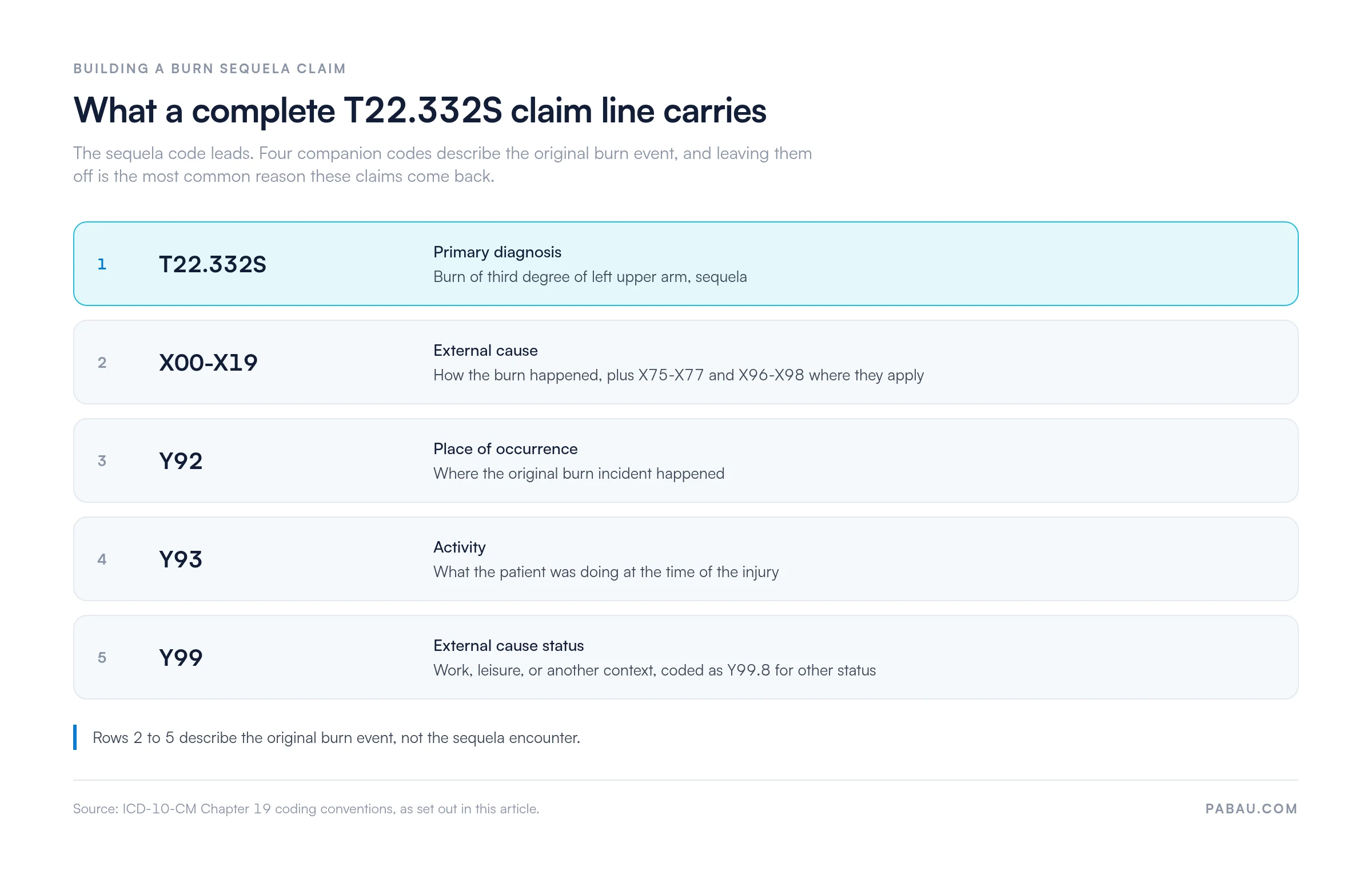
For sequela encounters, the external cause codes describe the original burn event rather than the current visit. Practices that submit electronically through Claim.MD can send T22.332S with its companion codes in one transmission.
Checking the common denial codes before submission is worth the minute it takes, because several of them flag missing external cause information.
When you move a patient from T22.332D to T22.332S, the physician note must say two things. The burn wound is healed, and the current complaint is a direct late effect of it. Build that prompt into your encounter template so coders never have to infer the causal link from the chart.
Sequela burn claims usually fail audit over documentation rather than code choice. The clinical record must carry five specific elements for T22.332S to hold up under review.
Practices managing burn sequela patients across several visits benefit from claims management software that links diagnosis codes to the patient’s encounter history. That link is what surfaces a missing external cause code before the claim leaves the building.
Most practices code a sequela visit in one system and submit the claim in another. The coder opens the prior encounter to confirm the burn is healed, then re-keys the external cause codes into the billing screen. Each hop is a chance to drop Y92 or Y93.
Pabau, our practice management software, holds the clinical note, the diagnosis codes and the claim in one record. A coder opening the sequela encounter sees the original burn visit alongside it. The causal link is on screen rather than in a separate chart.
Claims go out electronically through our Claim.MD integration, with eligibility checks and ERA reconciliation in the same place. Your billing team spends less time re-keying codes and chasing remittances.

Pabau integrates with Claim.MD for electronic ICD-10-CM claim submission, eligibility checks and ERA reconciliation. Your billing team spends less time chasing denials.

Burn sequela claims turn on documentation more than on code selection. The difference between T22.332D and T22.332S is a clinical judgment, and it has to live in the physician note. Pick the right 7th character, attach the external cause codes, and make the causal link explicit.
Do that consistently and the T22.332S claims that used to come back stop coming back. Book a demo to see how Pabau tracks burn sequela documentation and submits the claim from the same record.

Coding another third-degree burn sequela? ICD-10 code T22.342S covers the left axilla, where the same 7th character rules apply.
Want to reduce claim denials across your practice? Denial management in healthcare outlines the most common denial triggers and how to resolve them upstream.
Looking to improve your billing documentation workflow? Medical billing compliance walks through documentation standards that keep audit-sensitive codes like T22.332S defensible.
ICD-10 code T22.332S is a billable ICD-10-CM diagnosis code for a burn of third degree of the left upper arm, sequela. The ‘S’ 7th character means the patient is presenting with a late effect of a prior third-degree burn. The wound is not under active treatment. It entered the 2026 edition of ICD-10-CM on October 1, 2025.
Yes. T22.332S is a billable, specific ICD-10-CM code valid for reimbursement submission. It is confirmed as billable in the 2026 ICD-10-CM edition by the CDC/NCHS ICD-10-CM web tool and the AAPC code lookup.
All three codes describe a third-degree burn of the left upper arm, but at different stages of care. T22.332A applies during active treatment. T22.332D applies during the healing or recovery phase. T22.332S applies once the burn has healed and a late effect such as scarring or contracture appears. Only one 7th character applies per encounter.
Per ICD-10-CM coding guidelines, T22.332S requires an external cause code for the original burn (X00-X19, X75-X77, X96-X98). Add place of occurrence (Y92), activity (Y93), and external cause status (Y99) where identifiable. These codes describe the original burn event, not the sequela encounter.
Use the ‘S’ 7th character on the injury code, which is T22.332S for the left upper arm. The record must document that the original wound is healed. It must also name the specific late effect, such as contracture or scarring.
Sequela codes apply once the burn wound has fully healed and the patient returns with complications arising from that prior injury. Common sequela presentations include hypertrophic scarring, scar contracture limiting joint mobility, and chronic neuropathic pain at the burn site. The physician, not the coder, makes the determination that the wound is healed and documents that clinical decision.



