

ICD-10 code S61.201A: Open wound of left index finger without nail damage
ICD-10 code S61.201A covers a left index finger wound of unstated type ICD-10 co...

Last Updated: Oct 16, 2026
Billable Code Specific Code
V73.9XXA is the billable ICD-10-CM code for unspecified occupant of bus injured in collision with car, pick-up truck or van in traffic accident, initial encounter. Use it when a car, pick-up or van hits a bus on a public road. The record doesn't say whether the patient drove or rode.
It's an external cause code, so it explains how the injury happened and never stands alone. The injury code goes first. Getting the role, the setting and the 7th character right keeps the claim from coming back. Below, you'll see how to pick between the V73 siblings and what payers check before they pay.
Let Pabau's smart automation suggest the right codes, reduce claim denials, and keep your practice compliant—effortlessly.
Automate repetitive tasks and focus on what matters most—your patients.
Reduce coding errors and ensure compliance with the latest regulations.
Clean claims, fewer denials, and faster reimbursements.
Powerful insights and reporting to help your practice thrive.
HIPAA compliant SOC 2 certified GDPR-compliant Trusted by 4,000+ clinics worldwide

V73.9XXA is a billable ICD-10-CM external cause code for an unspecified bus occupant hurt when a car, pick-up or van hits the bus in traffic.
It’s always a secondary code, so the patient’s injury code goes first on the claim.
If the record names a role, use V73.5 for the driver, V73.6 for a passenger or V73.7 for someone on the outside of the bus.
The 7th character A marks active treatment, D marks subsequent care and S marks sequela.
Pabau, the practice software we build, submits claims through Claim.MD and tracks claim status and remittances.
ICD-10 code V73.9XXA describes one scenario. A car, pick-up truck or van hits a bus in traffic and injures someone on board. The record doesn’t say whether that person drove or rode. The A on the end marks the first phase of care, when the patient is in active treatment.
The code sits in Chapter 20, External causes of morbidity (V00-Y99), inside the bus occupant block V70-V79. Like every external cause code in our ICD-10-CM library for coders, it explains the cause rather than the injury.
In medical billing, that difference decides the order on the claim. Say a passenger breaks a wrist when a van hits the bus. The fracture code comes first, and V73.9XXA follows it as the secondary code.
Here is the reference data for V73.9XXA, as published by CDC/NCHS in the official ICD-10-CM tabular list.
V73.9XXA applies only when all five conditions are met. If one of them fails, a different code is correct.
The 7th character tells the payer which phase of care you’re billing. A wrong one is a common reason external cause claims are rejected. All three versions describe the same collision, and only the encounter type changes.
The “XX” fills the 5th and 6th character positions, which this category doesn’t subdivide. Keep both placeholders. Coders who drop them create an invalid code string.
V73.9XXA is the most specific level of its branch. Knowing the levels above it helps you switch codes when the documentation says more than “unspecified.”
If the patient’s role is documented, move to a specific traffic code instead. Use V73.5 for the driver, V73.6 for a passenger and V73.7 for a person on the outside of the bus. Each one still needs XX and its own 7th character.
The V73 category describes the same bus-versus-car collision for different people and settings. Picking the wrong sibling when the record is clear is a coding accuracy error.
The table below draws on the AAPC ICD-10-CM code reference and covers the codes coders mix up most.
Two questions settle the choice: who was the patient, and was the bus on a public road? The grid maps every answer to its V73 code.
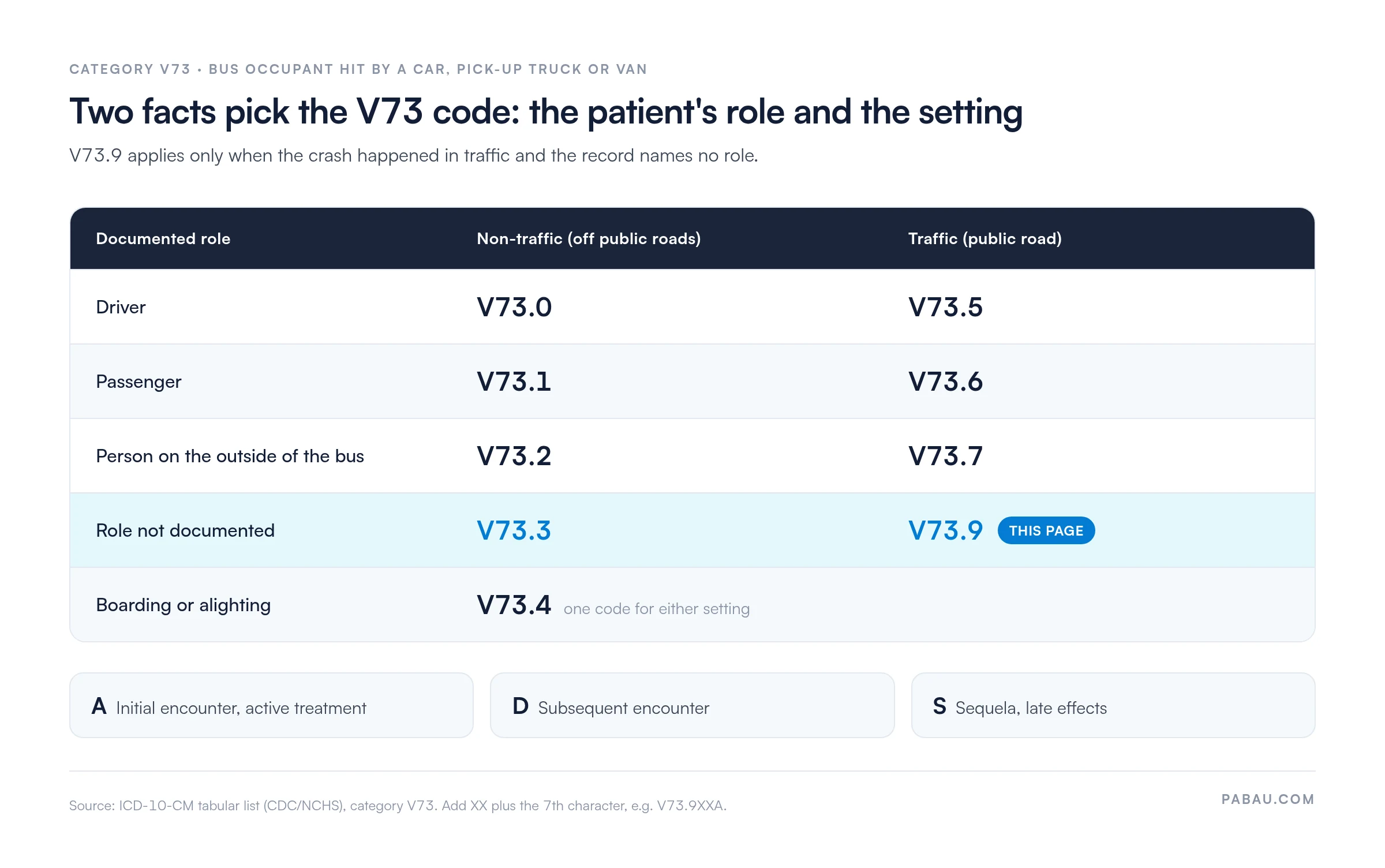
Every sibling also comes in A, D and S versions. A passenger’s late effects from a non-traffic collision, for example, are coded V73.1XXS.
Several scenarios look like V73.9XXA but belong to other codes. Using V73.9XXA for them gets the claim rejected at the payer’s edit stage.
When the ED report says only ‘bus occupant’ or ‘person on the bus’, that documentation supports V73.9XXA. Ask the attending to record the patient’s role in the discharge summary. Follow-up claims can then carry the specific code.
The code you can assign depends on what the provider writes down. Three details matter most.
Coders can’t infer a role from context. If the note is silent, V73.9XXA is correct, and a query to the provider is the way to get something more specific.
V73.9XXA never appears alone. ICD-10-CM guidelines and some payer policies call for related codes that explain the injury and its circumstances.
Place, activity and status codes go on the initial encounter only. The status code also signals when workers’ compensation may be the payer.
The order never changes: the injury code leads, and V73.9XXA follows. Reversing it is a common reason external cause claims come back unpaid.
No national rule requires external cause codes. CMS doesn’t require them on Medicare Part B claims, though ICD-10-CM guidelines encourage reporting them. Some state Medicaid programs require them, and commercial payers set their own rules in provider agreements.
Here’s the path a typical bus accident claim takes:
Step three trips teams up most often. A work-related bus accident sent to a commercial plan can take weeks to unwind. That’s why getting a clean claim out on the first pass matters so much here.
Run through these checks before the claim leaves your system. They catch the errors that cause most rework on bus accident claims.
Transportation accident codes tend to fail in the same few ways. Spotting the pattern early keeps your denial management workflows from turning into a backlog.
For medical billing compliance, track denial reasons by code group. A pattern across V-codes shows up much faster than it does claim by claim.
Before October 2015, transportation injuries were coded with ICD-9-CM E-codes. The approximate equivalent for V73.9XXA is E813.9, a motor vehicle traffic accident involving collision with another vehicle, unspecified person.
Treat that mapping as approximate. The CMS General Equivalence Mappings (GEMs) file is the authoritative translation table. Check it before using the crosswalk in a legacy system, a research dataset or payer correspondence.
Urgent care centers, emergency departments, orthopedic practices and physical therapy practices see motor vehicle injuries every week. Each claim needs the injury code first, the right V73 code second and a matching 7th character. Chasing those claims across payers by hand eats into the billing team’s day.
Pabau’s claims software for practices builds the CMS-1500 from the visit and submits it electronically. Claims go through the Claim.MD clearinghouse, which reaches thousands of US payers.
Eligibility checks run in real time, so you know who pays before the patient leaves. Pabau also tracks claim status and electronic remittance advice (ERA), so your team can see which claims were paid and which need work.

Pabau’s claims management software submits claims through Claim.MD, checks eligibility in real time and tracks claim status and ERA remittances. Your team spends less time chasing payers.

V73.9XXA is a fallback, not a first choice. It fits only when the crash happened in traffic and nobody recorded who the patient was on the bus.
So the best fix starts upstream. When clinicians note the role and the setting, coders can reach for V73.5, V73.6 or V73.7 instead, and payers ask fewer questions. When the note stays silent, V73.9XXA is the honest code, as long as it sits behind the injury code.
Book a demo to see how Pabau tracks your accident claims from submission to remittance.

Need to understand how external cause codes interact with the revenue cycle? Revenue cycle management in healthcare explains the end-to-end billing workflow from encounter to payment posting.
Want guidance on reducing claim rejections from coding errors? How to submit a clean claim covers the pre-submission checks that prevent the most common ICD-10-CM errors from reaching the payer.
Looking for the clearinghouse that handles US transportation accident claims? Medical claims clearinghouse guide explains how electronic claim routing works across commercial and government payers.
Yes, if the vehicle meets the ICD-10-CM definition of a bus. That means a motor vehicle designed or adapted primarily to carry more than 10 persons. A full-size school bus qualifies, and the same role and setting rules apply. A smaller vehicle may be coded as a van instead.
A pedestrian struck by a bus is not a bus occupant, so V73 doesn’t apply. Pedestrian injuries in collision with a bus fall under category V04, which covers heavy transport vehicles and buses. Traffic cases use V04.1-, with the 5th character showing how the pedestrian was moving.
The car occupant gets a code from category V44, car occupant injured in collision with heavy transport vehicle or bus. In traffic, V44.5 is the driver, V44.6 is a passenger and V44.9 is an unspecified occupant. Each needs XX and a 7th character.
Yes. ICD-10-CM guidelines let you assign as many external cause codes as needed to explain the cause. List the transport code first, then place, activity and status codes. Skip an external cause code when another chapter’s code already states the cause.



