ICD-10 code V43.42XS: Car boarding injury, sequela
ICD-10 code V43.42XS covers the late effects of a car boarding injury ICD-10 cod...

Last Updated: Oct 7, 2026
Billable Code Specific Code
V73.1XXS is the billable ICD-10-CM code for passenger on bus injured in collision with car, pick-up truck or van in nontraffic accident, sequela. It covers a visit for a lasting effect of a bus crash that happened off a public road, such as in a parking lot. The code is always secondary to the residual condition being treated.
Two placeholder X characters occupy positions 5 and 6, which places the 7th character S in the seventh position. S tells the payer the injury has healed and the visit treats what it left behind. Coders frequently confuse this code with V73.1XXD (subsequent encounter) or sequence it first, which draws payer edits or audit queries.
Let Pabau's smart automation suggest the right codes, reduce claim denials, and keep your practice compliant—effortlessly.
Automate repetitive tasks and focus on what matters most—your patients.
Reduce coding errors and ensure compliance with the latest regulations.
Clean claims, fewer denials, and faster reimbursements.
Powerful insights and reporting to help your practice thrive.
HIPAA compliant SOC 2 certified GDPR-compliant Trusted by 4,000+ clinics worldwide

V73.1XXS applies only when the acute phase of a nontraffic bus-accident injury has resolved and the patient presents with a documented residual condition.
V73.1 is four characters without the decimal, so two placeholder Xs fill positions 5 and 6 and S lands in position 7. Submitting V73.1S or V73.1XS fails format edits.
V73.1XXS is an external cause code from ICD-10-CM Chapter 20, so it never serves as the principal or first-listed diagnosis. The residual condition is coded first.
A collision on a public road, or one whose location the chart never states, takes traffic codes such as V73.6XXS instead.
Pabau’s claims management software pre-fills claim forms from the patient record, offers an ICD-10-CM lookup library, and checks required claim fields before you submit.
ICD-10 code V73.1XXS describes a bus passenger injured when the bus collides with a car, pick-up truck or van in a nontraffic accident. The current visit treats a sequela of that crash, not the acute injury itself.
The code sits in ICD-10-CM Chapter 20 (External causes of morbidity, V00-Y99), in block V70-V79 for bus occupants. Its parent category is V73, bus occupant injured in collision with car, pick-up truck or van.
Four facts must all hold for this code to apply:
When one of them fails, a different V73 code or a different category applies. The sections below show which one, starting with the code’s key facts.
The 7th character S marks a sequela, a late effect of the bus-accident injury after its acute phase has ended. Under the ICD-10-CM Official Guidelines, the residual condition is sequenced first and the sequela code second. V73.1XXS is never the principal diagnosis.
Coders often confuse S with D, and the line between them is clinical. Use D while the patient still receives active treatment for the injury itself, even if that runs for months. Switch to S only once the provider documents that the injury has resolved and a residual condition remains.
The guidelines set no time limit on a sequela, so S can apply years after the crash. The table shows how each 7th character maps to the encounter.
ICD-10-CM requires the 7th character to sit in the 7th position. V73.1 is four characters long, because the decimal point is not counted. Without placeholders, S would land in position 5 and the code would be invalid. Two X characters fill positions 5 and 6, so S lands in position 7.
The breakdown below shows what each position carries:
S is the 7th character; the decimal point is not counted. The decimal is written between positions 3 and 4 but takes no position of its own. Submitting V73.1S or V73.1XS produces an invalid-format error at the clearinghouse, so the claim is rejected before the payer reviews it.
V73.1XXS covers one combination of facts, and changing any of them hands the claim to a neighboring code. The chart below walks the three questions in the order a coder should ask them.
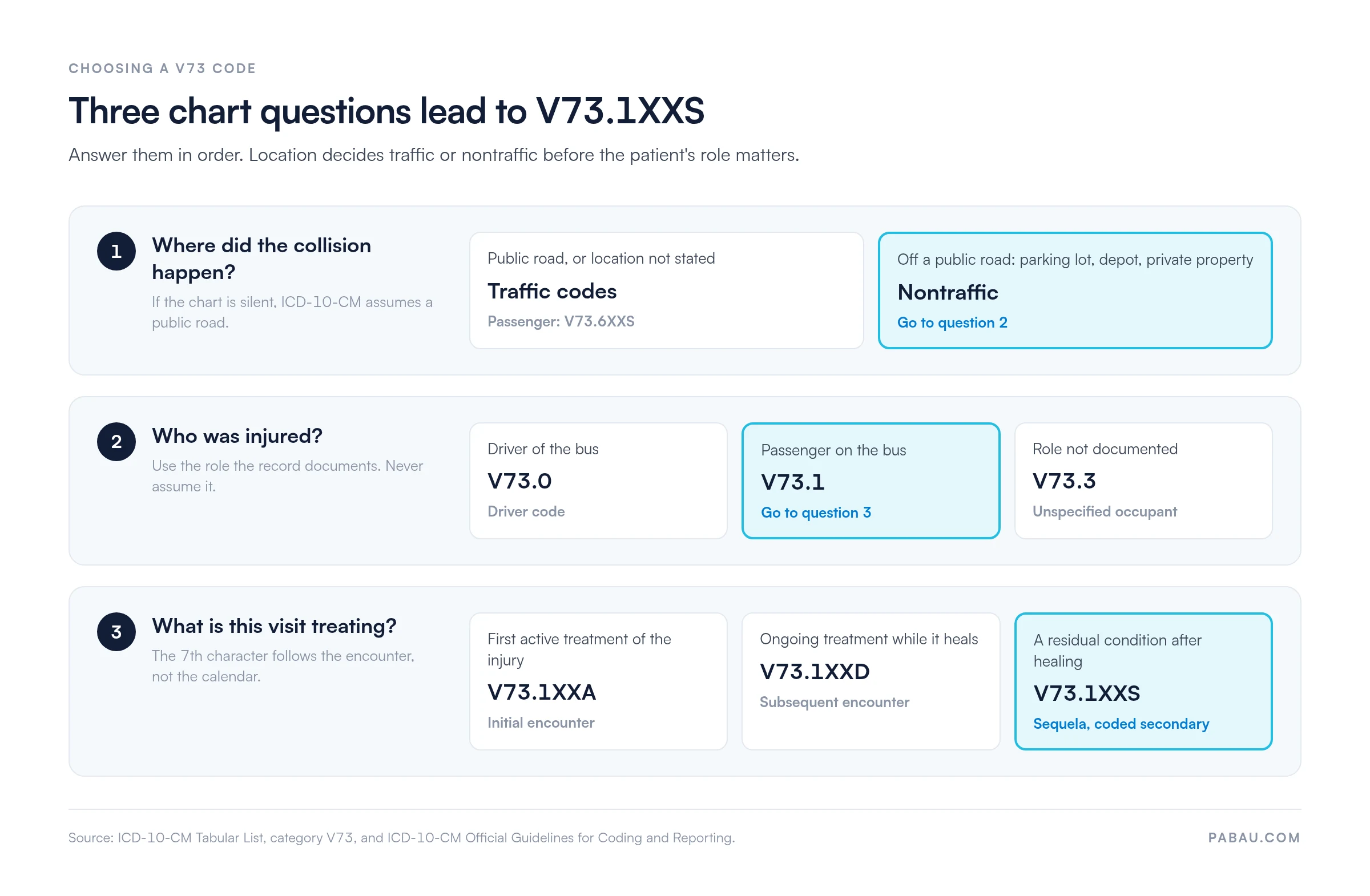
Location comes first because the ICD-10-CM Tabular List assumes a vehicle accident happened on a public road unless the record names another place. A chart that never says where the bus was hit points to traffic codes, not V73.1XXS.
Check these exclusions before you settle on the code:
Each V73 code differs by occupant role, by traffic or nontraffic setting, and by encounter type. Picking the wrong sibling is a common error in this category, so compare the options side by side.
Two confusion pairs come up again and again with this code.
V73.1XXD vs. V73.1XXS: The dividing line is whether the original injury is still being treated. A healing fracture, or physical therapy for acute whiplash, stays on the D code. Once the provider documents that the injury has resolved and chronic pain remains, switch to the S code. Billing D out of habit invites audits asking why subsequent-encounter claims run years past the accident.
V73.0XXS vs. V73.1XXS: Driver versus passenger is a documentation question, not a clinical judgment. If the record does not state the patient’s role, query the provider or report V73.3XXS for an unspecified occupant. Assuming passenger status without support is a compliance risk. The AAPC’s ICD-10-CM code reference shows the occupant’s role built into every code in this block.
A third error is reporting V73.1XXS on its own. External cause codes never stand alone, so the residual condition must be coded first.
Payers and auditors apply the sequela guidelines strictly on accident claims, especially in workers’ compensation and auto liability cases.
Solid medical billing compliance depends on the record holding five elements before you assign V73.1XXS:
When the record leaves the patient’s role thin or ambiguous, V73.3XXS (unspecified occupant) is more defensible than V73.1XXS. A specific code with weak support carries more audit risk than a less specific code the record backs.
Code reference pages tend to stop at the descriptor, yet errors usually creep in during the workflow. Follow these five steps for each sequela encounter:
Worked example: A car hit a shuttle bus in a hospital parking lot, injuring a seated passenger. Eight months later the fracture has healed, but the provider now treats chronic post-traumatic pain. The claim lists G89.21 first, then the fracture code with 7th character S, then V73.1XXS.
Denials on this code follow predictable patterns, and knowing them in advance prevents rework. A structured denial management workflow helps you track and resolve each one:
Compare your rejections against medical billing denial codes to see whether V73.1XXS problems share a CARC/RARC combination. Clearinghouses that parse CARCs automatically make that pattern faster to spot.
Run a quarterly audit on claims that contain V73.1XXS. Filter for denials whose CARC points to an invalid format or a sequencing problem. Both types are preventable with a check before submission.
External cause codes from Chapter 20 are not universally required. The Official Guidelines state there is no national requirement for mandatory external cause reporting.
Knowing how medical billing works across payer types helps before you submit V73.1XXS, because requirements vary by setting and plan.
The CDC/NCHS ICD-10-CM web tool confirms V73.1XXS as a valid, billable code for the current fiscal year. Before routing external cause codes through any claims workflow, confirm each payer’s submission rules. Sending a clean claim means knowing whether the payer will accept the external cause code before it arrives.
A quick pass over the claim catches the errors covered above while they are still cheap to fix:
In many practices, sequela claims are still assembled by hand. A biller retypes codes from the provider’s note, checks payer rules in a separate portal, and finds missing fields only when the claim bounces.
Pabau, the practice management platform we build, moves that work into the patient record. Its streamlined claims management pre-fills claim forms from the chart and offers an ICD-10-CM lookup library. Required-field checks run before you submit, and US claims go out through Claim.MD with eligibility and remittance tracking.
The coder still owns sequencing and the S-versus-D call. What changes is the retyping and the missing fields, so sequela claims leave complete and come back less often.

Pabau’s claims management tools pre-fill ICD-10 codes from the patient record and check required claim fields, so sequela claims go out complete.

V73.1XXS rewards the coder who reads the chart before reaching for the code. Location, role and the state of the injury each change the answer. Ask them in that order, and the right V73 code is rarely in doubt.
The trade-off worth remembering is specificity against support. A precise code on a thin record is a bigger audit risk than V73.3XXS on a solid one. When the note is silent, query the provider, and keep V73.1XXS behind the residual condition.
If retyping codes and chasing claim fields eat into your week, book a demo and see Pabau build sequela claims from the patient record.

Need to understand how clearinghouse validation works? How a medical claims clearinghouse works explains the validation steps a claim passes through before it reaches the payer.
Want to read ERA and remittance data for sequela denials? Electronic remittance advice explained covers how to read 835 ERA files and spot denial reason codes at scale.
Coding another nontraffic transport sequela? ICD-10 code V26.29XS applies the same nontraffic and sequela logic to a motorcycle crash.
Comparing clearinghouse options for your practice? Claim.MD vs Office Ally compares two US clearinghouses on format validation, payer reach and denial reporting.
Usually not. The guidelines assign place of occurrence (Y92), activity (Y93) and external cause status (Y99) codes once, at the initial encounter. A sequela visit carries V73.1XXS without them.
There is no time limit. The ICD-10-CM guidelines allow a sequela code whenever a residual condition appears, months or years after the crash. What matters is documentation linking the condition to the accident.
Not with a related one. The guidelines say a sequela external cause code should never be used with a related current nature-of-injury code. If the visit treats an active injury from the crash, use V73.1XXA or V73.1XXD instead.
Yes, when the collision happens entirely off a public road, such as in a parking lot, depot or private driveway. If the record does not say where it happened, ICD-10-CM assumes a traffic accident.
No. External cause codes do not affect MS-DRG grouping. Their value lies in injury data, liability and workers’ compensation review, and payer edits that expect them.
Yes. V73.1XXS is a billable, specific ICD-10-CM code, valid since FY2016 (October 1, 2015). It is never reported alone, because the sequela condition is coded first.