Pabau Engage inbox

Pabau Engage is here: every patient conversation in one inbox.

Learn more
ICD-10-CM Code

ICD code V70.6XXA – Bus passenger injured in pedestrian or animal collision

Billable Code Specific Code


Code Definition

V70.6XXA is the billable ICD-10-CM code for passenger on bus injured in collision with pedestrian or animal in traffic accident, initial encounter. Use it while the passenger is still in active treatment after the bus collided with a pedestrian or animal on a public road.

It is an external cause code, so it always follows the injury code on the claim. Common denial causes for this code include listing it as the principal diagnosis and choosing the wrong 7th character. Dropping one of the two placeholder X characters is another.

Chapter
V00-Y99 External causes of morbidity
Category
V70 Bus occupant injured in collision with pedestrian or animal
Group
V70.6 Passenger on bus injured in collision with pedestrian or animal in traffic accident
Billable
Yes
Code also known as
bus accident injury, bus crash passenger, transit bus collision injury, motor vehicle accident bus occupant
Save time. Improve accuracy. Get paid faster.
Automate coding with Pabau

Let Pabau's smart automation suggest the right codes, reduce claim denials, and keep your practice compliant—effortlessly.

  • AI-powered code suggestions
  • Real-time compliance checks
  • Faster claims, fewer denials
Why practices choose Pabau
Save hours every week

Automate repetitive tasks and focus on what matters most—your patients.

Improve accuracy

Reduce coding errors and ensure compliance with the latest regulations.

Get paid faster

Clean claims, fewer denials, and faster reimbursements.

Grow with confidence

Powerful insights and reporting to help your practice thrive.

HIPAA compliant SOC 2 certified GDPR-compliant Trusted by 4,000+ clinics worldwide

Key takeaways

Key takeaways

V70.6XXA is a billable ICD-10-CM external cause code for a bus passenger injured when the bus hits a pedestrian or animal in traffic.

It can never be the principal diagnosis, so list the injury code first and V70.6XXA after it.

The two X characters are mandatory placeholders, and dropping either one makes the code invalid.

Match the external cause code’s 7th character to the injury code’s, so A stays on while active treatment continues.

Pabau’s claims management software supports ICD-10-CM coded claim submission through Claim.MD.

ICD-10 code V70.6XXA in one table: The facts coders look up first

ICD-10 code V70.6XXA reports a passenger on a bus who was injured when the bus collided with a pedestrian or animal on a public road. It covers the initial encounter, meaning the whole stretch of active treatment. It’s a billable external cause code, so it always sits after the injury code on the claim.

The table below summarizes the lookup facts. Every detail matches the current tabular list in the CDC/NCHS ICD-10-CM web tool.

FieldDetail
CodeV70.6XXA
Official descriptorPassenger on bus injured in collision with pedestrian or animal in traffic accident, initial encounter
BillableYes, as the full 7-character code
Code typeExternal cause of morbidity (additional code only)
ICD-10-CM chapterChapter 20: External causes of morbidity (V00-Y99)
Code blockV70-V79: Bus occupant injured in transport accident
Valid 7th charactersA (initial encounter), D (subsequent encounter), S (sequela)
Principal diagnosisNever, it is always an additional code

Three facts in the record decide whether V70.6XXA fits

V70.6XXA fits a passenger riding on a bus when the bus collides with a pedestrian or animal in traffic. It never covers the driver or the pedestrian. All three parts of the descriptor have to be true at the same time.

  • Occupant role: The patient was a passenger riding on the bus. The driver is coded under V70.5XXA, and pedestrians, cyclists and occupants of other vehicles each have their own code blocks.
  • Collision object: The bus hit, or was hit by, a pedestrian or animal. A collision with another motor vehicle, a fixed object or a train sits in a different V7x category.
  • Road status: The accident happened in traffic, on a public road or highway. Nontraffic accidents, such as on private property or in a depot, take a different code in the same V70 family.

Road status trips coders up more often than the occupant role does. ICD-10-CM treats a traffic accident as one on a public highway or street. When the record doesn’t say where the accident happened, the tabular list assumes a public highway, so default to traffic.

Seven characters, read left to right: How V70.6XXA is built

ICD-10 code V70.6XXA has seven characters, and each position carries a specific meaning. Drop even one and the code is invalid, which gets the claim rejected before anyone reviews it.

Character(s)ValueWhat it means
1VTransport accident (Chapter 20)
2-370Bus occupant injured in collision with pedestrian or animal
46Passenger, traffic accident
5-6XXMandatory placeholder characters with no clinical meaning, needed to reach the 7th position
7AInitial encounter, while the patient receives active treatment

The 7th character tracks the phase of care, not the visit count

Many coders assume “A” only covers the emergency department visit. It applies to every visit during active treatment, including surgery, inpatient stays and evaluation by the treating physician.

The official guidelines add a simple cross-check. The external cause code’s 7th character should match the injury code’s 7th character on the same claim.

Code7th characterWhen to useClinical example
V70.6XXAA, initial encounterThe patient is still receiving active treatment for the injuryED visit, orthopedic surgery, evaluation by the treating surgeon
V70.6XXDD, subsequent encounterActive treatment has ended and the patient receives routine healing careCast removal, wound check, physical therapy after discharge from acute care
V70.6XXSS, sequelaThe patient has a late effect or complication of the original injuryChronic pain or a functional deficit months after the collision

V70.6XXA among its V70 siblings: One character changes the code

Every code in category V70 describes a bus colliding with a pedestrian or animal, per the CDC/NCHS tabular list. Only the fourth character moves, and it records who was hurt and whether the accident happened in traffic.

Here is the full set of sibling codes at the initial encounter.

CodeOccupant / circumstance
V70.0XXADriver, nontraffic accident
V70.1XXAPassenger, nontraffic accident
V70.2XXAPerson on outside of bus, nontraffic accident
V70.3XXAUnspecified occupant, nontraffic accident
V70.4XXAPerson boarding or alighting
V70.5XXADriver, traffic accident
V70.6XXAPassenger, traffic accident (this code)
V70.7XXAPerson on outside of bus, traffic accident
V70.9XXAUnspecified occupant, traffic accident

Laid out as a grid, the choice comes down to two questions about the person and the road.
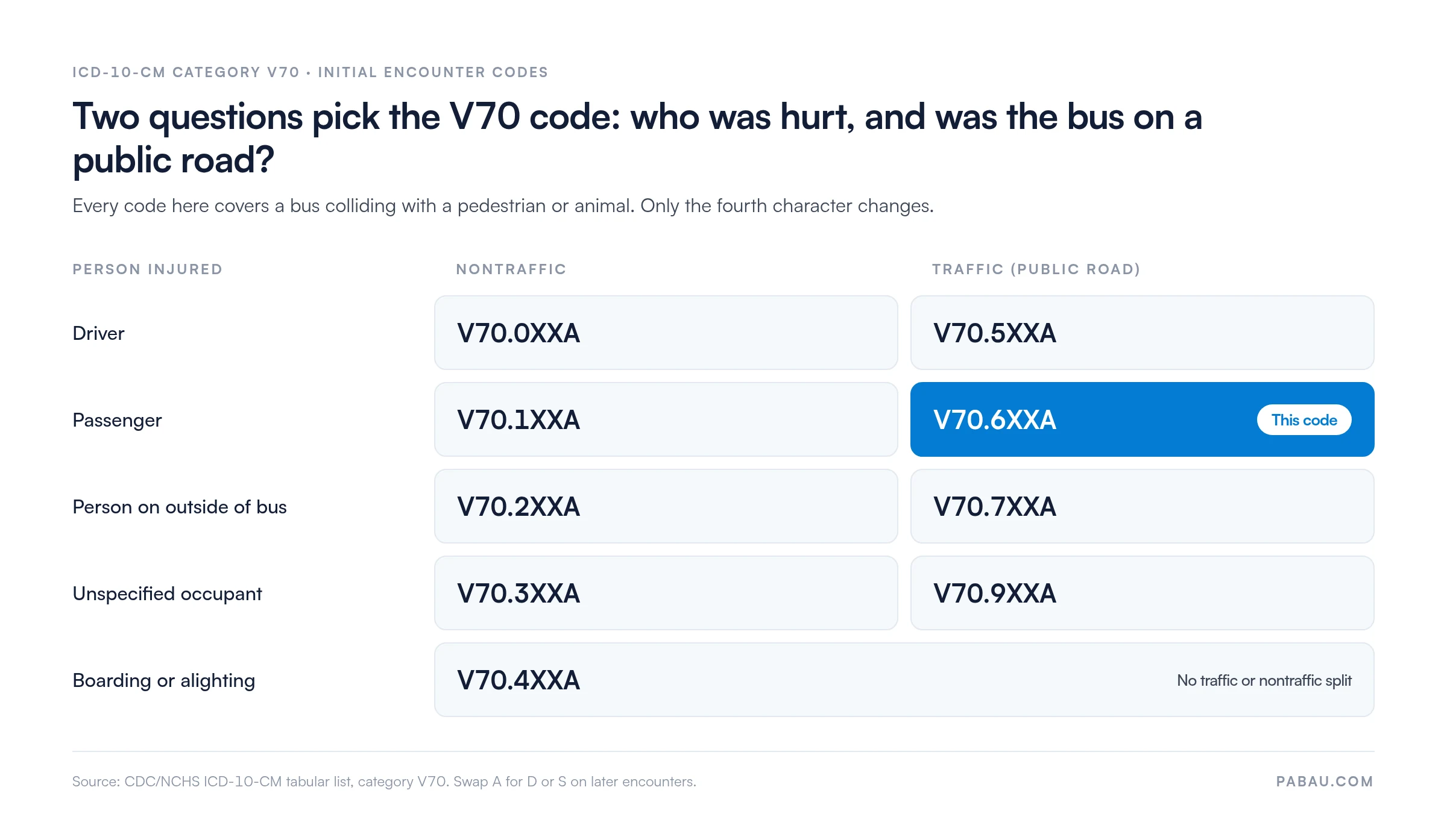
Matrix of ICD-10-CM V70 initial encounter codes by person injured and road status
Pin down the person’s role and the road status, and the V70 code follows from the grid. Codes come from the CDC/NCHS ICD-10-CM tabular list.

The broader hierarchy runs from Chapter 20 (V00-Y99) to transport accidents (V00-V99), then bus occupants (V70-V79), then the collision type. Within V70, the fourth character identifies occupant role and traffic context. V70.6XXA is the only code that pairs passenger with traffic for a pedestrian or animal collision.

Commonly confused codes, and how to pick the right one

The codes below get swapped with V70.6XXA most often. The differentiator is almost always occupant role, collision object or encounter phase. For neighboring categories, our diagnostic code library lists each one with its own guide.

CodeKey differentiatorUse instead when…
V70.5XXABus driver, not passengerThe patient was driving the bus at the time of the collision
V70.1XXAPassenger, nontrafficThe accident happened on private property or off a public roadway
V70.6XXDSubsequent encounter, same eventActive treatment has ended and the patient is in routine recovery care
V70.6XXSSequela (late effect)The visit is for a residual condition caused by the original injury
V73.6XXABus occupant, collision with carThe bus collided with a car, pick-up truck or van
V79.3XXABus occupant (unspecified) injured in unspecified nontraffic accidentThe record names a nontraffic bus accident but not the occupant role or collision type

Pro Tip

Check the medical record for three items before assigning V70.6XXA. First, the patient was a passenger riding on the bus, not the driver or someone boarding. Second, the bus collided with a pedestrian or animal, not another vehicle. Third, the accident happened on a public road. Missing any one of these moves the code to a V70 sibling or another V70-V79 category.

Sequence V70.6XXA after the injury code, every time

V70.6XXA is an external cause code, so it can never be sequenced as the principal diagnosis. It explains how the injury happened, while the injury code explains what happened to the patient.

Good medical billing fundamentals start with that order, and transport injury claims fail predictably when it slips.

  1. Code the injury first: Assign the diagnosis code that describes the injury. For example, S72.001A reports a closed fracture of the neck of the right femur, part unspecified, at the initial encounter.
  2. Add V70.6XXA as an additional code: Place it after the injury code or codes in the claim’s diagnosis fields.
  3. Add companion codes where they apply: Include place of occurrence (Y92), activity (Y93) and external cause status (Y99) when the documentation supports them.

Companion codes go on the first claim only

The Y92, Y93 and Y99 codes are reported once, at the initial encounter for treatment. Status code Y99.8 covers leisure and other non-work activity. Some payers want all three, while others accept the injury and cause codes alone, so check the payer’s rules before submitting.

Code categoryExampleWhat it documents
Y92, place of occurrenceY92.410, unspecified street and highwayWhere the accident happened
Y93, activity codeY93.89, activity, other specifiedWhat the patient was doing at the time of injury
Y99, external cause statusY99.8, other external cause statusWhether the activity was work-related, leisure or something else

A worked example: One collision, two claims

A city bus strikes a deer on a highway, and a passenger fractures the neck of the right femur. The patient was heading home from a shopping trip, which counts as leisure. The emergency department claim lists the codes in this order:

  1. S72.001A, the injury, always first.
  2. V70.6XXA, the external cause.
  3. Y92.410, the place of occurrence.
  4. Y99.8, the external cause status.

Surgery and inpatient care keep the “A” on both codes. Six weeks later, active treatment has ended and the patient returns for a routine healing check. That claim carries S72.001D and V70.6XXD, and the Y92 and Y99 codes stay off it because they were already reported.

Documentation the record must show before you assign V70.6XXA

The clinical documentation has to establish four facts to support V70.6XXA. If any of them is missing or vague, query the provider before you code, because an unsupported external cause code invites an audit.

  • Passenger role confirmed: The record shows a passenger riding on the bus. It rules out the driver, someone boarding or alighting, and a pedestrian struck by the bus. Emergency department notes, EMS run sheets and police reports referenced in the record often carry this detail.
  • Vehicle identified as a bus: “Public transit bus”, “school bus”, “motor coach” and “charter bus” all qualify. Minibuses, vans and personal vehicles fall under V50-V59, not V70.
  • Collision object is a pedestrian or animal: The record shows the bus struck, or was struck by, a pedestrian or animal. If a car, pick-up truck or van was involved, the code sits in V73 instead.
  • Encounter type is active treatment: The visit note shows the provider is actively treating the injury. Surgical treatment, emergency care and evaluation and continuing treatment by the physician all count.

Two documentation habits draw the most audit attention. One is a triage note that says “MVA” without naming the vehicle type or occupant role. The other is a note dated weeks after the accident that keeps the “A” without showing that active treatment is still going.

Before you submit: A five-point check for V70.6XXA claims

Run this check on every claim that carries V70.6XXA. Each item maps to a rejection or denial that shows up on transport injury claims.

  • Order: V70.6XXA sits after the injury code, never in the first diagnosis position.
  • Length: The code has all seven characters, including both X placeholders.
  • Phase: The 7th character matches the injury code’s 7th character and the phase documented in the visit note.
  • Companions: Y92, Y93 and Y99 codes appear on the initial encounter only, and only when the payer wants them.
  • Support: The note names a passenger, a bus, a pedestrian or animal, and a public road.

Payer rules for external cause codes vary more than you’d expect

There is no national rule that makes external cause codes mandatory. The ICD-10-CM Official Guidelines require them only where a state mandate or a payer calls for them. That makes the payer mix the deciding factor for transport injury claims.

  • Medicaid and state mandates: Some states require external cause reporting, and requirements vary by state. Check the specific state Medicaid bulletin.
  • Workers’ compensation: Workers’ comp payers commonly ask for external cause codes, because they help show whether the injury happened at work.
  • Auto insurance (PIP/MedPay): Personal injury protection and medical payments carriers often ask for transport codes to match the claim to the accident. V70.6XXA shows the insured was a bus passenger, not a driver.
  • Commercial health plans: Requirements vary by plan. Some want external cause codes only on inpatient claims, while others want them on every injury-related encounter, so check the provider manual.
  • Medicare: Medicare doesn’t require external cause codes for payment, but it accepts them. Including them is still good practice.

For clean claim submission, pair V70.6XXA with the correct injury code and every companion code the payer needs on the first submission. That cuts the back-and-forth of information requests.

Common denial reasons for V70.6XXA, and the fix for each

External cause codes on transport injury claims fail in predictable ways. Each denial below maps to one coding or documentation error.

Denial reasonRoot causeCorrection
Invalid principal diagnosisV70.6XXA submitted as the first-listed codeMove V70.6XXA to an additional position and list the injury code first
Invalid code, wrong character countV70.6A submitted with the placeholder XX left outUse the full 7-character code V70.6XXA with both X placeholders
Wrong 7th characterV70.6XXD used while the patient is still in active treatmentUse A during active treatment, and switch to D only after it ends
Missing injury codeExternal cause code submitted without a diagnosis codeAlways pair V70.6XXA with the specific injury code or codes from Chapter 19
Missing place of occurrenceThe payer requires a Y92 code and the claim has noneAdd the Y92 code when the documentation supports it and the payer requires it

Catch the placeholder and sequencing errors before submission, because both trigger automatic rejections rather than human review. A steady process for denial management in healthcare then handles whatever still comes back.

Chapter 20 guideline rules that shape every V70.6XXA claim

Section I.C.20 of the ICD-10-CM Official Guidelines for Coding and Reporting governs external cause codes, including ICD-10 code V70.6XXA. The AAPC’s ICD-10-CM code lookup lets coders confirm code validity before they submit.

These are the Section I.C.20 rules that matter most for this code.

  • Never the principal diagnosis: In the guideline’s own words, “An external cause code can never be a principal (first-listed) diagnosis.” The rule applies to outpatient claims too.
  • Report as many external cause codes as needed: When one accident involves several events, code each external cause. A collision followed by a fall from the bus is one example.
  • Transport accidents rank high: When more than one external cause applies, transport accidents come first, behind only abuse, terrorism and cataclysmic events.
  • Intent defaults to accidental: All transport accident categories assume accidental intent unless the record says otherwise.
  • Sequela coding: At a sequela visit, list the late effect first. The injury code and the external cause code follow it, both with 7th character S.

Clearinghouses run front-end edits on every claim, and an external cause code in the first diagnosis slot can trip them. Our guide to medical claims clearinghouse workflows explains what happens to a claim between the practice and the payer.

How Pabau keeps transport injury claims moving from note to payer

On many teams, a coder reads the visit note, retypes the injury and external cause codes into a claim form, then chases missing policy details. Each handoff is a chance for a code to land in the wrong slot.

Pabau, the practice management platform we build, includes claims software for practices that bill US payers. It pre-fills the CMS-1500 from the patient record and gives coders an ICD-10-CM lookup library. It also checks that required claim fields, such as membership numbers and authorization codes, are complete before the claim can be sent.

Claims then go out through Claim.MD, which connects to thousands of US payers. Your team can run eligibility checks before the visit and post ERA remittances when payment arrives.
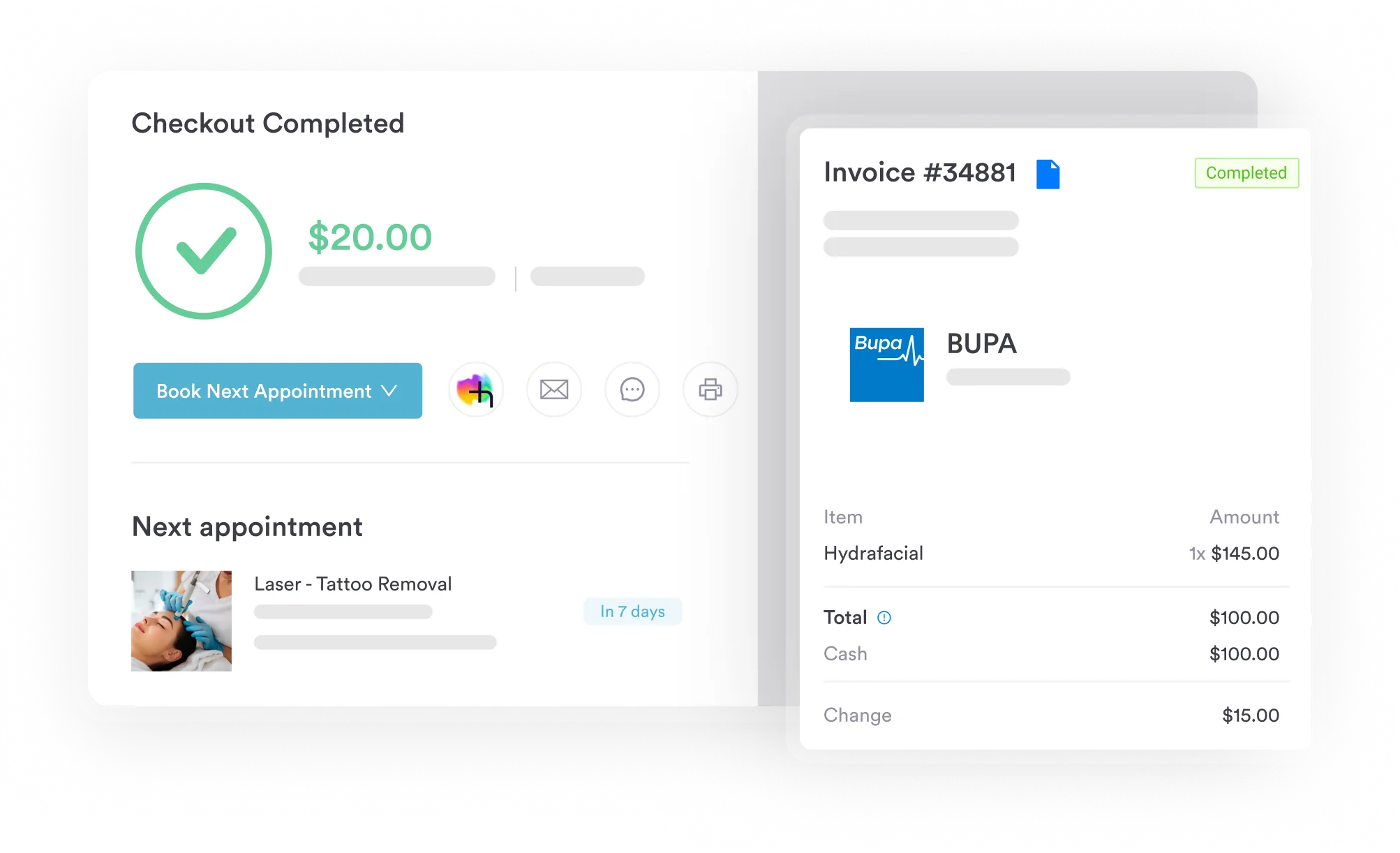
Pabau claims and billing screen
Pabau’s claims and billing tools pre-fill the claim from the patient record, so coders spend their time on code order instead of retyping.

Send transport injury claims with fewer reworks

Pabau pre-fills claims from the patient record and supports ICD-10-CM coded claim submission through Claim.MD. See how it works for your practice.

Pabau claims management dashboard

Conclusion

V70.6XXA rewards a coder who confirms three things before assigning it: occupant role, collision object and road status. Get those right, keep the code behind the injury code, and match its 7th character to the injury code’s. Most of the denials in this guide then never happen.

The trade-off worth remembering is time. A query to the provider about a vague “MVA” note costs minutes, while a denied claim costs weeks.

Pabau supports ICD-10-CM coded claim submission through Claim.MD, with claims pre-filled from the patient record. Book a demo to see how your transport injury claims would move from visit note to payer.

Continue your research

Continue your research

Need a foundation for understanding medical billing workflows? What is medical billing explains the end-to-end claims process from patient encounter to payment posting.

Seeing claim rejections you can’t diagnose? Denial management in healthcare covers the most common rejection categories and how to resolve them systematically.

Want to understand how clearinghouses fit into the claims process? Medical claims clearinghouse workflows explains what happens to a claim between the practice and the payer.

Got a reason code on the remittance you don’t recognize? Denial codes in medical billing breaks down the codes payers use to explain a denied or adjusted claim.

Frequently asked questions

What code applies if the bus hits a cyclist instead of a pedestrian?

Collisions with a pedal cycle sit in category V71, not V70. A passenger hurt in a traffic collision between a bus and a cyclist takes V71.6XXA at the initial encounter. The occupant and road rules work the same way.

Which code applies if the bus collides with a horse and rider?

An animal being ridden, or an animal-drawn vehicle, is coded as a nonmotor vehicle rather than an animal. For bus occupants, those collisions fall under V76. V70 covers loose animals such as deer, dogs or livestock.

What if the bus brakes hard to avoid a pedestrian and hits no one?

With no collision, V70 doesn’t apply. Injuries from sudden braking or swerving without impact are coded as a noncollision transport accident, category V78 for bus occupants. A passenger in traffic takes V78.6XXA.

Does V70.6XXA cover a tour bus or an airport shuttle?

Yes, if the vehicle is designed to carry more than 10 people. ICD-10-CM defines a bus by its capacity, not its route or owner. A smaller shuttle van is coded in V50-V59 instead.


Avatar photo
Monika Lazarevska
Content Writer

Monika Lazarevska writes content for owners and healthcare professionals who want clear, no-fluff content that actually helps them run their practice better. With a background in storytelling and SEO, she knows how to make even the driest topics worth reading. Off the clock, you'll find her in a café somewhere in Europe, probably with a good book and an even better coffee.
×