ICD-10 code S31.30XD – Open wound of scrotum and testes
ICD-10 code S31.30XD covers a scrotal or testicular wound at follow-up ICD-10 co...

Last Updated: Nov 2, 2026
Billable Code Specific Code
V74.5XXS is the billable ICD-10-CM code for driver of bus injured in collision with heavy transport vehicle or bus in traffic accident, sequela. It identifies the cause of a residual condition that a bus driver still carries after the original crash injury has healed.
Use it as a secondary code at a sequela visit. The residual condition is listed first, then the injury code with 7th character S, then V74.5XXS. While the injury is still healing, the D (subsequent encounter) character applies instead.
Let Pabau's smart automation suggest the right codes, reduce claim denials, and keep your practice compliant—effortlessly.
Automate repetitive tasks and focus on what matters most—your patients.
Reduce coding errors and ensure compliance with the latest regulations.
Clean claims, fewer denials, and faster reimbursements.
Powerful insights and reporting to help your practice thrive.
HIPAA compliant SOC 2 certified GDPR-compliant Trusted by 4,000+ clinics worldwide

V74.5XXS codes the cause of a bus driver’s sequela after a traffic collision with a heavy transport vehicle or bus.
The seventh character S applies only after the original injury has healed and the visit treats a residual condition.
V74.5XXS is never first-listed. The residual condition goes first, the injury code with 7th character S second, and V74.5XXS third.
No-Fault or PIP auto coverage may be the primary payer for sequela care, so confirm coordination of benefits before billing the health plan.
Pabau’s claims management software scrubs claims for missing or invalid details before submission.
ICD-10 Code V74.5XXS is the billable external cause code for a sequela visit by a bus driver hurt in a traffic collision.
The other vehicle is a heavy transport vehicle or another bus. The code sits in Chapter 20 of the ICD-10-CM Tabular List and is always a secondary code. Use the table below to confirm the code details before building a claim.
The full descriptor packs five distinct clinical and circumstantial elements into a single code. Each element must be supported by the medical record or the code does not apply.
Residual conditions that commonly pair with ICD-10 Code V74.5XXS include chronic post-traumatic cervical pain, lumbar disc injury sequela, and post-concussion syndrome. Peripheral nerve damage and musculoskeletal dysfunction that persist after fracture healing are common too. The sequela code documents the accident’s causal chain, not the nature of the residual condition itself.
Injury and external cause codes in ICD-10-CM take one of three seventh characters. A marks the initial encounter, D a subsequent encounter during healing, and S a sequela. Because all three share the same base code, the wrong character is an easy slip on bus accident claims.
The S seventh character requires a clinical determination by the treating provider, not the coder. The note must state that the original injury has healed. It must also say the current problem is a direct late effect of that injury. Coders who select S based on time elapsed alone, without a provider statement, are applying the character incorrectly and expose the practice to audit risk.
All three codes share the same base descriptor. The seventh character alone controls which phase of care is being documented. The table below shows when each variant applies and the documentation the record must contain.
Read the provider’s note for the problem being treated. While it still names the original injury, use the D character. Once it describes a residual condition from a healed injury, shift to S. Time alone does not determine encounter type.
V74.5 is one of nine sub-codes within the V74 category. Confusing the driver position with a passenger position is the sub-code error to watch for, and the AAPC ICD-10-CM code reference lists each one. The table below maps the full V74 block.
Adjacent blocks to know: V73 covers bus occupants injured in collision with a car, pick-up truck, or van. V75 covers collision with a railway train. V79 covers bus occupants in unspecified transport accidents. Selecting V73 when the collision partner was a heavy transport vehicle is a specificity error that reduces claim accuracy.
External cause codes are supplementary codes, per the ICD-10-CM Official Guidelines for Coding and Reporting (Section I.C.20.a). They are never the principal or first-listed diagnosis. V74.5XXS always follows the residual condition being treated and the injury code that caused it.
The correct sequencing order for a sequela claim is:
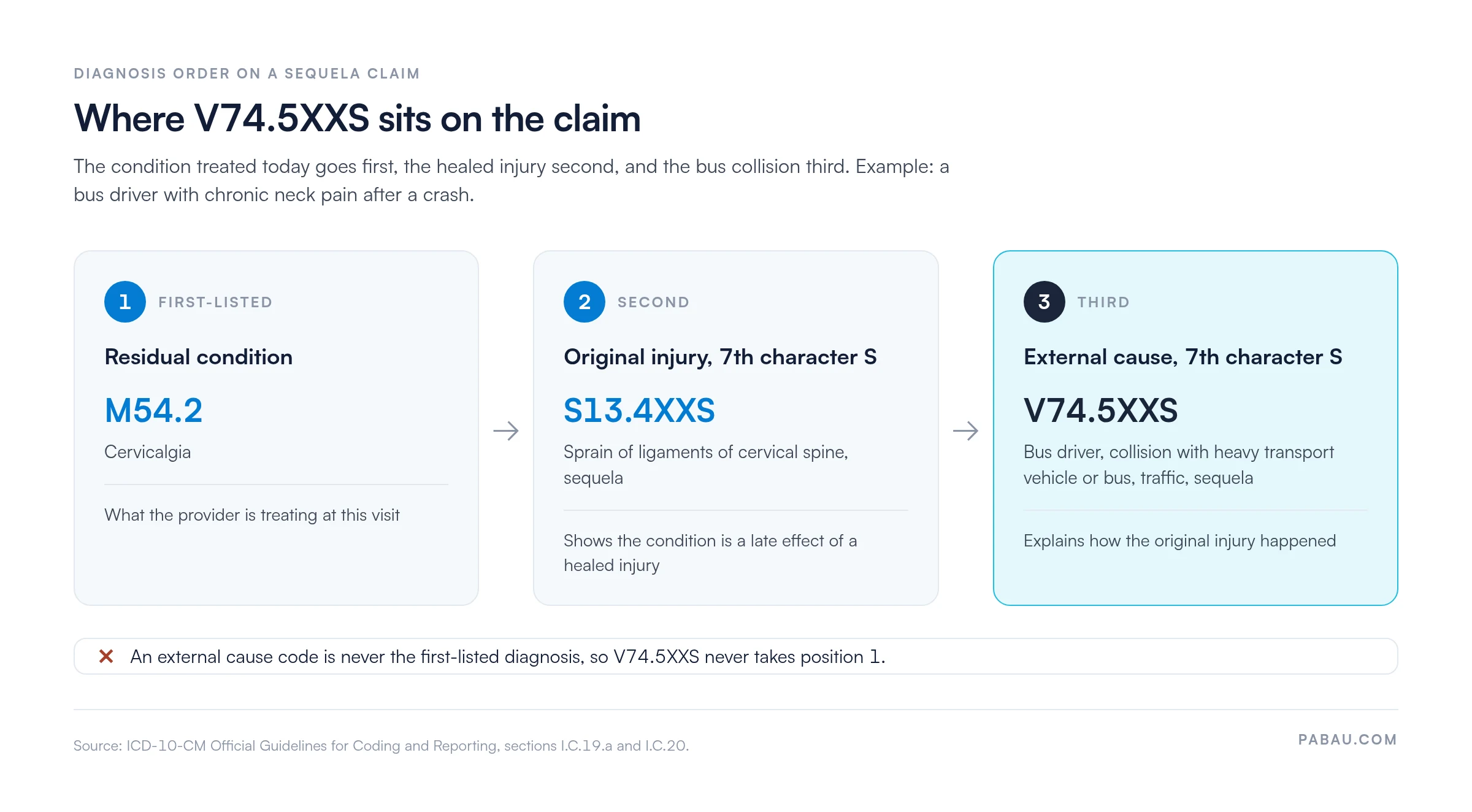
A common submission error is listing V74.5XXS in position one. Claims that list an external cause code as the primary diagnosis may be rejected or denied. The fix is a corrected claim with the residual condition moved to position one.
Before finalizing sequela claims, confirm the provider’s note explicitly states that the original bus collision injury has resolved. Document the note date that established resolution. Payers may look harder at sequela claims, because late-effect liability can shift to an auto insurer rather than the health plan.
The clinical record must support every element of the code descriptor. Incomplete documentation is a common cause of V74.5XXS denials. A structured approach to medical billing compliance makes each element easy to prove in an audit. The checklist below maps each code element to the record it needs.
Accident reports, police records, or occupational health incident documentation can supplement the clinical note when confirming vehicle type and collision partner. Coders should never make clinical determinations about whether the original injury has resolved; that statement must come from the provider.
External cause codes in Chapter 20 are required by some payers and optional for others, so check payer policy before submission. Medicare sets no national requirement to report external cause codes. Follow your Medicare Administrative Contractor’s (MAC’s) and any state or payer mandate. The CMS ICD-10 codes guidance carries the current fiscal year’s code set and guidelines.
Bus accident claims also need coordination of benefits with automobile insurance. When the accident involved a commercial bus, No-Fault or personal injury protection (PIP) coverage may be the primary payer for sequela treatment. The patient’s health plan is then secondary. Missing this step triggers coordination-of-benefits (COB) denials that can delay payment by weeks.
Key payer-specific considerations when submitting ICD-10 Code V74.5XXS claims:
Denials on V74.5XXS claims tend to trace back to sequencing errors, the wrong seventh character, or provider notes that leave out a required element. The table below lists five denial types to watch for and the corrective action for each. Effective denial management in healthcare starts with catching these patterns before submission rather than on appeal.
Understanding the specific denial codes a payer returns helps billing staff route appeals correctly. A CO-4 denial (procedure inconsistent with modifier) looks different from a CO-16 (claim lacks information) and requires a different response. Practices can also use clean claim submission checklists to catch these errors at the point of charge entry rather than post-payment.
Chapter 20 (V00-Y99) covers the external causes of morbidity, including all transport accidents, falls, assaults, and environmental events. The CDC/NCHS ICD-10-CM web tool provides the authoritative searchable Tabular List for this chapter. V74.5XXS sits within the transport accident block (V01-V99), specifically under the bus occupant block (V70-V79).
External cause codes in Chapter 20 are never reported as standalone diagnoses. They provide context for how an injury occurred and for which party is financially responsible. In multi-code claims involving accident injuries, the Chapter 20 code always supplements the injury or residual condition code rather than replacing it. Payers use this code to identify claims that may trigger subrogation recovery from third-party liability carriers.
Practices managing high volumes of accident-related claims benefit from integrating external cause code reporting into their standard charge-capture workflow. Knowing where these codes sit in revenue cycle management helps billing teams focus appeal work on the claims most likely to hit COB disputes.
Cross-reference V74.5XXS in the CDC/NCHS ICD-10-CM tool or the AAPC code lookup to confirm current fiscal year validity. Before submitting sequela claims, check for any local coverage determination (LCD) or payer policy linked to this code range.
A sequela claim like this usually passes through several hands. The coder orders the codes, someone checks auto and health coverage, and the claim goes to the clearinghouse. A missing detail often surfaces only when the payer rejects it.
Practices submitting these claims through Pabau’s claims management software open each claim pre-filled from the invoice. Pabau scrubs claims for missing or invalid details before submission, so the fix happens before the claim leaves the practice. US claims then go through the Claim.MD clearinghouse to thousands of US payers.
Real-time eligibility checks through Claim.MD show the patient’s coverage before the visit. That helps your team spot whether auto insurance or the health plan should pay first for accident-related sequela care. If a claim still comes back rejected, Pabau flags it as Needs action and shows the reason, so staff can correct and resubmit it.

Pabau’s claims management tools scrub claims for missing or invalid details before submission, then route them through Claim.MD to thousands of US payers. See how it works in a live demo.

V74.5XXS rarely causes trouble on its own. The claims that stall are the ones where the provider note never says the injury healed, or the codes go out in the wrong order.
So make the provider’s resolution statement a required check before anyone selects S, and confirm whether auto insurance pays first. That costs a minute at charge entry, against weeks lost to a COB denial or a corrected claim.
Those checks belong early in the medical billing process, before submission rather than after a rejection. Book a demo to see how Pabau checks accident-related claims for missing details before they reach the payer.

Need to understand denial codes returned on rejected claims? Denial codes in medical billing explains the most common CARC and RARC codes and how to respond to each.
Looking for a clearinghouse that connects to thousands of US payers? The Claim.MD clearinghouse guide covers how the integration works, what payers it supports, and how it handles ERA remittances.
Want to build a clean-claim workflow for accident-related codes? Medical billing compliance covers documentation standards, audit readiness, and the policies practices need to have in place.
ICD-10 Code V74.5XXS is the external cause code for a bus driver injured in a traffic collision with a heavy transport vehicle or another bus. It applies at the sequela stage. It records how a residual condition began once the original crash injury healed. It is always a secondary code, listed after the residual condition and the injury code with 7th character S.
Use S when the original bus collision injury has resolved and the visit treats a late effect, such as chronic post-traumatic pain or nerve damage. The treating provider, not the coder, must document that the injury has healed and that the current condition is a sequela.
V74.5XXA applies to the initial encounter, when the patient receives active treatment for the bus collision injury itself. V74.5XXS applies only after that injury has healed and the visit addresses a residual condition caused by the accident. Using A at a sequela visit, or S during active treatment, is incorrect and can lead to a denial.
No. Per ICD-10-CM Official Guidelines Section I.C.20.a, Chapter 20 external cause codes are never sequenced as the principal or first-listed diagnosis. Claims that list V74.5XXS first may be rejected or denied. The residual condition goes in position one, followed by the injury code with 7th character S, then V74.5XXS.
No. Medicare sets no national requirement to report external cause codes. Follow your Medicare Administrative Contractor’s (MAC’s) and any state or payer mandate. Check those requirements again when the code set updates each fiscal year.
Common sequela conditions paired with V74.5XXS include chronic post-traumatic cervical or lumbar pain, lasting nerve damage, and post-concussion syndrome. Scar tissue complications and musculoskeletal dysfunction after fracture healing also qualify. The treating provider must document the causal link to the original bus accident in the clinical record.