ICD-10 Code S82.242H: Displaced spiral tibial shaft fracture, delayed healing
ICD-10 Code S82.242H: Definition and code details ICD-10 Code S82.242H designate...

Last Updated: Oct 15, 2026
Billable Code Specific Code
V46.1XXS is the billable ICD-10-CM code for car passenger injured in collision with other nonmotor vehicle in nontraffic accident, sequela. The other vehicle is a streetcar, an animal-drawn vehicle, or an animal being ridden.
The 7th character "S" marks a sequela encounter, so the visit treats a late effect of the collision. Assign it only once the original injury has resolved. A collision on a public road takes V46.6 instead.
Let Pabau's smart automation suggest the right codes, reduce claim denials, and keep your practice compliant—effortlessly.
Automate repetitive tasks and focus on what matters most—your patients.
Reduce coding errors and ensure compliance with the latest regulations.
Clean claims, fewer denials, and faster reimbursements.
Powerful insights and reporting to help your practice thrive.
HIPAA compliant SOC 2 certified GDPR-compliant Trusted by 4,000+ clinics worldwide

V46.1XXS covers a car passenger, not the driver, injured in a nontraffic collision with another nonmotor vehicle. That means a streetcar, an animal-drawn vehicle, or an animal being ridden.
Do not confuse V46 with V44, which covers collisions with a heavy transport vehicle or bus. Mixing the two is the most common error on this code.
The 7th character ‘S’ marks a sequela encounter, where the visit treats a late effect of the injury rather than the injury itself.
This is an external cause code from the V00-Y99 chapter, so it cannot stand alone as the principal diagnosis. It must accompany a primary nature-of-injury code.
Pabau’s claims management software validates billable status and links external cause codes to primary injury codes before submission, reducing sequela-related denials.
ICD-10 code V46.1XXS is a valid, billable ICD-10-CM code in the fiscal year 2026 edition, which took effect on October 1, 2025. Its full official descriptor is: Car passenger injured in collision with other nonmotor vehicle in nontraffic accident, sequela.
The code belongs to the V00-Y99 external cause of morbidity chapter. That placement means it supplements a primary injury code rather than replacing it.
The phrase “other nonmotor vehicle” is defined by the inclusion note under V46. It covers a streetcar, an animal-drawn vehicle, and an animal being ridden. A collision with a truck or a bus is coded to V44 instead. A collision with another car, a pick-up truck, or a van belongs to V43.
A pedal cycle is not on that V46 list, so a collision with one falls outside the category. A pick-up truck or van passenger struck by a pedal cycle off a public road takes V51.1XXS for the sequela visit.
Who was hurt matters as much as the counterpart, since every V46 code describes a car occupant. A pedestrian on foot hit by a streetcar or an animal-drawn vehicle moves to V06 instead. When the note never says whether the collision happened on a public road, the initial encounter is coded V06.90XA.
Two more branches sit just outside V46. A car passenger injured in a traffic collision with a fixed or stationary object belongs to V47, and the subsequent encounter is V47.6XXD. The bus occupants in that V44 crash are coded from V73 instead, and a nontraffic sequela visit for a bus passenger is V73.1XXS.
Because V46.1XXS lives in the external cause chapter, it cannot appear as a standalone claim. The CMS ICD-10-CM coding resources make clear that external cause codes are always secondary to the nature-of-injury code.
Common primary codes here include S13.4XXS for cervical sprain sequela and S14.2XXS for injury of a cervical nerve root, sequela. A cervical spinal cord injury is coded to S14.0 or S14.1 instead, never to S14.2.
The 7th character in ICD-10-CM injury codes indicates the type of encounter. Choosing the wrong one is a frequent reason sequela claims are denied. For the V46.1 code family, three extensions apply.
Per the CDC/NCHS ICD-10-CM official tool and Section I.C.19 of the annual guidelines, the “S” extension carries two conditions. The original injury must have reached maximum medical improvement.
The current visit must be for a residual or late-effect condition traceable to that injury. Common sequelae after these collisions include chronic cervical pain, peripheral neuropathy, PTSD, and post-traumatic arthropathy.
Both D and S apply after the first visit, which is where the two get swapped. A subsequent encounter (D) is used while the patient is still under active treatment for the injury. A sequela encounter (S) is used once the injury itself has resolved and the patient is dealing with a downstream condition it caused.
A nontraffic accident is any transport accident that does not occur on a public roadway open to normal motor vehicle traffic. The distinction is codified in the ICD-10-CM official guidelines. For an injured car passenger it decides between V46.1 (nontraffic) and V46.6 (traffic).
The nontraffic qualifier in V46.1 is meaningful because it shifts liability context and affects how insurers review claims. If the accident occurred on a public road, V46.6 (traffic accident) codes are required. Using V46.1XXS for a public-road collision is a coding error that can result in claim rejection or audit flags.
The V46 category covers every car occupant position injured in a collision with another nonmotor vehicle. The inclusion note names a streetcar, an animal-drawn vehicle, and an animal being ridden. Knowing where V46.1XXS sits in that hierarchy prevents the most common category-level errors.
The placeholder “X” characters in positions 5 and 6 are required by ICD-10-CM convention. When a code has fewer than 6 characters before the 7th character extension, the empty positions must be filled with “X.” Submitting V46.1S without the placeholders will be rejected as an invalid code.
Before choosing between V46.1 and V46.6, confirm the accident location in the clinical note. ‘Parking lot’ or ‘private property’ points to V46.1, the nontraffic code. ‘Road,’ ‘highway,’ or ‘intersection’ points to V46.6, the traffic code. An ambiguous note needs a provider query before the claim goes out.
The ICD-10-CM official guidelines, Section I.C.19, govern how sequela codes for injuries are applied. For injury external cause codes the rule is consistent. Report the sequela code for the nature of the injury together with the external cause sequela code.
Many clearinghouses flag claims where the sequela injury code and the external cause code carry mismatched 7th characters. Both must carry “S.”
ICD-10 code V46.1XXS applies to a narrow clinical situation, and four decisions get you there. The injured person was a car passenger, not the driver and not someone on the outside of the car.
The car collided with another nonmotor vehicle. The accident happened off a public roadway, and the current visit treats a late-effect condition.
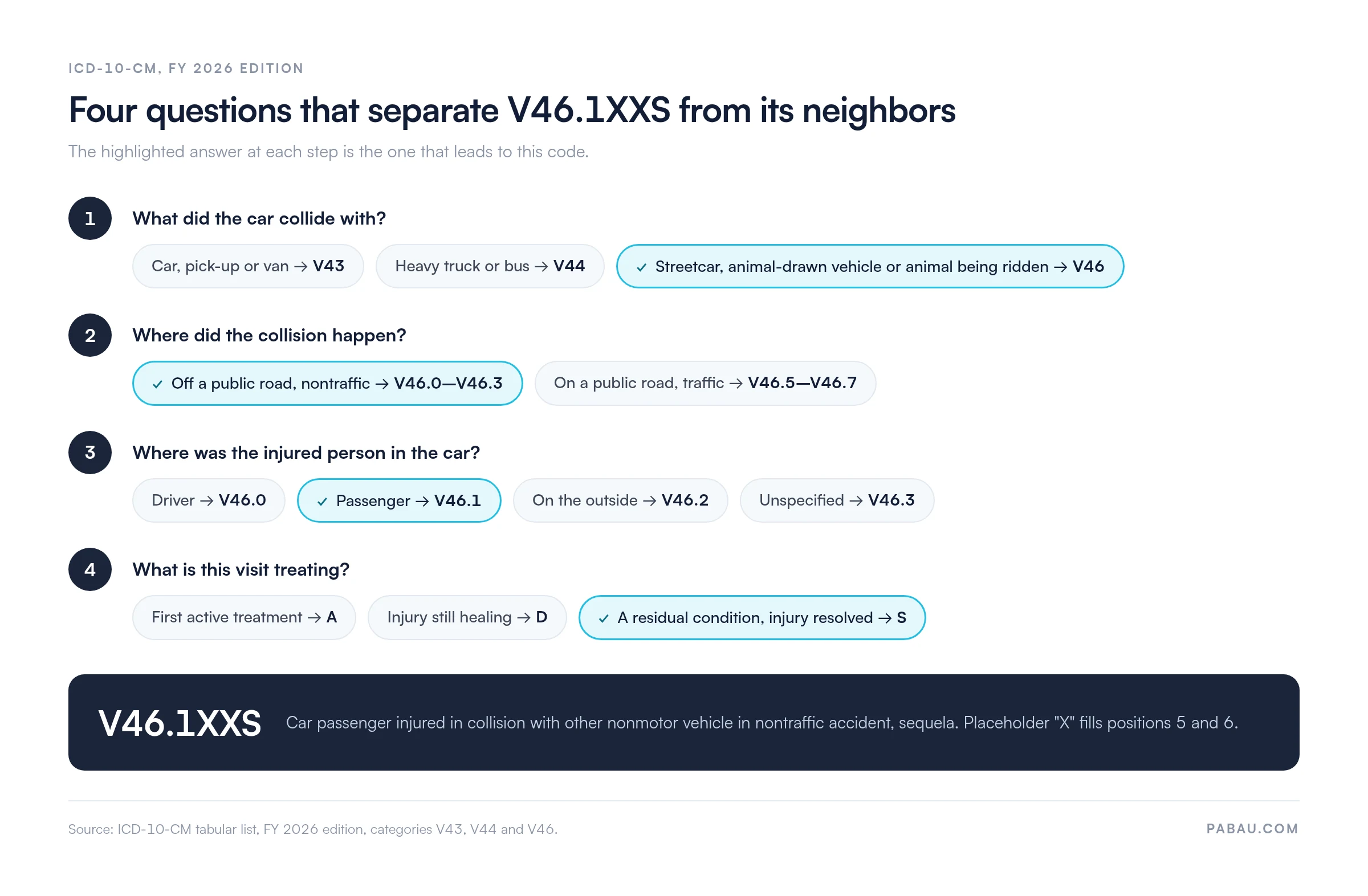
The scenarios below show correct and incorrect application.
Post-traumatic psychiatric conditions such as PTSD, adjustment disorder, and anxiety are among the more common sequelae after a motor vehicle accident. Each one carries its own primary sequela code alongside V46.1XXS.
Sequela claims are audited more rigorously than initial or subsequent encounter claims. Months or years separate the original injury from the current visit, which leaves the causal chain open to question. Payers look for that chain in writing. For clean claim submission, the physician note supporting V46.1XXS must contain all of the following.
A note that documents the residual condition without mentioning the original accident gives a payer grounds to deny on medical necessity. Those denials come back under the same denial codes that cover any other documentation failure. Track them as a group rather than case by case.
The codes most commonly confused with V46.1XXS, or required alongside it, are listed below. After a motor vehicle accident a traumatic brain injury sequela code often carries the principal diagnosis, with V46.1XXS as the secondary external cause code.
Practices submitting these paired combinations can validate the pairing logic inside an integrated billing platform before the claim leaves the practice. Remittance responses then land against the same claim record, so patterns in sequela outcomes surface faster.
For practices working with legacy data or historical claim research, the closest ICD-9-CM equivalents to V46.1XXS are shown below.
The General Equivalence Mappings (GEMs) published by CMS do not produce a one-to-one match. ICD-9 lacked the 7th character encounter-type system, and it classified these accidents by the nonmotor vehicle involved rather than by the car occupant’s position.
The fourth digit in the E826-E829 range identifies the injured person rather than the car occupant position. None of these codes reproduces the driver, passenger, and outside-the-car split that V46 makes. ICD-9 also had no equivalent to the sequela 7th character. Late effects were coded with separate late-effect categories, the E929.x series.
For crosswalk purposes, ResDAC guidance on ICD codes in Medicare files treats GEM mappings from external cause codes as approximate. Have a certified coder review them before using them in retrospective research or billing. Crosswalk codes serve historical analysis only, and ICD-9 codes cannot be submitted on current claims.
When auditing historical sequela claims that originally used ICD-9 late-effect codes, map the original external cause code to its ICD-10-CM equivalent. Doing that inside your claims software keeps the reporting continuous. This matters most in workers’ compensation cases, where a single claim can span the ICD-9-to-10 transition period.
V46.1XXS is an external cause code in the supplementary range, so it will never appear as the first-listed code on a claim. Most US payers accept external cause codes as secondary diagnosis codes on the CMS-1500 form and 837P electronic claims.
Some commercial payers and Medicaid programs designate them as optional rather than required. Confirm payer-specific requirements before assuming they are always needed.
Pabau submits through Claim.MD, our US clearinghouse partner, which reaches thousands of US payers and validates ICD-10-CM code pairings before transmission. That check catches a mismatched 7th character before the claim reaches the payer.
One example is a principal injury code carrying “D” alongside an external cause code carrying “S.” The ERA/835 remittance data is stored against the claim, so denial patterns for sequela pairings can be tracked over time.
Coding a sequela claim by hand means holding two codes at once. The coder looks up the nature-of-injury code, checks its 7th character, then finds the matching external cause code in a separate reference. The patient record itself offers no confirmation that the two agree, so the mismatch surfaces when the payer rejects the claim.
Pabau, practice management software for medical and aesthetic practices, moves that lookup into the encounter. Coders attach V46.1XXS and its paired injury code from inside the patient record. The billing software for practices then flags a 7th-character mismatch before anything is transmitted.
The documentation that supports the claim stays with the record too. The original accident note, the statement of resolution, and the causal link sit in one patient file. An audit request is answered from that file instead of a search across three systems.

Pabau embeds ICD-10-CM code lookup directly in the clinical encounter. Attach V46.1XXS and its paired injury code to a claim without leaving the patient record, then submit it to the clearinghouse in the same workflow.

V46.1XXS is a narrow code, and both decisions that put a claim at risk are decisions about documentation. The first is applying it during active treatment, when the D extension is correct. The second is using it for a collision on a public road, where V46.6XXS applies.
Read the accident note before you pick the 7th character, and query the provider whenever the location or the injury status is unclear. A note that names the place, the occupant position, and the resolution of the original injury will carry the claim on its own.
Pabau surfaces ICD-10-CM code attributes, validates code pairings, and submits to the clearinghouse in a single workflow. Book a demo to see how external cause sequela claims move through it.

Need to understand how clearinghouse submissions work for external cause codes? How Claim.MD clearinghouse works explains the submission and ERA workflow for US practices.
Want to reduce sequela claim denials across your practice? Denial management in healthcare sets out how to work a denial queue and stop the same rejection recurring.
Managing workers’ compensation or auto liability billing? Medical billing compliance outlines the documentation requirements that support external cause code claims in regulated billing contexts.
Tracking where sequela claims lose money? What is revenue cycle management shows where a denied external cause claim sits in the wider revenue cycle.
ICD-10 Code V46.1XXS is the billable ICD-10-CM code for a car passenger injured in collision with another nonmotor vehicle in a nontraffic accident, sequela. The “1” identifies the passenger position, not the driver or a person outside the car. “Nontraffic” means the accident occurred off a public road. “S” marks the encounter as treating a late-effect condition after the original injury has resolved.
The inclusion note under V46 names a streetcar, an animal-drawn vehicle, and an animal being ridden. A collision with a truck or a bus is not coded here, because heavy transport vehicles belong to category V44. A collision with another car, a pick-up truck, or a van belongs to category V43.
Yes, V46.1XXS is a valid and billable ICD-10-CM code for the FY 2026 edition, effective October 1, 2025. It cannot appear as a standalone principal diagnosis because it is an external cause code. It must accompany a primary sequela nature-of-injury code on the claim.
A subsequent encounter (7th character D) is used while the patient is still in active treatment for the original injury. A sequela encounter (7th character S) is used after the original injury has fully resolved. The current visit then treats a residual condition caused by that injury. Using D after the injury has resolved is a common claim error. Payers may deny it as an incorrect encounter type.
A nontraffic accident is any transport accident occurring on private property, or in an area not open to normal motor vehicle traffic. Examples include a parking lot, a private driveway, a factory yard, and agricultural land. If the collision happened on a public road, highway, or street, the accident is classified as a traffic accident. V46.6XXS (passenger, traffic, sequela) applies instead.
Use V46.1XXS when the injured person was a passenger in the car at the time of the nontraffic collision. Use V46.0XXS when the injured person was the driver. The position distinction is explicit in the ICD-10-CM tabular: V46.0 = driver, V46.1 = passenger, V46.2 = person on outside of car.
V46.1XXS became effective October 1, 2025 as part of the FY 2026 ICD-10-CM edition. It was not a new code in that cycle; it carried forward from prior fiscal years. The October 1 effective date marks the start of each new ICD-10-CM fiscal year per the CMS annual update cycle.