

ICD-10 code S61.201A: Open wound of left index finger without nail damage
ICD-10 code S61.201A covers a left index finger wound of unstated type ICD-10 co...

Last Updated: Oct 16, 2026
Billable Code Specific Code
V66.4XXS is the billable ICD-10-CM code for person boarding or alighting a heavy transport vehicle injured in collision with other nonmotor vehicle, sequela.
Coders most often confuse this code on two fronts. They apply the wrong 7th character (D instead of S), or they submit it as a stand-alone primary diagnosis. Both errors can trigger denials. V66.4XXS sits in Chapter 20 of ICD-10-CM, External Causes of Morbidity, and must always accompany the sequela injury code it supplements.
Let Pabau's smart automation suggest the right codes, reduce claim denials, and keep your practice compliant—effortlessly.
Automate repetitive tasks and focus on what matters most—your patients.
Reduce coding errors and ensure compliance with the latest regulations.
Clean claims, fewer denials, and faster reimbursements.
Powerful insights and reporting to help your practice thrive.
HIPAA compliant SOC 2 certified GDPR-compliant Trusted by 4,000+ clinics worldwide

V66.4XXS codes the late effect of an injury to a person boarding or alighting a heavy transport vehicle hit by another nonmotor vehicle.
The 4th character .4 means the person was getting on or off the vehicle, not riding inside it or on its outside.
The other nonmotor vehicle is an animal-drawn vehicle, an animal being ridden, or a streetcar, so collisions with cars or cyclists use other categories.
V66.4XXS is never first-listed: sequence the late-effect condition first, then the original injury code with S, then V66.4XXS.
Place, activity, and status codes (Y92, Y93, Y99) belong to the initial encounter only, so they are not reported with V66.4XXS.
ICD-10 Code V66.4XXS is the billable code for a person boarding or alighting a heavy transport vehicle injured in collision with other nonmotor vehicle, sequela. It is a valid code in the CDC/NCHS ICD-10-CM classification for fiscal year 2027.
The code describes how the original injury happened. The condition treated today is coded separately and listed first. It is reported as a secondary external cause code at encounters for a late effect of that injury.
The hierarchy runs from Chapter 20 (V00-Y99) to block V60-V69, category V66, and subcategory V66.4. The 7th character S then marks the encounter as a sequela encounter.
The 7th character S designates a sequela encounter. The patient is being treated for a late effect of the original injury, such as a scar, chronic pain, or post-traumatic arthritis. ICD-10-CM Official Guidelines Section I.C.19.a defines the three 7th characters used across injury and external cause codes.
V66.4 is a four-character subcategory: the letter V, two digits, and the 4th character 4 after the decimal. Category V66 requires a 7th character, so two placeholder X characters fill the 5th and 6th positions.
Dropping a placeholder produces an invalid code. V66.4S and V66.4XS will both fail clearinghouse edits, so confirm the full seven-character code (V66.4XXS) before the claim leaves the practice.
V66.4XXS applies when the record documents four facts together. The patient was getting on or off a heavy transport vehicle, and another nonmotor vehicle struck them. Today’s visit treats a late effect of that injury. The decision path below shows where each mismatch sends the code instead.
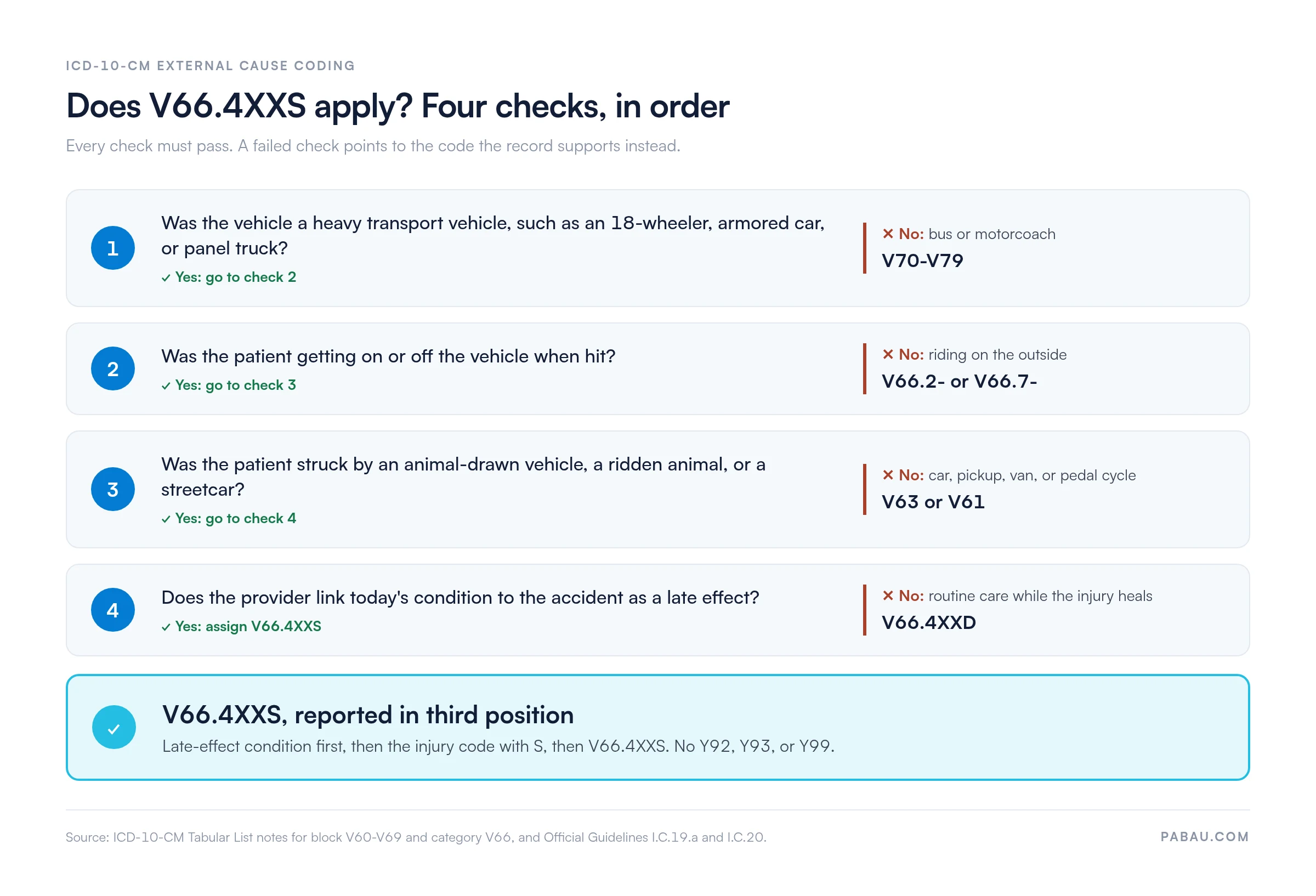
The sequela (S) and subsequent encounter (D) characters are the most commonly confused choice for V66.4 codes. The deciding question is what the provider treats at today’s visit. Elapsed time alone never settles it.
A patient can present six weeks after the accident still in routine healing care, or two years later with a new late effect. The provider’s note decides the 7th character, specifically whether it links the current condition to the accident.
The Tabular List notes for block V60-V69 and category V66 decide whether this category fits at all. Review them before you choose the 4th character.
Category V66 has nine subcategories, set by the person’s position and, for most positions, by traffic status. V66.4 is the only subcategory with no traffic or nontraffic split. The ICD List code browser can help confirm the subcategory when documentation is ambiguous. Our diagnostic codes library covers other Chapter 20 external cause codes in the same format.
The most common mix-up is V66.4 against V66.2 or V66.7. Getting on or off the vehicle is V66.4, while riding on its step, ladder, or cargo bed is V66.2 or V66.7.
V66.4XXS supplements the diagnosis codes and cannot stand alone. ICD-10-CM Official Guidelines Section I.C.20 states that an external cause code can never be a principal or first-listed diagnosis. Report the codes in this order:
Do not add Y92 (place of occurrence), Y93 (activity), or Y99 (external cause status) here. Guidelines Sections I.C.20.b, I.C.20.c, and I.C.20.k limit each of them to the initial encounter for treatment.
For more on building clean claims from these codes, see our guide to medical billing fundamentals.
The medical record must support four facts before V66.4XXS is assigned. The AAPC ICD-10-CM coding reference is a useful check on how each code’s scope is worded.
V66.4XXS is exempt from present-on-admission (POA) reporting. External cause codes in this range appear on the CMS POA exempt list. Inpatient claims carry no Y, N, U, or W indicator for this code.
On the UB-04, leave the POA field blank for V66.4XXS. Check that your billing system does not auto-fill an indicator for Chapter 20 codes.
There is no national requirement to report external cause codes. Reporting depends on state mandates and payer policy. Some commercial payers and state Medicaid programs use them to identify injury claims for liability and coordination of benefits.
For how remittance advice reports denial reasons on these claims, see our guide on reading electronic remittance advice.
Audit your EHR’s external cause defaults every quarter. A reused template can carry V66.4XXD into a sequela visit, or attach Y92, Y93, and Y99 codes that belong to the initial encounter only.
Denials for this code usually trace back to code structure, sequencing, or documentation. Our denial management workflows guide covers the wider process, and the table below covers V66.4XXS.
Sequela claims usually fail on the paperwork. The accident narrative sits in an old ER note, and today’s visit lacks the causal link. Then the claim goes out with V66.4XXS in the wrong slot.
Pabau keeps the treatment note, intake forms, and billing on one patient record. The provider can document the boarding or alighting detail and the causal link where the coder will see them.
Pabau’s claims management software pulls that record into a pre-filled claim and submits it through Claim.MD in the US. Your team then tracks claim status and remittances without leaving Pabau.

Pabau keeps the accident narrative, the provider’s causal link, and the claim on one patient record. Your team submits and tracks external cause claims from the same system.

V66.4XXS fits one narrow situation. A person getting on or off a heavy transport vehicle is hit by an animal-drawn vehicle, a ridden animal, or a streetcar. When the note says the patient was riding on the outside, the right code is V66.2 or V66.7.
Before you assign it, confirm the provider has written the causal link for today’s condition. Then sequence the condition, the injury code with S, and V66.4XXS, and leave the Y codes off. Book a demo to see how Pabau keeps that documentation and the claim on one record.

Need to understand how external cause claims reach payers? Medical claims clearinghouse overview explains how 837P files are validated and transmitted across US payer networks.
Want to reduce denial rates across your coding team? Denial codes in medical billing covers the most common ANSI remark codes and how to respond to each.
Looking for a full overview of what clean claim requirements mean for ICD-10 submissions? Clean claim requirements guide breaks down the submission standards that determine whether a claim processes or suspends.
ICD-10 Code V66.4XXS is the billable code for a person boarding or alighting a heavy transport vehicle injured in collision with other nonmotor vehicle, sequela. The 4th character 4 means the person was getting on or off the vehicle. The 7th character S marks an encounter for a late effect of that injury.
Report the late-effect condition first, then the original injury code with 7th character S, then V66.4XXS. Do not add Y92, Y93, or Y99 codes, because the guidelines limit them to the initial encounter for treatment. V66.4XXS can never be a principal or first-listed diagnosis.
The record must show four facts. The patient was boarding or alighting, the vehicle was a heavy transport vehicle, and an animal-drawn vehicle, ridden animal, or streetcar struck them. The provider must also state that today’s condition results from that accident.
No. There is no national requirement to report external cause codes, and Medicare accepts them without requiring them. Some state Medicaid programs and commercial payers do use them for liability and coordination of benefits, so check each payer’s provider manual.
V66.4XXS covers a person getting on or off the heavy transport vehicle when hit. V66.2XXS covers a person riding on the outside of the vehicle in a nontraffic accident, and V66.7XXS covers the same position in traffic.



