ICD-10 code S61.201A: Open wound of left index finger without nail damage
ICD-10 code S61.201A covers a left index finger wound of unstated type ICD-10 co...

Last Updated: Oct 16, 2026
Billable Code Specific Code
V51.1XXS is the billable ICD-10-CM code for passenger in pick-up truck or van injured in collision with pedal cycle in nontraffic accident, sequela.
The "S" 7th character marks a late-effects encounter. The original collision injury has resolved, and the patient now presents with a residual condition traceable to that crash. Coders often misapply the code during active treatment, when V51.1XXA or V51.1XXD is correct.
Let Pabau's smart automation suggest the right codes, reduce claim denials, and keep your practice compliant—effortlessly.
Automate repetitive tasks and focus on what matters most—your patients.
Reduce coding errors and ensure compliance with the latest regulations.
Clean claims, fewer denials, and faster reimbursements.
Powerful insights and reporting to help your practice thrive.
HIPAA compliant SOC 2 certified GDPR-compliant Trusted by 4,000+ clinics worldwide

V51.1XXS is a billable ICD-10-CM external cause code for a pick-up truck or van passenger hurt in a nontraffic pedal cycle collision.
The 7th character “S” restricts the code to sequela encounters, so the original injury must be resolved before it applies.
V51.1 covers nontraffic collisions only, and the traffic-accident equivalent for a passenger is V51.6XXS.
Always pair V51.1XXS with a principal diagnosis for the residual condition, such as post-traumatic pain, scarring, or a functional deficit.
Pabau validates ICD-10-CM code pairs at the clearinghouse, so sequencing errors surface before the claim reaches the payer.
ICD-10 Code V51.1XXS is the billable ICD-10-CM code for the sequela of a pick-up truck or van passenger. The injury came from a collision with a pedal cycle in a nontraffic accident. The code sits in the external causes of morbidity chapter (V00-Y99), under category V51.
A nontraffic accident happened somewhere other than a public highway. Parking lots, driveways, farm tracks, and private land all qualify. If the same collision happened in traffic, the passenger sequela code is V51.6XXS instead.
As an external cause code, V51.1XXS never stands alone on a claim. It supplements the principal diagnosis that describes the residual condition the patient presents with. According to the CMS ICD-10-CM code set, external cause codes are always secondary to the nature-of-injury or condition code.
On a claim, V51.1XXS goes in alongside the primary code for the late-effects condition. That might be chronic pain, a musculoskeletal limitation, or disfigurement traced back to the original collision.
The 7th character “S” designates sequela, meaning the patient is being treated for a late effect rather than an active injury. Under ICD-10-CM Official Guidelines Section I.C.19, sequela coding applies only after the acute injury phase has resolved. A residual condition such as pain, limited range of motion, scarring, or neurological deficit becomes the reason for the visit.
Three 7th characters apply across the V51 category:
The sequela code is always reported alongside the condition code for the residual. A patient with post-traumatic headache from the collision gets the headache code first, then V51.1XXS as the external cause. Reversing that order is a common sequencing error that triggers claim edits.
The official clinical description is: Passenger in pick-up truck or van injured in collision with pedal cycle in nontraffic accident, sequela. That descriptor pins down five variables at once: vehicle type, occupant role, collision party, accident setting, and encounter phase.
Coders and clinical documentation systems phrase the same scenario in several ways. None of the wordings below appears in the CDC/NCHS tabular list, which carries only the formal descriptor above.
These phrasings matter for query-based coding systems and natural-language documentation matching. If a physician’s note describes the late-effects visit in any of these terms, V51.1XXS is still the code to use.
Confirm the vehicle type before you reach for a V51 code. Pick-up trucks and vans are V51. A car occupant hit by a pedal cycle belongs in V41, and a heavy transport vehicle occupant in V61. Coding the wrong vehicle class puts the claim in the wrong category entirely, which payers do catch.
V51.1XXS sits three levels deep in the ICD-10-CM external cause hierarchy. Knowing the parent structure helps you navigate to sibling codes for drivers, unspecified occupants, and other encounter types. The CDC/NCHS ICD-10-CM web tool publishes the official tabular list for each fiscal year edition.
Within the nontraffic half of V51, the subcategories split by who was hurt. V51.0 is the driver, V51.1 the passenger, V51.2 a person riding on the outside, and V51.3 an occupant whose role was never documented.
Query the record before defaulting to V51.3, because an unspecified occupant attracts extra documentation requests from payers.
The traffic and nontraffic halves of the category run in parallel, and a single wrong column changes the code. The grid below maps every combination.
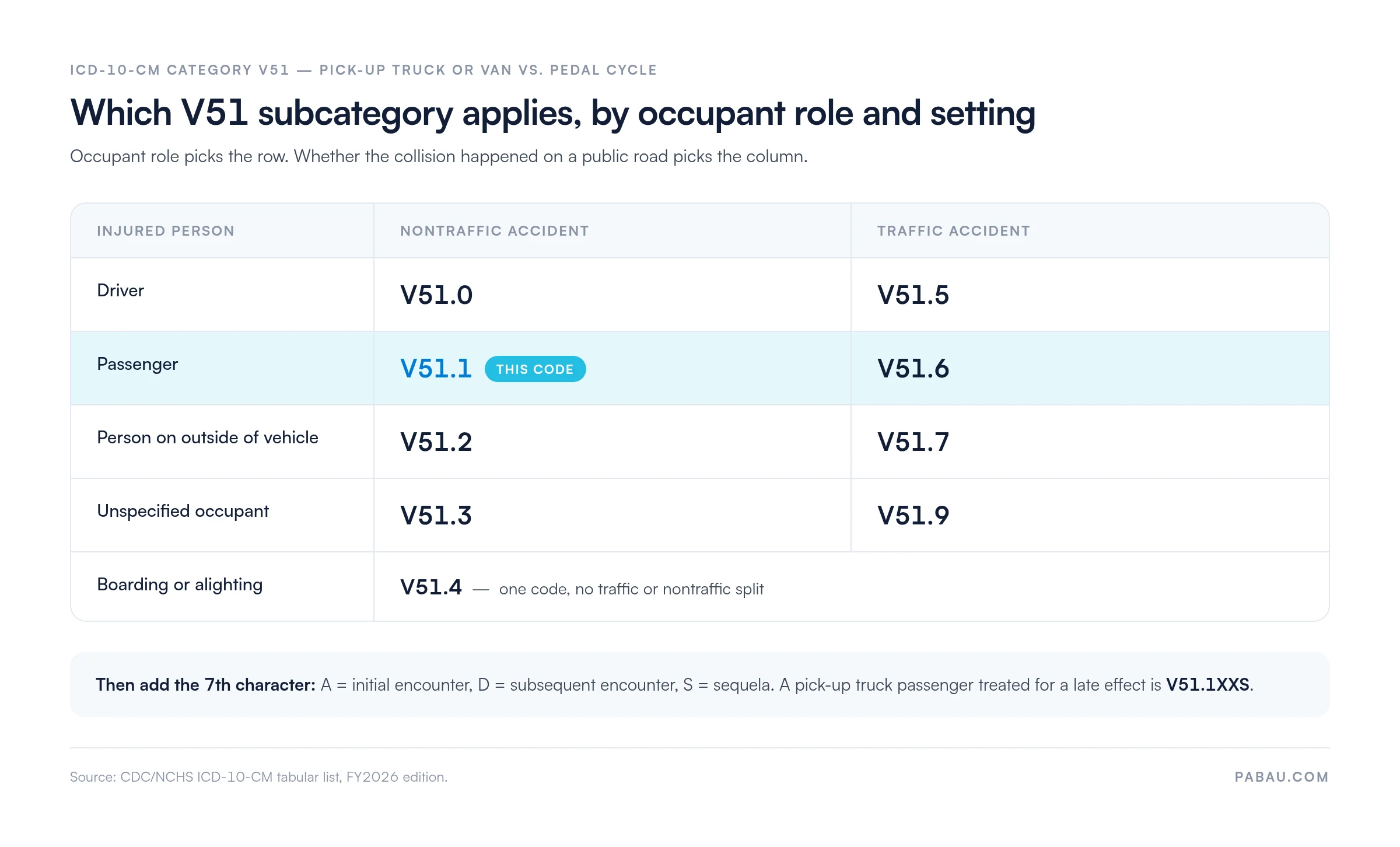
Picking the right neighboring code turns on three variables. They are the vehicle the injured person occupied, their role in it, and whether the crash happened in traffic. The table below covers the codes most often confused with V51.1XXS.
The other party in the crash moves the category as well. A person injured while boarding or alighting a pick-up truck or van that collides with a railway train is coded V55.4XXD. Its D character marks a subsequent encounter, so it does not cover the sequela phase.
The same logic applies when no second vehicle is involved. A pick-up truck or van that strikes a pole or a wall belongs in V57. An unspecified occupant seen at follow-up after such a traffic accident takes V57.9XXD. Where a heavy transport vehicle hit the object and the occupant’s role went undocumented, the initial traffic encounter is V67.9XXA.
Practices that separate initial, subsequent, and sequela encounters early in the coding workflow field fewer payer requests for extra documentation on transport accident claims.
ICD-9-CM carried no 7th character extensions and no encounter-phase distinctions, so the crosswalk from V51.1XXS is approximate. The CMS General Equivalence Mappings give it one legacy target. The AAPC ICD-10-CM lookup carries the same mapping data alongside the current tabular.
The mapping only runs one way. CMS maps V51.1XXS forward to E929.0, but E929.0 maps back to V87.0XXS and V89.3XXS, never to V51.1XXS. A round-trip conversion therefore loses the vehicle type, the occupant role, and the collision partner.
Anyone converting legacy records for a billing audit or a research dataset should treat the ICD-9 side as a single bucket. It covers late effects of any motor vehicle accident, with no further detail. That asymmetry is why ICD-10-CM introduced the V51 granularity in the first place.
V51.1XXS has been valid and billable since ICD-10-CM took effect in the United States. CMS and the CDC National Center for Health Statistics co-maintain the code set and publish updates each October 1. The 2026 edition took effect on October 1, 2025, leaving the descriptor and validity status unchanged.
Annual verification is still worth the minute it takes. CMS occasionally retires codes or adds specificity at the subcategory level, so confirm the status against the current fiscal year tabular before you submit.
Most coding reference databases stop at billable status. They say little about what the medical record has to contain before a payer accepts V51.1XXS. The requirements below come from the ICD-10-CM Official Guidelines and standard payer documentation practice.
The most frequent error is applying V51.1XXS during an active-treatment or follow-up encounter. A patient still being treated for the original collision injuries takes V51.1XXA or V51.1XXD. V51.1XXS applies only once the original injury has fully resolved.
The second error is sequencing V51.1XXS as the principal diagnosis. External cause codes are always secondary, so the condition code for the residual leads the claim. Reversing the order flags the claim for review.
Reading the denial codes your payer returns on incorrectly sequenced claims will surface the pattern before it turns into a recurring write-off.
The third error is reaching for V51.1XXS when the collision happened on a public road. That scenario is V51.6XXS. Every V51 occupant role is split across a traffic and a nontraffic subcategory, and only one of the pair is ever correct.
List the principal diagnosis for the sequela condition before V51.1XXS on the claim. Common pairings include post-traumatic musculoskeletal pain codes, post-concussion syndrome codes, and scar or disfigurement codes.
The external cause code explains where the condition came from, for statistical reporting and payer liability, but it never replaces the condition code.
Practices submitting these claims electronically can catch pairing and sequencing problems at the clearinghouse, before the claim reaches the payer. A medical claims clearinghouse runs payer-specific edits on the code combination and returns the rejection in minutes rather than weeks.
A sequencing error usually surfaces weeks after submission, on a remittance advice, and someone then rebuilds the claim from the chart. That delay is administrative rather than clinical, and it repeats each time the same scenario comes up again.
Pabau is practice management software that holds the coding, the clinical note, and the claim in one patient record. Its Claim.MD clearinghouse integration validates ICD-10-CM code pairs against payer-specific edits before the claim leaves the practice, across more than 4,000 US payers.
For a sequela claim, the external cause code is checked against the principal diagnosis while the coder is still in the record. Pabau’s smarter claims management then tracks each claim by status and groups denials by remark code. A repeating sequencing mistake reads as a pattern the billing lead can act on.

Pabau validates ICD-10-CM code pairs and catches sequencing errors before submission. Payer responses on your transport accident claims are tracked in the same platform that holds the note.

Four conditions have to hold: a pick-up truck or van passenger, a pedal cycle, a nontraffic crash, and a resolved original injury. Change any one of them and the code changes with it. The encounter phase and the traffic setting are the two variables worth checking twice.
Treat the documentation requirements as the working checklist, rather than the code lookup itself. A record that names the vehicle, the role, the setting, and the resolved injury supports V51.1XXS without a payer query. A record that names only the code does not.
Pabau checks ICD-10-CM code pairs and sequencing before claims reach the payer, which cuts the documentation-related denials that sequela coding produces. Book a demo to see how transport accident claims move through the workflow.

Need to understand how clearinghouses validate ICD-10 code pairs before submission? Revenue cycle management explained covers the full claim lifecycle from coding through payment posting.
Looking for guidance on denial patterns for external cause codes? Denial management in healthcare outlines how to track, appeal, and prevent recurring denial types by remark code.
Want to verify ICD-10-CM eligibility and coverage before treatment? Insurance eligibility verification explains how real-time eligibility checks reduce claim rejections downstream.
ICD-10 Code V51.1XXS is the billable ICD-10-CM external cause code for the sequela of a pick-up truck or van passenger. The injury came from a collision with a pedal cycle in a nontraffic accident. It identifies the origin of a residual condition once the original injury has resolved.
Yes, V51.1XXS is billable and specific, and valid for reimbursement in the 2026 edition effective October 1, 2025. It must be submitted as a secondary code alongside the principal diagnosis for the residual condition. Payers do not accept external cause codes as standalone primary diagnoses.
The “S” is the sequela 7th character extension. It marks treatment for a late effect of the original injury rather than for the injury itself. It applies only after the acute phase has fully resolved. Initial encounters use “A” and healing-phase follow-up uses “D”.
The CMS General Equivalence Mappings translate V51.1XXS to a single legacy code, E929.0, late effects of motor vehicle accident. The mapping runs one way only. E929.0 maps back to V87.0XXS and V89.3XXS, so a round-trip conversion loses the vehicle type and the occupant role.
V51.1XXS became effective with the initial US ICD-10-CM implementation on October 1, 2015 (FY2016). The 2026 edition, effective October 1, 2025, maintains the code without revision. CMS and CDC/NCHS issue annual updates each October 1 and practices should verify status for each fiscal year.
Closely related codes include V51.0XXS for the driver, V51.3XXS for an unspecified occupant, V51.1XXA for the initial encounter, and V51.1XXD for the subsequent encounter. V51.6XXS covers the same passenger when the collision happened in traffic. For a different vehicle, V43.13XS covers a car passenger injured in a nontraffic collision with a pick-up truck.