

ICD-10 code S61.201A: Open wound of left index finger without nail damage
ICD-10 code S61.201A covers a left index finger wound of unstated type ICD-10 co...

Last Updated: Oct 16, 2026
Billable Code Specific Code
V26.41XD is the billable ICD-10-CM code for electric (assisted) bicycle driver injured in collision with other nonmotor vehicle in traffic accident, subsequent encounter.
Where coders most commonly trip up is assigning the "D" seventh character: it covers any follow-up visit once active treatment has concluded, not just a single check-up. Using "A" (initial encounter) on a routine wound review or a physical therapy progress visit is the most frequent audit finding on these claims, because the care phase has already shifted. Documentation must clearly reflect that no new active treatment is being rendered.
Let Pabau's smart automation suggest the right codes, reduce claim denials, and keep your practice compliant—effortlessly.
Automate repetitive tasks and focus on what matters most—your patients.
Reduce coding errors and ensure compliance with the latest regulations.
Clean claims, fewer denials, and faster reimbursements.
Powerful insights and reporting to help your practice thrive.
HIPAA compliant SOC 2 certified GDPR-compliant Trusted by 4,000+ clinics worldwide

V26.41XD applies to electric bicycle drivers injured in a nonmotor vehicle traffic collision, seen at a subsequent (follow-up) encounter.
The seventh character D is required for all routine care, wound checks, and rehabilitation visits after the active treatment phase ends.
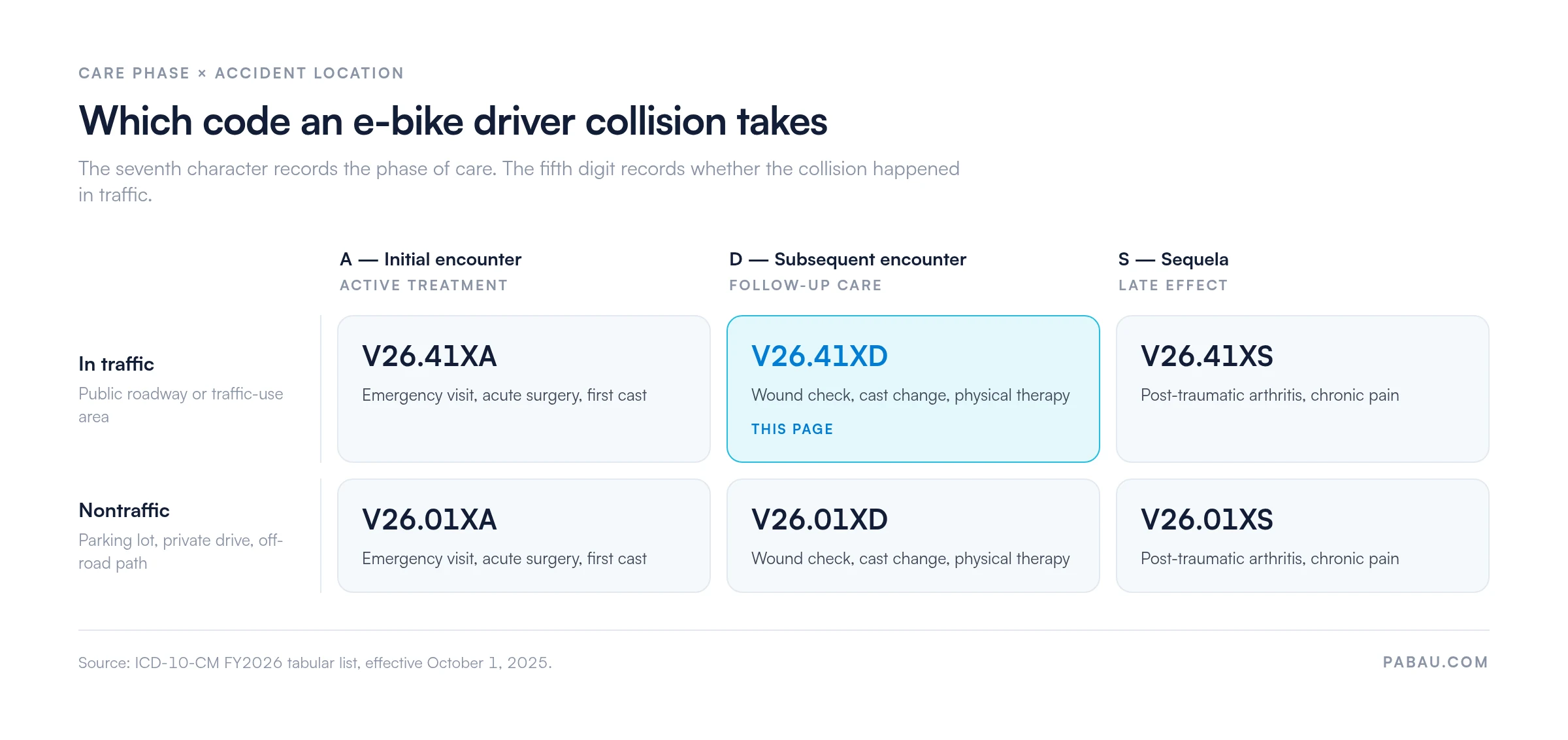
Sibling codes V26.41XA (initial encounter) and V26.41XS (sequela) cover the other two care phases for the same injury mechanism.
Nontraffic collisions off a public road take V26.01XA, V26.01XD, or V26.01XS instead.
Pabau’s claims management software supports accurate external cause code assignment and clean claim submission through the Claim.MD clearinghouse.
ICD-10 Code V26.41XD is a valid, billable ICD-10-CM diagnosis code for fiscal year 2026 (effective October 1, 2025). It carries a full seven-character structure and is accepted for claim submission without further specificity.
Per the CMS ICD-10-CM code resources, code validity is confirmed annually. Coders should verify against the current FY release before claim submission, as codes can be revised or retired between fiscal years.
Breaking the descriptor into its components helps coders confirm they have selected the right code before submitting a claim. Each element of V26.41XD must be supported by clinical documentation.
Records that do not say whether the patient was driving or riding as a passenger cannot support V26.41XD. The code requires the driver role. A passenger hurt on the same e-bike in the same accident takes a different code within the V26 category.
Swap the e-bike for a skateboard and the code leaves V26 altogether. A skateboarder struck by a pedal cycle takes V01.92XD at the follow-up visit when traffic status is undocumented.
A nontraffic crash with an undocumented rider role moves the code to another part of V26. V26.29XS covers an unspecified rider of another type of motorcycle in a nontraffic collision with a nonmotor vehicle. Use it at the sequela visit when the chart does not name driver or passenger.
The seventh character in ICD-10-CM external cause codes indicates the phase of care, not the severity or recurrence of injury. For V26.41X codes, three options exist.
The CDC/NCHS ICD-10-CM coding tool and the Official Guidelines for Coding and Reporting agree on the trigger. “Subsequent encounter” applies whenever the patient is seen after the active treatment phase has ended.
The provider rendering care at a subsequent visit does not have to be the same provider who treated the initial injury. The encounter type is decided by the nature of the care rendered, not by visit number.
Selecting the wrong seventh character is the single most common error on V26 external cause codes. Use this decision framework before assigning the character.
Document the care phase explicitly in every note. A phrase such as ‘returning for follow-up wound check, initial fracture care completed in the emergency department’ is enough to defend D over A.
V26.41XD sits within a specific hierarchical path in ICD-10-CM Chapter 20. Understanding the parent categories helps coders confirm they have selected the most specific code.
The placeholder “X” in the sixth position is a dummy character required to preserve the seven-character structure before the seventh-character suffix. It carries no clinical meaning.
Omitting it or replacing it with another character creates an invalid code that payers will reject. Neighboring V-codes follow the same seven-character pattern, and the ICD-10-CM code directory lists them side by side.
V29.008S covers other motorcycle drivers injured in a nontraffic collision with unspecified motor vehicles. Its seventh character S marks sequela rather than the subsequent encounter D, and its six-character base takes no X placeholder.
V26.41 covers the electric (assisted) bicycle driver in a traffic collision, and its seventh character separates the three care phases. The AAPC ICD-10-CM code lookup lists the full set.
Nontraffic variants (V26.01X_) apply when the collision occurred off a public road. If the incident happened in a parking lot, private driveway, or off-road path, the nontraffic code is correct and the traffic variant is wrong. The grid below pairs each care phase with each accident location.
External cause codes in Chapter 20 carry specific instructional notes that govern how and when they may be used alongside other codes. Coders must check both the category-level and chapter-level notes before finalizing a claim.
Chapter 20 use note: External cause codes are never sequenced as a principal diagnosis. They are always reported as additional codes alongside the code describing the injury itself. That partner code is usually a fracture or laceration code from Chapter 19. Reporting V26.41XD alone on a claim, without the corresponding injury code, produces an incomplete claim.
Applicable-to note at V26: The V26 category covers riders injured in a collision with another nonmotor vehicle. V26.41 applies that category to electric (assisted) bicycle drivers. Excludes1 and Excludes2 notes at the category level govern which combinations are permitted. Check the current CMS tabular list directly rather than working from a paraphrase.
ICD-9 crosswalk note: ICD-9-CM codes are no longer valid for HIPAA-covered transactions. Any legacy crosswalk reference is for historical audit purposes only. ICD-10-CM is the mandated standard, and no ICD-9 equivalent for V26.41XD should appear on a current claim.
Seventh-character errors on external cause codes are a consistent audit target. The mistakes below account for most denials and compliance findings on V26.41XD and similar codes.
Practices that record the encounter type in the note itself catch seventh-character mismatches before submission. Effective denial management begins with clean documentation at the point of care, well before the claim reaches the clearinghouse.
External cause codes like V26.41XD are a known weak point in revenue cycle management. The seventh character depends on the note clearly recording the care phase. Manual processes rarely capture that detail consistently across providers and visit types.
Practice management software like Pabau integrates with Claim.MD, our US clearinghouse partner, for both ICD-10-CM diagnosis codes and CPT procedure codes. Claims pass through real-time eligibility checks and validation before they reach the payer. That reduces the chance a seventh-character error or a missing external cause code turns into a rejection.
Practices that route every claim through a dedicated medical claims management workflow catch these errors before submission rather than after a denial.

The Claim.MD integration supports 4,000+ US payers and handles CMS-1500 and 837P claim formats. It also processes electronic remittance advice, which makes denial patterns easier to trace back to a specific code. Reviewing remittance data by code is the fastest way to spot a systematic seventh-character error across several providers.

Pabau’s documentation and claims management tools capture the encounter type, injury mechanism, and external cause code at the point of care. Follow-up visits then submit cleanly the first time.

ICD-10 Code V26.41XD is a valid, billable code for FY2026. It covers an electric bicycle driver injured in a traffic collision with a nonmotor vehicle, at the subsequent encounter stage. The most common error is continuing to use the A suffix after active treatment has ended. That exposes the practice to audit risk on every follow-up visit.
Getting the seventh character right starts with the clinical note. Record the care phase in plain words at every follow-up visit, and the claim will hold up under an audit query. Book a demo to see how Pabau supports accurate ICD-10 claim submission.

Want to understand how clearinghouses validate ICD codes before submission? What makes a clean claim explains the pre-submission checks that catch seventh-character and sequencing errors.
Looking for an overview of medical billing compliance requirements? What is medical billing outlines the end-to-end process from code assignment through payment posting.
V26.41XD is the ICD-10-CM code for an electric (assisted) bicycle driver injured in a collision with another nonmotor vehicle in a traffic accident. It applies at the subsequent encounter stage of care. The seventh character D indicates the patient is receiving routine follow-up care after active treatment for the injury has been completed.
Use V26.41XD once the patient’s active treatment phase is complete. It fits follow-up visits such as wound checks, physical therapy, cast changes, or medication reviews. Use V26.41XA only while active treatment is still being rendered, such as during an emergency department visit, initial fracture management, or acute wound repair.
Initial encounter (A) covers visits where the patient is receiving active treatment for the injury. Subsequent encounter (D) covers routine follow-up after active treatment ends. Sequela (S) applies when the patient presents with a late effect after the original injury has healed. Post-traumatic arthritis and chronic nerve damage are typical examples.
Yes, V26.41XD is a valid, billable ICD-10-CM code for FY2026. It carries a complete seven-character structure and is accepted for claim submission. It must always be sequenced as an additional code alongside the injury code, never as a principal diagnosis.
The sibling codes are V26.41XA (initial encounter) and V26.41XS (sequela), covering the same injury mechanism across the three care phases. The nontraffic variants V26.01XA, V26.01XD, and V26.01XS apply when the collision occurred off a public road.
Report the injury code from Chapter 19 as the principal diagnosis. Then add V26.41XD as an additional external cause code for the accident mechanism and care phase. Ensure the clinical note documents that active treatment has been completed and this is a routine follow-up encounter.



