ICD-10 Code T87.32: Neuroma of amputation stump, left upper extremity
ICD-10 Code T87.32: Quick-reference summary ICD-10 Code T87.32 is the billable, ...

Last Updated: Oct 20, 2026
Billable Code Specific Code
V28.01XD is the billable ICD-10-CM code for electric (assisted) bicycle driver injured in noncollision transport accident in nontraffic accident, subsequent encounter.
In plain terms, the patient was driving an e-bike off a public road and fell, was thrown, or overturned without hitting anything first. The D marks a follow-up visit after active treatment ended. Report it after the injury code it explains, never first.
Let Pabau's smart automation suggest the right codes, reduce claim denials, and keep your practice compliant—effortlessly.
Automate repetitive tasks and focus on what matters most—your patients.
Reduce coding errors and ensure compliance with the latest regulations.
Clean claims, fewer denials, and faster reimbursements.
Powerful insights and reporting to help your practice thrive.
HIPAA compliant SOC 2 certified GDPR-compliant Trusted by 4,000+ clinics worldwide

V28.01XD is a billable ICD-10-CM external cause code for an e-bike driver hurt in a noncollision, nontraffic accident, at a follow-up visit.
Noncollision means the driver fell, was thrown, or the e-bike overturned without first hitting anything.
The seventh character D applies once active treatment is complete and the patient is in routine healing-phase care.
V28.01XD is always secondary. The injury code, such as the fracture or sprain being followed up, is listed first.
Place of occurrence, activity, and status codes (Y92, Y93, Y99) belong on the initial encounter only, not on V28.01XD visits.
ICD-10 Code V28.01XD is the billable code for an electric (assisted) bicycle driver injured in a noncollision transport accident in a nontraffic accident, subsequent encounter. It describes how the injury happened, not the injury itself.
Picture an e-bike driver who lost control on a private trail, fell, and fractured a wrist. The emergency visit took the A version of this code. Every later visit for routine healing care, such as a cast check or a physical therapy session, takes V28.01XD.
The code is valid for FY 2027, effective October 1, 2026, per the CMS ICD-10 codes page. The V28.01 subcategory itself is fairly new: it was added on October 1, 2022, when ICD-10-CM split electric bicycles out from other motorcycles.
Every character in V28.01XD narrows the scenario. Coders who read the code segment by segment catch selection errors before submission rather than after a denial.
The placeholder X is mandatory. A claim that reads V28.01D is an invalid code, and payers reject it at the front-end edit before anyone reviews it.
Seventh character D means active treatment for the injury is complete and the patient is now receiving routine care during healing or recovery. Section I.C.19.a of the official guidelines, available through the CDC/NCHS ICD-10-CM browser tool, defines three seventh characters for injury and external cause codes.
The deciding question is whether the original injury has healed. If the patient is still recovering and the visit is part of that recovery, the D character applies. If the record documents the injury as healed and the visit treats a lasting effect of it, use the S character.
A patient seen three weeks after an e-bike fall, with the wrist fracture still consolidating, takes V28.01XD. The same patient a year later, treated for post-traumatic arthritis in that wrist, takes V28.01XS. On the sequela claim, the arthritis code comes first.
A noncollision transport accident is one where no other object, person, or vehicle was struck first. The V28 includes note lists the scenarios that qualify:
A nontraffic accident is one that happens entirely off a public highway. A fall on a private trail, a farm track, a parking lot, or a driveway counts. A fall on a public street codes to V28.41- instead, even when the rider was alone.
The V20-V29 block includes electric bicycle, e-bike, and e-bicycle in its includes note, and the pedal cycle block V10-V19 excludes them. A driver thrown from an e-bike therefore codes to V28, never to the pedal cycle noncollision category V18.
Two neighboring vehicles take other paths. A conventional motorcycle, moped, or motor scooter driver in the same fall takes V28.09XD. A standing electric scooter is a pedestrian conveyance and codes to V00.84- instead.
Only the seven-character codes at the bottom of this tree are billable. V28, V28.0, and V28.01 are headers and cannot go on a claim.
External cause codes follow their own set of rules in Section I.C.20 of the official guidelines. Four of them shape every V28.01XD claim:
The injury code and the external cause code must carry matching encounter characters. A follow-up for a distal radius fracture pairs the D version of that fracture code with V28.01XD.
Before you add a Y92 or Y93 code to an e-bike follow-up claim, check the encounter character. Those codes belong with V28.01XA on the initial visit, so repeating them on a D claim adds lines that fail payer edits.
Choosing the right V28 code takes four data points: the vehicle, the patient’s role, the traffic setting, and the encounter. Check them in that order, because each wrong answer leads to a different sibling code.
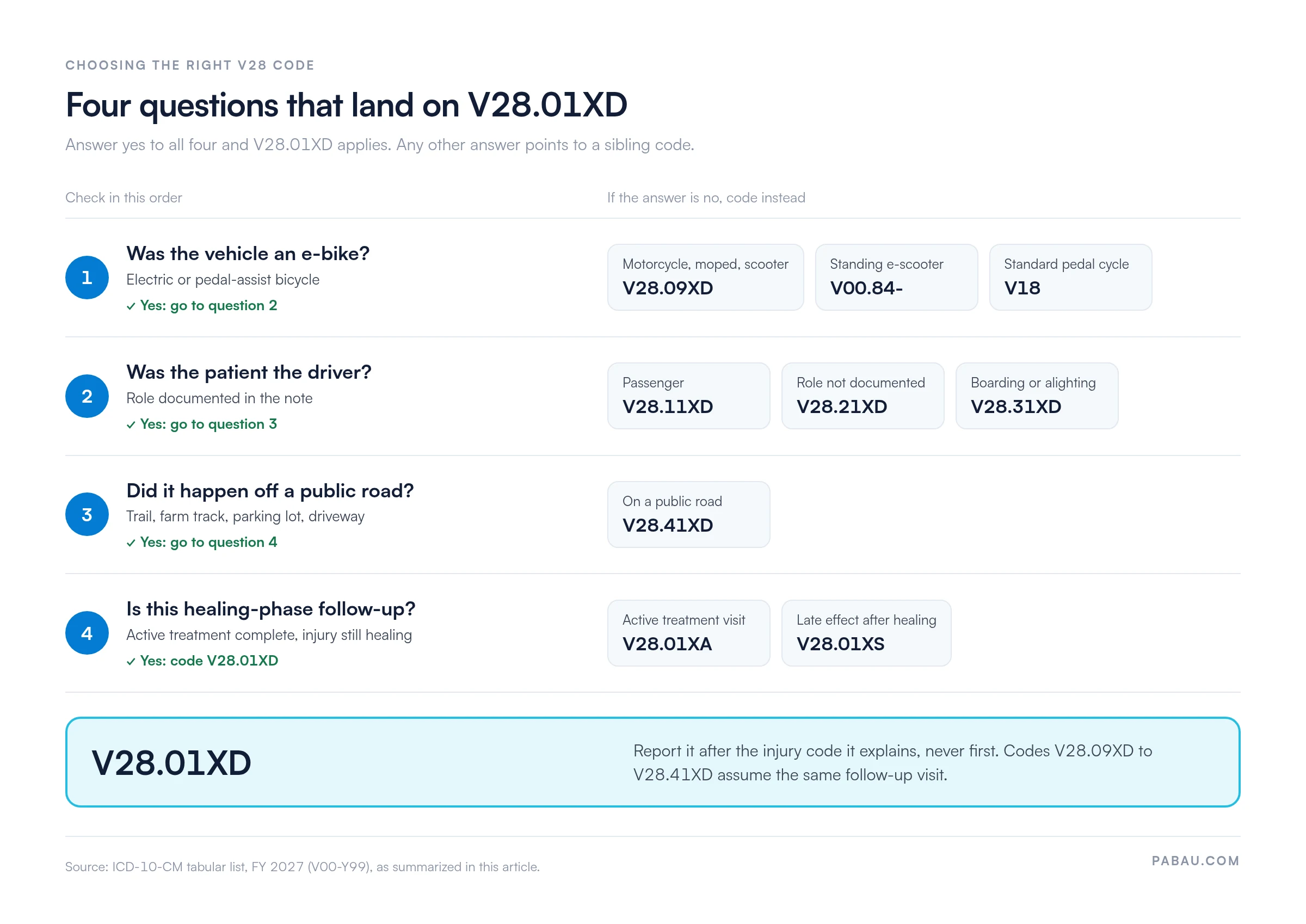
The codes below are the ones most often confused with V28.01XD, each shown with its official descriptor.
The most common error in this family is carrying V28.01XA forward from the first visit. Check the visit type against the seventh character on every claim before it leaves the practice.
Every code on a claim must be supported by provider documentation. For V28.01XD, the record should establish five facts:
When one of these facts is missing, query the provider before you code. An unspecified role points to V28.21XD instead, and an undocumented setting makes the nontraffic choice hard to defend in an audit.
Practices using integrated claims management software can add these prompts to follow-up visit templates. The coder then sees an incomplete record before the claim is built, not after it is denied.
V28.01XD is exempt from present-on-admission reporting, so inpatient claims leave the POA indicator blank or exempt for it. Confirm that against the annual CMS POA exempt list each fiscal year.
Accident codes also draw attention from coordination of benefits teams. A transport accident code can prompt a payer to ask about other coverage, such as homeowner’s, liability, or workers’ compensation, before paying.
Most rejections on V28.01XD trace back to a short list of avoidable errors. The table pairs each trigger with its root cause and the fix. When a claim does come back, the remittance states the reason as a claim adjustment reason code. Our guide to denial codes decodes the common ones.
Practices that see repeat denials on external cause codes benefit from a quarterly audit of seventh characters and sequencing. Our guide to denial management workflows covers how to structure that audit.
Run a monthly report of V28.01XA claims older than 30 days. If the same patient has returned since, check the follow-up claims for a carried-forward A before they age into denials.
Follow-up coding for an e-bike injury usually breaks at handoff. The emergency visit sets the codes, and each later visit inherits them unless someone changes the seventh character by hand.
Pabau, the practice management and billing platform we build, keeps the visit note, the diagnosis codes, and the claim in one record. Coders can see that a visit is follow-up before they pick the encounter character.
Through its Claim.MD clearinghouse integration, Pabau checks eligibility in real time and sends electronic claims to thousands of US insurance payers. Claim statuses and electronic remittance advice come back into the same billing workflow, so a rejected follow-up claim is corrected and resent quickly.

Pabau checks eligibility in real time and sends electronic claims to thousands of US insurance payers through Claim.MD. Your team sees encounter and sequencing errors before a follow-up claim goes out.

V28.01XD earns its place on a claim only when the note supports all four facts behind it: e-bike, driver, off-road, and healing-phase care. Code from the documentation, and query the provider when one fact is missing rather than guessing.
The one habit worth building is a seventh-character check at every follow-up visit, since a carried-forward A costs more rework than any other error here. That check is what turns an e-bike follow-up into a clean claim on the first pass. Book a demo to see how Pabau flags encounter and sequencing errors before a follow-up claim leaves your practice.

Need a structured approach to external cause coding workflows? Medical billing fundamentals covers the end-to-end claim lifecycle from documentation through payment posting.
Dealing with auto insurance coordination issues? Electronic remittance advice (ERA) processing explains how ERAs surface COB denial reasons so your team can act fast.
Follow-up claims held by an open accident questionnaire? Timely filing limits by payer sets out the deadlines for initial and corrected claims, so a delayed resubmission still lands in time.
Scheduling surgery or advanced imaging after an e-bike injury? The prior authorization process walks through the five steps to get approval before the service.
ICD-10 Code V28.01XD means an electric (assisted) bicycle driver injured in a noncollision transport accident in a nontraffic accident, subsequent encounter. In practice, the e-bike driver fell, was thrown, or overturned off a public road without hitting anything first. The D shows the visit is routine follow-up after active treatment ended.
Yes. V28.01XD is a billable, specific ICD-10-CM code for FY 2027, effective October 1, 2026. It is reported as a secondary code, after the injury diagnosis, because an external cause code can never be the first-listed or principal diagnosis.
No. The V20-V29 motorcycle block lists electric bicycle, e-bike, and e-bicycle in its includes note, and the pedal cycle block V10-V19 excludes them. An e-bike driver injury therefore codes to V20-V29, and a fall with no collision codes to V28.
Subsequent encounter (D) applies while the original injury is still healing and the visit is routine follow-up. Sequela (S) applies once the injury has healed and the patient is treated for a late effect, such as chronic pain. For sequela, the late-effect condition is listed first and V28.01XS follows the injury code.
No. Under ICD-10-CM guidelines, place of occurrence (Y92), activity (Y93), and external cause status (Y99) codes are reported once, at the initial encounter. They belong with V28.01XA. The V28.01XD follow-up claim carries the injury code and V28.01XD only.
The usual mix-ups are V28.01XA (initial encounter), V28.01XS (sequela), and V28.09XD (other motorcycle driver rather than an e-bike). Others are V28.11XD (e-bike passenger) and V28.41XD (e-bike driver in a traffic accident). Check vehicle type, role, traffic setting, and encounter before you submit.