ICD-10 code S61.201A: Open wound of left index finger without nail damage
ICD-10 code S61.201A covers a left index finger wound of unstated type ICD-10 co...

Last Updated: Oct 16, 2026
Billable Code Specific Code
V20.21XA is the billable ICD-10-CM code for an unspecified electric (assisted) bicycle rider injured in a collision with a pedestrian or animal, nontraffic, initial encounter.
The vehicle is an e-bike rather than a conventional motorcycle, and the whole incident happened off the public highway. “Unspecified rider” means the record never establishes whether the patient was driving or a passenger; documenting the role moves the code to V20.01XA or V20.11XA instead.
Let Pabau's smart automation suggest the right codes, reduce claim denials, and keep your practice compliant—effortlessly.
Automate repetitive tasks and focus on what matters most—your patients.
Reduce coding errors and ensure compliance with the latest regulations.
Clean claims, fewer denials, and faster reimbursements.
Powerful insights and reporting to help your practice thrive.
HIPAA compliant SOC 2 certified GDPR-compliant Trusted by 4,000+ clinics worldwide

V20.21XA covers an unspecified electric (assisted) bicycle rider injured by a pedestrian or animal collision away from any public road, at the initial encounter.
The vehicle is an e-bike and the setting is nontraffic. Both details are easy to lose in a busy trauma note.
‘Unspecified rider’ means the record never establishes who was driving. Document the role and the code moves to V20.01XA or V20.11XA.
The code is not new for FY2026. It has been in ICD-10-CM since the FY2023 code set took effect on October 1, 2022.
V20.21XA is an external cause code, so it always sits behind a primary injury diagnosis on the claim.
ICD-10 Code V20.21XA covers an unspecified electric (assisted) bicycle rider injured in a collision with a pedestrian or animal. The accident is nontraffic, and the encounter is the initial one. The code is billable in ICD-10-CM.
The vehicle is an e-bike, not a conventional motorcycle, and the whole incident happened off the public highway. The chart does not say whether the patient was driving or riding as a passenger, which is what “unspecified rider” records.
The code sits in the V20-V29 block of Chapter 20, which covers external causes of morbidity. Like every code in that chapter, it is never submitted as the principal or first-listed diagnosis. Pair it with the injury code that describes the harm the collision caused.
Three parts of the descriptor carry the classification. “Unspecified” refers to the rider’s role, which the record leaves open. “Electric (assisted) bicycle” rules out a conventional motorcycle, a moped, and a plain pedal cycle. “Nontraffic” places the whole incident away from a public road. Change any one of the three and the code changes with it.
The official descriptor reads “Unspecified electric (assisted) bicycle rider injured in collision with pedestrian or animal in nontraffic accident, initial encounter.” Each element answers a separate documentation question. The vehicle is an electric-assisted bicycle. The object struck is a pedestrian or an animal. The location is anywhere other than a public highway. The rider role is undocumented, and the encounter is the active treatment phase.
One point is worth correcting, because several code lookup tools invite the mistake. V20.21XA is not new for FY2026. It entered ICD-10-CM with the FY2023 code set on October 1, 2022. That update subdivided the V20-V29 block at the fifth character, separating electric bicycles from other motorcycles.
The code has carried forward unchanged through FY2024, FY2025, and FY2026. The October 1, 2025 date shown on many code pages is the effective date of the FY2026 edition, which every V20 code carries. The Centers for Medicare and Medicaid Services (CMS) and the National Center for Health Statistics publish each annual update.
The American ICD-10-CM edition differs from the WHO’s international ICD-10 classification in how much detail it demands. The US version adds characters that capture encounter type and vehicle type where the international version does not. The fifth character and the seventh character in V20.21XA are both examples of that added specificity.
The V20-V29 block is titled “Motorcycle rider injured in transport accident,” which is why V20.21XA is sometimes read as a motorcycle code. The block title is not the code descriptor. Its Includes note lists electric (assisted) bicycle, e-bike, moped, motorized bicycle, motor scooter, and motorcycle with sidecar. All of those vehicles are indexed under one heading.
The vehicle is named by the fifth character, not by the block. A fifth character of 1 means an electric (assisted) bicycle. A fifth character of 9 means another motorcycle in that block, such as a moped or a conventional motorbike. V20.21 carries the 1, so the patient was on an e-bike. Writing “motorcycle driver” into the chart note for this code misstates both the vehicle and the rider role.
“Unspecified rider” is a statement about the record, not about the patient. It is assigned when the documentation confirms the person was on the e-bike. The record never establishes whether they were operating it or riding as a passenger. Tandem e-bikes, cargo e-bikes with a rear seat, and unwitnessed incidents all produce this situation.
Role is worth chasing, because a documented role moves the code. The subcategories sit side by side within V20, and they share the same nontraffic setting and the same collision counterpart.
A short query to the treating provider often resolves it. If it cannot be resolved, V20.21XA is the correct choice, and assigning it is not a documentation failure. Guessing at driver status to reach a more specific code is the error.
ICD-10-CM defines a nontraffic accident as a vehicle accident that occurs entirely in a place other than a public highway. A traffic accident is one that happens on a public highway. The definition turns on where the incident happened, not on how busy the area was or how fast the e-bike was moving.
These settings usually produce a nontraffic code such as V20.21XA:
If any part of the collision took place on the public roadway, the traffic branch applies instead. The initial-encounter traffic counterpart for an unspecified e-bike rider is V20.91XA. A patient struck while crossing from a sidewalk into the street is a traffic case, even though the ride began on a path.
The seventh character records where the patient sits on the care timeline. Choosing it wrongly is a common reason external cause codes get flagged in claim review. V20.21 has only five characters, so a placeholder X fills the sixth position before the extension is added.
Per the CDC and NCHS ICD-10-CM guidelines, “initial encounter” describes the period of active treatment. It does not mean the first time a patient sees a particular provider. A physical therapist seeing the patient two weeks after discharge is coding a subsequent encounter, so the correct character is D.
Sequela applies when the injury itself has healed and the patient presents with a residual condition caused by it. Chronic pain, nerve damage, or lasting loss of movement would each take the S extension on the external cause code. The residual condition gets its own sequela code alongside it.
V20.21XA sits at the most granular level of its branch in Chapter 20. Reading the branch from the top down helps when documentation will not support the most specific option and you need the nearest valid alternative.
The placeholder matters at submission. ICD-10-CM requires a dummy X when a code needs a seventh character but has fewer than six characters of its own. V20.21A, with the X left out, is rejected as an invalid code format. V20.21 on its own is also invalid, because the seventh character is mandatory throughout category V20.
Coders working with V20.21XA usually keep three sets of codes nearby. The first set holds the other encounter characters for the same scenario. The second applies once rider role is documented. The third applies when the setting or the vehicle turns out to be different.
Category V20 is limited to collisions with pedestrians and animals. Collisions with other vehicles or with fixed objects move to V21-V29, and those categories carry the same electric-bicycle subdivision at the fifth character. Falls and other noncollision e-bike incidents belong in V28.
Every V20 code assumes the e-bike rider is the patient. If the pedestrian is the person treated, the encounter is coded from V00-V09 instead. The initial-encounter code for a person on foot struck by a motorcycle, moped, or motor scooter off the public highway is V02.00XA.
The V20-V29 block carries an Includes note that defines the vehicle family, and category V20 carries an Excludes1 note that redirects one specific collision counterpart. Applying both correctly prevents rejections and keeps audit findings away.
The Excludes1 note is narrow and often paraphrased incorrectly. It applies to a collision with an animal-drawn vehicle or with an animal that someone was riding. A collision with a loose animal, or with one nobody was riding, stays inside V20.
When a classification question stays open, the AAPC ICD-10-CM code lookup shows the official notes per code. Write the reasoning into the coding note as well, so an auditor can follow the same path a year later.
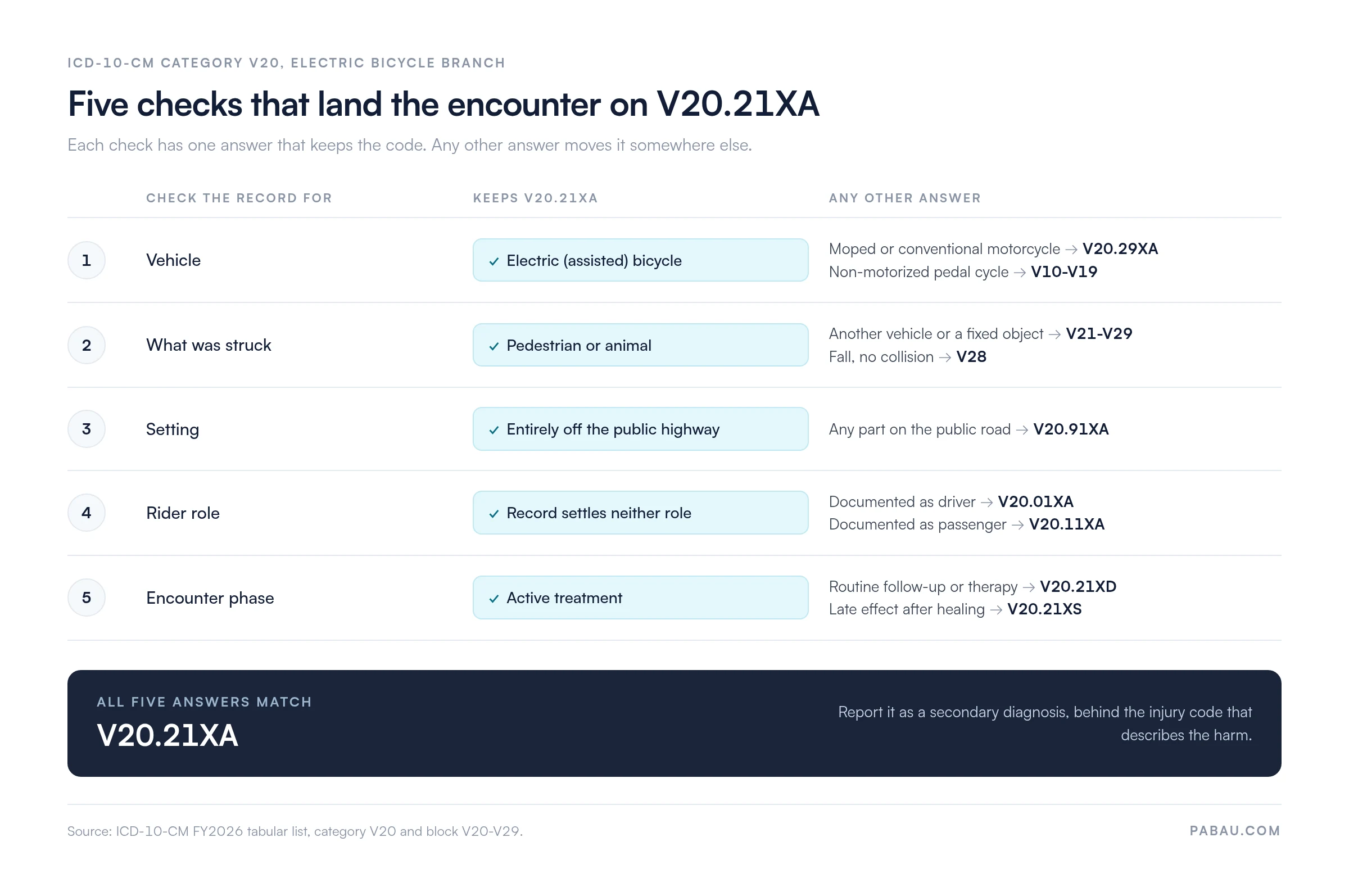
Five elements support this code in the medical record. Miss one and the assignment is exposed at audit. Trauma teams often capture the clinical picture in full while leaving the mechanism thin, so the coding team should know exactly what to look for.
Read in order, those five elements work as a decision path. Each check has one answer that keeps V20.21XA, and any other answer routes the encounter to a named alternative in the same family.
These patients often reach outpatient care weeks after the emergency visit. The seventh character therefore has to be rechecked at every encounter. Once active treatment ends, the coder switches from V20.21XA to V20.21XD before the next claim goes out.
Capture the vehicle and the location at the point of initial assessment, not at coding time. A trauma note written in the ED is the strongest supporting record for external cause specificity. If the provider wrote ‘bike accident’ with no further detail, query before assigning V20.21XA. That phrase covers pedal cycles in V10-V19 as well as e-bikes in V20-V29. Contemporaneous source records are far easier to defend during a payer audit than a retroactive query.
V20.21XA is an external cause code, and that has one governing practical consequence. It cannot be submitted as the principal or first-listed diagnosis. The ICD-10-CM Official Guidelines place every Chapter 20 code behind the injury diagnosis it explains. A claim that leads with V20.21XA is rejected before clinical review.
Place of occurrence deserves a second look on this code. V20.21XA already tells the payer the incident was nontraffic, so the Y92 code should agree with it. A Y92 value that points at a street or highway contradicts the nontraffic setting and invites a review.
Practices submitting through a clearinghouse get a validation pass before the payer sees the claim. Practice management software like Pabau routes claims through Claim.MD, which returns format and structure errors at submission. A sequencing problem can then be corrected while the claim is still with the practice.
Trauma encounters also change what the payer side asks for. Workers compensation carriers, auto liability insurers, and personal injury cases want more than a standard health plan does. Clean claim submission standards for these cases can include the accident date, a description of the incident, and third-party payer details.
Denials on V20.21XA cluster around three causes. The external cause code goes out with no primary injury code behind it. The A character is carried past the active treatment phase. The place of occurrence code contradicts the nontraffic setting.
A denial codes reference maps those three causes to the adjustment reason codes you will see. CO-11 covers a diagnosis inconsistent with the procedure, and CO-16 covers a claim that lacks required information. The remittance advice carries the specific reason code back to the practice.

Today a coder reads the trauma note, picks the injury code, then adds the external cause code from a lookup tool in another tab. No check runs on the sequence before the claim leaves the practice. The first sign of an error is a remittance advice two weeks later.
Pabau keeps that work in one place. Diagnosis codes sit on the clinical record rather than in a separate billing note. The injury code and the external cause code stay attached to the same encounter.
Its built-in claims management then sends the claim through Claim.MD. Sequencing and format problems surface there, while the claim can still be fixed.
Encounter phase gets easier to track, because the record shows when active treatment ended for that patient. The coder can see that the visit in front of them is a follow-up, so the seventh character moves from A to D on time.
Fewer corrected claims go out as a result, and the practice gets paid on the first submission more often.

Pabau pairs the injury diagnosis with its external cause code on the same encounter record. The claim is then validated through Claim.MD before it reaches the payer. See how it works for your practice.

V20.21XA comes down to four readings of the record. The vehicle was an electric-assisted bicycle. The patient hit a pedestrian or an animal. The incident happened entirely off the public highway. The chart never says whether the patient was driving or riding along. Get any one of those wrong and the code describes a different event.
Two mistakes are worth guarding against. The first reads the V20-V29 block title as a vehicle description. The second treats the FY2026 edition date as a sign the code is new. Neither holds. This is an e-bike code in a nontraffic setting, and it has been valid since October 1, 2022.
For practices billing trauma encounters, catching a sequencing problem at submission costs far less than appealing the denial it would have caused. To see how Pabau handles injury coding workflows, book a demo with the team.

Need a billing compliance framework for trauma encounters? Medical billing compliance standards covers the documentation and submission requirements that protect practices during payer audits.
Working through a claim denial on an injury code? Denial management in healthcare explains the most common adjustment reason codes and how to build a systematic appeal workflow.
Want to understand how clearinghouse submissions work? Medical claims clearinghouse guide breaks down how 837 files are validated before reaching payers.
V20.21XA is the billable ICD-10-CM code for an unspecified electric (assisted) bicycle rider. The rider was injured in a nontraffic collision with a pedestrian or animal, at the initial encounter. The vehicle is an e-bike and the incident happened off the public highway. The record does not say whether the patient was driving or riding as a passenger.
Yes, V20.21XA is a valid, billable ICD-10-CM code in the FY2026 code set. It cannot stand alone as the primary diagnosis, because it is an external cause code. List it as a secondary diagnosis alongside the injury code that describes the physical harm.
No. The V20-V29 block is titled ‘Motorcycle rider injured in transport accident’. Its Includes note covers e-bikes, mopeds, and motor scooters, so all of them are filed under one heading. The vehicle for a specific code is named at the fifth character. The 1 in V20.21 means an electric (assisted) bicycle, not a motorcycle.
No. V20.21XA entered ICD-10-CM with the FY2023 code set, effective October 1, 2022. That update subdivided the V20-V29 block to separate electric bicycles from other motorcycles. It has carried forward unchanged since then. The October 1, 2025 date on many lookup pages is the FY2026 edition date that every V20 code shows.
The immediate parent is V20.21, the same scenario without an encounter character. Above that sits V20.2, for an unspecified motorcycle rider injured in a nontraffic collision with a pedestrian or animal. Category V20, the V20-V29 block, and Chapter 20 sit above it in turn. None of those parent codes are billable on their own.