ICD-10 Code T87.81: Dehiscence of amputation stump
ICD-10 Code T87.81: clinical definition and scope of dehiscence ICD-10 Code T87....

Last Updated: Oct 7, 2026
Billable Code Specific Code
V16.4XXD is the billable ICD-10-CM code for pedal cycle driver injured in collision with other nonmotor vehicle in traffic accident, subsequent encounter.
Coders use this code at follow-up visits when the patient was operating the bicycle and collided with a nonmotor vehicle on a public road. The other vehicle can be an animal-drawn vehicle, a ridden animal, or a streetcar. If the record does not state where the collision happened, ICD-10-CM presumes a public highway. A collision documented entirely off public roads takes V16.0XXD instead.
Let Pabau's smart automation suggest the right codes, reduce claim denials, and keep your practice compliant—effortlessly.
Automate repetitive tasks and focus on what matters most—your patients.
Reduce coding errors and ensure compliance with the latest regulations.
Clean claims, fewer denials, and faster reimbursements.
Powerful insights and reporting to help your practice thrive.
HIPAA compliant SOC 2 certified GDPR-compliant Trusted by 4,000+ clinics worldwide

V16.4XXD is a billable ICD-10-CM code for a cyclist injured while riding in traffic, reported at follow-up visits after active treatment ends.
The 4th character .4 means driver in a traffic accident. The nontraffic driver code is V16.0XXD, and a traffic passenger takes V16.5XXD.
When the record does not state where the collision happened, ICD-10-CM presumes a public highway, which points to the traffic codes.
External cause codes like V16.4XXD always follow the injury code on the claim and are never first-listed.
Pabau, our practice management platform, pulls the codes on the patient record into a pre-filled claim and tracks it through to remittance.
ICD-10 Code V16.4XXD is a billable ICD-10-CM external cause code for one scenario. A cyclist operating the bicycle collides with another nonmotor vehicle on a public road, and the visit is a follow-up. The nonmotor vehicle can be an animal-drawn vehicle, a ridden animal, or a streetcar.
Every element must be in the record for the code to hold up on audit: driver role, nonmotor vehicle, traffic setting, and subsequent encounter. A collision on a city street or in a bike lane on the roadway is the typical case.
The code sits in Chapter 20 of ICD-10-CM (External causes of morbidity, V00-Y99), which classifies how injuries happen rather than which structures are damaged. The CMS FY2027 ICD-10-CM code files list it as valid and billable for FY2027 (effective October 1, 2026).
Each character segment carries a distinct meaning. Misreading any one of them produces a different code.
The two X placeholders in positions 5 and 6 are mandatory. Submitting V16.4D without them produces an invalid code that fails format checks. ICD-10-CM requires every code to reach its full length, and the placeholder X fills unused positions before the 7th character.
The 7th character D marks an encounter after the patient has completed active treatment and is receiving routine care during healing or recovery. Cast changes, follow-up X-rays to check fracture healing, removal of fixation devices, and medication adjustments are typical D visits.
A common mistake is reading A as the first visit only, or using it at every follow-up. The guideline ties A to active treatment, whichever visit that happens at. Once routine healing care begins, D takes over.
The external cause 7th character should also match the 7th character of the injury code at the same encounter. A fracture coded S52.001D pairs with V16.4XXD, never with V16.4XXA.
Sequela (S) covers a different situation. If a cyclist develops post-traumatic arthritis after the fracture has healed, the arthritis is coded first. The fracture code and V16.4XXS then carry the S to identify the original injury.
V16.4XXD is a traffic code because ICD-10-CM assigns the 4th character .4 to a pedal cycle driver in a traffic accident. A traffic accident is any vehicle accident on a public highway, including one that starts or ends there. If the same collision happened entirely off public roads, the code is V16.0XXD.
The ICD-10-CM Tabular List defines a public highway as the full width between property lines of land open to the public for travel. That covers more than the paved roadway. It also sets a default that changes code selection.
A vehicle accident is assumed to have occurred on a public highway unless another place is specified. So when a note says only that a cyclist collided with a horse-drawn carriage, the traffic code applies. A nontraffic code needs a documented off-road location.
The traffic classification also matters for insurance. When a bicycle collision on a public road involves auto or liability coverage, carriers use the accident details to decide who pays first. Coding a road collision as nontraffic, or the reverse, can delay payment and start a coordination-of-benefits dispute.
The 4th character of V16 carries both the rider role and the traffic setting, which is where most confusion starts. Review these sibling codes before selecting V16.4XXD, and check AAPC’s ICD-10-CM lookup if the descriptor is unclear.
V16 has no .6, .7 or .8 subcategory, and V16.9 means the rider role is unknown, not the traffic status. The grid below sets the codes side by side.
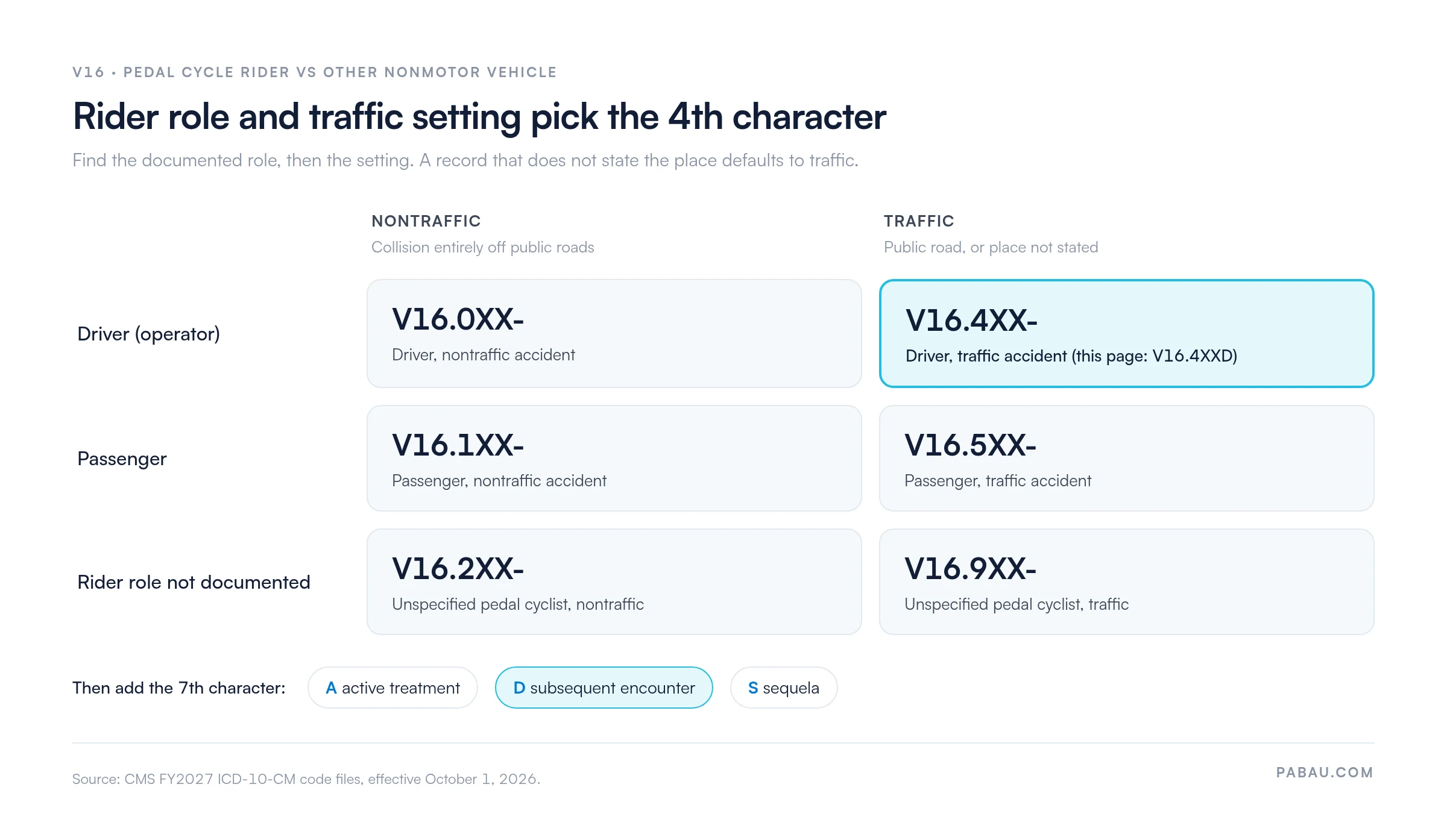
If the other vehicle was not a nonmotor vehicle, use the matching V10 to V14 category instead. When the record says the patient was riding but does not confirm they were the operator, the fallback is V16.9XXD. Query the provider rather than assume driver status, since the distinction carries weight in liability and insurance claims. The injury code that leads the claim comes from the exam and imaging findings, and our diagnostic codes guide lists the descriptors.
V16.4XXD explains how the injury happened. It does not describe the injury itself. Per ICD-10-CM Official Guidelines Section I.C.20, an external cause code can never be the first-listed diagnosis, so the injury code always leads.
That sequencing rule is the foundation of any medical billing workflow involving V-codes. A claim with V16.4XXD in the first-listed position breaks the guidelines and is likely to be rejected by claim edits.
At the initial encounter, a street collision would typically carry Y92.414 (local residential or business street) or Y92.410 (unspecified street and highway). The same claim could add Y93.55 (activity, bike riding) and Y99.8 (other external cause status) for leisure cycling, when documented.
Submitting V16.4XXD alone is not valid. The external cause code has no standalone meaning on a claim without the injury it explains.
The medical record must support every element coded. For V16.4XXD, that means four checkpoints that providers and coders should verify together. Medical billing compliance reviews often find one of them missing.
Document the query. If a note says only bicycle accident, ask the provider to confirm three details. Was the patient the operator, did the collision happen on a public road, and what was the other vehicle? A short query prevents a denial, an appeal, and a possible audit flag.
There is no national requirement to report external cause codes, according to the ICD-10-CM Official Guidelines. Reporting becomes mandatory only under a state-based reporting mandate or when a particular payer requires it. Payers coordinating with auto or liability insurance on bicycle claims often ask for them, so check each payer’s rules.
Pabau’s claims management software pulls the injury and external cause codes already on the patient record into the claim. That keeps the coder’s sequencing intact from the chart to submission.
For bicycle collisions on public roads, auto insurance or a third-party liability carrier is often involved. The traffic classification in V16.4XXD then feeds directly into coordination of benefits. Submitting the nontraffic code V16.0XXD for a road collision can misdirect the claim while carriers dispute who pays first.
Run an eligibility check before each follow-up visit on these cases. Checking coverage first makes a coordination-of-benefits problem less likely to surface after a denial.
External cause codes generate a predictable set of denials. Most trace back to one of six root causes. A strong denial management workflow catches these before they become resubmissions.
To correct a denied V16.4XXD claim, check the note against the four documentation checkpoints above. Then confirm the 7th character for the date of service, verify sequencing, and resubmit. Read the electronic remittance advice first to see which remark codes the payer applied.
A consistent step sequence reduces errors on every bicycle injury claim at the subsequent encounter stage. Verify each step against the source documentation before assigning any code.
Build a V16 selection cheat sheet for your coding team. List the rider role down one side and traffic or nontraffic across the top, then add the 7th character. The grid covers every V16 code and cuts selection time at chart review.
Pabau pre-fills claims from the codes and patient details already on the record, so coders do not re-key them. Claims then go out through the Claim.MD integration to US payers. The workflow supports clean claim submission because the claim carries the codes exactly as the coder sequenced them.
Electronic remittance advice (835) files return into Pabau, so coders see denial reason codes alongside the original claim. Eligibility checks before a follow-up visit confirm that coverage is still active and the correct payer is on file. That matters on bicycle injury cases with liability coordination, and every Pabau subscription includes the full claims workflow.

Pabau pre-fills claims from the codes on the patient record, submits them through Claim.MD, and brings remittance files back beside the original claim.

V16.4XXD belongs on a follow-up claim only when the record shows a bicycle operator hit by a nonmotor vehicle on a public road. When the place is missing, the traffic code is the default, and a documented off-road location is what moves the claim to V16.0XXD.
On the claim, the injury code leads and V16.4XXD follows with the same 7th character. For practices handling injury claims at volume, see how Pabau handles revenue cycle management so the claim trail stays in one place. Book a demo to walk through the bicycle injury claim workflow.

Need a step-by-step guide to the claims process? Claim.MD clearinghouse overview explains how Pabau routes ICD-10 coded claims to payers electronically.
Confused about clean claim requirements? Superbill documentation guide covers what diagnosis and procedure code fields must be complete before a claim can be accepted.
Dealing with a coordination-of-benefits dispute? Insurance eligibility verification explains how real-time eligibility checks surface coverage conflicts before the claim goes out.
ICD-10 Code V16.4XXD is the billable external cause code for a pedal cycle driver hit by a nonmotor vehicle in a traffic accident. It applies at a subsequent encounter. Each character specifies the category (V16), the driver in traffic (.4), placeholders (XX), and the encounter type (D). It is always sequenced after the injury code on the claim.
Yes. V16.4XXD is a billable ICD-10-CM code valid for FY2027. It is submitted as a secondary external cause code alongside the injury code. It can never be the first-listed diagnosis.
V16.4XXD applies to traffic accidents, meaning collisions on a public road. The 4th character .4 is the ICD-10-CM designation for a pedal cycle driver in traffic. If the collision happened entirely off public roads, the correct code is V16.0XXD. When the record does not state the place, ICD-10-CM presumes a public highway.
The most frequent denials come from a wrong 7th character, an external cause code sequenced first, or missing X placeholders (V16.4D). Others are a traffic code on an off-road collision and an unspecified code when the record supports a specific one. Each needs a corrected claim with the error fixed.
No national rule requires external cause codes, according to the ICD-10-CM Official Guidelines. They become mandatory under a state-based reporting mandate or when a particular payer requires them. Payers coordinating with auto or liability insurance often ask for them, so check each payer’s provider manual.