ICD-10 Code V91.84XS: Other burn due to burning watercraft
ICD-10 Code V91.84XS: overview and key facts ICD-10 Code V91.84XS identifies the...

Last Updated: Oct 30, 2026
Billable Code Specific Code
V66.3XXD is the billable ICD-10-CM code for unspecified occupant of heavy transport vehicle injured in collision with other nonmotor vehicle in nontraffic accident, subsequent encounter.
It covers follow-up visits after a truck hits an animal-drawn vehicle, a ridden animal or a streetcar off a public highway. Use it when the record doesn't say whether the patient was driving, riding as a passenger or outside. Common causes of denial include reporting it as the principal diagnosis, dropping the placeholder Xs and using D during active treatment.
Let Pabau's smart automation suggest the right codes, reduce claim denials, and keep your practice compliant—effortlessly.
Automate repetitive tasks and focus on what matters most—your patients.
Reduce coding errors and ensure compliance with the latest regulations.
Clean claims, fewer denials, and faster reimbursements.
Powerful insights and reporting to help your practice thrive.
HIPAA compliant SOC 2 certified GDPR-compliant Trusted by 4,000+ clinics worldwide

V66.3XXD is a billable ICD-10-CM external cause code for an unknown-role heavy transport vehicle occupant hurt in a nontraffic collision with a nonmotor vehicle.
The 7th character D marks a subsequent encounter, meaning routine healing-phase care after active treatment has ended.
Positions 5 and 6 must be placeholder X characters, so V66.3D is an invalid code that claim edits reject.
A record silent on the accident location defaults to a traffic accident, which points to V66.9XXD instead.
Pabau, the practice management platform we build, submits and tracks claims through Claim.MD using the codes your team enters.
ICD-10 code V66.3XXD is the billable ICD-10-CM code for a follow-up visit after a nontraffic collision between a heavy transport vehicle and a nonmotor vehicle. It applies when the record doesn’t say whether the injured occupant was the driver, a passenger or riding outside. The code sits in Chapter 20 of the ICD-10-CM classification (V00-Y99), the external causes of morbidity chapter. So it describes how the injury happened, not the injury itself.
V66.3XXD never appears alone on a claim. It follows a principal diagnosis that names the injury, which is how external cause codes work across medical billing.
Each position in V66.3XXD carries a meaning defined by the CDC/NCHS ICD-10-CM classification system. The two placeholder X characters in positions 5 and 6 are the easiest to drop. A coder who omits them submits a string that claim edits reject.
The ICD-10-CM Official Guidelines, Section I.A.4, are explicit. When a code needs a 7th character and has fewer than six characters, placeholder X fills each empty position. V66.3 has four characters, so two Xs fill positions 5 and 6. Without them, the submitted code is V66.3D, which fails format edits before anyone reviews the claim. You’ll see the same placeholder pattern across the ICD-10-CM codes for injuries and external causes.
A subsequent encounter is a visit after the patient has completed active treatment and is receiving routine care during healing or recovery. Section I.C.19.a of the ICD-10-CM Official Guidelines lists cast changes, X-rays to check healing, medication adjustments and other follow-up visits. Section I.C.20 adds that the external cause code’s 7th character should match the injury code’s.
Each episode character maps to a different stage of the same accident:
A frequent mistake is switching to D while A still applies. If the patient is still in active treatment, such as ongoing surgery, active wound care or acute fracture management, keep the A character. The guidelines tie the character to active treatment, not to whether a new provider is seeing the patient. Switching to D too early misrepresents the episode of care and can invite a medical record audit.
V66.3XXD applies when a patient returns for follow-up care after a heavy transport vehicle collided with a nonmotor vehicle away from a public highway. The record must also leave the patient’s occupant role unstated.
A practical example: a delivery truck crossing a private farm lot collides with a horse-drawn wagon, and the driver sustains rib fractures. The emergency department visit uses V66.0XXA (driver, initial encounter) because documentation confirms the driver role.
Six weeks later, the patient returns to an orthopedic practice for follow-up imaging. The chart there documents only “occupant of truck,” without driver or passenger status. If the emergency department record isn’t available and a query can’t establish the role, the external cause code for that visit is V66.3XXD.
Key conditions that must all be true before applying V66.3XXD:
Query the physician when the record states only ‘occupant of truck’ or ‘passenger in vehicle’ without specifying the role. If the patient was the driver, V66.0XXD is the correct code. If a passenger, V66.1XXD applies. Use V66.3XXD only when the role still cannot be determined after querying.
The V66 category covers occupants of heavy transport vehicles injured in collisions with other nonmotor vehicles. Its subcategories split by occupant role and by whether the accident happened on a public highway. Coders resolve both before assigning any V66 code.
Nontraffic vs. traffic: The ICD-10-CM transport accident definitions call a vehicle accident nontraffic when it occurs entirely in a place other than a public highway. Private yards, warehouses, construction sites and private farm roads qualify. Public streets, highways and intersections do not.
The same definitions set a default that catches coders out. A vehicle accident is assumed to have happened on a public highway unless the record names another place. So a chart that is silent on location points to V66.9XXD, not V66.3XXD. A police report or provider note naming the accident location is the most reliable support for the nontraffic designation.
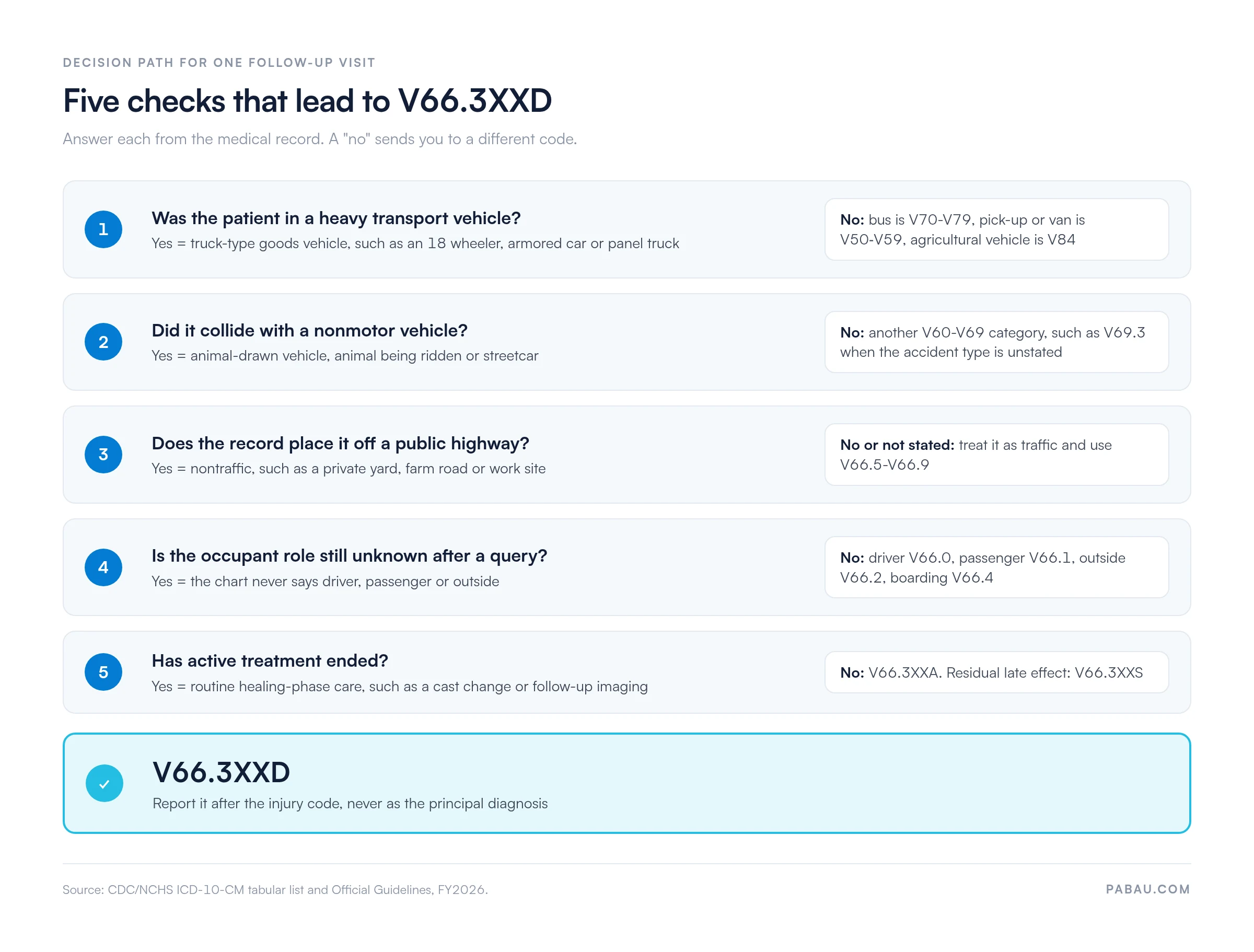
The five checks below put those rules in order, from vehicle type to the 7th character.
V66.3XXD is an external cause code, so it is always sequenced as an additional code and never as the principal diagnosis. The principal diagnosis is the injury code: the fracture, contusion, traumatic brain injury or soft tissue damage from the accident.
ICD-10-CM Chapter 20 guidelines use external cause codes alongside the injury code to identify the cause and circumstances of the injury. Common principal diagnosis codes paired with V66.3XXD include:
Payer requirements for external cause codes vary. The guidelines set no national reporting mandate, but state-based mandates and some payers do require them. Verify each payer’s current policy before treating the code as optional. When a payer requires it and it is absent, the claim can deny for incomplete coding.
Pabau’s claims management software sends the claim to the Claim.MD clearinghouse with the ICD-10-CM and CPT codes your team enters. It doesn’t assign or check codes, so the coding review stays with your coders. A clean claim also depends on the other fields payers check before processing.
V66.3XXD sits among several codes that differ by a single character or by one documented fact. The table below sets out the ones coders mix up on heavy transport vehicle accidents.
The V69.3XXD confusion is worth calling out. Both codes cover a heavy transport vehicle occupant in a nontraffic accident at a subsequent encounter. V69.3XXD applies when the record doesn’t say what kind of accident it was. Once the chart names a collision with a nonmotor vehicle, V66.3XXD is the more specific code.
If the record also fails to place the accident off a public highway, the traffic default applies, and the unspecified-accident code becomes V69.9XXD. Verify the distinction in the AAPC ICD-10-CM code lookup when cross-referencing the two categories.
The medical record must support each element V66.3XXD encodes. That means the vehicle type, the collision, the accident location, the patient’s occupant status and the phase of care.
Required documentation elements for V66.3XXD:
Common causes of denial on V66.3XXD claims include:
When a claim denies for external cause code errors, review the payer’s remittance advice CARC codes to identify the specific reason, then correct and resubmit. The denial management workflow for external cause code rejections typically involves a documentation query to the provider, then resubmission with the corrected code string. Staying current on medical billing compliance requirements by payer reduces the volume of these corrections.
Set up a coding review checklist for all V66 codes: (1) Confirm the vehicle is a heavy transport vehicle. (2) Confirm a collision with a nonmotor vehicle. (3) Verify the nontraffic location in the record. (4) Establish or query the occupant role. (5) Confirm the episode-of-care character matches the visit type. Run it before every claim that carries a Chapter 20 code.
A patient hurt in a truck collision may return for follow-ups over several weeks. Each visit’s claim needs the injury code plus V66.3XXD. Without a connected system, staff re-key the codes every time and chase stalled claims by phone.
In Pabau, the codes your coder enters go on the claim with the CPT codes from the visit. Pabau submits the claim to the Claim.MD clearinghouse and shows its status as it moves through the payer. Pabau doesn’t choose or validate codes, so your pre-submission checklist still does that job.
The checkout screen also books the next follow-up before the patient leaves, so the healing-phase visits stay on the calendar.
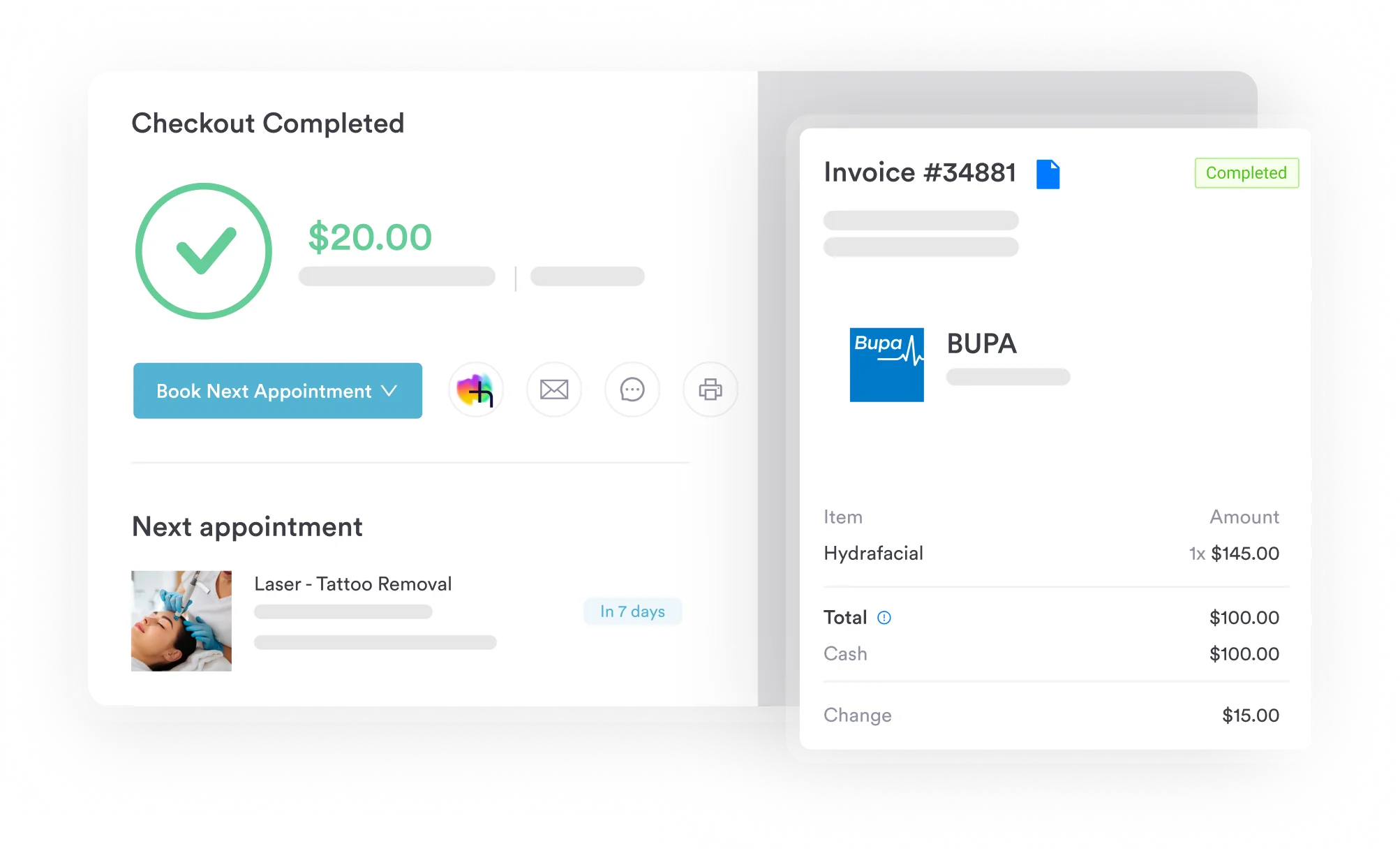

Pabau sends your claims to the Claim.MD clearinghouse with the codes your coders enter, then tracks each one to payment. See how it fits your billing workflow.

V66.3XXD fits a claim only when the record supports five facts. They are a heavy transport vehicle, a collision with a nonmotor vehicle, an off-highway location, an unknown role and a healing-phase visit. If one is missing, a neighboring code fits better.
The trade-off is time at the front end. A physician query about the occupant role or the accident location takes minutes, while a denied claim costs a resubmission cycle. Query first, then code.
Book a demo to see how Pabau submits and tracks your external cause code claims through Claim.MD.

Need a broader framework for managing claim denials? Denial management in healthcare covers the end-to-end workflow for identifying, correcting, and resubmitting denied claims.
Want to understand how external cause codes fit into clean claim requirements? Clean claim submission guidelines explains the elements payers check before processing a claim.
Looking for broader ICD-10 coding context? What is medical billing provides foundational context on how diagnosis codes drive the revenue cycle.
V66.3XXD is a billable external cause code for a subsequent encounter. It covers an unspecified occupant of a heavy transport vehicle injured in a nontraffic collision with a nonmotor vehicle. It belongs to Chapter 20 of ICD-10-CM and is always reported after the principal injury diagnosis, never as the primary code on a claim.
Yes, V66.3XXD is a billable ICD-10-CM code with sufficient specificity for claim submission. It requires all 7 characters, including the two placeholder X characters in positions 5 and 6. Submitting it without those placeholders (as V66.3D) makes the code structurally invalid and triggers a format rejection.
External cause code requirements vary by payer. Medicare does not universally mandate them. Many state Medicaid programs and some commercial payers do require them as a condition of claim payment. Verify the current policy for each payer before treating V66.3XXD as optional on claims involving heavy transport vehicle injuries.
No. V66.3XXD is an external cause code from Chapter 20 of ICD-10-CM and cannot be sequenced as the principal diagnosis. It describes the circumstances of an injury, not the injury itself. The principal diagnosis must be the injury code (fracture, contusion, TBI, etc.), with V66.3XXD listed as an additional code.