ICD-10 Code Y76.0: Diagnostic obstetric and gynecological devices
ICD-10 Code Y76.0: Definition and billable status ICD-10 Code Y76.0 is a valid, ...

Last Updated: Oct 23, 2026
ICD-10 Code P95 is the billable ICD-10-CM diagnosis code for stillbirth, assigned on the fetal record. It applies when a delivery shows no signs of life at or beyond the gestational age threshold. The code belongs on the fetal death certificate, not on the mother’s claim.
The maternal record takes O36.4XX- (maternal care for intrauterine death) plus a Z37 outcome-of-delivery code instead. A loss below the threshold is coded O03 (spontaneous abortion), and P95 never applies to a liveborn infant.

P95 is a billable ICD-10-CM code for stillbirth, assigned on the fetal record and never on the maternal record.
The maternal record uses O36.4XX- for intrauterine fetal death, and P95’s Excludes1 note keeps the two codes off the same record.
The US federal threshold for P95 is 20 completed weeks, and the WHO standard is 22 weeks or 500g. State law governs in practice.
Pabau, the practice management platform we build, includes claims management software that flags incomplete fetal-loss records before the maternal claim goes out.
ICD-10 Code P95 is the single billable diagnosis code for stillbirth in ICD-10-CM. It sits in the P90-P96 block (Other disorders originating in the perinatal period) of Chapter 16 (Certain conditions originating in the perinatal period, P00-P96).
The CDC/NCHS ICD-10-CM web tool lists P95 with the full descriptor “Stillbirth”. It remains valid and billable for FY2027, with no change to its descriptor or block assignment.
The code applies only to the fetal or infant record. It does not capture the cause of fetal death, which is coded separately when the physician documents a contributing condition.
Stillbirth describes a delivery that produces no signs of life. For P95 to apply, the fetus must meet the gestational age threshold set by state law or institutional policy. It must also show no heartbeat, respiratory effort, or voluntary muscle movement at delivery.
Clinical notes use intrauterine fetal death (IUFD) and fetal demise interchangeably with stillbirth, and P95 covers all three terms.
Three fetal outcomes are commonly confused, and each one takes a different code:
The decision path below shows how each outcome routes to a code, and which record every code lands on.
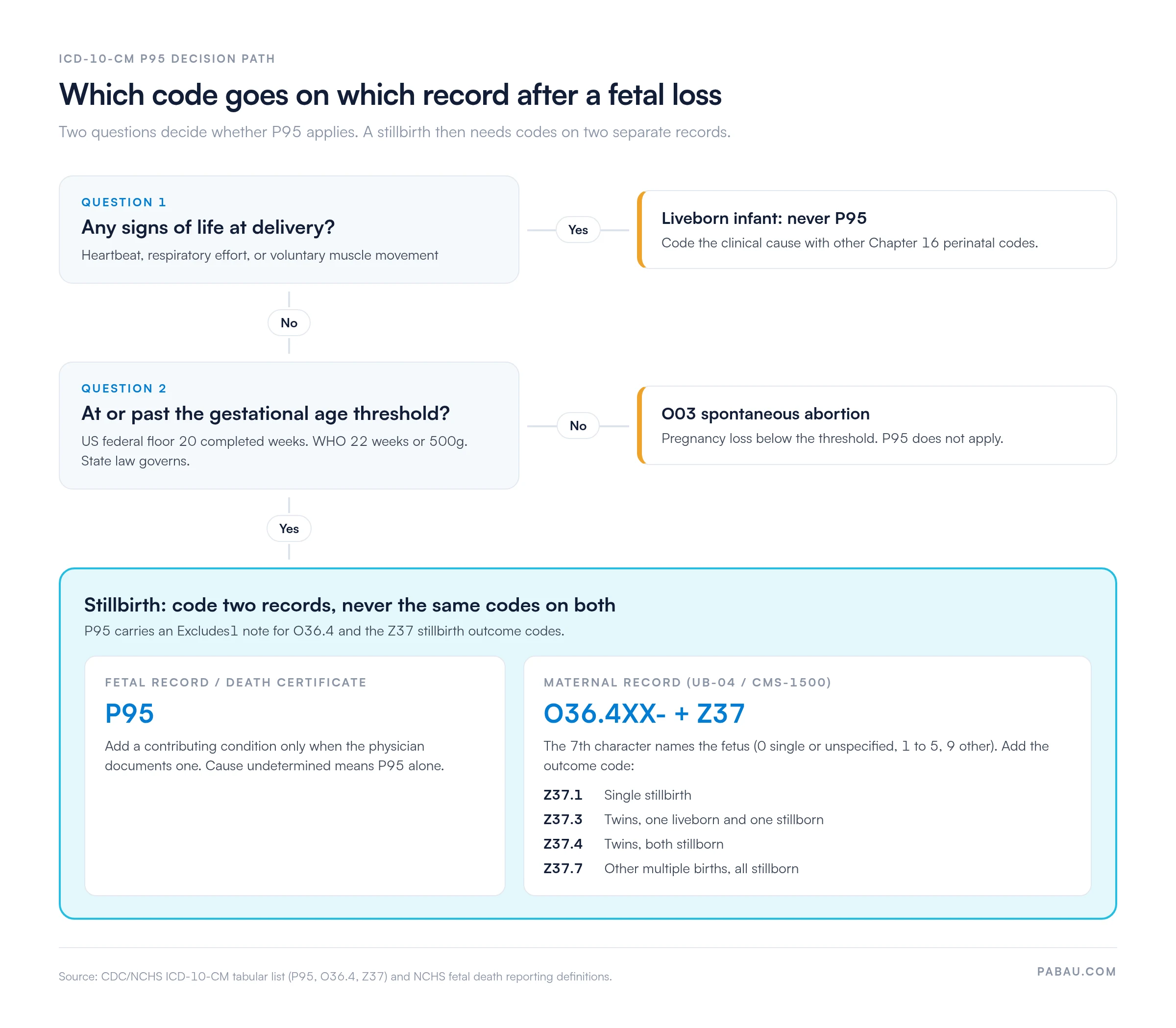
The gestational age threshold decides whether P95 or O03 applies, and no single universal US threshold exists. The CMS ICD-10 codes page defers to CDC NCHS mortality reporting definitions, which set the federal floor at 20 completed weeks. State law may set a lower threshold, and the WHO standard differs.
When gestational age is not documented, query the attending physician or midwife before assigning P95. Assuming eligibility from clinical context alone is a documentation compliance risk.
The ICD-10-CM tabular list carries instructional notes that define P95’s scope. Misreading them is a common root cause of coding errors on fetal-loss encounters.
In practice, P95 never applies to:
P95 also carries an Excludes1 note in the tabular list. It excludes maternal care for intrauterine death (O36.4), missed abortion (O02.1), and the stillbirth outcome-of-delivery codes Z37.1, Z37.3, Z37.4, and Z37.7.
An Excludes1 note means the excluded codes are never reported together with P95. Chapter 16 coding instructions add that the fetal record is created separately from the maternal record for reporting purposes.
P95 and O36.4 are never assigned on the same record, because they describe one clinical event on two different records. O36.4 (maternal care for intrauterine death) belongs on the maternal inpatient claim, and P95 belongs on the fetal death certificate. The split decides which payer receives which claim, and which record carries the diagnosis.
O36.4 has no trimester subdivision. Its 7th character identifies the fetus in a multiple gestation instead. Use 0 for a single gestation or unspecified fetus, 1 to 5 for the fetus number, and 9 for any other fetus.
So a singleton intrauterine death is coded O36.4XX0, while the death of fetus 1 in a twin pregnancy is coded O36.4XX1.
Companion code sequencing depends on which record is being coded. The fetal death certificate and the maternal claim each follow their own pattern.
Sequence O36.4XX- as the principal diagnosis, then add the Z37 outcome-of-delivery code that matches the delivery:
Z37 codes are required on the maternal record for every delivery encounter, stillbirths included. When the Z37 code is left off, payers often respond with an additional documentation request.
P95 stands as the primary code. The physician may document a contributing condition, such as placental abruption, an umbilical cord accident, or maternal infection. Code it from the applicable Chapter 16 category as an additional diagnosis.
P95 alone is correct when the cause of fetal death is undetermined and the physician has not documented a contributing condition.
When the cause of fetal death is listed as ‘undetermined’ on the death certificate, assign P95 alone. Do not reach for a probable cause from the clinical notes without explicit physician attestation. Query the attending before adding any contributing condition code.
Incomplete documentation is the most common denial trigger for fetal-loss encounters. Meeting medical billing compliance requirements means the record holds specific elements before P95 is assigned. They align with the CDC ICD-10 Mortality/Fetal Manual requirements for death certificate completion.
Required documentation elements:
When any of these elements is missing, send a physician query before finalizing the fetal death certificate. A clean claim submission for the maternal encounter also depends on complete delivery documentation. Some Medicaid programs cross-reference the maternal claim against the certificate.
P95 is primarily a mortality and vital-records code, governed by the CDC NCHS ICD-10 Mortality and Fetal Death manual rather than by claims rules. Most US states mandate fetal death registration once a loss meets the state’s gestational age threshold, commonly 20 weeks. That registration uses P95 on the fetal death certificate.
Key distinctions for billing staff:
Most claim issues on stillbirth encounters arise on the associated maternal claim rather than from P95 itself. Clear denial management workflows for perinatal encounters help billing teams catch them before submission.
Review the common medical billing denial codes on obstetric encounters to build a denial-prevention checklist for your OB department.
Because P95 is a vital-records code rather than a claims code, most payer billing requirements for stillbirth encounters attach to the maternal record. That split between vital-records coding and facility billing is worth teaching explicitly alongside medical billing fundamentals for OB staff.
Key payer considerations:
The delivery procedure itself is reported with an obstetric CPT code on the professional claim. Common examples are CPT 59400 for routine obstetric care with vaginal delivery and CPT 59510 for the cesarean equivalent.
P95 sits at the end of Chapter 16, which covers conditions originating in the perinatal period. Knowing the block structure helps coders avoid a neighboring code meant for a different clinical situation. The WHO ICD-10 browser shows the international structure that ICD-10-CM Chapter 16 is derived from.
Every code in P90-P94 and P96 applies to liveborn infants, and P95 is the only code in this block assigned to a fetal death. Swapping P95 for P96, P91, or P94 on a liveborn record is a mapping error that triggers a clinical documentation query.
When fetal-loss documentation lives across delivery notes, certificate worksheets, and a separate billing system, P95 can drift onto the maternal claim. A missing Z37 code slips through the same way, and the claim comes back weeks later.
Pabau’s error-checking claims management runs pre-submission documentation checks that flag incomplete fetal-loss records before they reach the payer. The Claim.MD clearinghouse integration adds eligibility checks and 837P / CMS-1500 claim validation before the maternal delivery claim goes out.
The result is fewer returned maternal claims and less rework on perinatal encounters, so your billing team spends less time chasing resubmissions.


Pabau’s claims management software checks documentation completeness before fetal-loss claims reach the payer. That cuts rework on maternal delivery encounters for OB and perinatal billing teams.

P95 is narrow by design, with one descriptor, one record type, and one main use on the fetal death certificate. The denials and audit flags around it trace back to two habits. One is placing P95 on the maternal claim instead of O36.4XX-, and the other is assigning it below the gestational age threshold.
The change worth making now is a short check at the point of coding. Confirm signs of life, gestational age in completed weeks, physician attestation, and the matching Z37 code before either record is finalized.
Book a demo to see how Pabau checks perinatal documentation before the maternal delivery claim reaches the payer.

Want to learn how medical billing works end to end? Medical billing fundamentals explains the full revenue cycle from encounter to payment posting.
Coding a liveborn infant from the same block? ICD-10 code P90 covers convulsions of newborn, a neighboring Chapter 16 code that applies only to liveborn infants.
ICD-10 Code P95 is the billable diagnosis code for stillbirth. It is assigned on the fetal or infant record when a delivery shows no signs of life at or beyond the gestational age threshold. It is used mainly on fetal death certificates filed with state vital statistics offices, not on maternal claims.
Yes. P95 is a valid and billable ICD-10-CM diagnosis code for FY2027, with no pending deletion or descriptor change. Its main home is the fetal death certificate rather than a health insurance claim. That is why it rarely appears on UB-04 or CMS-1500 submissions.
P95 is assigned on the fetal record, which means the fetal death certificate. O36.4XX- is assigned on the maternal inpatient record to capture the mother’s care for intrauterine fetal death. The two are never used on the same record. O36.4XX- drives the maternal claim reimbursement, and P95 drives vital statistics reporting.
The US federal standard (CDC/NVSS) sets the floor at 20 completed weeks of gestation. The WHO standard is 22 completed weeks or a birthweight of 500g or above. State law governs in practice, and some states set lower thresholds. Below the applicable threshold, use O03 (spontaneous abortion) rather than P95.
On the fetal death certificate, P95 stands alone unless the physician documents a contributing condition coded from Chapter 16. On the maternal record, O36.4XX- is paired with a Z37 outcome-of-delivery code. Use Z37.1 for a single stillbirth and Z37.3 for twins with one liveborn and one stillborn. Use Z37.4 for twins who are both stillborn, or Z37.7 for other multiple births that are all stillborn.
Most P95-related denials happen on the maternal claim, not the fetal death certificate. Common causes include P95 on the UB-04 instead of O36.4XX-, a missing Z37 outcome-of-delivery code, or no documented gestational age. A missing physician attestation of fetal death causes denials too. Each one is fixed by completing the documentation before submission.