ICD-10 Code Y76.0: Diagnostic obstetric and gynecological devices
ICD-10 Code Y76.0: Definition and billable status ICD-10 Code Y76.0 is a valid, ...

Last Updated: Oct 23, 2026
Billable Code Specific Code
Q16.2 is the billable ICD-10-CM code for absence of eustachian tube. It covers a congenital anomaly in which the tube linking the middle ear to the nasopharynx never forms.
Coders see Q16.2 most often in pediatric ENT and audiology, from newborn hearing screen workups to ear reconstruction. One code covers unilateral and bilateral absence. Q16.1 is a separate code for the external auditory canal, so confirm which structure the note names before assigning either.
Let Pabau's smart automation suggest the right codes, reduce claim denials, and keep your practice compliant—effortlessly.
Automate repetitive tasks and focus on what matters most—your patients.
Reduce coding errors and ensure compliance with the latest regulations.
Clean claims, fewer denials, and faster reimbursements.
Powerful insights and reporting to help your practice thrive.
HIPAA compliant SOC 2 certified GDPR-compliant Trusted by 4,000+ clinics worldwide

Q16.2 is the billable ICD-10-CM code for congenital absence of the eustachian tube, valid through the 2026 code year.
Q16.2 has no laterality characters, so right-sided, left-sided and bilateral absence all take the same code.
The error to watch for is assigning Q16.1, the external auditory canal code, when the note documents an absent eustachian tube.
Pabau’s claims management software helps ENT and audiology practices catch incomplete Q16.2 claims before submission and flag denied claims for rework.
ICD-10 code Q16.2 is the billable, specific ICD-10-CM code for congenital absence of the eustachian tube. One code covers one or both sides, and the table below sets out the billing facts to confirm before you submit a claim.
Q16.2 covers congenital absence of the eustachian tube, which fails to form during fetal development. The eustachian tube, also called the auditory tube or pharyngotympanic tube, normally connects the middle ear cavity to the nasopharynx.
The tube equalizes pressure and drains fluid. Without it, the middle ear can’t regulate pressure, leaving the patient prone to chronic effusion, recurrent infection and conductive hearing loss.
Clinically, congenital absence of the eustachian tube is rare. It often occurs alongside other structural ear anomalies, such as middle ear dysplasia, ossicular malformation and microtia.
The National Center for Health Statistics (NCHS) places Q16.2 in the Q16 block of congenital malformations. Documentation should therefore make clear that the anomaly was present from birth, not acquired.
Q16.2 captures any documented congenital absence of the eustachian tube, whether the anomaly is unilateral or bilateral. The ICD-10-CM tabular list has no separate codes for right-sided and left-sided absence, so both are reported under Q16.2. Coders used to laterality characters in other ear codes often look for one here, and Q16.2 doesn’t have one.
Inclusion terms that map to Q16.2 include congenital agenesis and congenital aplasia of the eustachian tube. Malformations that cause functional obstruction rather than complete structural absence belong elsewhere in the Q16 block.
Payers audit for specificity before they adjudicate a claim, so match the code to the exact structure documented. The same rule runs through our ICD-10-CM guides for coders, chapter by chapter.
Q16.2 does not carry its own Excludes1 or Excludes2 notes at the individual code level. It sits within the Q16 block, though, and coders must apply that category’s instructions. The exclusion that matters most day to day is the boundary between Q16.2 and its immediate neighbors, Q16.0 and Q16.1.
Congenital ear anomalies coded under Q17 (other congenital malformations of ear) are also out of scope for Q16.2. Q17 covers auricular shape anomalies such as macrotia and bat-ear deformity that do not cause hearing impairment from structural malformation of the canal or tube.
Q16.2 targets a single anatomical structure, the eustachian tube, while each of its neighbors in the block targets a distinct part of the ear. Mixing them up is a frequent cause of claim rejection in this code family, so the map below starts from the structure the note names.
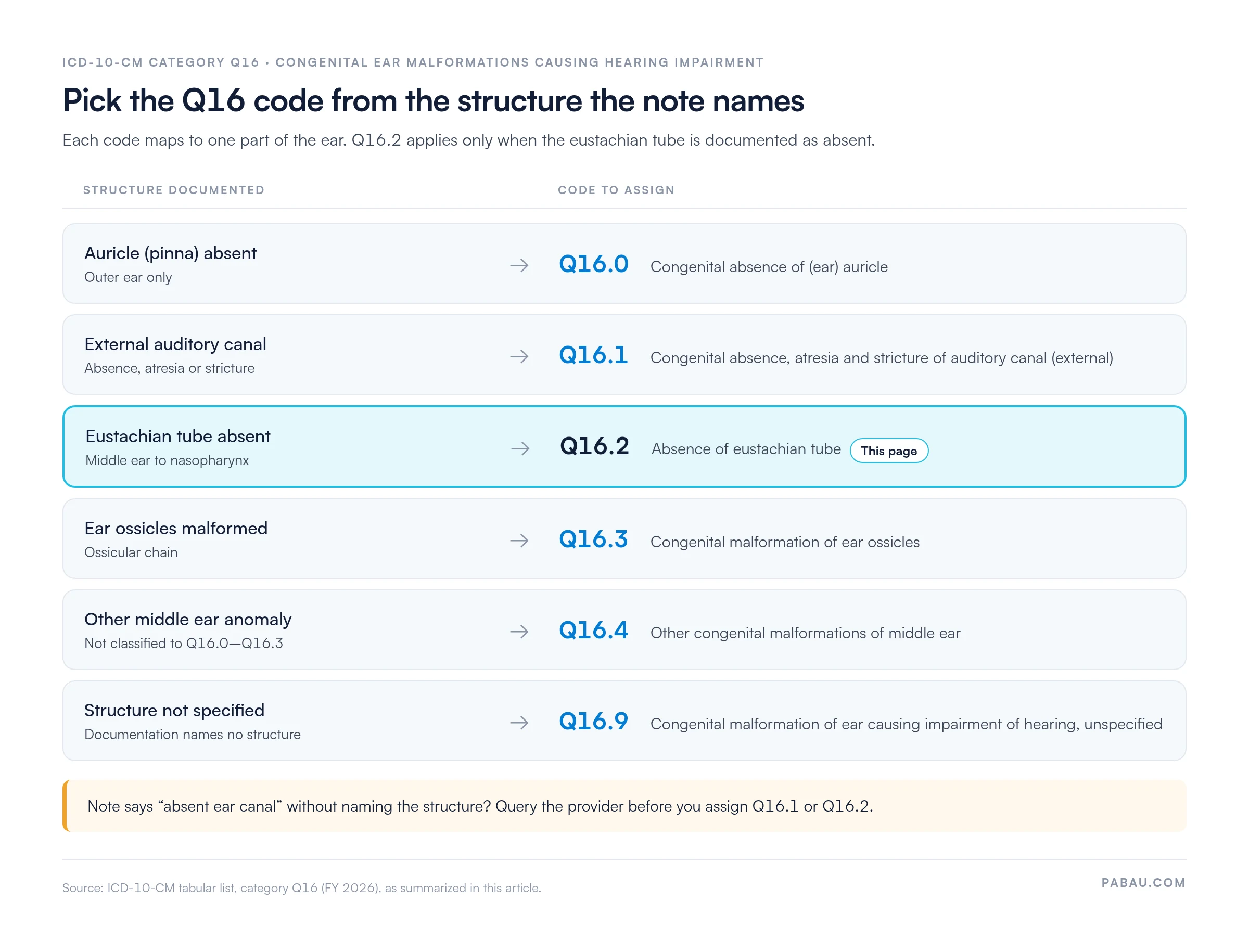
The critical distinction between Q16.1 and Q16.2 comes down to anatomy. The external auditory canal runs from the outer ear to the eardrum. The eustachian tube runs from the middle ear to the back of the throat.
An ENT note documenting “canal atresia” maps to Q16.1. A note documenting “absent eustachian tube” maps to Q16.2. When the operative or diagnostic note is ambiguous, query the provider before assigning either code.
Flag any ENT documentation that uses the phrase ‘absent ear canal’ without specifying whether it refers to the external auditory canal or the eustachian tube. The two phrases are clinically different and code to different Q16 codes. A single provider query before submission prevents a denial cycle that can take 60-90 days to resolve.
A coder cannot assign ICD-10 code Q16.2 from clinical suspicion alone. The documentation has to establish three facts:
These sources supply that evidence in the record:
ICD-10 code Q16.2 supports medical necessity for several CPT codes in ENT and audiology, including the tympanometry and reflex testing billed under CPT 92550. The correct pairing depends on the procedure performed and the payer’s local coverage determination (LCD) for pediatric ear procedures.
Payer LCDs govern which CPT codes are covered for a given diagnosis. Before submitting a complex reconstructive procedure paired with Q16.2, check the LCD your Medicare Administrative Contractor (MAC) publishes for pediatric ear surgery. Medicare Advantage plans may require prior authorization for any procedure coded with a Q-chapter diagnosis in a pediatric patient.
Payer rules for Q16.2 vary significantly across Medicare, Medicaid and commercial plans. No universal prior authorization (PA) requirement applies, but several triggers are consistent enough to plan around.
Complete insurance eligibility verification before scheduling any procedure tied to this diagnosis. Pediatric ENT benefits often sit on a separate benefit tier with different cost-sharing rules.
Track PA status separately from claim submission in your ENT claims management software. Practices that treat PA approval and claim adjudication as one step miss the appeal window when an approved procedure is still denied on billing grounds.
Claims paired with ICD-10 code Q16.2 fail for a predictable set of reasons, and each one can be caught before submission. Structured denial management workflows pick up most of these patterns before they reach the payer.
A clearinghouse that validates claims before transmission removes many of these preventable rejections. Pair one, such as the Claim.MD clearinghouse, with a clean claim submission checklist. That way the diagnosis, procedure code and PA number are all confirmed before the claim leaves the practice.
Most Q16.2 encounters originate in one of three settings: the newborn nursery, a pediatric ENT outpatient visit, or a birth defect surveillance registry. Each has specific coding considerations.
When Q16.2 is identified during the neonatal period, the code goes on the newborn’s record, not the mother’s. Per ICD-10-CM official guidelines, congenital conditions present at birth are coded for as long as they remain clinically relevant, including on later pediatric encounters.
The newborn hearing screen that prompts the workup is coded separately. Use Z13.5 (encounter for screening for eye and ear disorders) on the screening visit. The follow-up exam after a failed screen takes Z01.110 (encounter for hearing examination following failed hearing screening).
Q16.2 is a reportable congenital anomaly in several US state birth defect surveillance programs, including the New York State registry. Practices that serve neonatal populations should confirm their state’s mandatory reporting requirements for Q16 block codes.
According to the CMS ICD-10 coding guidelines, codes from the congenital malformations chapter (Q00-QA0) aren’t limited to the birth encounter.
They can be reported throughout the patient’s life while the condition stays clinically relevant. The CDC/NCHS ICD-10-CM web tool confirms Q16.2 as valid and specific for the 2025 and 2026 code years.
When a patient carries both Q16.2 and a documented conductive hearing loss, such as H90.2, sequence the structural anomaly as the principal diagnosis. The hearing loss follows as an additional code. This reflects the etiology-first convention in ICD-10-CM, where the anatomical cause precedes the functional deficit it produces.
The AAPC ICD-10-CM lookup and the WHO ICD-10 browser both list Q16.2 in the congenital malformations chapter.
A pediatric patient with Q16.2 may also have a documented hearing aid fitting. In that case, add Z46.1 (encounter for fitting and adjustment of hearing aid) as a secondary code on the audiology visit. This combination accurately reflects the clinical purpose of the encounter and supports medical necessity for the audiological service billed.
The Q16.2 denials covered above start before the claim is built. The ENT note names the wrong structure, coverage goes unchecked, or the PA number never reaches the claim. The biller then finds out weeks later from a remittance.
Pabau, the practice management platform we build, runs those checks from the patient record. Its Claim.MD integration verifies coverage in real time before treatment and submits the claim electronically as a CMS-1500. Validation runs every time you send a claim, so missing details are caught before the payer sees them.
Every claim then moves through clear statuses, from Pending to Paid or Error, in one Claims dashboard. Electronic remittance advice (ERA) comes back into Pabau and matches the claim it settles. Denied claims are flagged for rework, so your team corrects a Q16.1 and Q16.2 mix-up while the appeal window is still open.
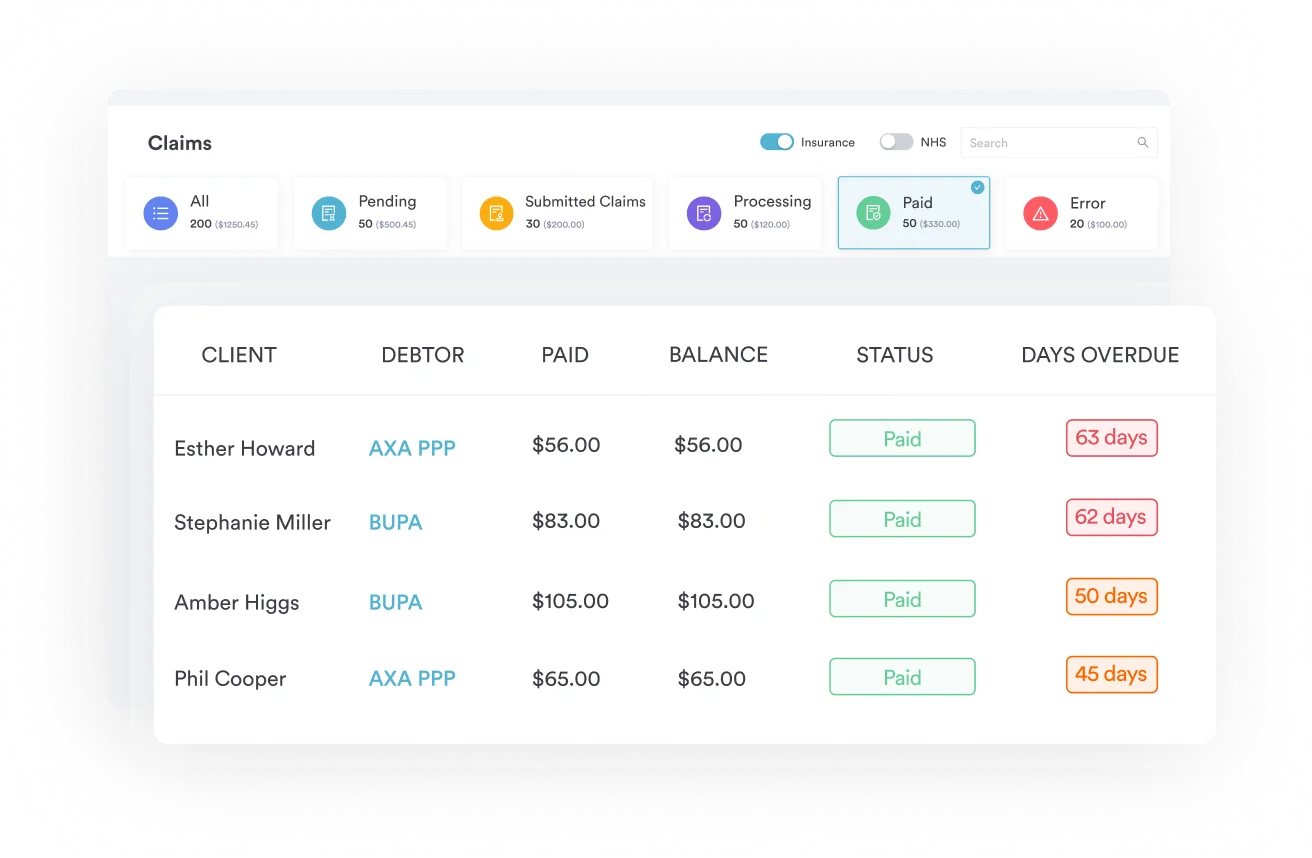

Pabau checks each claim for missing details before it goes out through Claim.MD, verifies coverage in real time, and flags denied claims for rework. ENT and audiology practices spend less time resubmitting Q16.2 claims.

Q16.2 is one of the simpler congenital codes to assign once the record is clear. It has no laterality characters, no child codes and only one structure to confirm. The coding work sits upstream, in getting ENT, radiology and audiology notes to name the eustachian tube explicitly.
Do your notes often say “absent ear canal” without naming the structure? Add a standard provider query to your workflow before the next claim goes out. It takes a minute per chart and spares you a denial cycle that can run 60 to 90 days.
Book a demo to see how Pabau checks coverage and claim details before a Q16.2 claim reaches the payer.

Need to understand how clearinghouse edits catch ICD-10 errors before submission? Medical claims clearinghouse guide explains how pre-submission validation works and what edits to expect on congenital diagnosis codes.
Trying to reduce first-pass denial rates across your ENT practice? Medical billing fundamentals covers the claim lifecycle, from eligibility check through remittance posting, and where Q-code claims most often stall.
Want to see how Pabau handles ERA and denial tracking for pediatric specialties? Electronic remittance advice (ERA) guide covers how 835 files surface denial reasons and how to map CARC codes back to the originating claim.
ICD-10 code Q16.2 is the billable ICD-10-CM diagnosis code for congenital absence of the eustachian tube, which fails to develop during fetal growth. It sits in category Q16 (congenital malformations of ear causing impairment of hearing), within the Q00-QA0 chapter. It is valid for the 2025 and 2026 code years.
Yes. Q16.2 is a specific, billable ICD-10-CM code valid for claim submission. It is a terminal code with no further sub-divisions, which means coders assign Q16.2 directly without selecting a more specific child code.
Q16.1 covers congenital absence, atresia or stricture of the external auditory canal, the passage from the outer ear to the eardrum. Q16.2 covers congenital absence of the eustachian tube, which connects the middle ear to the nasopharynx. The two structures are anatomically distinct, so never use the codes interchangeably. When documentation is ambiguous, query the provider before assigning either code.
The most common triggers are Q16.1 selected in place of Q16.2 and a missing CT temporal bone report to support medical necessity. A CPT and ICD-10 pairing flagged by the payer’s crosswalk, or a surgical claim without its prior authorization number, also leads to denials. A clearinghouse with pre-submission edits catches most of these before the claim reaches the payer.
No. Q16.2 does not have laterality extensions in the current ICD-10-CM tabular list. There are no separate codes for right-sided or left-sided eustachian tube absence. Coders should document the affected side in the clinical record for accuracy, but the code itself remains Q16.2 regardless of laterality.
Pediatric ENT (otolaryngology) and audiology practices use Q16.2 most frequently. Neonatology and general pediatrics follow, when the anomaly is identified during newborn hearing screen workups. The code also appears in birth defect surveillance registries maintained by state health departments.