ICD-10 Code Y76.0: Diagnostic obstetric and gynecological devices
ICD-10 Code Y76.0: Definition and billable status ICD-10 Code Y76.0 is a valid, ...

Last Updated: Oct 23, 2026
Billable Code Specific Code
Q04.3 is the billable ICD-10-CM code for other reduction deformities of brain. It covers nine inclusion terms: lissencephaly, agyria, pachygyria, microgyria, hydranencephaly, and absence, agenesis, aplasia, or hypoplasia of part of brain.
Arhinencephaly (Q04.1) and holoprosencephaly (Q04.2) have their own sibling codes. Assigning Q04.3 turns on the physician's note naming one of the nine terms, with neuroimaging in the chart to support it.
Let Pabau's smart automation suggest the right codes, reduce claim denials, and keep your practice compliant—effortlessly.
Automate repetitive tasks and focus on what matters most—your patients.
Reduce coding errors and ensure compliance with the latest regulations.
Clean claims, fewer denials, and faster reimbursements.
Powerful insights and reporting to help your practice thrive.
HIPAA compliant SOC 2 certified GDPR-compliant Trusted by 4,000+ clinics worldwide

Q04.3 is a billable ICD-10-CM code for named brain reduction deformities, distinct from Q04.9, which covers unspecified malformations.
Its nine inclusion terms cover lissencephaly, agyria, pachygyria, microgyria, hydranencephaly, and absence, agenesis, aplasia, or hypoplasia of part of brain.
Arhinencephaly (Q04.1) and holoprosencephaly (Q04.2) have their own sibling codes and are never coded to Q04.3.
Brain MRI findings and a physician diagnosis naming a specific deformity are required documentation before submitting Q04.3.
Pabau’s claims management software builds the claim from the documented diagnosis, so the code matches the physician’s wording.
ICD-10 Code Q04.3 is a specific, billable ICD-10-CM diagnosis code valid for all fiscal years through FY2027, confirmed by the CMS ICD-10 code files.
Its full official descriptor is “Other reduction deformities of brain.” Because the code is specific rather than unspecified, it can be submitted directly on a claim without a more granular child code.
The code sits under parent category Q04 within the Q00-Q07 block, which covers all congenital malformations of the nervous system. For practitioners managing medical billing workflows for pediatric neurology patients, Q04.3 is the right code whenever the physician’s documentation names one of its inclusion terms.
The FY2027 ICD-10-CM Tabular List gives nine inclusion terms under Q04.3. Assigning this code requires that the physician’s documentation explicitly names one of these conditions, or a synonym documented with sufficient clinical specificity.
Lissencephaly is the most frequently coded condition under Q04.3. Its two main subtypes, agyria (complete smooth brain) and pachygyria (partial lissencephaly), are both inclusion terms, so either documents the code.
When the MRI report describes an agyria-pachygyria spectrum without specifying which predominates, Q04.3 still applies, provided the neurologist’s note confirms the diagnosis. Genetic testing confirming LIS1 or DCX mutations strengthens documentation but is not required for the code assignment.
Arhinencephaly and holoprosencephaly sit right beside Q04.3 in the Q04 category, which is why they get misfiled here. Neither is a Q04.3 inclusion term. Arhinencephaly codes to Q04.1, and holoprosencephaly codes to Q04.2 whatever its subtype (alobar, semilobar, or lobar).
The quick test is the diagnosis wording itself. If the note names one of the nine terms above, Q04.3 fits. If it names a failure of the forebrain to divide, or an absent olfactory bulb and tract, check Q04.2 and Q04.1 first.
When the record documents one of those conditions alongside a separate Q04.3 condition, code each one to its own code. The map below routes each documented diagnosis to its Q04 code.
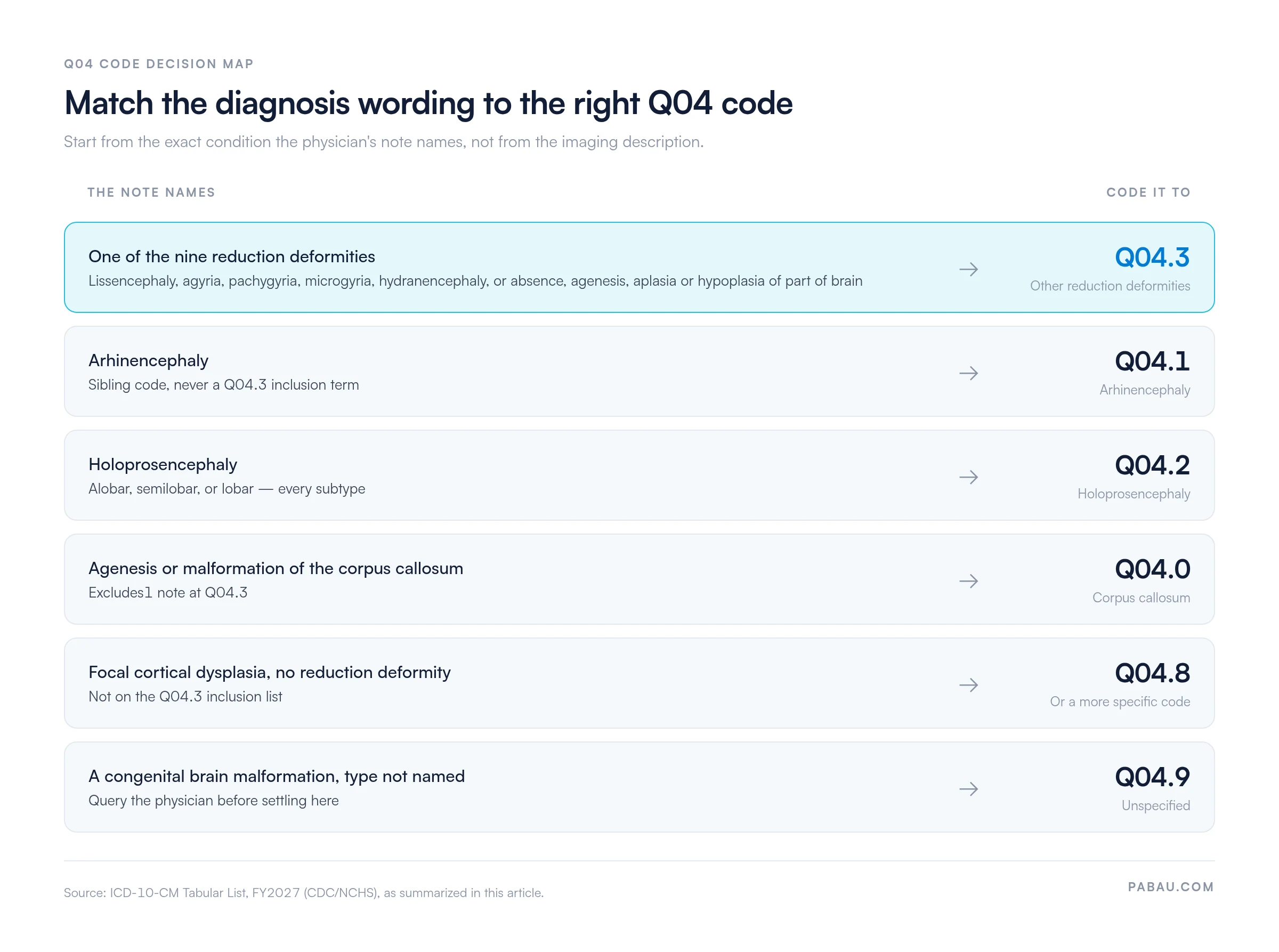
Q04.3 carries one Excludes1 note of its own: congenital malformations of corpus callosum (Q04.0). The parent category Q04 adds two more Excludes1 notes that govern every code within it.
Q04.9 (Congenital malformation of brain, unspecified) is the fallback code when the physician’s documentation describes a congenital brain abnormality without naming a specific condition. The decision rule is simple: if the note names any condition from the Q04.3 inclusion list, Q04.3 is required.
Submitting Q04.9 when Q04.3 is supported by documentation is a specificity error that Medicare and most commercial payers can audit and reject.
The Q04 parent category spans Q04.0 through Q04.9. Understanding the full sibling structure helps coders confirm Q04.3 is the most specific match for a given diagnosis.
You can look up any of these codes in the CDC/NCHS ICD-10-CM web tool for the current tabular and alphabetic index. For congenital and neurological codes outside Q04, our ICD-10-CM code library lists each one with its billing notes.
ICD-10-CM guideline I.C.17, issued by CMS and the NCHS, governs coding for congenital malformations, deformations, and chromosomal abnormalities. For Q04.3, the guideline permits the code throughout the patient’s life, not only at birth.
It applies whenever the condition is documented as the reason for a visit or service. Practices focused on medical billing compliance should build a documentation checklist around four elements.
Prior authorization requirements for services billed with Q04.3 vary by payer and plan. Commercial insurers frequently require pre-authorization for brain MRI billed under CPT 70553, for EEG, and for genetic testing panels.
Medicaid requirements differ by state. Always verify with the individual payer before scheduling elective diagnostic workup for a known Q04.3 patient. Checking each claim against the clean claim standard before it goes out reduces the risk of documentation-related denials.
Run a documentation pre-check before submitting Q04.3 claims. Confirm the note names a specific inclusion term and attach the MRI report reference. If a complicating condition such as congenital hydrocephalus is also present, verify the primary and secondary code order.
Practices billing Q04.3 as the supporting diagnosis typically pair it with neuroimaging, neurology evaluation, EEG, or genetic testing CPT codes. The table below lists the most common pairings. Coverage for any CPT-plus-Q04.3 combination depends on the payer.
For Medicare, that means the Local Coverage Determination (LCD) from the patient’s Medicare Administrative Contractor (MAC); commercial plans apply their own medical policy. Running each claim through error-catching claims management that flags LCD conflicts before submission prevents a significant share of these denials.
Denials on ICD-10 Code Q04.3 cluster around six root causes. Most are preventable with the right pre-submission review. Practices with structured denial management workflows catch the majority before the claim leaves the practice.
Most Q04.3 claim failures start with paperwork. The MRI report sits in one system, the neurologist’s note in another, and the claim gets built in a third. When the named diagnosis and the imaging finding drift apart, the coder falls back on Q04.9 or the payer asks for records.
In Pabau, the practice management platform we build, the note, the imaging report, and the claim sit on one patient record. The claim draws on the diagnosis already documented there, so the coder works from the physician’s exact wording rather than a summary.
Pabau also submits claims electronically through Claim.MD, which validates them against CMS edits across more than 4,000 US payers before transmission. Sequencing errors and POA field mistakes get flagged while you can still fix them, before the payer sees the claim.

Pabau helps pediatric neurology and specialty practices manage documentation, coding, and electronic claim submission in one place. Q04.3 claims reach the payer accurately the first time.

Q04.3 is narrower than its title suggests. It covers nine inclusion terms, and the two conditions most often filed here by mistake, arhinencephaly and holoprosencephaly, each have their own sibling code. Coding from memory is how both the Q04.9 specificity denial and the wrong-sibling error happen.
The habit worth building is one check before submission. Match the physician’s exact diagnosis wording to the Tabular list, with the MRI report already in the chart. Book a demo to see how Pabau keeps the note, the imaging, and the claim on one record for your neurology billing.

Scheduling MRI or genetic testing for a Q04.3 patient? Insurance eligibility verification walks through confirming coverage and authorization before the service date.
ICD-10 Code Q04.3 is the billable ICD-10-CM diagnosis code for other reduction deformities of brain. Its nine inclusion terms are absence, agenesis, aplasia, and hypoplasia of part of brain, plus agyria, hydranencephaly, lissencephaly, microgyria, and pachygyria. It sits in the Q00-Q07 block (congenital malformations of the nervous system) under Chapter 17. It is valid for FY2027 with no change from FY2026.
Yes. Q04.3 is a specific, billable ICD-10-CM code valid for submission on HIPAA-covered electronic claims. It does not require a child code and can be submitted directly. Its billable status is confirmed in the official CDC/NCHS ICD-10-CM Tabular List.
Q04.3 applies when the physician documents a specific named brain reduction deformity from the inclusion list (such as lissencephaly or pachygyria). Q04.9 (Congenital malformation of brain, unspecified) is reserved for cases where the physician’s note describes a congenital brain anomaly without naming a specific condition. Submitting Q04.9 when a specific deformity is documented is a coding specificity error that payers can audit and deny.
No. Holoprosencephaly has its own code, Q04.2, and every subtype (alobar, semilobar, and lobar) codes there. Arhinencephaly also has its own code, Q04.1. Neither condition is an inclusion term of Q04.3.
No. Focal cortical dysplasia is not an inclusion term under Q04.3. Code it to Q04.8 (Other specified congenital malformations of brain) or another applicable specific code. Using Q04.3 for focal cortical dysplasia is a coding error. The FY2027 Tabular List does not include cortical dysplasia among the Q04.3 inclusion terms.
The code itself does not trigger prior authorization. However, the CPT codes commonly billed alongside it often need prior authorization from commercial payers. These include CPT 70553 (MRI brain with and without contrast), 95816 (EEG), and 81479 (genetic panel). Requirements vary by payer and plan. Always verify them before scheduling elective diagnostic services for a Q04.3 patient.
Lissencephaly is coded as Q04.3. It is an explicit inclusion term in the ICD-10-CM Tabular List under “Other reduction deformities of brain.” Both agyria (complete smooth brain) and pachygyria (partial lissencephaly) are also inclusion terms under Q04.3, so the entire agyria-pachygyria spectrum maps to this code. Confirm the physician’s note names the condition before assigning.