ICD-10 Code Y76.0: Diagnostic obstetric and gynecological devices
ICD-10 Code Y76.0: Definition and billable status ICD-10 Code Y76.0 is a valid, ...

Last Updated: Oct 23, 2026
Billable Code Specific Code
T87.0X2 is the billable ICD-10-CM code for complications of reattached (part of) left upper extremity. It covers any complication of a replanted left arm, forearm, hand, or finger, such as necrosis, infection, or vascular compromise. Use it only when the chart confirms the part was surgically reattached.
Common denials tied to this code include assigning unspecified-side T87.0X9 when the record documents the left side. Another is confusing a reattached part with an amputation stump, where necrosis codes to T87.5-. Below, you'll see what the chart must show, how the claim moves, and what to check before you submit.
Let Pabau's smart automation suggest the right codes, reduce claim denials, and keep your practice compliant—effortlessly.
Automate repetitive tasks and focus on what matters most—your patients.
Reduce coding errors and ensure compliance with the latest regulations.
Clean claims, fewer denials, and faster reimbursements.
Powerful insights and reporting to help your practice thrive.
HIPAA compliant SOC 2 certified GDPR-compliant Trusted by 4,000+ clinics worldwide

T87.0X2 is the billable ICD-10-CM code for complications of a reattached left arm, forearm, hand, or finger.
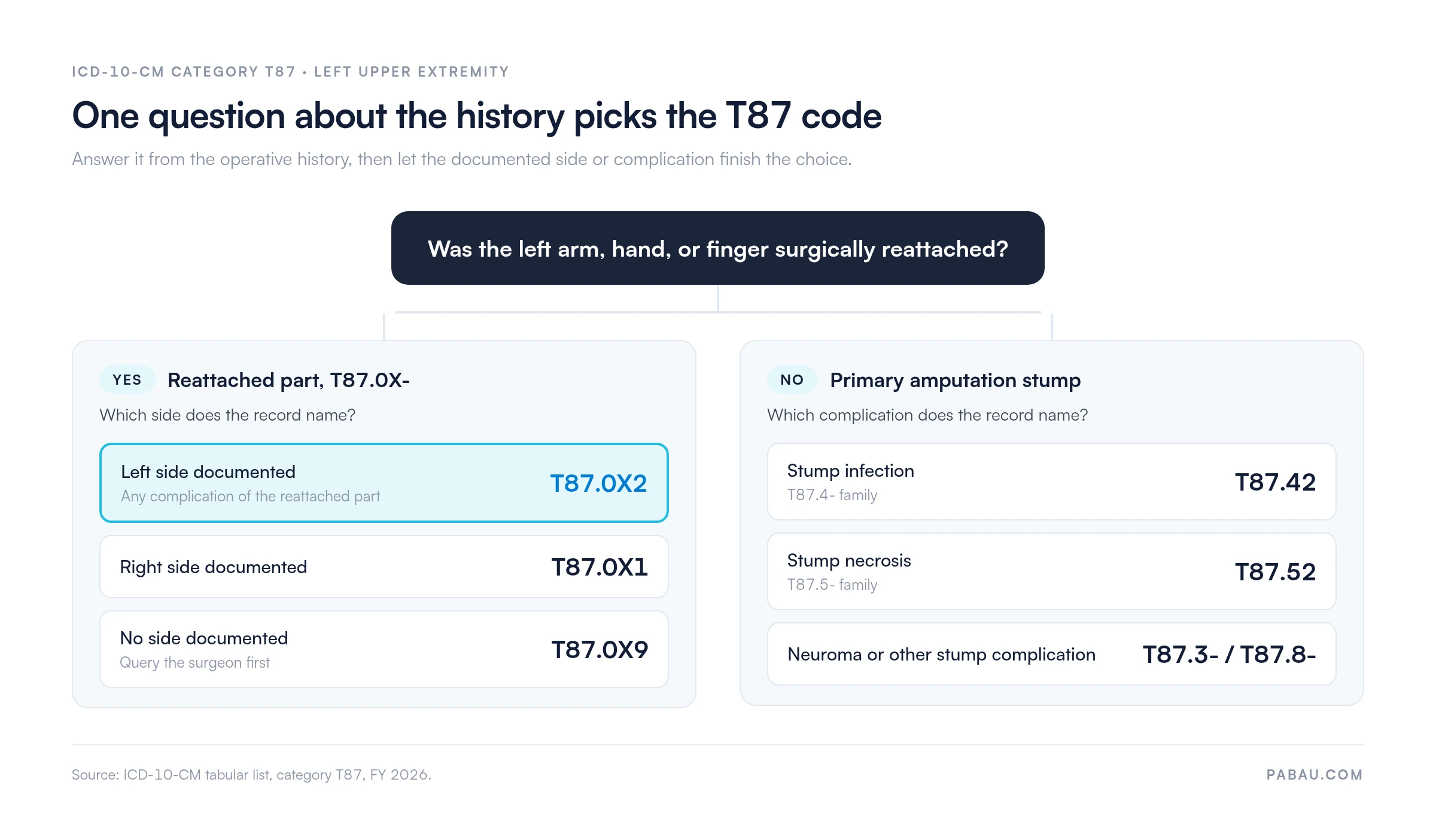
The sixth character sets the side, so T87.0X1 is right, T87.0X2 is left, and T87.0X9 is unspecified.
Use it only when the part was surgically reattached. A primary amputation stump takes a stump code from T87.3 to T87.9 instead.
The chart must name the complication, state the left side, and confirm the earlier replantation.
The code is complete at six characters, so never append an A, D, or S.
ICD-10 code T87.0X2 is the billable ICD-10-CM code for complications of a reattached (part of) left upper extremity. It sits in Chapter 19 (S00-T88), within block T80-T88, Complications of surgical and medical care, not elsewhere classified. Keep the reference data below on hand before you build the claim.
Verify the current fiscal year descriptor using the CDC/NCHS ICD-10-CM web tool, which publishes annual updates each October. The CMS ICD-10 codes page also hosts the official tabular list and code update files.
T87.0X2 applies when a complication develops in a left upper extremity part that was reattached after a traumatic amputation. Replantation surgery restores blood flow to a severed arm, hand, or digit.
Afterward, the reattached part can develop vascular compromise, infection, or necrosis, and each one falls under this code.
The code works at any level of the left upper extremity, as long as the part was reattached:
A primary amputation stump is a different case. No part was reattached, so its complications take their own codes. On the left upper extremity, stump infection is T87.42 and stump necrosis is T87.52.
The decision path below shows how one question about the history routes the code.
T87.0X2 is a child of category T87, which groups complications of reattached parts and of amputation stumps. A quick look at the whole category confirms you’re in the right subcategory before you pick the side.
The first three subcategories cover reattached parts, sorted by limb or body part. Subcategories T87.3 through T87.9 describe stumps instead. That split is why necrosis of a reattached finger stays in T87.0X2, while necrosis of a stump moves to T87.5-.
The T87.0X- series uses a sixth-character laterality convention. Picking the wrong digit is one of the most preventable errors in this code family. Defaulting to unspecified when the chart names the side is another.
ICD-10-CM guidelines tell coders to assign the most specific code the documentation supports. So when the operative note says “left hand replantation,” T87.0X2 is required. A right-side case takes T87.0X1. Save T87.0X9 for a record that names no side, and query the surgeon first.
Here’s how the code reads, character by character:
Unlike fracture codes and many other Chapter 19 injury codes, T87.0X2 takes no seventh character for encounter type. Coders sometimes add an A, D, or S out of habit. That produces an invalid code, and payers reject it outright.
Support for T87.0X2 rests on four elements the physician must record explicitly. If one is missing, the payer has grounds to deny the claim or ask for records.
Sometimes the notes leave it unclear whether the problem involves a reattached part or a stump. In that case, query the attending surgeon before you assign the code. Coding from ambiguous notes is a compliance risk.
A follow-up claim for a complicated replant passes through five stages, and each one can stall it.
Medicare, Medicaid managed care plans, and commercial insurers all expect that diagnosis-to-procedure match. Prior authorization rules for replantation procedures vary by payer and plan, so check each plan’s policy before scheduling. And a clean claim with T87.0X2 starts with a code that’s valid for the service date’s fiscal year.
T87.0X2 denials cluster around a few predictable errors. Catching them before submission costs far less than working them on appeal. A steady denial management workflow also stops the same losses repeating on replant follow-up visits.
When a rejection comes back, look up its CARC in our guide to medical billing denial codes. CARC 11 means the diagnosis is inconsistent with the procedure. CARC 96 flags a non-covered charge, and CARC 252 asks for more documentation.
Run these checks on every T87.0X2 claim before it leaves the practice. With the chart open, they take a couple of minutes.
Many coding errors here come from blurring where T87.0X2 stops and the stump codes begin. Medical billing compliance for reattachment complications depends on keeping the two apart.
Necrosis: check the history first. T87.5- covers necrosis of a primary amputation stump, a limb end that was never reattached. If a left finger stump turns necrotic with no prior replantation, code T87.52. The surgical history drives that choice, whatever the tissue looks like.
Infection: same test. Infection of a stump codes to T87.4-, which is T87.42 on the left upper extremity. Infection of a reattached left part is a complication of that part, so it stays in T87.0X2. Either way, code from the physician’s note, never from an inference about the wound.
Coders on replant follow-up claims often re-key patient, provider, and diagnosis details by hand. Each manual step is a chance to drop the left-side code or leave a required field blank.
Pabau, the practice management platform we build, pre-fills each claim from the patient record. Its claims management software includes ICD-10-CM and CPT lookup libraries, so coders search and select T87.0X2 instead of typing it. Pabau then checks that required claim fields are complete before the claim goes out.
Claims go out through Pabau’s Claim.MD integration, which also runs insurance eligibility checks and returns electronic remittance advice (ERA). Your team sees each payment or denial against the original claim, so a T87.0X2 rejection gets worked quickly.
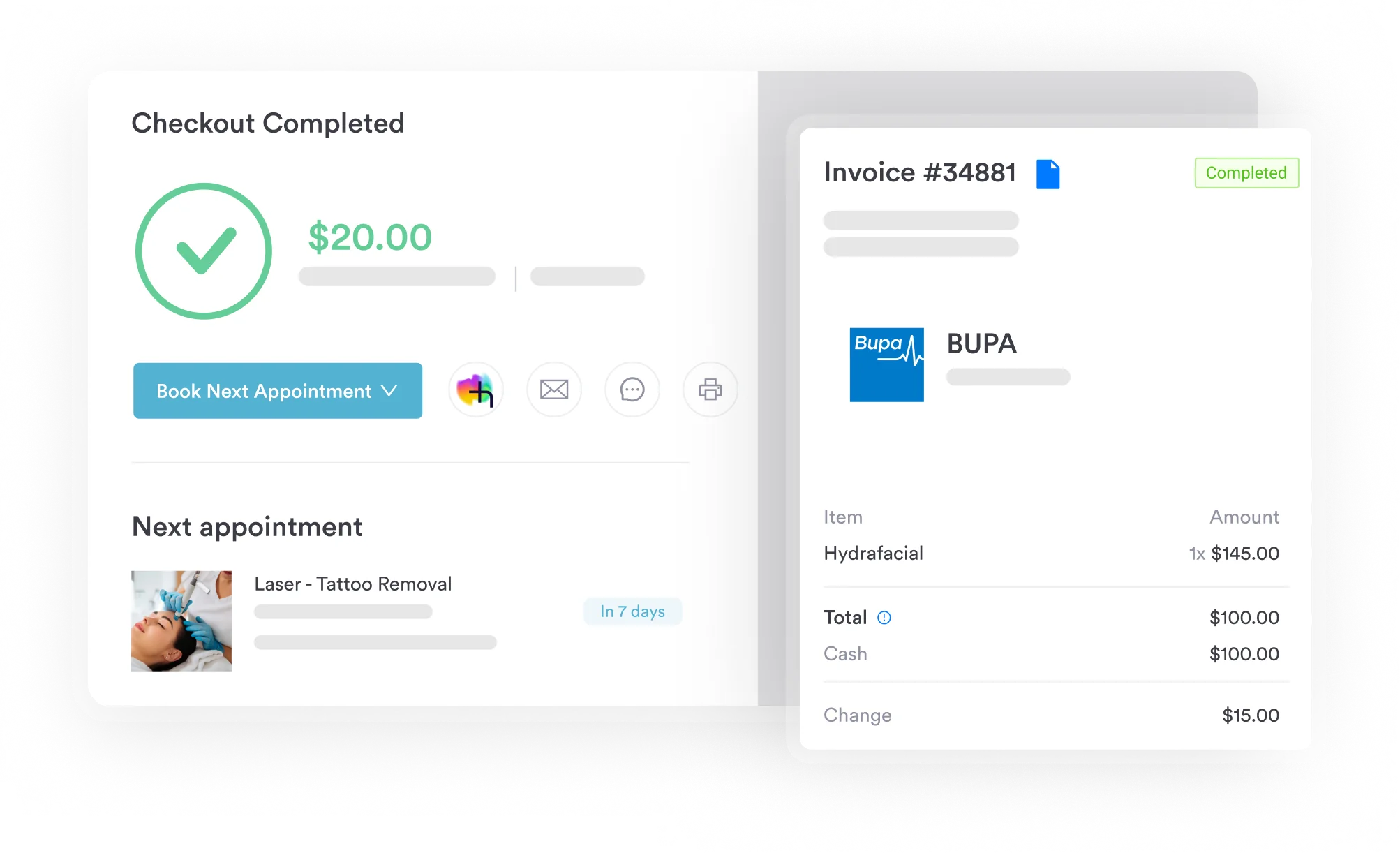

Pabau pre-fills claims from the patient record, checks required claim fields, and sends them through Claim.MD with eligibility checks and ERA.

Getting T87.0X2 right comes down to reading the history before the wound. A reattached part, a documented left side, and a named complication make the code easy to defend. If the chart can’t confirm all three, a short query to the surgeon beats a denial and a resubmission.
The trade-off is speed. Stopping to query feels slow on a busy coding day, but it’s quicker than reworking a CARC 11 rejection weeks later.
Want replant follow-up claims that reach the payer with every required field in place? Book a demo to see how Pabau carries a T87.0X2 claim from the visit note to remittance.

Need to understand how denials are tracked after submission? Electronic remittance advice explains how ERA files return CARC denial codes for ICD-10 complication claims.
Want a structured framework for claim-level billing audits? Superbill documentation covers how to structure diagnosis and procedure code pairings before submission.
New to the billing cycle behind complication codes? What is medical billing walks through how a diagnosis turns into a paid claim.
Coding a reattached part outside the limbs? ICD-10 code T87.2 covers complications of other reattached body parts, such as an ear or scalp.
Yes. Under the CMS-HCC V28 risk adjustment model, T87.0X2 maps to HCC 405, Traumatic Amputations and Complications. For a Medicare Advantage patient, it counts toward risk adjustment only when documented at a face-to-face visit each calendar year.
Use T87.1X2, complications of reattached (part of) left lower extremity. T87.0X2 covers the upper limb only, from the arm down to the fingertips. The lower extremity series uses the same sixth-character laterality pattern.
Use T87.2, complications of other reattached body part. It covers reattached parts outside the limbs and takes no laterality character. Confirm the reattachment in the operative note before you assign it.
Yes. A replanted left finger that fails is a complication of the reattached part. That covers treatment such as revision surgery or a completion amputation. Pair T87.0X2 with the CPT code for the procedure performed.
No. T87.0X2 needs a documented complication. A routine follow-up of a replant that’s healing normally takes the aftercare or follow-up Z code that fits the visit instead.