

ICD-10 code S61.201A: Open wound of left index finger without nail damage
ICD-10 code S61.201A covers a left index finger wound of unstated type ICD-10 co...

Last Updated: Oct 16, 2026
Billable Code Specific Code
T86.852 is the billable ICD-10-CM code for intestine transplant infection.
It reports an infection that involves the transplanted intestine. The tabular list tells coders to add a code that names the infection.
Let Pabau's smart automation suggest the right codes, reduce claim denials, and keep your practice compliant—effortlessly.
Automate repetitive tasks and focus on what matters most—your patients.
Reduce coding errors and ensure compliance with the latest regulations.
Clean claims, fewer denials, and faster reimbursements.
Powerful insights and reporting to help your practice thrive.
HIPAA compliant SOC 2 certified GDPR-compliant Trusted by 4,000+ clinics worldwide

ICD-10 Code T86.852 is the billable, specific ICD-10-CM code for intestine transplant infection, valid in the FY 2027 code set.
It is one of five codes under T86.85: rejection (T86.850), failure (T86.851), infection (T86.852), other complications (T86.858) and unspecified (T86.859).
The tabular list tells you to add a second code that names the infection. Add a B95–B96 or B97 organism code when the infection is bacterial or viral and the infection code does not already name the organism.
Z94.82 is not reported with T86.852, because the complication code already tells the payer the patient has a transplanted intestine.
Pabau, the practice software we build, keeps the clinical note and the insurer claim in one patient record. Billing staff raise and track the claim from there.
ICD-10 Code T86.852 is the ICD-10-CM code for intestine transplant infection. It reports an infection that involves the transplanted intestine, whether the organism is viral, bacterial or fungal.
T86.852 is billable and specific, so it can be submitted on a claim as it stands. Its parent, T86.85, is a header and cannot be billed. The CMS FY 2027 ICD-10-CM files list T86.852 as valid for encounters from October 1, 2026, to September 30, 2027.
Five billable codes sit under T86.85, and each one names a different kind of problem with the transplanted intestine. There is no T86.853. Infection has its own code, T86.852, rather than a slot at the end of the list.
Rejection and infection can occur together, because the drugs that treat rejection raise infection risk. When the physician documents both, report T86.850 and T86.852. For non-infectious problems such as an anastomotic stricture, see T86.858. For a complication with no stated type, see T86.859.
Intestine recipients take lifelong immunosuppression, so infection is one of the most common reasons they are readmitted. T86.852 applies when the physician links the infection to the graft. Typical documented scenarios include:
The test is whether the infection affects the transplanted organ. ICD-10-CM guideline I.C.19.g.3 assigns a transplant complication code only when the complication affects the function of the transplant. CMV pneumonia in an intestine recipient is coded to the pneumonia, not to T86.852. The decision path below turns that test into the claim you build.
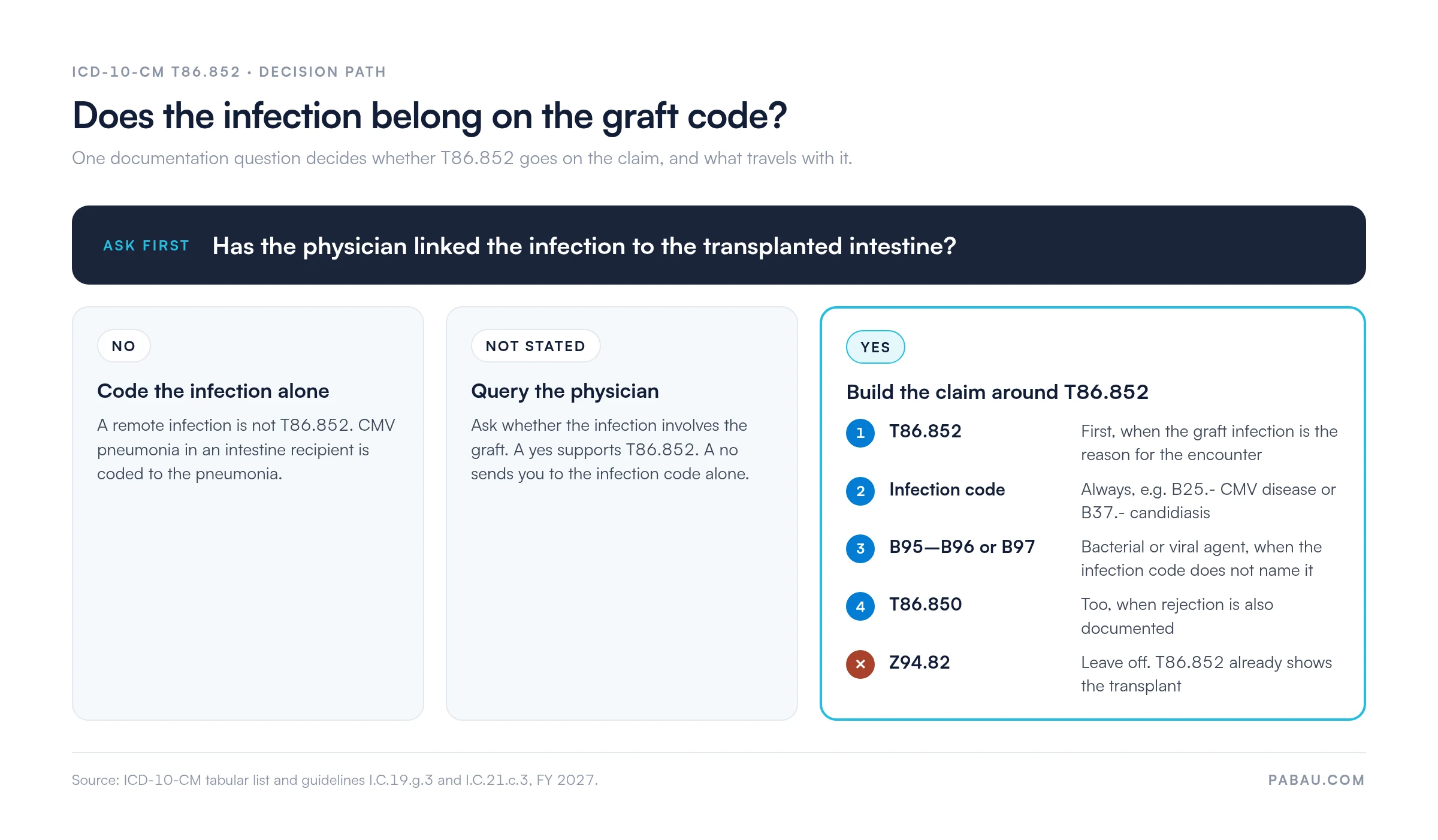
T86.852 tells the payer an infection is present but not what it is. The tabular list carries a “use additional code to specify infection” note at this code. The guidelines also require two codes for any transplant complication: the T86 code and a code that identifies the complication.
Z94.82, intestine transplant status, does not belong on this claim. The status-code guideline (I.C.21.c.3) bars a status code when the diagnosis code already carries that information. T86.852 already tells the payer the patient has a transplanted intestine.
If the infection progresses to sepsis with organ dysfunction, follow the sepsis guidelines in I.C.1.d for sequencing and add R65.2- for severe sepsis. Confirm every code against the CDC/NCHS ICD-10-CM browser tool for the date of service.
The coder can only assign T86.852 when the record answers four questions. Each one maps to a code on the claim or to a payer review point.
When the note says a transplant patient has an infection but does not say where, query the physician. Ask whether the infection involves the transplanted intestine. A yes supports T86.852, and a no sends you to the infection code alone.
Each of these errors is visible before submission if the coder checks the claim against the note. Our denial management guide covers how to track them once they reach the remittance.
NCHS and CMS release ICD-10-CM updates every October. The FY 2027 update took effect on October 1, 2026, and T86.852 carries over with its descriptor unchanged. Check the code each October, because a revision changes what the claim must say.
Browse neighboring codes in our ICD-10-CM code reference.
A graft infection claim usually carries three or four codes from different parts of the record. The biopsy result sits in one place, the physician note in another, and the claim in a billing tool. Each hand-off is a chance to lose the infection code or the organism code.
Pabau keeps the clinical note and the insurer claim in one patient record. Its claims management software lets billing staff raise the claim from the same record that holds the biopsy result and the physician note.

Once the claim goes out, a status dashboard shows where each one sits, from submitted to paid. When the insurer pays, Pabau reconciles the payment against the claim. Billing staff can see which high-cost transplant encounters are still open and follow them up sooner.

Pabau raises insurer claims from the patient record that holds the clinical note. It then tracks each ICD-10 Code T86.852 claim through to payment.

T86.852 is the graft infection code, and it never works as a catch-all for other intestine transplant complications. Code it only when the physician ties the infection to the transplanted intestine. From there, the record decides which infection and organism codes join it.
Where the note leaves that link unstated, query the physician before you code. The query takes a few minutes. A claim that misreads T86.852 can cost a full appeal cycle on one of the most expensive encounters a practice bills. Book a demo to see how Pabau keeps transplant documentation and insurer claims in one patient record.

Need to understand how clearinghouse claims validation works? Medical claims clearinghouse guide explains how electronic claim submission and error checks can lower denial rates.
Wondering how to build a cleaner billing workflow? Clean claim requirements covers what makes a claim pass first-pass edits before it reaches the payer.
Want the full path from coding to payment? Revenue cycle management explained covers the end-to-end process from code assignment through payment posting.
Coding a kidney recipient instead? ICD-10 Code T86.13 covers kidney transplant infection and the codes reported alongside it.
Working a lung transplant infection claim? ICD-10 Code T86.812 walks through the same infection logic for a transplanted lung.
ICD-10 Code T86.852 means intestine transplant infection. It reports a viral, bacterial or fungal infection that involves the transplanted intestine.
Yes. T86.852 is billable and specific, and it is valid in the FY 2027 code set for dates of service from October 1, 2026.
Add a code that names the infection, such as B25.- for CMV disease or B37.- for candidiasis. Add a B95–B96 or B97 organism code when the infection is bacterial or viral and the infection code does not already name the organism.
No. The status-code guideline bars Z94.82 here, because T86.852 already shows the patient has a transplanted intestine.
T86.852 is for infection of the transplanted intestine. T86.858 covers other named complications, such as an anastomotic stricture, that are not rejection, failure or infection.
No. The T86.85 subcategory has five codes: T86.850, T86.851, T86.852, T86.858 and T86.859. Infection is T86.852.



