ICD-10 Code Y76.0: Diagnostic obstetric and gynecological devices
ICD-10 Code Y76.0: Definition and billable status ICD-10 Code Y76.0 is a valid, ...

Last Updated: Oct 23, 2026
Billable Code Specific Code
T86.858 is the billable ICD-10-CM code for other complications of intestine transplant.
The code is valid for HIPAA-covered transactions in FY2026 and fills the "not elsewhere classified" (NEC) slot inside the T86.85x subcategory.
Let Pabau's smart automation suggest the right codes, reduce claim denials, and keep your practice compliant—effortlessly.
Automate repetitive tasks and focus on what matters most—your patients.
Reduce coding errors and ensure compliance with the latest regulations.
Clean claims, fewer denials, and faster reimbursements.
Powerful insights and reporting to help your practice thrive.
HIPAA compliant SOC 2 certified GDPR-compliant Trusted by 4,000+ clinics worldwide

ICD-10 Code T86.858 is a billable, specific code for other (NEC) complications of intestine transplant, valid for FY2026 HIPAA-covered transactions.
It sits under parent code T86.85 (Complication of intestine transplant) and is distinct from rejection (T86.850), failure (T86.851), infection (T86.852), and unspecified (T86.859).
Use T86.858 only when the physician documents a specific complication that is not rejection, failure, or infection. T86.859 applies when the complication type is never stated.
Claims management software like Pabau’s connects the coded diagnosis to submission, so transplant teams catch specificity problems before the claim goes out.
ICD-10 Code T86.858 is a specific, billable ICD-10-CM code for documented post-intestinal-transplant complications that the other T86.85x codes do not capture.
The CMS ICD-10-CM code set confirms T86.858 as valid for all HIPAA-covered electronic transactions in FY2026. The National Center for Health Statistics (NCHS) maintains that list and revises it every year.
“Billable/specific” in ICD-10-CM terminology means the code is granular enough for claim submission. Parent codes such as T86.85 cannot be billed on their own. Coders have to select a fifth-character extension, and T86.858 is that extension for the NEC category.
T86.858 belongs to the Injury, Poisoning and Certain Other Consequences of External Causes chapter (S00-T88) of ICD-10-CM. Knowing its position in the tree stops coders from billing a non-billable parent code.
It also stops them reaching for a transplant complication code that belongs to another organ. Our ICD-10-CM code reference follows the same parent-to-child logic across every chapter.
Five codes share the T86.85 parent, and selecting the wrong one is the most frequent error on intestine transplant cases. Each code maps to a distinct, mutually exclusive clinical condition. Where the documentation supports rejection, failure, or infection, T86.858 is incorrect however similar the clinical picture looks.
The order you rule those categories out in is what decides the code. Work down the subcategory: rejection first, then failure, then infection, and only then the NEC and unspecified codes. The path below shows where each documented condition lands.
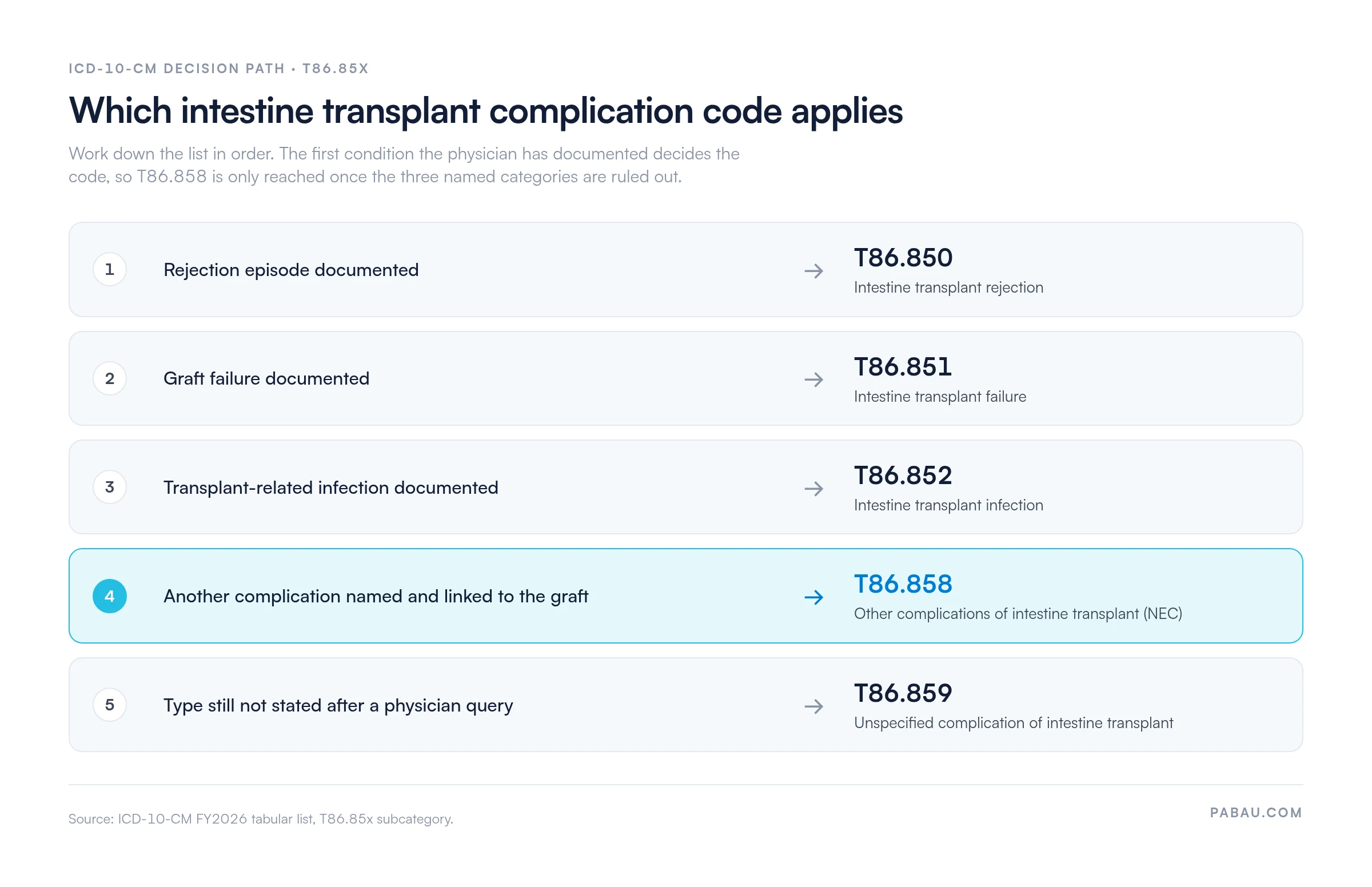
“Other complications” in ICD-10-CM terminology means “not elsewhere classified” (NEC). The physician has documented a specific complication, but it does not match the named conditions in T86.850, T86.851, or T86.852.
The complication is known and written down, and it simply falls outside those three categories. That is the distinction from T86.859, where the complication type is never stated.
According to the CDC/NCHS ICD-10-CM web tool, the approximate synonyms for T86.858 include “intestine transplant complications NEC.” Clinical contexts that may qualify include graft-versus-host-related manifestations limited to the intestinal graft.
Post-transplant lymphoproliferative disorder localized to the transplanted segment also qualifies, as does chronic allograft enteropathy that is not specified as rejection.
Applying T86.858 to small bowel or multivisceral transplant cases takes physician documentation that explicitly links the complication to the transplanted organ. Where the clinical mapping is uncertain, confirm the assignment against AHA Coding Clinic before the claim is built.
T86.858 applies when a specific complication is documented. T86.859 applies when no complication type is stated at all. The distinction carries direct reimbursement consequences. Payers scrutinize unspecified codes on high-acuity transplant cases, and a T86.859 claim submitted without a physician query may trigger a medical necessity review.
Intestine transplantation is performed for patients with irreversible intestinal failure, most commonly short bowel syndrome. Post-transplant follow-up produces a range of complications that transplant center coders see regularly. Each documented complication has to be matched to the most specific available code before the claim is built.
T86.858 applies in these scenarios:
In each scenario the physician’s note has to name the complication and link it to the transplant. It also has to sit outside the definitions of rejection, failure, and infection. Where the documentation is ambiguous, query the physician before assigning T86.858.
Documentation is what separates a clean T86.858 claim from one that defaults to T86.859 or comes back for more information. Three elements have to be present in the physician’s note.
Where documentation is incomplete, AHIMA guidelines recommend a physician query rather than a default to an unspecified code. Submitting T86.858 on the strength of an informal conversation rather than a signed attestation raises audit risk.
Run a monthly query on all discharged transplant patients coded to T86.859. For any case where the physician’s note names a complication type, initiate a physician query before billing closes. Converting defensible T86.859 codes to T86.858 reduces payer scrutiny and supports accurate case-mix reporting.
Intestine transplant complication coding produces predictable errors across transplant centers. Catching them in a pre-submission review costs far less than working them on appeal.
Transplant coordinators and coders working intestine transplant cases meet the full T86.85x family, plus the broader T86 codes for other transplanted organs. The AAPC ICD-10-CM code lookup displays the whole T86 hierarchy for cross-reference.
A pancreas transplant has no T86 subcategory of its own, so a complication outside rejection, failure, and infection takes T86.898. Failure of that pancreas graft is reported with T86.891 instead. Intestine transplants keep their own T86.85x codes.
A failed corneal graft belongs one subcategory above, in T86.84, and is reported with T86.841. That code needs a seventh character for the eye, so it is not billable in its six-character form.
Once the code is selected and the documentation supports it, the submission workflow matters as much as the coding decision. Transplant complication claims are high-acuity encounters, and payers review them closely for medical necessity and diagnostic specificity.
Submitting through a clearinghouse with a built-in ICD-10 catalog reduces the format errors that hide a valid code at the payer’s front door. A rejected file never reaches an adjudicator, so the coding work behind it counts for nothing.
Meeting clean claim standards on a transplant encounter takes three checks before the file goes out:
T86.858 has been valid in the ICD-10-CM tabular list since the system was implemented in the United States, with no substantive description changes through FY2026. The CMS ICD-10-CM FY2026 update files confirm that the code is still active.
Check validity every year, because CMS and NCHS release updates each October for the new fiscal year. Codes can be deleted, revised, or have their descriptions amended.
Most transplant centers keep the clinical note in one system and the claim in another. A coder reads the note, assigns T86.858 or one of its siblings, and rekeys the code into a separate billing tool. Specificity gets lost at each hand-off, and the physician query that would have fixed it arrives after billing has closed.
Pabau is practice management software that holds the documentation and the claim in one patient record. Pabau’s claims management software carries the coded diagnosis from the encounter into the claim itself. The code the physician’s note supports is the code the payer receives.
Its pre-submission review flags sequencing problems, a missing additional complication code, and a code version that predates the service date. Coders spend less time reworking transplant claims after a denial, and coordinators can see which encounters are still waiting on a query.

Pabau connects your clinical documentation to claims submission. Transplant coordinators and coding teams can send ICD-10 Code T86.858 and its siblings with the right specificity.

Intestine transplant complication coding comes down to one question. Has the physician named a complication that is not rejection, failure, or infection? If the answer is yes, ICD-10 Code T86.858 is the correct choice over T86.859.
Where the note is ambiguous, raise the query before billing closes. A query costs a coder minutes, while an unspecified code on a high-acuity transplant claim can cost a whole review cycle. Book a demo to see how Pabau keeps transplant documentation and claim submission in one record.

Need to understand how denial patterns affect transplant claims? Denial management in healthcare covers the most common denial reasons and the pre-submission review that catches coding errors early.
Want to see how clearinghouse submissions work in practice? Claim.MD clearinghouse explains how Pabau’s US clearinghouse integration processes 837P claims, checks eligibility, and returns ERA data.
Looking for a primer on the full billing cycle? What is medical billing walks through the process from diagnosis coding to payment posting, and where specificity decisions bite hardest.
ICD-10 Code T86.858 classifies documented post-intestinal-transplant complications that are not rejection, failure, or infection. It is the “other/NEC” code inside the T86.85x subcategory. It is valid for FY2026 HIPAA-covered transactions once the physician has named a complication outside the three more specific categories.
Yes. T86.858 is a billable, specific ICD-10-CM code confirmed as valid for FY2026 electronic claim submission. Its parent code, T86.85, cannot be billed on its own. T86.858 is the fifth-character extension a claim requires.
T86.858 is the “other/NEC” code, used when the physician documents a specific complication outside rejection, failure, and infection. T86.859 is the “unspecified” code, used only when the complication type is never stated. Defaulting to T86.859 when a complication is named is a coding error.
Use T86.858 when the physician’s documentation identifies a complication that is not rejection (T86.850) or failure (T86.851). If biopsy findings or clinical criteria support rejection or failure, those more specific codes take precedence. T86.858 is not a fallback when a sibling code is documented.
Three elements are required. The physician has to name the specific complication and link it causally to the intestine transplant. The note also has to carry findings, such as biopsy results or labs, that exclude rejection, failure, and infection. Ambiguous documentation should trigger a physician query.
The parent code is T86.85 (Complication of intestine transplant), a non-billable subcategory that sits under T86.8, T86, and the broader S00-T88 chapter. T86.858 is the billable fifth-character extension for “other” complications within T86.85.