ICD-10 code T87.52: Necrosis of amputation stump, left upper extremity
ICD-10 code T87.52 at a glance: Left arm, not left leg ICD-10 code T87.52 is the...

Last Updated: Oct 26, 2026
Billable Code Specific Code
T86.33 is the billable ICD-10-CM code for heart-lung transplant infection, an infection affecting a combined heart-lung allograft. The tabular list requires an additional code that specifies the infection, and omitting it is a frequent cause of denied claims.
The code applies only when the heart and lungs were transplanted together. An infection after an isolated heart transplant is coded T86.23 instead. The matching status code for T86.33 is Z94.3, not Z94.1.
Let Pabau's smart automation suggest the right codes, reduce claim denials, and keep your practice compliant—effortlessly.
Automate repetitive tasks and focus on what matters most—your patients.
Reduce coding errors and ensure compliance with the latest regulations.
Clean claims, fewer denials, and faster reimbursements.
Powerful insights and reporting to help your practice thrive.
HIPAA compliant SOC 2 certified GDPR-compliant Trusted by 4,000+ clinics worldwide

T86.33 is the billable ICD-10-CM code for an infection of a combined heart-lung transplant, distinct from rejection (T86.31) and failure (T86.32).
An infection after an isolated heart transplant is coded T86.23, not T86.33, so confirm which organs were transplanted before you assign the code.
The tabular list requires an additional code that specifies the infection, plus a B95-B97 organism code when that infection code doesn’t name the organism.
Z94.3 (heart and lungs transplant status) is the matching status code, never Z94.1. Claims software such as Pabau can check these pairings before submission.
ICD-10 Code T86.33 is the billable ICD-10-CM code for heart-lung transplant infection. It sits in Chapter 19 Injury, poisoning and certain other consequences of external causes.
Under category T86 (Complications of transplanted organs and tissue). Its subcategory is T86.3 (Complications of heart-lung transplant), which covers patients who received the heart and both lungs together.
The code is valid and billable for FY2027, effective October 1, 2026. It needs no 7th character and is complete at five characters.
T86.33 applies when a documented infection affects a combined heart-lung allograft. The ICD-10-CM Official Guidelines assign a T86 code only when the complication affects the function of the transplanted organ. The infection must be clinically linked to the transplant, not to an unrelated condition that happens to be present.
Clinical presentations captured under T86.33, each paired with a code for the infection itself, include:
The approximate synonym in the index is “infection of heart-lung transplant.” Systemic infections that do not involve the allograft are coded to the infection code alone, without T86.33. A urinary tract infection in a heart-lung recipient, for example, takes the UTI code and no T86 code.
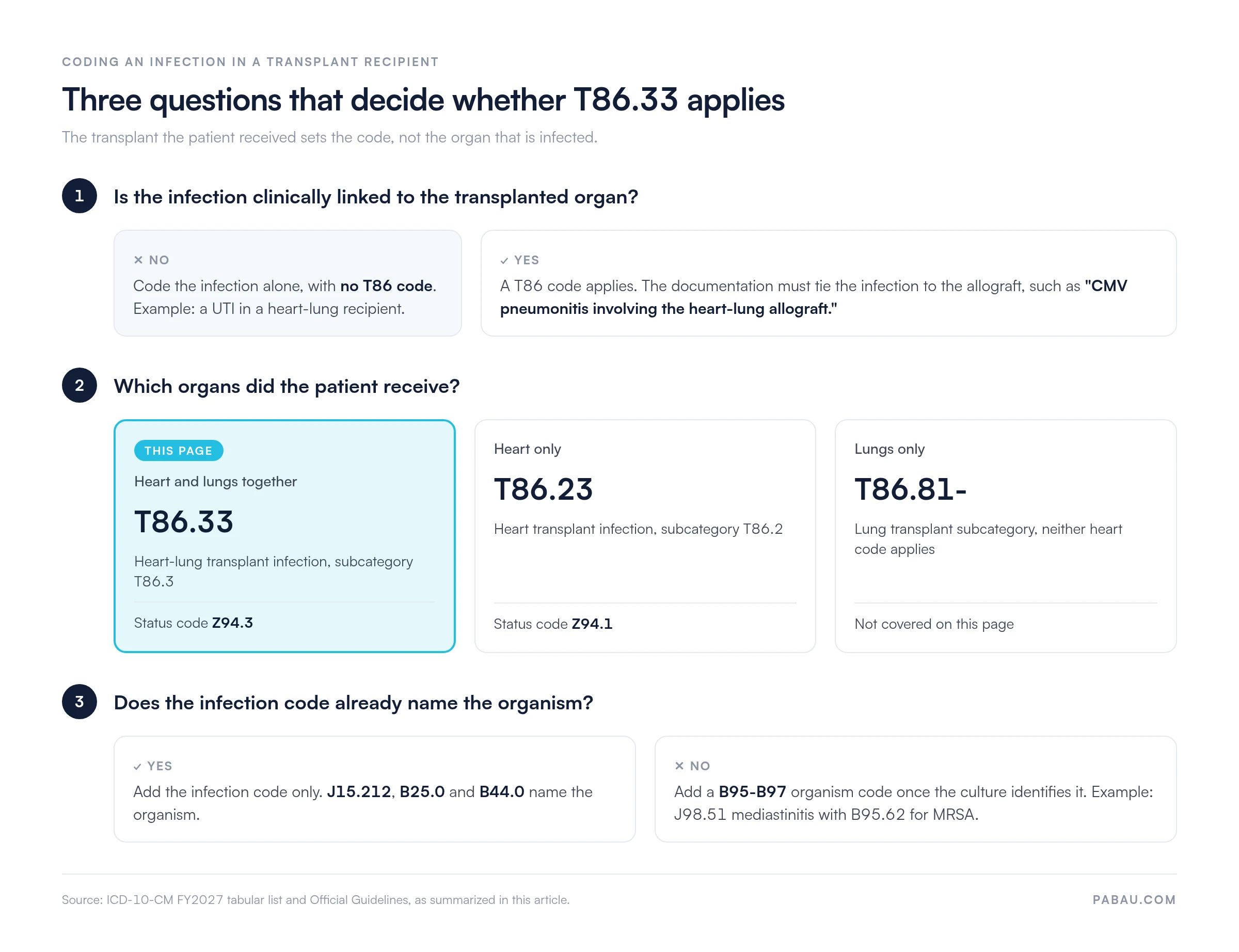
The fourth character of the code depends on which organs the patient received, not on which organ is infected. T86.33 belongs to T86.3, the heart-lung subcategory. An infection after an isolated heart transplant belongs to T86.2 instead, and is coded T86.23.
Check the transplant history in the record before you pick the subcategory. Then match the status code to the same transplant type:
A lung-only recipient falls under neither code. Those complications sit in their own lung transplant subcategory, T86.81-. The diagram below puts the three coding questions in the order a coder answers them.
The T86 category separates each transplanted organ into its own subcategory, and those boundaries define where T86.33 stops. Auditors regularly flag claims that cross them.
The T86.3 subcategory contains five billable codes for heart-lung transplant complications. Reporting T86.30, the unspecified code, when the record clearly documents infection is a costly mistake. It misstates the clinical picture and invites medical-necessity queries from payers.
Rejection has its own code, T86.31, and it sits alongside T86.33 only when a biopsy or clinical criteria confirm it separately. Use the table below to select the correct code before any claim leaves the billing department.
The ICD-10-CM tabular list carries a “Use additional code to specify infection” note at T86.33. The Official Guidelines add that two codes are required to describe a transplant complication fully.
Those are the T86 code and a secondary code identifying the complication. Coders working through medical billing workflows for transplant programs should build this pairing check into every claim review.
Infection and organism codes: Code the infection itself, then add a B95-B97 organism code only when the infection code doesn’t already name the organism.
Z94.3 (heart and lungs transplant status): Z94.3 is the status code that matches T86.33. Z94.1 (heart transplant status) describes a heart-only recipient, so it never pairs with T86.33.
Because T86.33 already implies the transplant, Z94.3 adds most value in encounters where the transplant drives management without being the principal diagnosis. Check payer policy before reporting both on the same claim.
Other transplant complications: Category T86 also instructs coders to add codes for related transplant complications. Examples include graft-versus-host disease (D89.81-), malignancy associated with organ transplant (C80.2), and post-transplant lymphoproliferative disorders (D47.Z1).
A claim carrying T86.33 needs documentation that does three things. It confirms the patient received a combined heart-lung transplant, it identifies the infection, and it links the infection to the allograft. Missing any one of those elements gives a payer grounds for denial.
The physician note, operative report, or discharge summary should contain all of the following for T86.33 to be defensible on audit:
CDI query trigger: Sometimes the note documents infection and transplant status but never connects the two. A clinical documentation improvement (CDI) query to the attending physician is appropriate before submission.
The same applies when the record doesn’t say whether the lungs were transplanted. Strong medical billing compliance protocols build this review into every transplant encounter.
Build a T86.33 pre-submission checklist into your transplant billing workflow. Confirm the record shows a combined heart-lung transplant, attach the code that specifies the infection, and add a B95-B97 organism code where needed. Then check that any status code is Z94.3 rather than Z94.1.
Under MS-DRG version 44, effective for FY2027 discharges, T86.33 as a principal diagnosis falls in MDC 5 (circulatory system). A medical stay without an operating room procedure groups to DRG 314, 315, or 316 (Other circulatory system diagnoses).
DRG 314 applies with an MCC, DRG 315 with a CC, and DRG 316 without either, per the CMS MS-DRG v44 Definitions Manual.
A surgical stay groups by the procedure performed rather than by T86.33 alone. When T86.33 is a secondary diagnosis, the v44 manual lists it as a CC, subject to the CC exclusion rules for the principal diagnosis.
Relative weights change every federal fiscal year, so verify them against the current CMS release before you model reimbursement.
Six denial patterns account for most T86.33 claim problems. Each has a corrective action that works at the point of coding rather than during appeals. Solid denial management workflows for transplant codes keep reimbursement flowing without extended AR aging.
Our guide to medical billing denial codes lists the CARC and RARC codes payers attach to T86.33 rejections. Your appeals team then knows which remittance code each resubmission letter must address.
T86.33 has been billable since ICD-10-CM took effect on October 1, 2015. The FY2027 release, effective October 1, 2026, made no change to the code or its descriptor. Check each October release for new instructional notes before updating your charge master or coding templates.
Most transplant billing teams check code pairings by hand, often after the claim has already been rejected. A missing infection code or the wrong status code then costs a resubmission cycle.
Pabau, the practice management platform we build, moves that check before submission. Its claims software for billers validates ICD-10-CM code pairings and flags incomplete code sets before a claim goes out.
Pabau also submits electronic claims through Claim.MD, our US clearinghouse partner. Billing teams get eligibility checks, 837P claim submission, and ERA/835 remittance reconciliation in one workflow.

Pabau’s claims management tools support ICD-10-CM code pairing, clean-claim validation, and electronic submission through Claim.MD for transplant and specialty practices across the US.

T86.33 claims fail for avoidable reasons: the wrong transplant subcategory, a missing infection code, or a note that never links the infection to the allograft. Each one can be fixed before the claim leaves the practice.
Start with the transplant type, because it decides between T86.33 and T86.23 and between Z94.3 and Z94.1. Then confirm the infection code and the documentation that supports it. Book a demo to see how Pabau helps transplant billing teams submit cleaner claims and resolve denials faster.

Need to understand how clearinghouse submission works for complex transplant claims? Medical claims clearinghouse guide explains how 837P files route from billing software to payer and where T86.33 claim edits typically trigger.
Want to reduce transplant claim AR days? Revenue cycle management overview covers the end-to-end workflow from code assignment through payment posting for specialty practices.
Looking for CARC codes specific to transplant denials? Electronic remittance advice (ERA) guide explains how to read 835 remittance files and match denial reason codes back to T86.33 claim errors.
ICD-10 Code T86.33 is the billable diagnosis code for heart-lung transplant infection. It covers a confirmed infection affecting a combined heart-lung allograft. It sits in subcategory T86.3 (Complications of heart-lung transplant) and needs an additional code that specifies the infection.
Yes, T86.33 is a billable ICD-10-CM code valid for FY2027, effective October 1, 2026. It needs no 7th character and is complete at five characters. It must be accompanied by a code that specifies the infection.
T86.33 is an infection after a combined heart-lung transplant, under T86.3. T86.23 is an infection after an isolated heart transplant, under T86.2. Pick the code from the transplant the patient received, and pair Z94.3 with T86.33 or Z94.1 with T86.23.
T86.30 is an unspecified heart-lung transplant complication, used only when the type is not documented. T86.31 is heart-lung transplant rejection, and T86.32 is heart-lung transplant failure. T86.33 is heart-lung transplant infection. Use the most specific code the documentation supports.
The tabular list requires an additional code that specifies the infection, such as J15.212 for MRSA pneumonia or B25.0 for CMV pneumonitis. Add a B95-B97 organism code only when the infection code doesn’t name the organism. Z94.3 is the matching transplant status code.
Yes, T86.33 and T86.31 may be coded together when infection and rejection are documented independently for the same episode. Rejection needs biopsy or clinical criteria, and infection needs cultures, serology, or clinical findings. Coding both without separate support invites conflicting-code denials.
The most common reasons are a missing infection code and T86.33 used for a heart-only transplant. Others are T86.30 used despite documented infection, or rejection billed alongside without separate support. A note that doesn’t link the infection to the allograft and a sequencing error also cause denials. Each is preventable at pre-submission review.