ICD-10 Code R06.02: Shortness of breath billing guide
ICD-10 Code R06.02: Definition and quick-reference details ICD-10 Code R06.02 is...

Last Updated: Nov 9, 2026
Billable Code Specific Code
T86.32 is the billable ICD-10-CM code for heart-lung transplant failure. It applies when the provider documents that the transplanted heart-lung bloc can no longer sustain adequate function, from an immune or a non-immune cause.
The code is complete at five characters and is reported with a second code that names the complication. Coders often confuse it with T86.31, heart-lung transplant rejection, because notes sometimes use the two terms interchangeably. Each code describes a distinct clinical event, so the provider's stated conclusion decides which one applies.
Let Pabau's smart automation suggest the right codes, reduce claim denials, and keep your practice compliant—effortlessly.
Automate repetitive tasks and focus on what matters most—your patients.
Reduce coding errors and ensure compliance with the latest regulations.
Clean claims, fewer denials, and faster reimbursements.
Powerful insights and reporting to help your practice thrive.
HIPAA compliant SOC 2 certified GDPR-compliant Trusted by 4,000+ clinics worldwide

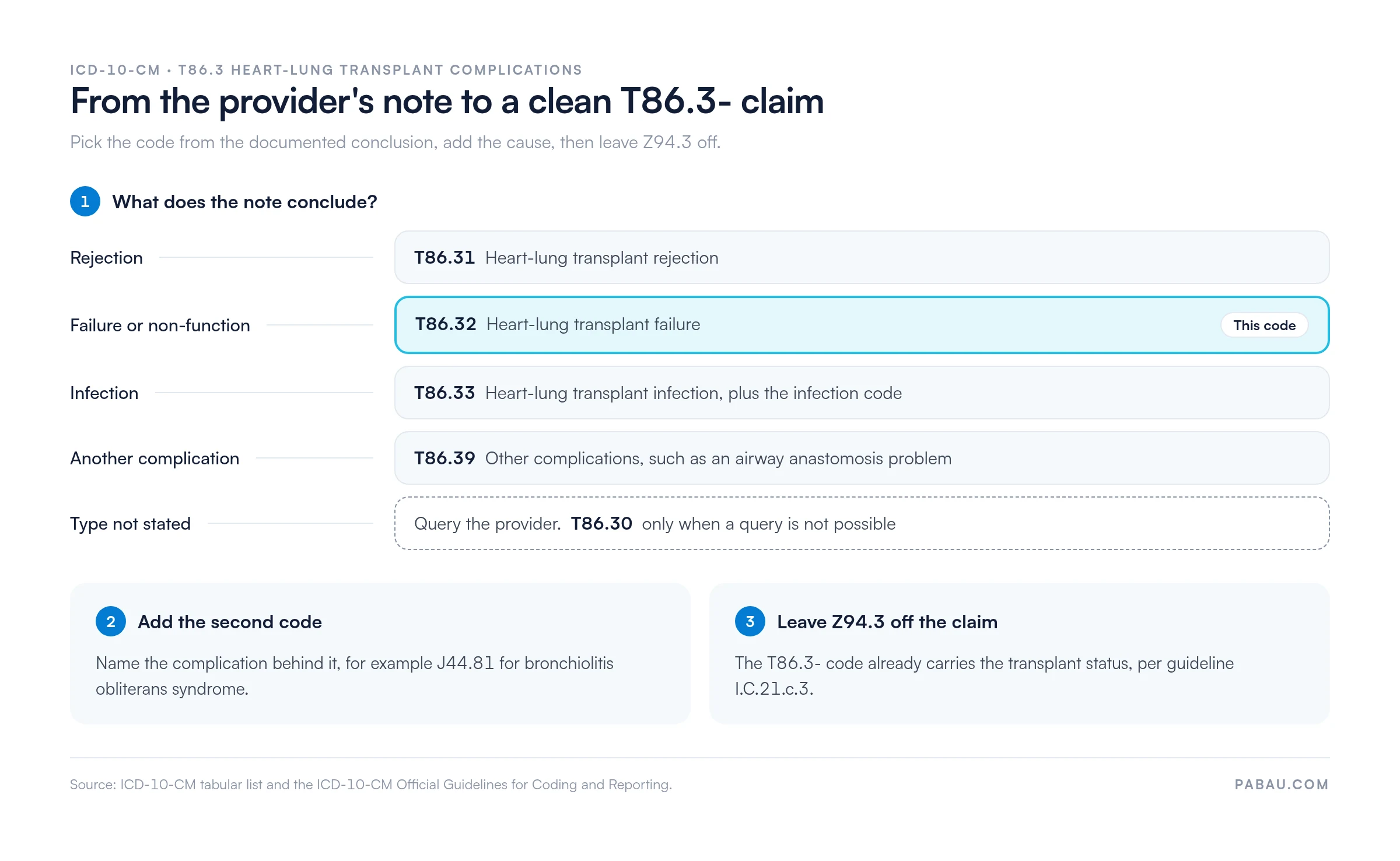
ICD-10 code T86.32 reports heart-lung transplant failure, separate from rejection (T86.31), infection (T86.33) and other complications (T86.39).
T86.32 is a complete, billable 5-character code with no 7th character, because category T86 has no A, D or S extension.
Do not report Z94.3 with T86.32, since the T86.3- code already tells the payer the patient has a heart-lung transplant.
Add a second code that names the complication itself, as the official guidelines require for every T86 code.
Most denials and audit findings trace back to rejection coded as failure, T86.39 used as a catch-all, or notes that only say graft dysfunction.
ICD-10 code T86.32 is the billable ICD-10-CM code for heart-lung transplant failure, a loss of function in a transplanted heart-lung bloc. It sits in subcategory T86.3 beside rejection, infection and other complications.
Report it as a complete five-character code, add a second code for the cause, and leave Z94.3 off the claim. The table below holds the reference facts.
Heart-lung transplant failure is the inability of the transplanted organ bloc to sustain adequate cardiopulmonary function. It is a separate event from an immune-mediated rejection episode.
The distinction matters because rejection (T86.31) is an alloimmune attack on donor tissue. Failure can follow primary graft dysfunction, chronic allograft vasculopathy, infection-related damage, or other non-immune causes of graft deterioration.
Provider documentation should state “failure” rather than “dysfunction” or “poor function” to support this code. A note that says “the graft is not performing well” is not enough without a clinician-level determination of failure.
Key clinical presentations that fall under T86.32 include:
Primary graft dysfunction is a recognized failure mechanism. Check current Coding Clinic guidance before you code it as T86.32, because direction on PGD has evolved.
Subcategory T86.3 contains five codes. Picking the wrong sibling, usually T86.31 or T86.39, is a frequent coding error on heart-lung transplant complication claims.
Rejection (T86.31) and failure (T86.32) are related but distinct events. Rejection is an immune attack on donor tissue. Failure is a loss of graft function that may or may not have an immune cause.
T86.32 is complete at five characters. Category T86 has no 7th-character extension, so there is no T86.32A, T86.32D or T86.32S to report.
The confusion comes from the neighbors. Most categories in the T80-T88 block, such as T81 through T85 and T88, require A, D or S to show the encounter type. T86 and T87 do not, and a claim scrubber built around the injury chapter can get this wrong.
If your claim scrubber or charge template appends A, D or S to T86.32, fix the rule at the source. An invalid code fails front-end edits on every claim built from it.
When heart-lung transplant failure is the reason for the encounter, T86.32 sequences as the principal or first-listed diagnosis. When the encounter is mainly for another condition, T86.32 sequences as a secondary diagnosis.
The official guidelines set two further rules for every T86 code. A transplant complication code is assigned only when the complication affects the function of the transplanted organ. Two codes are then needed: the T86 code, plus a secondary code that identifies the complication itself.
Codes that commonly sit alongside T86.32:
Z94.3 (heart and lungs transplant status) tells the payer that a patient has a heart-lung transplant. T86.32 already says the same thing, so the status code adds nothing.
The ICD-10-CM Official Guidelines address this directly in section I.C.21.c.3. A status code should not be used with a body system code that already includes the status information. The guidelines give Z94.1 with T86.2 as the example, and the same logic applies to Z94.3 with T86.3-.
Z94.3 belongs on encounters where the transplant is relevant but no T86.3- code applies. A visit for an unrelated condition in a stable heart-lung recipient is the typical case.
Code choice, the second code and the Z94.3 rule run in the same order on every T86.3- encounter, as the flow below shows.
The physician note must contain an explicit statement of failure, not just abnormal test values or vague clinical language. Coders cannot infer failure from results alone.
Documentation that supports T86.32:
When documentation is ambiguous between failure and rejection, CDI specialists should query the attending physician. The query asks whether the picture represents rejection, failure, or both. Record the query and the response in the medical record before you finalize the code.
The CDC/NCHS ICD-10-CM web tool provides the official tabular list and index. Use it to confirm the current descriptor and any instructional notes before you submit claims.
Transplant complication claims draw medical review because the code choice depends on a fine clinical distinction. Most problems on T86.32 trace back to documentation and code selection rather than the claim format. The reference on denial codes explains what each remittance reason means.
The most common denial and audit reasons for T86.32 claims:
Read the remittance before you resubmit. The denial management workflow and ERA processing guides explain how to route each reason code to the right fix.
Run a 90-day lookback on your T86.3- claims and sort them by denial reason code. If T86.31 and T86.32 keep trading places, the fix belongs in the provider note template, not the claim.
Medicare covers heart-lung transplants performed at Medicare-approved transplant centers. That requirement governs the transplant itself. Care for a later complication such as graft failure is billed under the usual Part A and Part B rules.
Key payer requirements to verify before submitting T86.32 claims:
Coverage policies for transplant complications vary by payer and plan year, so check the payer’s current policy before billing. The ResDAC ICD coding resources explain how ICD-10-CM codes are used in Medicare claims data, including how diagnoses feed DRG assignment.
For complex multi-code encounters, the clean claim guide covers the structural checks that prevent front-end edit rejections.
A T86.32 claim succeeds or fails on the note behind it and on how fast the team sees a denial. Pabau, the practice management and billing platform we build, keeps the clinical record, the claim and the remittance on one patient profile.
Pabau’s claims management software submits claims through the Claim.MD clearinghouse for US practices. It tracks each claim and returns the remittance with its reason codes, so a rejected T86.32 claim does not sit unnoticed.
Custom clinical note templates help on the documentation side. A transplant follow-up template can ask the clinician to state rejection, failure or infection outright, which removes the most common reason to query.

Pabau’s claims management submits your claims through the Claim.MD clearinghouse and brings remittance and denial codes back to the patient record. Your team can spot a rejection-versus-failure mix-up and correct it fast.

T86.32 is simpler to report than its reputation suggests. It needs no 7th character and no Z94.3, only a clear statement of failure and a second code for the cause.
The hard part is the word in the note. Build templates that make providers choose between rejection, failure and infection, and most T86.3- denials disappear before the claim is built.
Book a demo to see how Pabau ties transplant notes, claims and remittance together for specialty practices.

Need to track denial patterns across transplant complication codes? Denial management in healthcare covers how to build a systematic denial tracking and appeal workflow for specialty billing teams.
Submitting claims electronically for complex multi-code encounters? Understanding the 837 file format explains how ICD-10-CM codes like T86.32 are structured in electronic claim submissions.
Looking for a coding compliance framework for your transplant program? Medical billing compliance outlines the documentation and audit readiness practices that protect transplant centers during payer reviews.
Coding an infection in a heart-lung recipient? T86.33 covers heart-lung transplant infection and the infection code that goes with it.
ICD-10 code T86.32 is the billable ICD-10-CM code for heart-lung transplant failure. It applies when a transplanted heart-lung organ bloc can no longer sustain adequate function. It sits in subcategory T86.3, complications of heart-lung transplant, within block T80-T88.
Yes. T86.32 is a complete, billable 5-character code. Category T86 has no 7th-character extension, so codes such as T86.32A or T86.32D do not exist. Report T86.32 as it stands, with a second code that identifies the complication.
T86.31 is heart-lung transplant rejection, an immune attack on donor tissue usually confirmed by biopsy. T86.32 is heart-lung transplant failure, a loss of graft function with an immune or non-immune cause. The provider’s documented conclusion decides the code. When a note uses both terms, query the physician before you assign both.
No. Section I.C.21.c.3 of the ICD-10-CM Official Guidelines rules out a status code alongside a body system code that already includes the status. T86.32 already tells the payer the patient has a heart-lung transplant. Z94.3 belongs on encounters where no T86.3- code applies.
T86.39 covers heart-lung transplant complications that are not rejection (T86.31), failure (T86.32) or infection (T86.33). Examples include an airway anastomosis problem, or a malignancy of the transplanted organ reported with C80.2. Use T86.39 only when the documented complication is not a failure of the graft itself.