ICD-10 Code Y76.0: Diagnostic obstetric and gynecological devices
ICD-10 Code Y76.0: Definition and billable status ICD-10 Code Y76.0 is a valid, ...

Last Updated: Oct 23, 2026
Billable Code Specific Code
T86.23 is the billable ICD-10-CM code for heart transplant infection.
Most denials on this code trace to two avoidable errors: missing the organism identification code and failing to document the causal link between the transplant and the infection in the physician note.
Let Pabau's smart automation suggest the right codes, reduce claim denials, and keep your practice compliant—effortlessly.
Automate repetitive tasks and focus on what matters most—your patients.
Reduce coding errors and ensure compliance with the latest regulations.
Clean claims, fewer denials, and faster reimbursements.
Powerful insights and reporting to help your practice thrive.
HIPAA compliant SOC 2 certified GDPR-compliant Trusted by 4,000+ clinics worldwide

T86.23 is the billable ICD-10-CM code for an infection of a transplanted heart or its operative site.
It applies only when the provider documents the infection as a complication of the transplant.
List T86.23 first, then add the infection’s own code and the organism code when documented.
Heart-lung transplant infection is T86.33, and Z94.1 never goes on the same claim as T86.23.
Missing organism codes and weak causal documentation are the two denial triggers to check first.
When a transplanted heart becomes infected, ICD-10 code T86.23 is the code that carries the claim. It’s the billable ICD-10-CM code for heart transplant infection, from CMV in the allograft to mediastinitis after sternotomy.
One fact decides whether it applies. The provider has to document the infection as a complication of the transplant, in writing. A positive culture in a transplant patient isn’t enough on its own.
Getting this right protects more than one claim. T86.23 tells the payer a transplant complication occurred, so a weak note or a missing organism code invites denials and audits. Below, we cover the sibling codes, the claim build, documentation, denials and a pre-submission checklist.
T86.23 sits in Chapter 19 (S00-T88), inside the T80-T88 block for complications of surgical and medical care. Its hierarchy runs from T86 to T86.2 (Complications of heart transplant), then T86.23. At five characters it’s complete, with no seventh character to add.
Heart transplant infection means a bacterial, viral, fungal or protozoal infection involving the cardiac allograft or its operative site. Immunosuppression is why it’s common. Calcineurin inhibitors such as tacrolimus and cyclosporine hold off rejection, but they also weaken the patient’s defense against opportunistic pathogens.
Typical T86.23 scenarios include:
What these share is the provider’s statement tying the infection to the transplant. Under the ICD-10-CM Official Guidelines, complication codes depend on that documented cause-and-effect relationship. An infection that simply coexists with a transplanted heart doesn’t qualify.
So a urinary tract infection in a heart recipient, with no link to the allograft, gets its own infection code without T86.23. That matters because payers read T86.23 as a transplant complication and review the claim on those terms.
With the clinical picture settled, the next job is choosing the right code in the family. The T86.2 subcategory covers six distinct complications of a heart transplant. Picking the wrong sibling is one of the most common errors on these claims.
Two siblings can share a claim. If the provider documents rejection and infection as separate, concurrent complications, report T86.21 and T86.23 together.
Don’t confuse infection with graft failure, which is T86.22. Likewise, T86.298 is for documented complications outside the named codes. Reaching for T86.20 when the note names an infection is an easy denial.
Once you’ve chosen T86.23, it rarely travels alone. The tabular list carries a “use additional code” note to specify the infection. In practice, most claims need these codes, in this order:
Z94.1 (heart transplant status) doesn’t belong on this claim. ICD-10-CM Guidelines section I.C.21.c.3 says a status code shouldn’t ride alongside a diagnosis code that already carries that information, and T86.23 already tells the payer about the transplant.
Here’s how it plays out. Three weeks after transplant, a patient has sternal wound drainage, and cultures grow methicillin-susceptible Staphylococcus aureus (MSSA). The surgeon documents “post-transplant mediastinitis due to MSSA, a complication of heart transplant.” The claim carries T86.23, then J98.51, then B95.61.
The four checks below turn that reasoning into a build your team can repeat on every encounter.
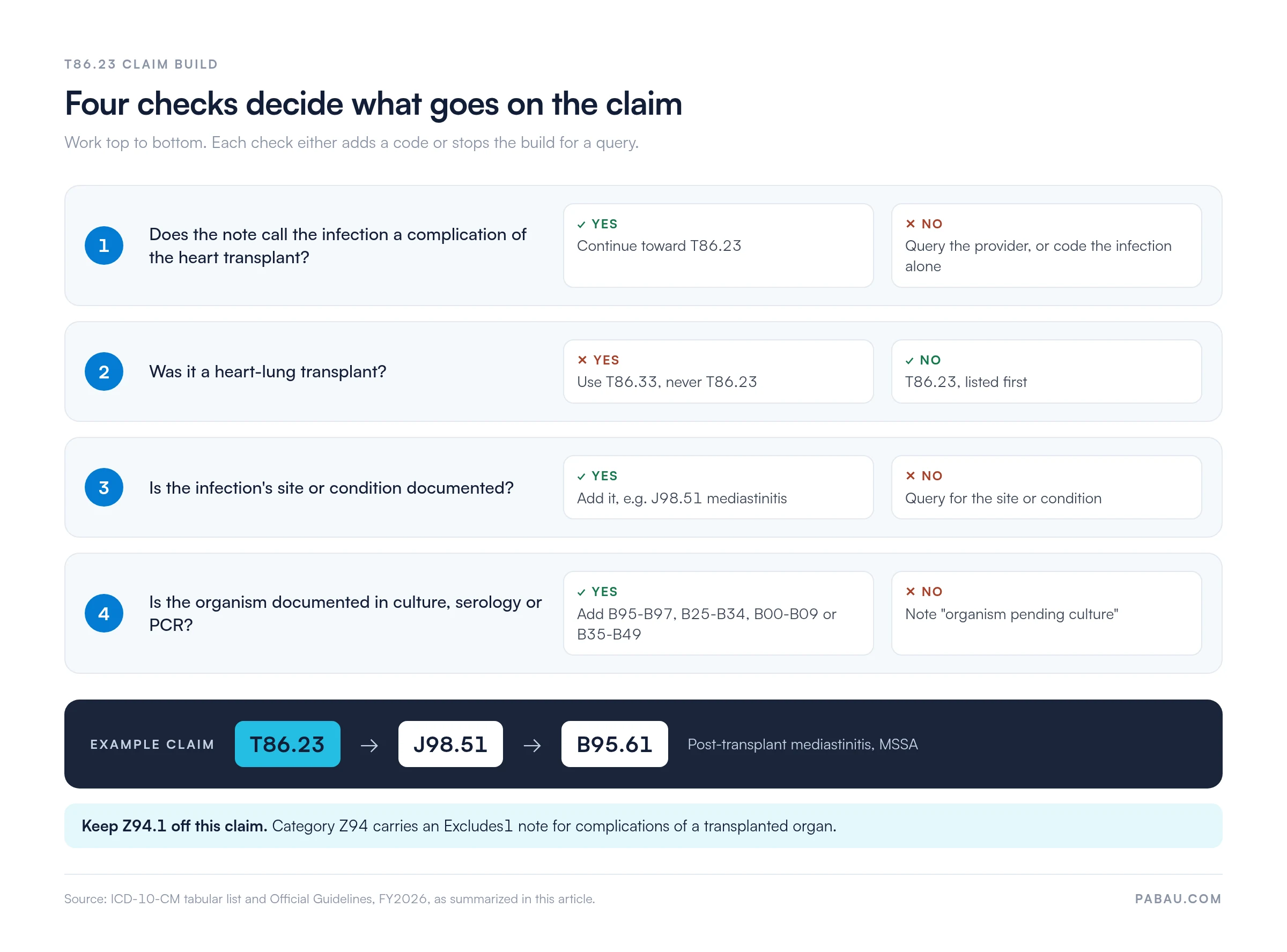
When the organism is documented, pick its code from the matching range:
Some codes name both the infection and the organism. CMV disease under B25 is one example, so it needs no separate agent code from B97.
The claim build only holds up if the note behind it does. The physician note must show causal linkage, organism identification and physician attestation. Timing alone doesn’t prove the link.
Take a note that reads “patient with heart transplant, now presenting with CMV viremia.” It isn’t enough. The note has to state that the infection is a complication of the transplant.
A well-documented encounter is the foundation of a clean claim on the first pass. Building the query into transplant intake also cuts retrospective queries later.
Build a transplant complication query template with three checkboxes: causal linkage statement, organism identification or ‘organism pending culture,’ and physician signature. Attach it to every transplant encounter flagged for a complication code. One missing checkbox is worth a query before the claim leaves the practice.
Even with a solid note, a few errors keep sending these claims back. Tracking denials by reason code shows which pattern is hitting your transplant program.
Reviewing your denial management workflows helps billing teams see which pattern drives volume. For the adjustment reason codes payers attach, see our guide to medical billing denial codes.
Those patterns are easiest to stop at the door. Before you submit a T86.23 claim, confirm each of these:
The checklist covers coding, and coverage is the other half. Medicare fee-for-service covers treatment of post-transplant infection when it’s documented as a transplant complication. The T86.23 diagnosis itself needs no pre-authorization. The treatments ordered alongside it often face their own coverage review.
IVIG is a common example. CMS Local Coverage Determinations (LCDs) set the documented indications for it, and those policies get revised. Check the current LCD in the CMS Medicare Coverage Database before billing IVIG in this context.
Commercial plans tend to be stricter. Most require pre-authorization for inpatient admissions involving transplant complications. Some also apply step therapy to antifungal or antiviral drugs. Run insurance eligibility verification and confirm authorization before treatment, particularly for IVIG or specialty antifungals.
With coverage confirmed, the procedure side comes next. Several CPT codes appear regularly beside T86.23, and payers check these pairs in automated edits. Verify each one against the current quarter’s NCCI tables before you submit.
NCCI edits update every quarter and can change a pair’s bundling status without much warning. A manual look at bronchoscopy and sternotomy pairs catches those changes before the claim reaches the clearinghouse.
Flag every T86.23 claim that includes a bronchoscopy or sternotomy repair code for a manual NCCI check before submission. The tables change quarterly, and bundled rejections on inpatient transplant claims are slow to appeal. A short check up front costs far less than an appeal.
Even a well-built claim can go wrong when the documentation is thin and a similar code looks close enough. Here’s the quick answer for each one.
Choose T86.23 whenever the note documents an infection. T86.298 covers other specified complications of heart transplant, so it only fits when the complication isn’t an infection.
It comes down to the organ. T86.812 is lung transplant infection. Heart-lung transplant infection is T86.33, never T86.23, because T86.2 carries an Excludes1 note against T86.3-.
No. B25.1, for example, is cytomegaloviral hepatitis. When CMV involves the heart allograft, T86.23 goes first and the B25 code follows it. A B25 code alone won’t support a transplant complication claim.
Not when the provider links it to the transplant. J98.51 is mediastinitis, a site-specific code. List T86.23 first and add J98.51 after it to name the site.
T86.23 is active and billable for FY2025 (effective October 1, 2024) and FY2026 (effective October 1, 2025). Neither release changed its descriptor, structure or instructional notes. FY2027 takes effect on October 1, 2026, so confirm the code against the new tabular list for later dates of service.
CMS and the National Center for Health Statistics (NCHS) publish ICD-10-CM updates every year. The CDC/NCHS ICD-10-CM browser reflects the current tabular list. The CMS ICD-10 page linked earlier carries the annual code files and the Official Guidelines.
Commercial tools such as AAPC Codify are handy for quick reference, but treat them as secondary to the official release. An October code review each year keeps annual changes from catching the billing team off guard.
On many transplant billing teams, one person reads the culture report and another keys the codes. The organism code is what usually drops out in that handoff.
Pabau, the practice platform we build, includes claims management software that starts the claim from the patient record. Diagnosis slots are seeded from the recorded problem list. A built-in ICD-10-CM and CPT lookup library covers the codes in this guide.
Before the Send button unlocks, Pabau checks that claim-required fields such as membership numbers and authorization codes are complete.
US claims then go out through our Claim.MD integration, with real-time eligibility checks and claim-status tracking. Your coders keep their time for the physician query, which is where T86.23 claims are won.

Pabau pre-fills claims from the patient record, checks required fields before sending, and tracks each claim through our Claim.MD integration. See how it fits your transplant billing workflow.

T86.23 rarely goes wrong because a coder misread the tabular list. It goes wrong upstream, when the note says “transplant patient with CMV” and never names a complication. So the fix with the biggest payoff sits in documentation.
Build the physician query into transplant intake, and T86.23 claims start clean. Add a pre-submission check for the organism code, Z94.1 and the heart-lung trap, and the appeals queue shrinks. The cost is a few minutes per encounter before the claim leaves, instead of weeks after it bounces.
Book a demo to see how Pabau builds transplant complication claims straight from the patient record.

Want the code for the most common late complication? ICD-10 code T86.290 covers cardiac allograft vasculopathy and how it differs from the rest of the T86.2 family.
Need guidance on how clearinghouses handle multi-code claims? Understanding medical claims clearinghouses explains how clearinghouse edits catch errors before a claim reaches the payer.
New to the full claim lifecycle? What is medical billing walks through each stage from charge capture to payment.
Looking for a way to capture every code at the point of service? Superbill best practices shows how to structure a superbill so multi-code encounters stay complete.
Worried about audit exposure on complex claims? Medical billing compliance covers the rules and habits that keep billing teams audit-ready.
It depends on the setting. In outpatient coding, don’t code a suspected diagnosis. Code the documented signs and symptoms instead. For inpatient discharges, a condition documented as “probable” or “suspected” at discharge can be coded as if confirmed.
Yes. When treating the infection of the transplanted heart is the main reason for admission, T86.23 is sequenced as the principal diagnosis. The infection and organism codes follow it.
Yes, if the provider documents it as a complication of the transplant. Timing alone doesn’t decide the code. The documented cause-and-effect link does, whether the infection appears in week three or year five.
Yes. T86.23 maps to the heart transplant status and complications category in the CMS-HCC V28 model. The diagnosis must be supported in a face-to-face encounter note each calendar year to count.