ICD-10 Code T32.71: Corrosions of 70-79% body surface area
ICD-10 code T32.71: Quick reference ICD-10 code T32.71 reports chemical corrosio...

Last Updated: Oct 23, 2026
Billable Code Specific Code
T63.591D is the billable ICD-10-CM code for toxic effect of contact with other venomous fish, accidental (unintentional), subsequent encounter.
The code sits in category T63, within the T51–T65 block for toxic effects of substances chiefly nonmedicinal as to source. It covers routine healing-phase care after a sting from venomous fish species other than stingrays, such as stonefish, lionfish and scorpionfish. Clinicians who document the fish, the sting date and the care at each visit give coders what they need to bill it cleanly.
Let Pabau's smart automation suggest the right codes, reduce claim denials, and keep your practice compliant—effortlessly.
Automate repetitive tasks and focus on what matters most—your patients.
Reduce coding errors and ensure compliance with the latest regulations.
Clean claims, fewer denials, and faster reimbursements.
Powerful insights and reporting to help your practice thrive.
HIPAA compliant SOC 2 certified GDPR-compliant Trusted by 4,000+ clinics worldwide

T63.591D codes routine healing-phase care for an accidental sting from a venomous fish other than a stingray, such as a stonefish, lionfish or scorpionfish.
The 7th character D marks routine care during healing or recovery. T63.591A covers each encounter for active treatment, and T63.591S covers sequela once late effects remain.
Stingray stings code to T63.51-, and jellyfish, man-o-war and sea anemone stings code to T63.6-, so the species named in the note decides the code.
T63.591D already identifies the agent and intent, so ICD-10-CM has no separate external cause code for the sting itself. Y92 place, Y93 activity and Y99 status codes are reported once, at the initial encounter.
Pabau, the billing and practice platform we build, turns invoices into CMS-1500 claims, submits them through Claim.MD and tracks each one to payment or denial.
ICD-10 Code T63.591D reports the toxic effect of an accidental sting from a venomous fish other than a stingray, during routine healing-phase care.
Stonefish, lionfish, scorpionfish and weever fish stings all code here once active treatment has ended. Confirm every field in the table below before the code goes on a claim, because payers validate it against the ICD-10-CM tabular list.
Verify current billability status against the CDC/NCHS ICD-10-CM web tool each fiscal year. The annual October update can retire or modify codes.
T63.591D is an alphanumeric string, and each character carries a specific meaning. Coders who can read each position catch a misassignment before the claim leaves the practice.
T63.59 covers every venomous fish except the stingray, which has its own subcategory, T63.51. Stings from stonefish, lionfish, scorpionfish and weever fish all code here. The fish’s name in the clinical note is what places the sting in T63.59.
Other marine stings sit elsewhere in T63. Portuguese man-o-war, jellyfish and sea anemone stings code to T63.6-, and venomous marine plants code to T63.7-. Land animals have their own subcategories too.
T63.011D, the follow-up code for rattlesnake venom, shows how far apart these subcategories sit. Coding a rattlesnake bite to T63.591D reports the wrong animal entirely, so the claim describes a sting the patient never had. A non-fish animal with no named subcategory belongs in T63.89-, never in T63.59-.
Before you assign T63.591D, confirm the note names a fish other than a stingray. A stingray wound codes to T63.511D at follow-up, and a jellyfish sting codes to the T63.6- subcategory. If the note says only marine sting, query the clinician before you code.
The 7th character D designates a subsequent encounter. It covers routine care during the healing or recovery phase, after active treatment of the sting has ended. The care delivered at this visit decides the character, so a fourth visit can still be active treatment.
The 7th character follows the type of care. A new clinician who only checks healing still uses D (T63.591D). One who starts or continues active treatment uses A (T63.591A). The decision path below puts the species and the type of care together.
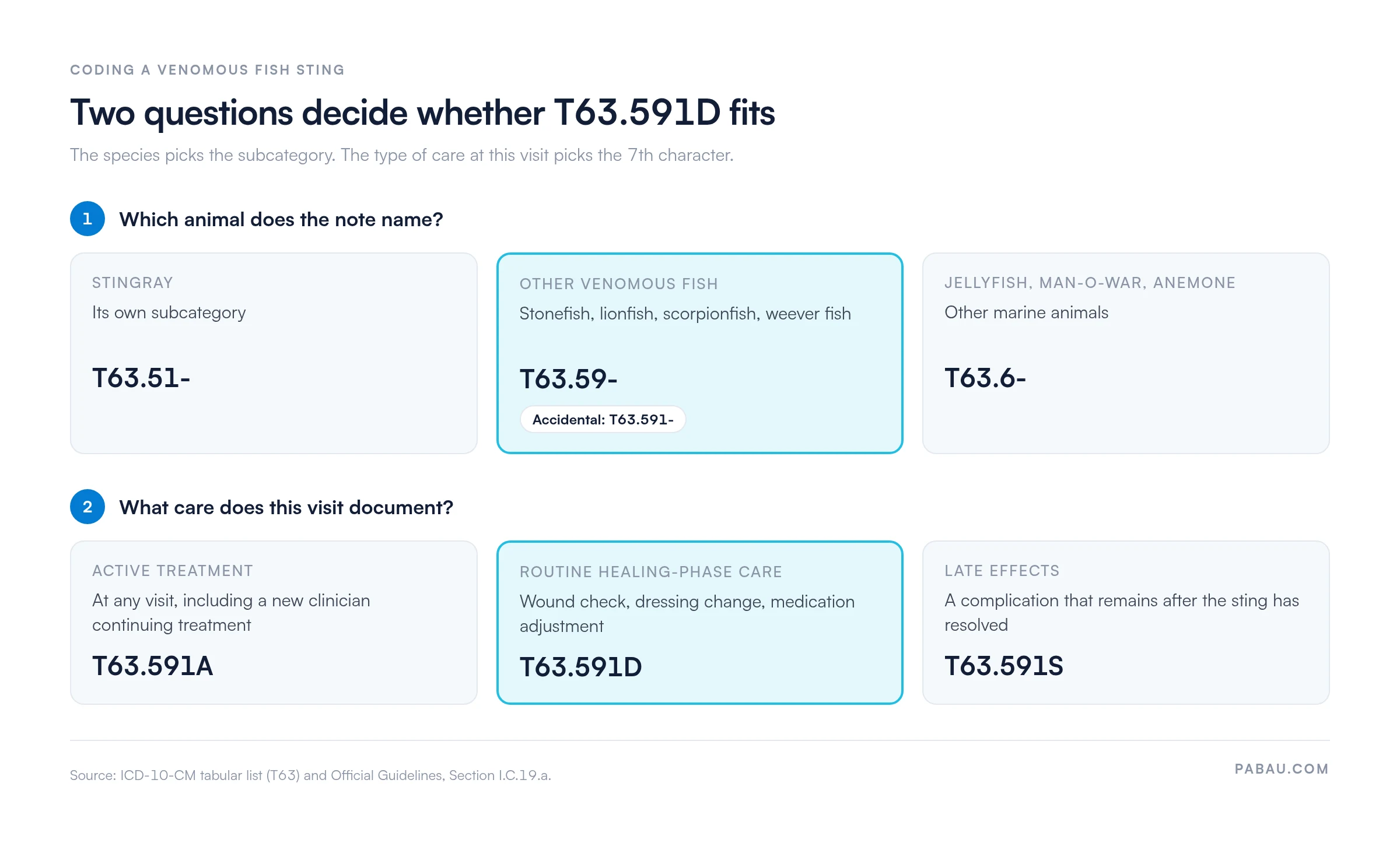
A sting that fails either question needs a different code, so check both before the claim goes out.
T63.591D inherits instructional notes from subcategory T63.5, category T63 and the T51–T65 block. Ignoring them creates claim edits that payer systems catch quickly.
Category T63 carries no Excludes1 note of its own. The Excludes1 that applies sits at the T51–T65 block level and covers contact with and suspected exposure to toxic substances (Z77.-). Z77.- describes exposure without a toxic effect, so it never sits beside T63.591D for the same exposure.
Category T63 carries an Excludes2 note for ingestion of a toxic animal or plant (T61.-, T62.-). Subcategory T63.5 adds its own Excludes2 for poisoning by ingestion of fish (T61.-). Excludes2 means the excluded condition isn’t part of this code, but the patient may have both.
A diver stung by a weever fish who separately develops ciguatera from eating reef fish would carry both a T63.59- code and a T61.- code. The T51–T65 block also tells you to code associated manifestations of the toxic effect separately.
T63.591D describes a toxic effect, not an adverse effect. Toxic effects arise from exposure to inherently poisonous substances, which here means fish venom. Adverse effects arise from correct administration of a therapeutic substance. Coding a fish sting as an adverse effect reports the wrong mechanism and can trigger a payer edit. Category T63 is the correct home for every venomous sting, however mild the presentation.
T63.591D already identifies the agent and intent, so ICD-10-CM has no separate external cause code for the sting itself. The ICD-10-CM Official Guidelines, Section I.C.20, state that there is no national requirement to report external cause codes. Some payers and state data systems do collect them.
Three supplementary families add context where they’re collected:
All three are reported once, at the initial encounter for treatment. On a T63.591D follow-up claim they normally don’t repeat. External cause codes are always secondary and are never sequenced as the first-listed diagnosis.
Coders assign T63.591D from the note alone, so each element below has to be in the record. Use the table as a pre-submission checklist you can share with your clinical team.
Practices using medical billing compliance workflows build these documentation prompts into the clinical note template. That catches missing details before the encounter closes, which costs far less than chasing documentation after a denial. Understanding medical billing fundamentals helps clinicians see why each field matters for claim adjudication.
Medicare and most commercial payers accept T63.591D as a valid diagnosis code for routine healing-phase visits after a venomous fish sting. Prior authorization is not typically required for routine follow-up wound care. It may apply when the visit involves a specialist consultation, imaging for a retained spine, or a procedure. Payer policies vary, so confirm the plan’s rules first.
Common procedure codes that pair with T63.591D include evaluation and management codes (99211-99215). Wound care visits may add debridement codes (97597, 97598) or 99070 for dressing supplies. Removing a retained spine fragment is active treatment, so that visit takes T63.591A with the matching foreign body removal code.
If a later visit includes imaging or removal of a retained spine fragment, check the 7th character first, because active treatment takes T63.591A. Then confirm whether the plan needs a fresh prior authorization before the appointment.
Five documentation and coding errors put a T63.591D claim at risk. Each one below comes with the corrective action that prevents it.
For practices managing a high volume of denials, structured denial management workflows help. Reviewing denial reason codes systematically, rather than claim by claim, surfaces the pattern quickly and helps prioritize corrective action.
Walk through this sequence before every T63.591D claim submission. Building it into your billing workflow catches the errors listed above before the claim goes out.
Billing a T63.591D claim means checking the encounter history, the fish named in the note and the payer’s edits, often across several visits. Doing that by hand across payer portals is slow, and a missed A-versus-D error comes back as a denial weeks later.
Pabau turns invoices into CMS-1500 claims and submits them as electronic claims via Claim.MD, our US clearinghouse partner. Claim.MD carries the claim to thousands of US payers, and Pabau shows its status from submission to payment or denial.
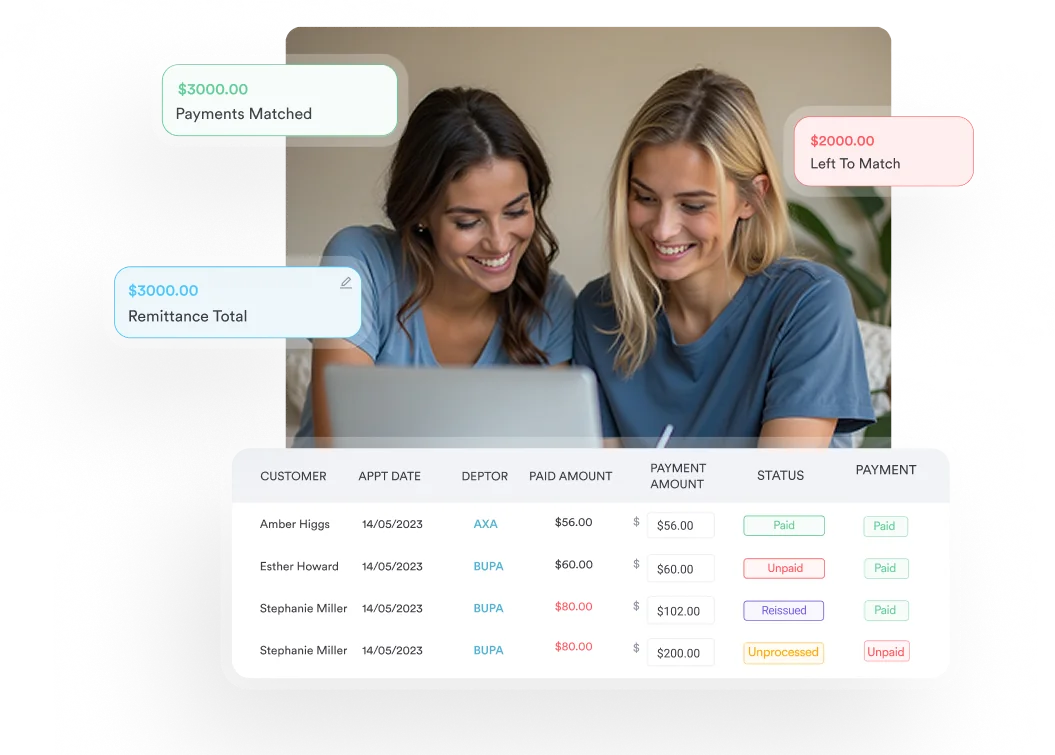
Pabau also checks patient eligibility in real time. Claim status updates and electronic remittance advice flow back into Pabau’s denial-tracking claims software, and denied claims are flagged for rework. Your billing team can follow every visit for the same sting from invoice to payment in one dashboard.

Pabau turns invoices into CMS-1500 claims, checks eligibility in real time, and sends each claim to payers through Claim.MD. See how it works for practices billing toxic effect codes.

T63.591D is narrow by design. It fits only an accidental sting from a venomous fish other than a stingray, during routine healing-phase care. Get the species and the type of care right, and the code rarely causes trouble.
The practical step is to make both facts hard to skip in the clinical note. Prompt for the named fish and for what care each visit delivers, then match the 7th character to it. Reading each electronic remittance advice file closes the loop on every visit you bill.
Book a demo to see how Pabau tracks each T63.591D claim from invoice to payment.

Want to see how a T63 claim travels from Pabau to the payer? Pabau’s Claim.MD clearinghouse guide explains how claim submission and real-time eligibility verification work together.
Managing a volume of toxic effect denials across multiple payers? Revenue cycle management fundamentals covers how to build a systematic denial review process that scales.
ICD-10 Code T63.591D is the billable code for the toxic effect of contact with other venomous fish, accidental (unintentional), subsequent encounter. It applies when a patient returns for routine healing-phase care after a venomous fish sting, once active treatment has ended. Stingrays have their own code, T63.51-, so typical examples are stonefish, lionfish and scorpionfish.
Yes, T63.591D is billable in the current ICD-10-CM release. The parent code T63.591 is not billable without its 7th character. Verify the status each fiscal year in the CDC/NCHS ICD-10-CM web tool, as CMS can modify or retire codes with each October update.
T63.591A applies to each encounter where the patient receives active treatment for the sting, at any visit. T63.591D applies to routine care during the healing or recovery phase, such as a wound check or dressing change. The type of care decides the character, not the visit count.
The 7th character D denotes a subsequent encounter, as defined in the ICD-10-CM Official Guidelines (Section I.C.19). The patient is receiving routine care during the healing or recovery phase, after active treatment has ended. A new clinician who only checks healing uses D, while one who starts or continues active treatment uses A.
Usually none on a T63.591D claim. The code already identifies the agent and intent, so ICD-10-CM has no separate external cause code for the sting itself. Place of occurrence (Y92), activity (Y93) and external cause status (Y99) codes are reported once, at the initial encounter. Follow your payer’s rules where they ask for more.
A frequent reason is a 7th character that doesn’t match the documented care, such as T63.591A on a routine wound check. A stingray or jellyfish sting coded to T63.59- is another, as is a note that doesn’t name the fish. Adverse effect coding and an unsupported procedure code also cause denials. Audit prior claims, match the species to its subcategory, and check procedure-to-diagnosis alignment before submission.