ICD-10 Code T32.63: Corrosions involving 60-69% body surface
ICD-10 Code T32.63: Full description and billable status ICD-10 Code T32.63 is a...

Last Updated: Nov 2, 2026
Billable Code Specific Code
T56.5X2D is the billable ICD-10-CM code for toxic effect of zinc and its compounds, intentional self-harm, subsequent encounter. It applies at follow-up visits once active treatment for a deliberate zinc exposure has ended.
The 6th character, 2, records self-harm intent, and the 7th character, D, records the subsequent encounter. Coders most often confuse it with T56.5X1D, the accidental-exposure code, which differs by that one intent character.
Let Pabau's smart automation suggest the right codes, reduce claim denials, and keep your practice compliant—effortlessly.
Automate repetitive tasks and focus on what matters most—your patients.
Reduce coding errors and ensure compliance with the latest regulations.
Clean claims, fewer denials, and faster reimbursements.
Powerful insights and reporting to help your practice thrive.
HIPAA compliant SOC 2 certified GDPR-compliant Trusted by 4,000+ clinics worldwide

T56.5X2D is a billable 7-character ICD-10-CM code for zinc toxicity from intentional self-harm at a subsequent encounter.
The 6th character, 2, signals intentional self-harm, and the 7th character, D, marks a subsequent encounter after active treatment ends.
External cause codes are recommended with T56.5X2D, and required only where a state mandate or payer rule applies.
Pabau’s claims management software validates claims for missing or invalid details before submission.
ICD-10 Code T56.5X2D is the billable ICD-10-CM code for the toxic effect of zinc and its compounds, intentional self-harm, subsequent encounter.
Report it at follow-up visits once active treatment for a deliberate zinc exposure has ended. Each character narrows the code, as the breakdown below shows.
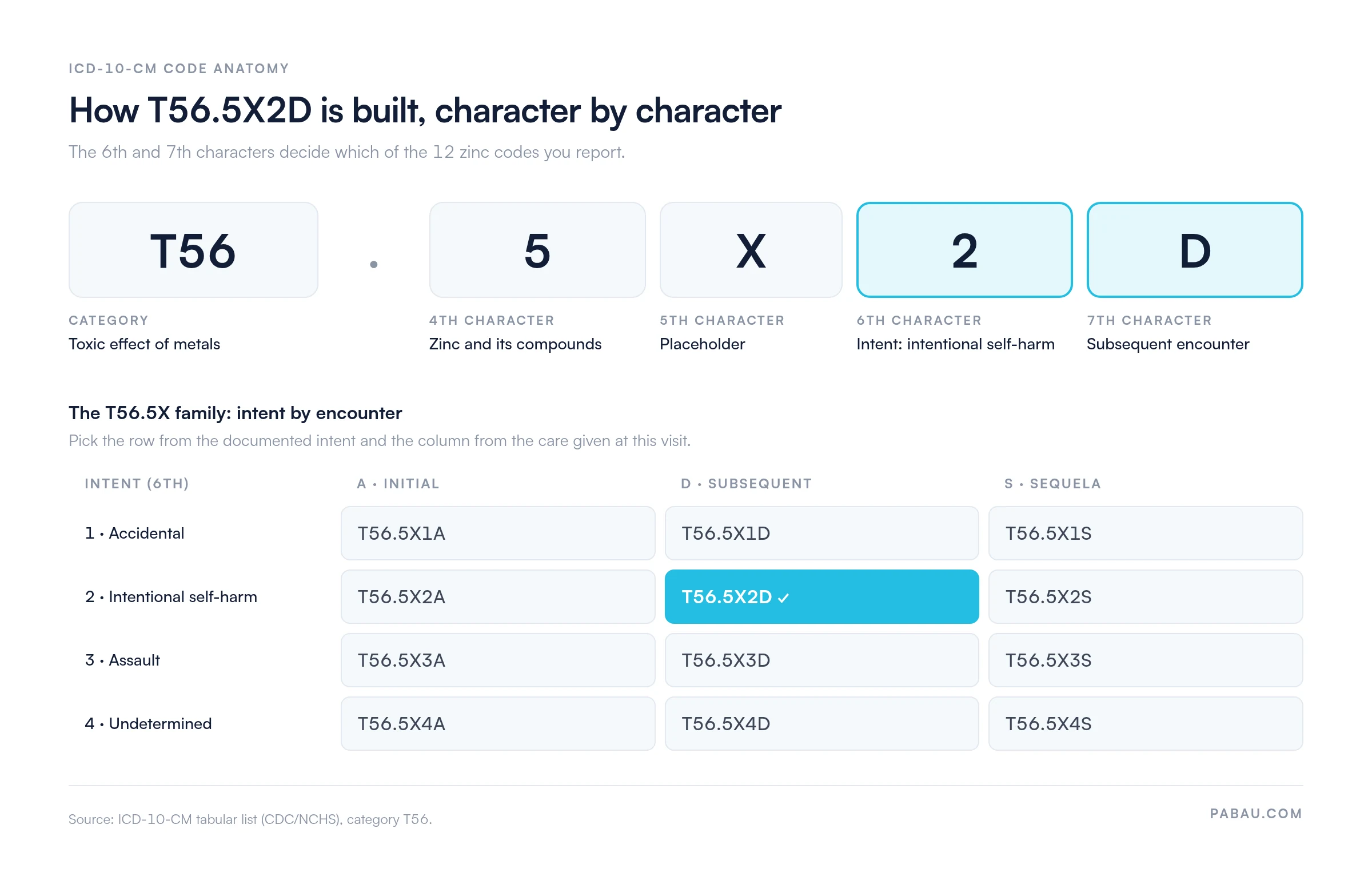
The reference table lists the official fields you need to confirm before you assign it.
T56.5X2D covers toxic exposures to elemental zinc and any zinc-containing compound. According to the CDC/NCHS ICD-10-CM tabular list, the T56.5X subcategory explicitly includes zinc compounds, not just elemental zinc metal.
The code applies to follow-up care after a documented, deliberate exposure to any of these non-medicinal zinc sources:
Medicinal zinc preparations, such as zinc sulfate eye drops, are indexed separately in the Table of Drugs and Chemicals. Check it before you assign a T56 code to a supplement or medication.
Zinc toxicity produces a recognizable clinical picture. To support the code, providers document signs such as nausea, vomiting or abdominal cramps. After longer exposure, they may also record copper deficiency and sideroblastic anemia, both well-established effects in the toxicology literature. Without documented clinical signs, payers may query medical necessity.
The 7th character D in T56.5X2D means the patient is at a subsequent encounter. Active treatment for the toxic effect is complete, and the patient now receives routine care, observation, or aftercare.
Per CMS ICD-10-CM Official Guidelines, Section I.C.19, the 7th character reflects the encounter type from the treating provider’s perspective, not the episode count. A patient can return for multiple subsequent encounters (D) for the same toxic effect event. Once only residual effects remain and the original condition has resolved, shift to S (sequela).
Apply the D character based on what care is being delivered at this visit, not on whether the patient has been seen before. A third follow-up visit for zinc toxicity monitoring still takes D if active treatment of the toxic effect has concluded. At that point the provider is monitoring recovery.
The 6th character of T56.5X2D encodes the patient’s intent. The ‘2’ specifically identifies intentional self-harm, meaning the provider has documented that the patient deliberately exposed themselves to the zinc compound.
The self-harm designation has implications beyond coding. Some jurisdictions require mandatory reporting of intentional self-harm events. That legal duty sits outside the coder’s scope, so confirm with your compliance team whether state reporting applies before you submit the claim.
Use T56.5X4D (undetermined) only when the treating provider has expressly stated that intent cannot be determined. Do not default to undetermined as a coding shortcut when the documentation is incomplete. If intent is not documented, query the provider. Assign the self-harm code only on the basis of a documented provider statement.
The T56.5X family covers all 12 intent and encounter combinations for zinc toxicity. The table maps every code in the family to its primary clinical use case.
Toxic effects (T51-T65) and poisoning by drugs (T36-T50) are separate categories in ICD-10-CM. Picking the wrong one is a common finding when auditors review medical billing documentation for toxicology cases.
The rule of thumb: If the substance causing harm is a pharmaceutical (prescribed, OTC, or illicitly obtained drug), use the T36-T50 poisoning block. If it is a metal, organic solvent, gas, corrosive, or other non-drug chemical, use the T51-T65 toxic effects block.
Non-medicinal zinc and zinc compounds are coded to T56.5X-. Check the Table of Drugs and Chemicals for medicinal zinc preparations.
A clean claim for T56.5X2D often carries more than one code. External cause codes are recommended, and required only where a state mandate or payer rule applies. Manifestation codes are added when the toxic exposure has produced identifiable conditions.
External cause codes capture the circumstances of the exposure. Where a payer or state requires them, the set for a zinc self-harm case typically includes:
No separate X-code is needed for intent, because the 2 in T56.5X2D already records it. Under Section I.C.20, Y92, Y93 and Y99 codes are reported once, at the initial encounter, so a follow-up claim coded D usually leaves them off.
When the zinc toxicity has produced identifiable conditions, code those manifestations in addition to T56.5X2D. Common additions include:
T56.5X2D is sequenced as the principal diagnosis when the toxic exposure is the reason for the visit. Manifestation codes follow T56.5X2D in the claim. External cause codes are always additional, never principal.
T56.5X2D is a billable ICD-10-CM code accepted by Medicare, Medicaid, and commercial payers. Payer-specific pre-authorization requirements vary and should be confirmed for each plan before treatment. This documentation checklist reflects standard payer expectations, though individual carriers vary.
T56-series codes generate a predictable set of claim rejections. Denial management in healthcare for toxic-effect codes centers on character-level errors and missing documentation rather than medical necessity questions.
Each rejection comes back with a reason code. Our guide to denial codes for billers maps those codes to the coding and documentation errors behind them.
Run a pre-submission edit to confirm every T56.5X_ code carries a valid 7th character (A, D, or S). Then check whether the payer or state mandates external cause codes, and report them at the initial encounter where it does.
The T56 category, Toxic effect of metals, covers a range of metals. Confirming T56.5X2D is the right choice requires knowing which metal sits in which subcategory. The AAPC ICD-10-CM code lookup and the ICD List reference tool both support navigation across the T56 category.
Zinc and copper (T56.4X_) are clinically related, because high zinc intake competitively inhibits copper absorption. When a patient has both zinc toxicity and documented copper deficiency, assign T56.5X2D as the principal diagnosis. Add E61.0 (copper deficiency) as an additional code. Do not substitute T56.4X_ for T56.5X_ simply because copper deficiency is present. The causative metal is zinc.
Without a pre-submission check, a wrong 7th character or a missing intent note on a T56.5X2D claim usually surfaces only when the payer rejects it. The fix then costs a resubmission and another wait for payment.
Pabau, the practice management and billing platform we build, validates claims for missing or invalid details before submission through its claims management software. For US practices submitting electronically, the Claim.MD clearinghouse integration routes ICD-10-CM coded claims to thousands of US payers. It adds real-time eligibility checks and electronic remittance advice (ERA).
Your billing team catches a missing detail before the claim leaves the practice. Fewer T56-series claims then come back for rework.

Pabau’s claims management software validates claims for missing or invalid details before submission, so your billing team catches errors before the payer does.

Code T56.5X2D only when two facts are on the record. A provider note must state deliberate self-harm, and active treatment for the zinc exposure must already be complete. If either is missing, query the provider before the claim goes out.
Resist the undetermined-intent code as a fallback. It needs its own explicit provider statement, so an incomplete note calls for a query first.
Building that query step into your medical billing compliance routine protects both the claim and the audit trail. Book a demo to see how Pabau checks claims for missing details before they reach the payer.

Need to understand how electronic claim submission works? Pabau’s Claim.MD clearinghouse guide covers how electronic claims are validated and routed to payers.
Want to reduce front-end claim rejections? Submitting a clean claim explains the documentation and code-set requirements payers check before accepting a claim.
Building a denial prevention workflow? Denial codes in medical billing maps common CARC denial reason codes to the upstream coding and documentation errors that cause them.
ICD-10 code T56.5X2D is the billable diagnosis code for the toxic effect of zinc and its compounds, intentional self-harm, subsequent encounter. The ‘2’ in the 6th character position indicates intentional self-harm. The ‘D’ in the 7th character position means active treatment is complete and the patient is receiving routine care or follow-up.
Yes, T56.5X2D is a valid billable ICD-10-CM code. It is a 7-character code at the highest level of specificity. Medicare, Medicaid, and commercial payers accept it for the claim date of service. Confirm validity for the specific fiscal year of the claim using the CDC/NCHS tabular list for that year.
The 7th character A (initial encounter) applies while the patient is receiving active treatment for the condition. The 7th character D (subsequent encounter) applies once active treatment is complete and the patient receives routine care, observation, or aftercare. The type of care at the current visit decides it, not the number of visits.
T56.5X2D covers toxic exposures to elemental zinc and zinc compounds, including zinc oxide, zinc chloride, zinc sulfate, and other zinc salts. The official descriptor reads “zinc and its compounds,” so compound exposures count as well as zinc metal. Medicinal zinc preparations are checked separately in the Table of Drugs and Chemicals.
Toxic effect codes (T51-T65) apply to non-medicinal substances such as metals, solvents, and corrosives. Poisoning codes (T36-T50) apply to pharmaceutical drugs and biologics. Non-medicinal zinc and zinc compounds are coded to T56.5X-. Check the Table of Drugs and Chemicals for medicinal zinc preparations, such as zinc sulfate eye drops.
The most common denial is a wrong 7th character, such as A instead of D at a follow-up visit. Next comes a wrong intent character, such as 1 when documentation shows self-harm. Others include omitting an external cause code where the payer or state requires one. A self-harm character assigned without a provider note documenting deliberate intent is denied too. A pre-submission coding review prevents each of these.
The treating provider must explicitly state in the medical record that the zinc exposure was deliberate or a self-harm or suicide attempt. Coders cannot infer intent from clinical presentation alone. Assign the ‘2’ intent character only after a provider attestation, a psychiatric consultation note, or a phrase such as “intentional ingestion” or “deliberate self-poisoning”.