ICD-10 Code Y76.0: Diagnostic obstetric and gynecological devices
ICD-10 Code Y76.0: Definition and billable status ICD-10 Code Y76.0 is a valid, ...

Last Updated: Oct 23, 2026
Billable Code Specific Code
T52.0X3D is the billable ICD-10-CM code for toxic effect of petroleum products, assault, subsequent encounter.
Where this code trips up coders most is not the substance itself but the two qualifiers encoded in the final two characters: the 6th character "3" locks in assault as the documented intent, and the 7th character "D" means the patient is past the active treatment phase and presenting for follow-up care. Both require explicit clinical documentation. Getting either wrong sends the claim back, and in an assault context, it can also trigger a payer audit or a compliance review.
Let Pabau's smart automation suggest the right codes, reduce claim denials, and keep your practice compliant—effortlessly.
Automate repetitive tasks and focus on what matters most—your patients.
Reduce coding errors and ensure compliance with the latest regulations.
Clean claims, fewer denials, and faster reimbursements.
Powerful insights and reporting to help your practice thrive.
HIPAA compliant SOC 2 certified GDPR-compliant Trusted by 4,000+ clinics worldwide

T52.0X3D is a billable ICD-10-CM code for a follow-up visit after another person exposed the patient to a petroleum product.
The 6th character 3 means assault, and the record has to say so. When no intent is documented, the code defaults to accidental.
The 7th character D fits once active treatment is over and the patient is receiving routine care while they recover.
Place, activity and status codes (Y92, Y93 and Y99) belong to the initial encounter, so they stay off a T52.0X3D claim.
Claims software like Pabau pre-fills the claim from the patient record and checks required fields, but your coder still picks the 7th character.
ICD-10 code T52.0X3D is the billable diagnosis code for a follow-up visit after an assault involving a petroleum product. Think gasoline, kerosene or naphtha used against a patient by another person.
Timing is the detail that matters most. The D means active treatment has ended and the patient is back for routine care while they recover. Code that visit with an A, or skip the assault documentation, and the claim is likely to come back.
Below, you’ll find the quick-reference data, the intent and encounter rules, the external cause codes that drop off at follow-up, and a pre-submission checklist.
The CDC/NCHS ICD-10-CM web tool is the official US source for this code’s annual validity and the inclusion terms under T52.0. Check it against the latest fiscal year release before you bill.
The CDC tabular list, which also sits on the CMS ICD-10 page, names six inclusion terms under T52.0. Match the chart against these terms rather than trade names.
The clinician should name the substance, or at least confirm it’s a petroleum product. A coder can’t infer it from the setting alone.
Several look-alikes code elsewhere. Methanol (methyl alcohol) goes to T51.1. Ethylene glycol goes to T51.8X, Toxic effect of other alcohols. And halogen derivatives of aliphatic and aromatic hydrocarbons sit in T53.-, under an Excludes1 note at T52. Carbon disulfide is another solvent that codes outside T52, at T65.4, so an accidental late effect takes T65.4X1S.
The 7th character records where the patient is in their care, not how sick they are. The FY2026 guidelines define D as routine care during the healing or recovery phase, after active treatment ends. All three options apply to T52.0X3.
Here’s the classic error. A coder keeps using A for the whole course of care because it feels natural. But A only fits while active treatment continues. Once the visit is about monitoring, lab follow-up or routine checks, switch to D.
Skip the aftercare Z codes here, too. The guidelines use the D character, not a Z code, for follow-up care of injuries and poisonings.
Flag the encounter type at the point of documentation, not at the point of billing. When the treating clinician documents ‘follow-up for petroleum exposure’ or ‘monitoring post-toxic ingestion,’ that note is the trigger to use ‘D.’ Build a documentation prompt into your intake workflow so the encounter type is explicit before the claim is coded.
The 6th character 3 means another person caused the exposure, and the record has to say so. Coders can’t assign assault from a hunch or the circumstances. The tabular note for T51-T65 sets the fallback: when no intent is documented, code accidental.
Undetermined intent has a narrow use. It fits only when the record specifically states that the intent can’t be determined.
Compare two notes. “Patient states substance was added to food by partner” documents assault, so the 3 applies. “Toxic ingestion, mechanism unclear” states no intent, so the code falls back to 1. Only a note saying intent can’t be established supports a 4.
Codes in the T52.0X3 family share the assault intent and differ only in the 7th character. Most selection errors, though, happen on the intent axis. Here’s how T52.0X3D compares with its closest neighbors.
If the assault also led to a mental health diagnosis, code that condition separately. It doesn’t change the T52 code.
Ask one question: is the toxic effect itself still the reason for the visit? If yes, use D. If it has resolved and a complication remains, use S.
In practice, “return visit for ongoing monitoring of kerosene ingestion effects” supports D. “Liver damage from prior petroleum ingestion, toxic condition resolved” supports the liver code, followed by T52.0X3S. Choosing S too early tells the payer the condition has resolved when it hasn’t.
The same order holds outside petroleum. T59.3X2S covers a tear gas late effect, and the residual condition is still coded first.
On a T52.0X3D claim, you usually report no Y92, Y93 or Y99 code at all. Here’s why, rule by rule, from the FY2026 ICD-10-CM Official Guidelines.
There’s also no national mandate to report external cause codes. Some states and payers require them, so check those rules for the initial claim. On the follow-up claim, add codes for any ongoing manifestation instead, such as a respiratory condition from J60-J70.
An auditor will look for four things in the note. If any one of them is missing, the claim gets harder to defend.
These errors are predictable, so it’s cheaper to catch them before submission than to rework a denial. When one does slip through, the remittance tells you why. Our guide to the denial codes billers see decodes each reason.
Fix these five and you’re far closer to a clean claim that the payer can process without coming back to you.
Use it at charge entry, after coding and before submission. Each line should get a clear yes.
Checking the hierarchy first confirms you’re in the right chapter and category. Then you can pick the 6th and 7th characters with confidence.
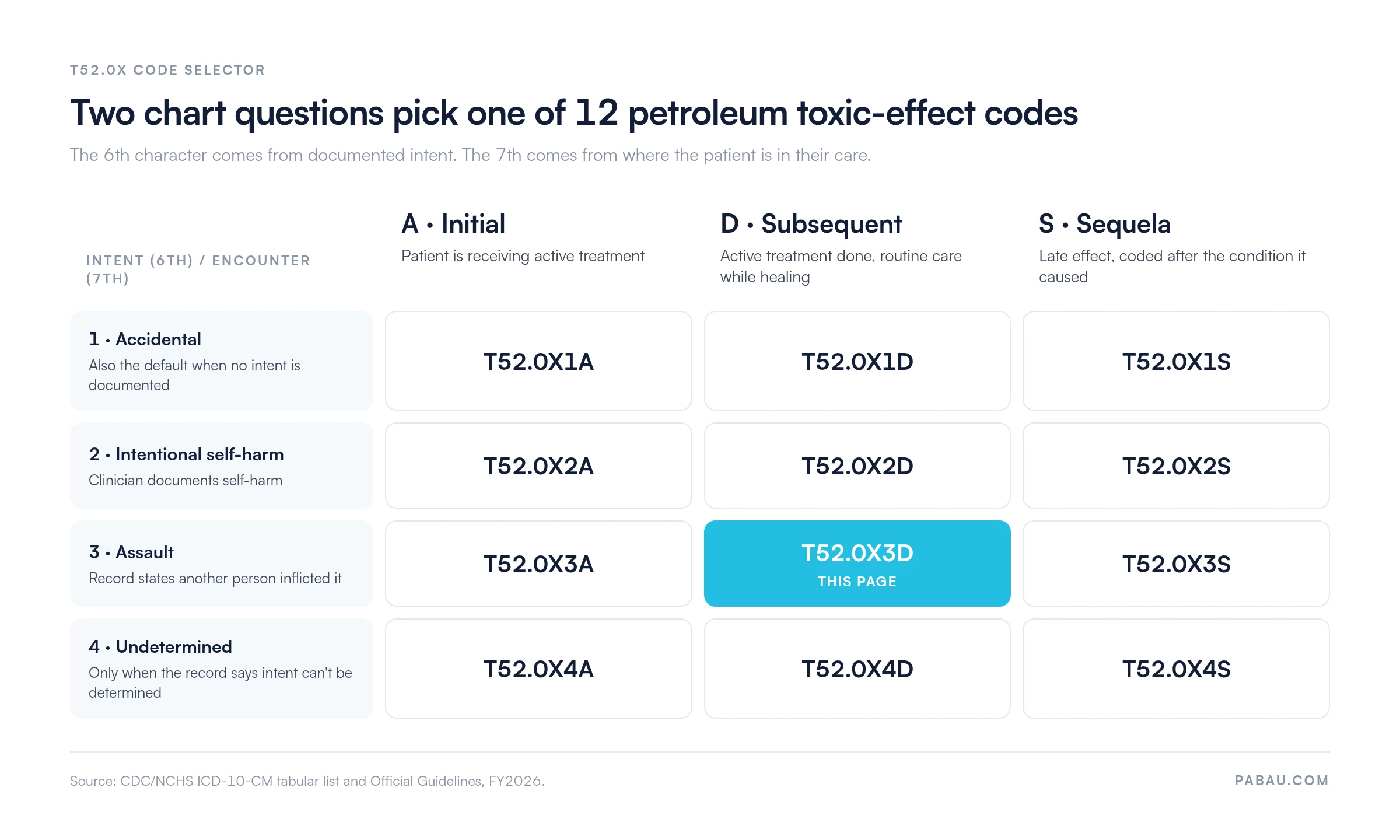
T52.0X3 isn’t billable on its own, so every claim needs the full 7-character code. The T52.0X subcategory holds 12 billable codes in total: four intents, each with an A, D or S. The grid below maps all 12.
Many billing teams still re-key diagnosis codes from the note into the claim form by hand. Then they wait to hear whether the payer accepted it. Each re-keyed field is another chance for a wrong 7th character to slip through.
Practice management software like Pabau shortens that loop. Its claims software for practices pre-fills the claim from the patient record and includes an ICD-10-CM code library for lookups. It also checks that required claim fields are complete before you send.
In the US, claims go out through the Claim.MD clearinghouse, with eligibility checks, remittance posting and status tracking built in. Pabau doesn’t choose the intent or encounter character for you. Your coder still makes that call, backed by what the note says.

Pabau pre-fills claims from the patient record, checks required fields before you send, and submits through Claim.MD in the US. Your team spends less time re-keying codes and chasing rejected claims.

T52.0X3D hangs on two sentences in the note. One says another person caused the exposure. The other says active treatment is over.
Get your clinicians writing both, and the coding follows without guesswork. Leave either one out, and the defensible code becomes accidental or initial instead. Querying the chart takes minutes, while defending an unsupported code on audit can take weeks.
If your team still re-keys these claims by hand, that step is the easiest one to take off their plate. Book a demo to see how Pabau pre-fills and submits follow-up claims like this one.

Coding a different toxic exposure? ICD-10 code T57.8X1A covers the accidental toxic effect of other inorganic substances, with the same intent and encounter logic.
Working with undetermined intent? ICD-10 code T56.7X4A shows how the undetermined intent character works on a beryllium toxic effect code.
Need help with denial patterns on toxic exposure codes? Denial management in healthcare covers the workflow steps practices use to reduce first-pass denial rates across complex diagnosis codes.
Want to understand claim submission for ICD-10 codes? What is revenue cycle management explains how coding accuracy connects to the full billing and collection cycle.
Looking for clearinghouse options for US claims? Medical claims clearinghouse outlines how clearinghouses validate and route claims before they reach payers, and what to look for in a clearinghouse partner.
Don’t use T52.0X3D. The T51-T65 block carries an Excludes1 note for contact with and suspected exposure to toxic substances. Those encounters code to Z77.- instead.
No. The FY2026 guidelines say aftercare Z codes aren’t used for conditions like injuries and poisonings that have a 7th character for subsequent care. Report T52.0X3D itself.
List T52.0X3D first, then add a code for each associated manifestation. The tabular list gives respiratory conditions due to external agents (J60-J70) as an example.
No. T52 has an Excludes1 note for halogen derivatives of aliphatic and aromatic hydrocarbons. Those go to category T53, such as T53.0 for carbon tetrachloride.
Yes. The 7th character depends on whether the patient is still in active treatment, not on whether the provider is seeing them for the first time.