ICD-10 code T43.604S: Psychostimulant poisoning sequela
What does ICD-10 code T43.604S cover? ICD-10 code T43.604S covers the late effec...

Last Updated: Oct 22, 2026
Billable Code Specific Code
T43.224S is the billable ICD-10-CM code for poisoning by selective serotonin reuptake inhibitors, undetermined, sequela.
The record must also state that the intent behind that poisoning could not be determined. The code is valid for FY2026, which took effect on October 1, 2025.
One digit separates T43.224S from the code it is most often confused with. Subcategory T43.21 belongs to the SNRIs, such as venlafaxine and duloxetine.
Subcategory T43.22 belongs to the SSRIs, such as fluoxetine and sertraline. The tabular list opens both entries with the word selective, so the two swap easily, and the claim carries no flag for the error.
Most SSRI poisoning encounters close at discharge. T43.224S is what you reach for when they do not. The patient returns weeks or months later with a tremor, a cognitive change, or another complication that traces back to the earlier overdose. Coders meet this code in outpatient follow-up and rehabilitation rather than in the emergency department.
Let Pabau's smart automation suggest the right codes, reduce claim denials, and keep your practice compliant—effortlessly.
Automate repetitive tasks and focus on what matters most—your patients.
Reduce coding errors and ensure compliance with the latest regulations.
Clean claims, fewer denials, and faster reimbursements.
Powerful insights and reporting to help your practice thrive.
HIPAA compliant SOC 2 certified GDPR-compliant Trusted by 4,000+ clinics worldwide

T43.224S is the billable ICD-10-CM code for poisoning by selective serotonin reuptake inhibitors (SSRIs), undetermined, sequela. It is valid for FY2026.
Subcategory T43.22 covers the SSRIs, such as fluoxetine and sertraline. The SNRIs sit under T43.21, so T43.214S is a different code.
The 6th character 4 means undetermined intent. Use it only when the record states that intent could not be determined, not when intent is simply missing.
The 7th character S marks a sequela. Sequence the residual condition first and T43.224S second, per Guidelines Section I.C.19.a.
Practice management software like Pabau integrates with Claim.MD to submit sequela claims to thousands of US payers, with ICD-10 validation built in.
The table below holds the reference data for T43.224S. Code status is reviewed every fiscal year, so check the code against the current tabular list before you submit.
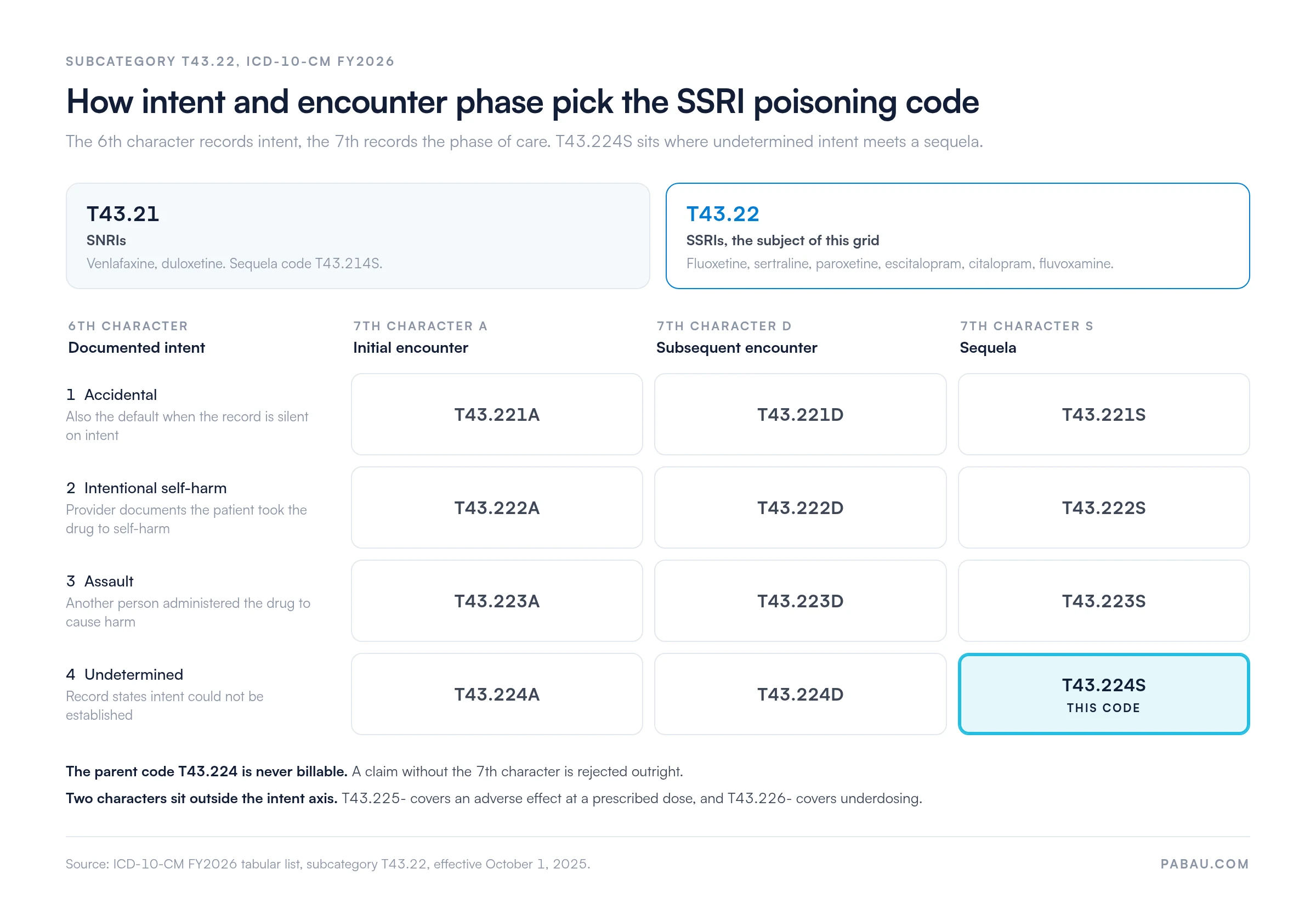
The parent code T43.224 is never billable on its own, because it needs a 7th character to be complete. Each of the three options maps to a distinct phase of care, and picking the wrong one is a common denial trigger. A claim carrying the six-character parent code will be rejected outright.
Key distinction: once the poisoning encounter closes and active treatment ends, later visits for residual complications take the S character. The poisoning is no longer the clinical focus. The sequela is.
The 6th character of T43.224S records intent, and the value 4 means undetermined. This is the digit most often assigned by habit rather than by the record. The ICD-10-CM Official Guidelines are explicit here: undetermined intent applies only when the documentation states that the intent cannot be determined.
If intent is simply unknown or missing from the note, the default is accidental intent, which points to T43.221S rather than T43.224S. Reading a silent chart as undetermined is a substitution error, and it is invisible to most claim scrubbers.
The same documentation test governs undetermined intent across categories T36 to T50. T44.1X4A carries it for cholinergic agonist poisoning, but at the initial encounter rather than the sequela stage.
The distinction matters beyond the claim. Intentional self-harm codes drive risk stratification, safety planning, and quality reporting. Coding an undetermined event as self-harm, or the reverse, changes the clinical picture a later reviewer sees.
The self-harm column produces its own codes across other poisoning categories. T38.5X2S is the sequela code for poisoning by other estrogens and progestogens when the record documents intentional self-harm.
Assault reaches outside the drug categories as well. T61.773S covers a late effect of other fish poisoning when the record documents that another person caused it. Unknown intent there defaults to accidental, just as it does in T43.22.
The two characters work as a pair, and the grid below shows every billable combination inside subcategory T43.22.
A sequela is a late effect or complication that arises after the acute phase of an injury or poisoning has ended. The original encounter is closed, and what remains is a condition caused by it. Sequela coding applies when the current visit treats or evaluates that residual condition.
Two codes are always required with T43.224S. Guidelines Section I.C.19.a puts the specific type of sequela first, followed by the code carrying the S character. So the coder assigns the tremor, the cognitive deficit, or the mood disorder, then adds T43.224S to identify the poisoning behind it.
That order reverses what coders learn for the acute encounter, where the poisoning code is sequenced first and the manifestation second. Getting the sequence backwards, or dropping the condition code, is a common audit finding on Chapter 19 claims.
Reading the hierarchy in full is the cheapest guard against the SSRI and SNRI swap, because the class name appears at the 5-character level. The path from chapter to billable code runs as follows.
Verify the current edition’s hierarchy directly in the CDC/NCHS ICD-10-CM web tool, which reflects each fiscal year’s tabular list and index updates.
T43.224S covers the SSRI class as a whole, because ICD-10-CM does not give each molecule its own code inside T43.22. These agents map to this code when an overdose of undetermined intent leaves a late effect behind.
The lookup path runs through the ICD-10-CM Table of Drugs and Chemicals rather than the alphabetic index. Find the substance, then read across to the undetermined poisoning column. Brand names cross-reference to the generic entry, and an agent with no row of its own is classified by drug class.
Three neighboring subcategories catch the antidepressants that are not SSRIs. SNRIs such as venlafaxine and duloxetine belong to T43.21, so their sequela code is T43.214S.
Other antidepressants belong to T43.29, and an antidepressant the record never names belongs to T43.20. The AAPC ICD-10-CM code lookup confirms class placement when documentation is ambiguous.
Verify the antidepressant class before you code, not after. Sertraline is an SSRI and maps to T43.224S. Venlafaxine is an SNRI and maps to T43.214S. The tabular list opens both class names with the word selective. That single shared word makes this one of the most frequent findings in psychiatric coding audits.
T43.224S claims carry a heavier documentation load than routine sequela codes. Payers need to trace a causal chain from a prior poisoning to a current condition. Missing any link triggers a denial. Capturing the chain while the clinician writes the note prevents most of them.
The clinical record must contain all of the following to support T43.224S:
The three scenarios below show the code in the settings where it appears most often, which are follow-up and rehabilitation rather than acute care.
What does not qualify: a patient taking sertraline at the prescribed dose who develops side effects. That is an adverse effect rather than a poisoning, and it belongs to T43.225A and its D and S siblings. An overdose the record calls accidental does not qualify either, because that is T43.221S.
T43.224S is billable and valid for claim submission. Sequela claims describe a condition arising from a prior event rather than an active illness.
Payers therefore want medical necessity documentation that connects this encounter to the original poisoning. This is where many T43.224S claims fail. The link exists in the clinician’s head, but not on paper.
Practices can route T43.224S claims through software for billing teams for a second look before submission. Practice management software like Pabau sends electronic claims through the Claim.MD clearinghouse, which reaches thousands of US payers with ICD-10 validation built in. That catches code-pair errors between the sequela condition code and T43.224S before the claim goes out.
Denial triggers to watch:
An ICD-10-CM diagnosis code carries no payment rate of its own, so T43.224S is not priced by a fee schedule. On an inpatient claim it feeds the MS-DRG grouper, and on an outpatient claim it supports medical necessity for the services billed.
A sequela code is rarely the principal diagnosis, so the residual condition usually decides the grouping. Confirm the assignment in the CMS MS-DRG definitions manual for the version covering the discharge date.
A pre-submission checklist covers the condition code, the causal link, the intent statement, and the 7th character. Running that check on every S-suffix claim catches the sequencing error before the batch leaves the practice.
Subcategory T43.22 holds six codes, and each one takes a 7th character. The table maps the sibling set at the sequela character, followed by the nearby antidepressant subcategories that coders confuse with it.
Consulting CMS ICD-10 coding resources confirms the includes and excludes notes for the current fiscal year. Pabau’s diagnostic code library breaks down the neighboring T43 entries in the same format.
T43.224S has no single ICD-9-CM match, because ICD-9 split the late effect, the substance, and the intent across separate codes. Legacy records covering the same clinical picture usually carry this combination:
The ICD-9 numbering carried the same trap. Code 969.02 covered the SNRIs and 969.03 covered the SSRIs, so the SNRI class sat one line above the SSRI class there too. That ordering is exactly what ICD-10-CM preserved in T43.21 and T43.22. GEMs were frozen after the 2015 transition and now serve legacy data analysis only, so never code a current claim from them.
Physician documentation rarely uses the exact tabular language. Coders and EHR search boxes reach T43.224S through the phrasings below. Approximate synonym lists in most code browsers map each of them back to the same billable code.
When a provider writes “late effects of Zoloft overdose” or “residual symptoms following Prozac toxicity,” those phrases map to T43.224S. Two conditions still apply. The record must confirm a poisoning rather than an adverse effect at a therapeutic dose, and it must state that intent could not be determined.
Query your EHR for encounters coded T43.224A or T43.224D in the past 6 to 12 months. Some of those patients came back with a late effect that was coded as a new condition instead of a sequela. A targeted audit of that list often surfaces undercoding that affects MCC and CC capture.
In most practices the evidence for T43.224S is scattered. The original overdose sits in a hospital discharge summary. The intent statement sits in a psychiatric note, and the current tremor sits in a free-text follow-up entry. A coder reading all three a week later ends up querying the prescriber, and the claim waits.
Pabau keeps that chain in one client record. Medical forms capture the prior event, the drug, and the intent statement as structured fields. The causal link gets written down while the clinician still remembers it. Coders then read the note rather than chase it.
Pabau also tracks each submitted claim through to its outcome. A rejected sequela claim surfaces while the encounter detail is still fresh. Your team can correct the code pair and resubmit in the same week rather than the next quarter.

Pabau integrates with Claim.MD to validate ICD-10 code pairs and submit sequela claims to thousands of US payers. Book a demo to see how the claims workflow handles T43.224S and other external cause codes.

T43.224S covers one narrow situation, and precision is what makes it pay. The drug has to be an SSRI, which puts it in T43.22 rather than T43.21. The record has to state that intent could not be determined. The residual condition has to be coded first, with T43.224S second.
Get those three right and the claim clears on the first pass. Pabau’s claims workflow, including ICD-10 validation through the Claim.MD clearinghouse, helps mental health practices submit sequela claims accurately the first time. To see how it handles external cause codes and code-pair validation, book a demo.

Want the documentation rules that keep a claim clean? Medical billing compliance sets out the record-keeping that supports complex diagnosis codes.
Want to see how clearinghouses validate ICD-10 pairs? Claim.MD clearinghouse overview explains how electronic claim validation catches code-pair errors before submission.
Managing claim denials across your practice? Denial management in healthcare covers the workflows that reduce rejection rates on complex diagnosis codes.
T43.224S is the billable ICD-10-CM code for poisoning by selective serotonin reuptake inhibitors, undetermined, sequela. Coders assign it when a patient presents with a late effect of a prior SSRI poisoning. The record must also state that the intent behind that poisoning could not be determined.
T43.224S is an SSRI code. Subcategory T43.22 covers selective serotonin reuptake inhibitors such as fluoxetine and sertraline. The SNRIs, including venlafaxine and duloxetine, sit under T43.21, so the matching SNRI sequela code is T43.214S.
The S marks a sequela, a late effect arising after the acute phase of the poisoning has ended. Guidelines Section I.C.19.a sequences the residual condition first, such as a tremor or a cognitive deficit. T43.224S is then sequenced second.
Undetermined is the 6th character value 4. It means the provider documented that the intent behind the poisoning could not be established. If the record says nothing about intent, code accidental intent instead, which gives T43.221S.
T43.224S covers the whole SSRI class under subcategory T43.22. That includes fluoxetine (Prozac), sertraline (Zoloft), paroxetine (Paxil), escitalopram (Lexapro), citalopram (Celexa), and fluvoxamine (Luvox). ICD-10-CM does not give each molecule its own code.
T43.224A is the initial encounter, where the patient is actively treated for the poisoning. T43.224D is a subsequent encounter, where the poisoning is still the clinical focus. T43.224S applies once the poisoning has resolved and a late effect is being treated.
The record must show the prior poisoning event with its date and drug, and it must name the SSRI specifically. It also needs a statement that intent could not be determined, the residual condition, and the causal link between them. A condition code is sequenced ahead of T43.224S.
Yes. When serotonin syndrome followed the poisoning and the patient now presents with a late effect, the residual condition code is sequenced first and T43.224S second. Check the current Excludes1 and Excludes2 notes in the tabular list before you finalize the claim.