ICD-10 Code V91.84XS: Other burn due to burning watercraft
ICD-10 Code V91.84XS: overview and key facts ICD-10 Code V91.84XS identifies the...

Last Updated: Oct 30, 2026
Billable Code Specific Code
T43.214S is the billable ICD-10-CM code for poisoning by selective serotonin and norepinephrine reuptake inhibitors, undetermined, sequela. It covers the late effects of an SNRI poisoning, such as venlafaxine or duloxetine, where the record states that intent could not be determined.
Two errors cause most problems with this code. Coders use it while the poisoning is still in active treatment, which calls for T43.214A or T43.214D. They also omit the sequela condition code, which must be sequenced before T43.214S.
Let Pabau's smart automation suggest the right codes, reduce claim denials, and keep your practice compliant—effortlessly.
Automate repetitive tasks and focus on what matters most—your patients.
Reduce coding errors and ensure compliance with the latest regulations.
Clean claims, fewer denials, and faster reimbursements.
Powerful insights and reporting to help your practice thrive.
HIPAA compliant SOC 2 certified GDPR-compliant Trusted by 4,000+ clinics worldwide

T43.214S reports the sequela (late effects) of SNRI poisoning, such as venlafaxine or duloxetine, where the record states intent could not be determined.
Sequela of SSRI poisoning is coded from T43.22- instead, so confirm the drug class before you assign a T43.21- code.
The resulting sequela condition is coded first, and T43.214S follows as an additional code.
Common denial causes include a wrong 7th character (A or D instead of S), a wrong intent character, and a missing lead sequela diagnosis.
Pabau, the practice management platform we build, keeps clinical notes and billing together and submits claims electronically through Claim.MD.
ICD-10 code T43.214S is a billable diagnosis code for poisoning by selective serotonin and norepinephrine reuptake inhibitors, undetermined, sequela. It reports a late effect of a prior SNRI poisoning where the record states the intent could not be determined. The ‘S’ 7th character marks a visit for that late effect, after the poisoning itself has resolved.
The code sits in Chapter 19 of the ICD-10-CM code set (Injury, poisoning and certain other consequences of external causes, S00-T88). Its hierarchy runs from T43 (psychotropic drugs) to T43.2 (other and unspecified antidepressants) and then T43.21 (SNRIs). T43.214 adds undetermined intent and needs a 7th character, and T43.214S is the sequela encounter. SSRIs have their own subcategory, T43.22.
Verify the code remains active each October 1, when annual ICD-10-CM updates take effect. Use the CDC/NCHS ICD-10-CM web tool to confirm validity against the current fiscal year release.
The 7th character ‘S’ means the patient is presenting with a condition that is a direct consequence of a prior, now-resolved poisoning episode. The original poisoning encounter is over, and ‘S’ captures the lasting harm the drug caused.
The ICD-10-CM Official Guidelines for Coding and Reporting (OGCR) cover sequela in Sections I.B.10 and I.C.19.a. A sequela is a residual effect that remains after the acute phase ends. The sequela condition is coded first, and T43.214S follows it. The ‘S’ goes on the T code only, never on the condition code.
A common documentation error is reporting T43.214D after the acute episode has clinically resolved. Once the visit treats a residual condition and not the poisoning itself, the 7th character changes to ‘S’.
T43.214S applies only to sequela of poisoning by serotonin and norepinephrine reuptake inhibitors (SNRIs). Drugs in scope include venlafaxine, duloxetine, desvenlafaxine, and levomilnacipran. Selective serotonin reuptake inhibitors (SSRIs) such as fluoxetine, sertraline, paroxetine, citalopram, escitalopram, and fluvoxamine are classified under T43.22-, with T43.224S as their undetermined sequela code. Confirm each drug’s class in the ICD-10-CM Table of Drugs and Chemicals.
These three categories describe different clinical scenarios, and each has its own 6th character. Mixing them up changes the claim and can trigger a payer audit. The Table of Drugs and Chemicals uses the same split for every drug, which makes it one of the medical billing fundamentals worth learning early.
Intent is part of the poisoning code itself. The 6th character records it: 1 for accidental, 2 for intentional self-harm, 3 for assault, and 4 for undetermined. T43.214S therefore covers undetermined intent only, carried forward from the original encounter.
If the original poisoning was accidental, self-harm, or assault, use T43.211S, T43.212S, or T43.213S instead. The OGCR codes unknown or unspecified intent as accidental. Reserve undetermined intent for records that state the intent cannot be determined.
T43.214S is correct when a patient’s current condition is documented as a direct consequence of a resolved SNRI poisoning. The original record must also state that intent could not be determined. In outpatient psychiatry, this code usually appears at follow-up visits weeks to months after the original event.
Common sequela presentations include persistent cognitive impairment, mood disturbances, or neurological effects such as tremor or coordination difficulties traceable to the overdose. The OGCR requires documentation linking the current condition to the original poisoning. Without that link in the record, the code cannot be supported.
Original encounter (6 months prior): Patient admitted after a venlafaxine overdose. The patient could not recall the event, and the treating team documented that intent could not be determined. Coded T43.214A (initial encounter, undetermined intent). Serotonin syndrome was treated and resolved during the inpatient stay.
Current visit: Patient presents to outpatient psychiatry with documented persistent short-term memory difficulties and concentration deficits. Treating physician documents in the note: “Cognitive impairment consistent with sequela of prior venlafaxine overdose admitted [date].”
Correct coding: Sequence the sequela condition first, using a code from category F06 (mental disorders due to known physiological condition) that matches the documented deficit. Then add T43.214S as the additional causal code.
Flag sequela encounters in your EHR by linking today’s visit to the original poisoning admission date. When a payer audits a sequela claim, that reference in the current note makes the original record quicker to find and send.
Sequencing for T43.214S follows the OGCR sequela rules. The condition resulting from the poisoning is coded first, and T43.214S is added to identify the causal drug and episode. T43.214S is never the principal or first-listed diagnosis on its own. Three checks decide whether the visit reaches it at all.
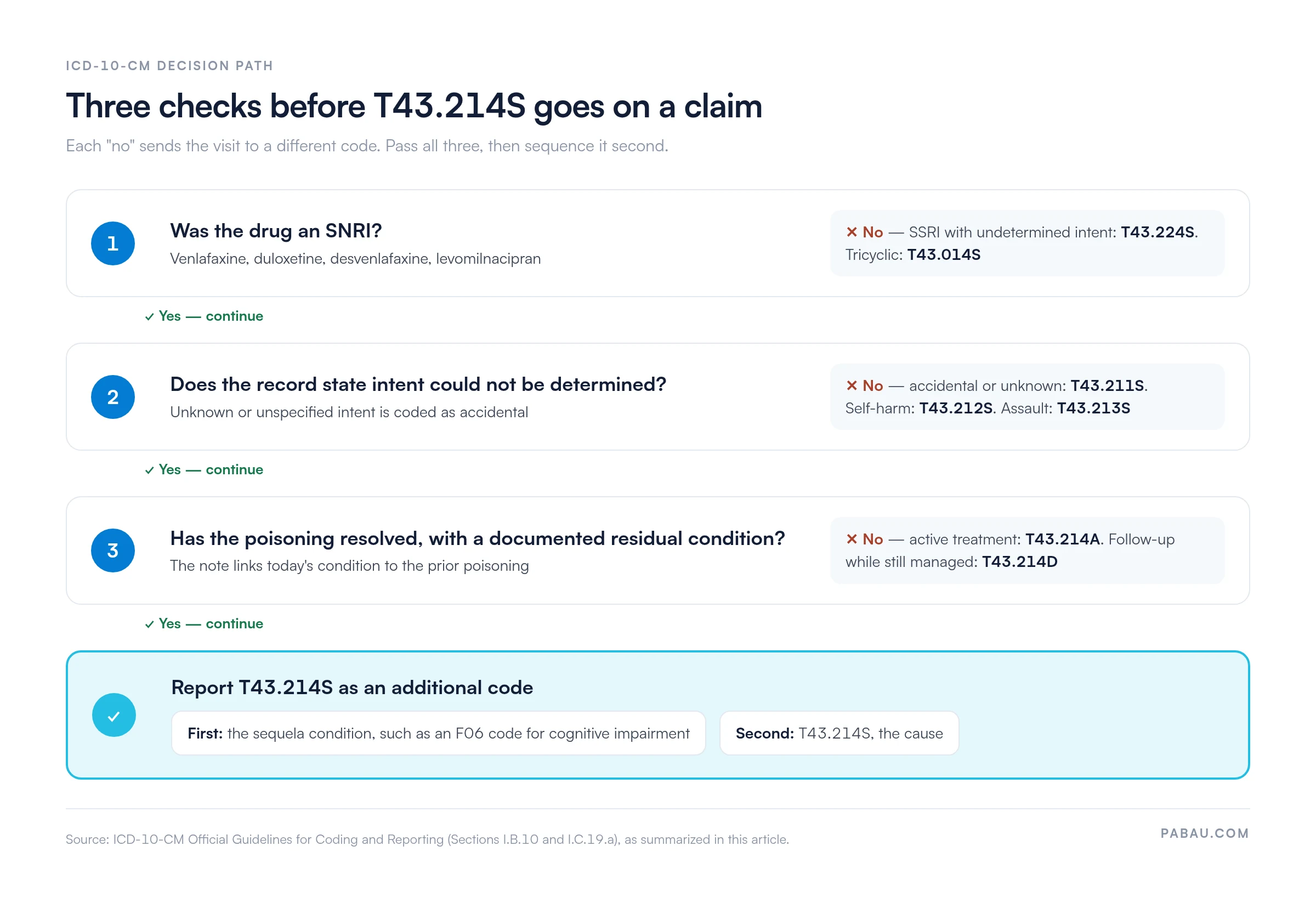
The T43.21- subcategory holds a code for each intent and encounter type of SNRI poisoning, plus adverse effect and underdosing. SSRI codes sit next door in T43.22-, which makes the two easy to mix up.
Payers expect the medical record to support T43.214S before they pay the claim. A missing element from the list below is a common reason these claims are denied. Claims management software keeps the note and the claim in one place, so coders can check the record before submission.
CMS guidelines require that diagnosis codes be supported by the provider’s documentation in the medical record. For sequela codes, auditors may ask for the prior encounter record itself, not only a reference to it.
T43.214S claims are often denied because the sequencing rule runs against the habit of listing the main diagnosis first. Each reason below traces back to one step in coding or documentation, and that step is where denial management workflows should catch it. The table below maps each common denial reason to a prevention step.
For practices with high volumes of psychiatric and toxicology claims, submitting a clean claim means catching these issues before they reach the payer. A pre-submission check that flags T43.214S with no sequela condition code above it removes a common cause of denial in this category.
Run a monthly remittance report filtered on T43.214 denials. Sort them into three buckets: wrong character, sequencing error, and missing documentation. Each bucket needs a different fix, so one mixed queue sends the wrong correction to the wrong problem.
Coding T43.214S correctly depends on the record. The coder needs the original poisoning, its documented intent, and the stated link to today’s condition. When notes and claims live in separate systems, those details get lost between the visit and the claim.
Pabau’s practice software keeps clinical notes and billing in one patient record. Claims go out electronically through the Claim.MD integration, which every subscription includes. Your coders can review the sequela documentation and the code order in one place before the claim leaves the practice.

Pabau keeps clinical notes and billing together and sends claims electronically through Claim.MD, included in every subscription. Your team can check sequela documentation and code order before each claim goes out.

T43.214S is narrow by design. It fits one drug class (SNRIs), one intent (undetermined), and one encounter type (sequela). A case that misses any of the three needs a different code, such as T43.224S for an SSRI or T43.211S for unspecified intent.
Before you assign it, confirm the drug class and read how the original record describes intent. Then check that today’s note states the link to the prior poisoning and that the sequela condition is coded first. With those steps in place, the claim holds up when a payer asks for the records.
Pabau supports the wider revenue cycle management workflow by keeping notes and claims together. Book a demo to see how it helps your team submit accurate psychiatric and toxicology claims.

Need to understand how clearinghouse claims validation works? Our Claim.MD clearinghouse guide covers how electronic claim routing catches coding errors before payer submission.
Seeing repeated claim denials without a clear pattern? Denial codes in medical billing breaks down the most common CARC denial codes and what each one requires to resolve.
Want to understand eligibility verification before billing sequela claims? Insurance eligibility verification explains how to confirm payer acceptance of diagnosis codes before the encounter ends.
ICD-10 code T43.214S is the billable code for poisoning by selective serotonin and norepinephrine reuptake inhibitors, undetermined, sequela. It applies when a patient presents with a residual condition caused by a prior SNRI poisoning of undetermined intent. The ‘S’ 7th character marks a sequela (late effect) encounter, not an active poisoning visit.
No. T43.214S covers SNRIs only, such as venlafaxine, duloxetine, desvenlafaxine, and levomilnacipran. Sequela of SSRI poisoning, such as sertraline or fluoxetine, is coded from T43.22-. With undetermined intent, that code is T43.224S.
T43.214A applies during initial treatment of the SNRI poisoning. T43.214D applies at follow-up visits while the poisoning is still being actively managed. T43.214S applies only after the poisoning has resolved and the patient presents with a residual condition caused by it. Only one of the three is reported at any single encounter.
Use a sequela code once the poisoning itself has fully resolved and the current visit is for a residual condition traceable to it. If the patient is still receiving treatment for the original poisoning, use the ‘A’ or ‘D’ encounter character instead. The clinical record should document that the poisoning is resolved before ‘S’ is assigned.
Poisoning occurs when a drug is taken incorrectly, such as the wrong dose, the wrong drug, the wrong person, or a harmful combination. An adverse effect occurs when a drug is taken exactly as prescribed and still causes a harmful reaction. For SNRIs, poisoning codes run from T43.211- to T43.214-, and adverse effects use T43.215-. Code the manifestation of an adverse effect first.
Yes. T43.214S is never the sole or primary code on a claim. The specific sequela condition (such as a cognitive disorder, mood disturbance, or neurological deficit) must be coded first. T43.214S is then listed as an additional code identifying the causal event. A claim with T43.214S as the only or first-listed code will typically be denied for a sequencing error.
The most common causes are sequencing and character errors. T43.214S is listed first instead of the sequela condition, or the 7th character is A or D in place of ‘S’. Claims are also denied when the code doesn’t match the drug class or the documented intent. Missing documentation linking the current condition to the prior poisoning causes more denials. The sequela condition code may also be missing from the Local Coverage Determination for the billed service.