

ICD-10 code S61.201A: Open wound of left index finger without nail damage
ICD-10 code S61.201A covers a left index finger wound of unstated type ICD-10 co...

Last Updated: Oct 16, 2026
Billable Code Specific Code
ICD-10 code T32.20 is the billable ICD-10-CM code for corrosions involving 20-29% of body surface with 0% to 9% third degree corrosion. It records how much of the body a chemical injury covers. Separate site codes record where it happened.
The figure that decides the claim is the third-degree share, measured against the whole body. Under 10% is T32.20. A chart showing 10-19% or 20-29% full-thickness corrosion needs T32.21 or T32.22. A wrong tier leaves the claim open to denial. So the coder's first job is finding that figure. After that comes sequencing T32.20 behind the toxic effect and site codes.
Let Pabau's smart automation suggest the right codes, reduce claim denials, and keep your practice compliant—effortlessly.
Automate repetitive tasks and focus on what matters most—your patients.
Reduce coding errors and ensure compliance with the latest regulations.
Clean claims, fewer denials, and faster reimbursements.
Powerful insights and reporting to help your practice thrive.
HIPAA compliant SOC 2 certified GDPR-compliant Trusted by 4,000+ clinics worldwide

T32.20 codes corrosions, meaning chemical injuries, that cover 20-29% of total body surface with under 10% at third degree.
The documented third-degree share sets the tier. Under 10% is T32.20, 10-19% is T32.21, and 20-29% is T32.22.
Measure both figures against the whole body, using the Rule of Nines for adults or the Lund-Browder chart for children.
When the record names a site, list the T51-T65 toxic effect code first, then the T20-T25 site codes, then T32.20.
A note with a total but no third-degree figure needs a provider query before anyone codes it.
ICD-10 code T32.20 is a valid, billable ICD-10-CM code for corrosions involving 20-29% of body surface with 0% to 9% third degree corrosion. The CDC/NCHS ICD-10-CM web tool lists it as active for FY2026.
The code carries two numbers, and both are measured against the patient’s total body surface. The first is the total extent of corrosion, 20-29%. The second is the share of the body corroded to full thickness, 0% to 9%. Any other third-degree figure moves the claim to a sibling code.
T32.20 sits in Chapter 19 of ICD-10-CM, inside block T30-T32. That block covers burns and corrosions of multiple and unspecified body regions. Category T32 sorts corrosions by extent, and subcategory T32.2 holds every 20-29% case.
Read the code from left to right. The fourth character sets the total-extent band. The fifth character carries the third-degree tier, and the code ends there.
Category T32 also carries its own instruction in the Tabular List. It’s the primary code only when the site of the corrosion is unspecified. When the record names a site, T32 may be used as a supplementary code with categories T20-T25.
Those site categories hold burns and corrosions together. Corrosion codes use fourth-character values 4 to 7, for unspecified, first, second, and third degree. For example, T23.6- is corrosion of second degree of wrist and hand.
Subcategory T32.2 splits into three codes, and the third-degree share is the only detail that separates them. So the coder’s job is to find that figure in the chart and match it to a tier.
The same pattern repeats across category T32. T32.10 covers a 10-19% total with 0% to 9% third degree. The 30-39% band splits four ways, from T32.30 (0% to 9% third degree) to T32.33 (30-39%). Wider extents add tiers, so the 40-49% group runs from T32.40 through T32.44.
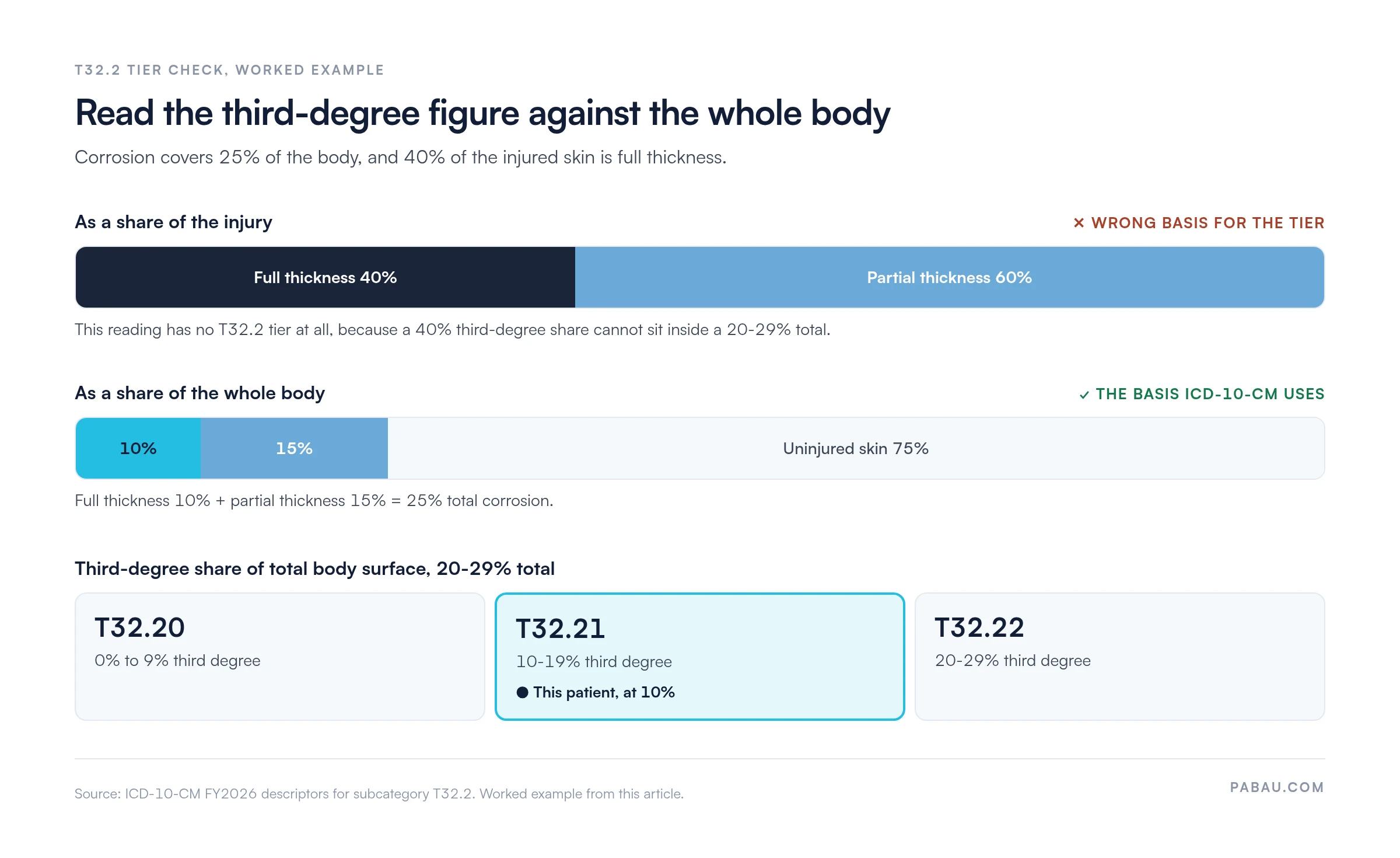
Always measure the third-degree figure against the whole body, never against the corroded area.
Take a patient with 25% total corrosion, where 40% of the injured skin is full thickness. That works out to 10% of the whole body, as the diagram below shows. So the chart supports T32.21, not T32.20.
Now and then, a note gives a total but no third-degree figure. The coder can’t pick a tier from that. Query the provider for the full-thickness percentage rather than reporting T32.20 by default.
In ICD-10-CM, a corrosion is an injury caused by a chemical, such as an acid, an alkali, or another caustic substance.
A burn comes from thermal energy, such as heat, electricity, radiation, or sunlight. Each mechanism has its own codes, so a mix-up sends the claim to the wrong code family.
Clinicians often write “chemical burn” at the bedside. That wording is fine clinically, but the coder translates it to corrosion and picks from T32, not T31. A thermal burn of the same extent and depth takes T31.20 instead.
The CMS ICD-10 codes page hosts the current code files and guidelines for both families.
Both percentages in T32.20 are clinical measurements. The provider records them, and the coder can’t report the code without them. Two assessment tools are in standard use.
The Rule of Nines divides the adult body into regions worth 9% or multiples of 9%. The head and neck count as 9%, each arm 9%, and each leg 18%. The front and back of the trunk count 18% each, and the genitalia 1%.
So a corrosion covering the whole front of the trunk plus one arm totals about 27%. That lands in subcategory T32.2, and the final code still depends on the third-degree share.
The provider documents the calculation along with the result. A note reading “approximately 25% BSA” with no body diagram or regional breakdown isn’t enough for some payers. The chart entry should show each affected region, its percentage, and its depth.
The Lund-Browder chart adjusts percentages for age, which makes it the preferred tool in pediatric burn care. A child’s head takes up more body surface than an adult’s. As a result, the Rule of Nines underestimates a child’s head involvement and overestimates leg involvement.
That correction matters near the 20% and 30% thresholds. A few points either way can move the case into T32.1 (10-19%) or T32.3 (30-39%). It can also push the third-degree share across a tier line.
Either tool gives a defensible figure when the completed chart sits in the medical record. A verbal summary without the calculation behind it raises audit risk. With a digital patient record, the completed chart can be attached to the encounter as a document.
Run through this list before the claim goes out. A payer reviewing the claim will look for each item in the record, so it needs to be there first.
On most claims, T32.20 isn’t the first code. The T32 Tabular List note makes it primary only when the corrosion site is unspecified. When the record names a site, T32.20 follows the site codes as a supplementary code.
A claim for a chemical injury with a named site usually runs in this order:
In outpatient coding, the first-listed diagnosis is the condition chiefly responsible for the visit. Take wound care for a chemical corrosion to the hand. The toxic effect code comes first under its code-first instruction. A site code such as T23.6- comes next, then T32.20 for extent.
The AAPC ICD-10-CM lookup lists the full set of corrosion site codes. All of these codes can appear on the same professional claim.
On the inpatient side, Uniform Hospital Discharge Data Set (UHDDS) rules select the principal diagnosis. The code-first instruction on the T20-T25 corrosion codes still applies. So the toxic effect code leads an admission with a documented site.
T32.20 moves up the claim only when the record names no site. At 20-29% of body surface, the extent code also signals severity. Injuries this size often need fluid resuscitation, intensive care, or surgical debridement.
Before you finalize an inpatient corrosion claim, open the admission note. Check that it gives both the total BSA and the third-degree share of the whole body. If either figure is missing, query the attending before coding. A wound photo or a nursing note can’t stand in for it.
From exam room to payment, a corrosion claim follows the same path each time. Each step is a chance to catch a tier error before the payer does.
Tier errors usually start in the first two steps. Either a figure is missing, or someone reads it against the injured area instead of the whole body.
T32.20 denials tend to trace back to one of seven errors. The table pairs each one with its root cause, which speeds up review. When a claim comes back, the payer’s denial codes point you to the matching row.
CMS doesn’t publish a coverage policy specific to T32.20. Wound care and burn treatment coverage sits in MAC-level policies, which vary by region. Still, most payers raise the same four questions.
Will the payer ask for records? Often, on high-cost injury claims. The BSA calculation, the third-degree share, and the chemical agent should be in the record before submission. Rebuilding them after a denial is much harder to defend.
Does the code affect inpatient payment? Yes. Corrosion codes feed MS-DRG assignment as principal or secondary diagnoses. The MS-DRG v43 burn groups are 927, 928, 929, 933, 934, and 935.
Where does T32.20 go on an outpatient wound care claim? After the site codes, as a supplementary code. Listing extent ahead of a documented site conflicts with the T32 Tabular List note.
Do payers expect a toxic effect code? Yes. They look for a T51-T65 code for the chemical and intent alongside T32.20. Some wound care prior authorizations ask for it before they approve treatment.
Coders working with T32.20 need three sets of neighbors. They’re the T32 extent family, the T20-T25 corrosion site codes, and the T51-T65 toxic effect codes. The ICD List lookup tool shows the full T32 family.
Corrosion claims break down when the BSA chart, the tier, and the claim form live in separate systems. A coder reading a scanned body chart in one place and keying codes in another can easily report the wrong tier.
Pabau keeps the patient record and the claim in one place. Its claims management software pre-fills the claim from the record and includes full ICD-10-CM code lookup. Coders find the right T32.2 code without leaving the claim. It also checks that required claim fields are complete before the claim can go out.
US practices submit through the Claim.MD clearinghouse integration. It adds real-time eligibility checks, claim status tracking, and electronic remittance posting. The coder still reads the tier from the chart, but that chart now sits in the same record as the claim.

Pabau pre-fills claims from the patient record, offers full ICD-10-CM code lookup, and checks required claim fields before submission. US practices add Claim.MD eligibility checks and remittance posting.

T32.20 comes down to two numbers in the chart, and both are read against the whole body. A 20-29% total with under 10% third degree is T32.20. A higher third-degree share points to T32.21 or T32.22.
So when a note gives a total with no third-degree figure, stop and query the provider. A tier guessed at the desk won’t hold up in an audit. Once the figures are in, sequence the toxic effect code first, then the site codes, then T32.20.
Does your team still switch between a scanned chart and a separate billing screen? That handoff is the step to fix first. Book a demo to see how Pabau keeps burn documentation and the claim in one record.

Need to understand how claim denials are managed at scale? Denial management in healthcare covers root-cause analysis frameworks and the workflow steps that reduce repeat denials.
Want to see how electronic claim submission works end to end? The 837 file guide explains the EDI transaction set used to transmit ICD-10-CM diagnosis codes to payers.
Tracking eligibility before submitting corrosion claims? Insurance eligibility verification explains how real-time checks reduce claim rejections before adjudication.
Getting ready for a payer records request? Medical billing compliance covers record retention, audit response, and payer policy tracking.
Third degree means full-thickness involvement, the deepest of the three depths ICD-10-CM recognizes. First degree is erythema and second degree is blistering. Code the depth from the provider’s documentation, and query when the note gives none.
Not always. The guidelines call an extent code advisable when extent data is needed, such as for burn-unit mortality data. They also advise one when third-degree involvement reaches 20% or more, which points to T32.22.
The X is a placeholder that keeps the fifth position filled. The 1 in the sixth position means accidental intent, and the final A marks the initial encounter. Later visits for the same injury take D, and sequela takes S.
No. T32.20 belongs to ICD-10-CM, the US clinical modification. UK coders use the WHO’s ICD-10, which stops at T32.2 and has no third-degree tier.
Yes, but only when the record doesn’t specify the corrosion site. When it does, the toxic effect code leads, the T20-T25 site codes follow, and T32.20 comes after them.



