ICD-10 code S61.201A: Open wound of left index finger without nail damage
ICD-10 code S61.201A covers a left index finger wound of unstated type ICD-10 co...

Last Updated: Oct 16, 2026
Billable Code Specific Code
T32.81 is the billable ICD-10-CM code for corrosions involving 80-89% of body surface with 10-19% third degree corrosion.
The second digit distinguishes it from sibling codes T32.80 and T32.82 through T32.89, each recording a different third degree severity band. T32 codes cover corrosions from chemical agents only; thermal burns of equal extent use T31 codes instead, and picking the wrong category is a common miscoding error.
Let Pabau's smart automation suggest the right codes, reduce claim denials, and keep your practice compliant—effortlessly.
Automate repetitive tasks and focus on what matters most—your patients.
Reduce coding errors and ensure compliance with the latest regulations.
Clean claims, fewer denials, and faster reimbursements.
Powerful insights and reporting to help your practice thrive.
HIPAA compliant SOC 2 certified GDPR-compliant Trusted by 4,000+ clinics worldwide

T32.81 is a billable ICD-10-CM code for corrosions covering 80-89% of body surface with 10-19% third degree damage.
The second digit (1) specifies that 10-19% of the involved surface carries third degree corrosion, a severity qualifier that drives reimbursement.
T32 codes cover corrosions from chemical agents only. Thermal burns of equal extent use T31 codes, and picking the wrong category is a common miscoding error.
T32.81 records the extent of injury, so it supports a site-specific corrosion code rather than replacing it.
Practice management software like Pabau supports ICD-10-CM claim submission, eligibility checks, and electronic remittance advice for these high-acuity codes.
ICD-10 Code T32.81 is the billable ICD-10-CM diagnosis code for corrosions involving 80-89% of total body surface area (TBSA) with 10-19% third degree corrosion. It became effective October 1, 2025 under the FY2026 ICD-10-CM edition.
The code sits within the T32 category, which classifies corrosions (chemical burns) by body surface extent. Coders assign it in severe inpatient admissions where a chemical agent has damaged nearly the whole body surface.
Coders in burn units, emergency departments, and plastic surgery practices meet T32.81 in unusually complex admissions. Assigning it correctly depends on the two-axis T32 matrix, TBSA calculation, external cause sequencing, and CMS Present on Admission rules.
ICD-10 Code T32.81 is a specific, billable diagnosis code valid for reimbursement under HIPAA-covered transactions in the United States. The CDC/NCHS ICD-10-CM web tool confirms its active status in the FY2026 edition, effective October 1, 2025. No more granular sub-code exists, so coders report it as the most specific level available for this presentation.
Because T32.81 is already the terminal code for this presentation, coders should not seek additional specificity. Whether it leads the claim or supports a site-specific corrosion code depends on the documentation, as the sequencing rules below explain.
Corrosions are chemical burns caused by a chemical agent rather than heat. The T32 coding system uses a two-digit matrix. The first digit represents total body surface involvement, and the second digit represents the share of that surface with third degree damage.
For T32.81, corrosive injury involves 80-89% of TBSA, and 10-19% of that surface carries third degree corrosion. Third degree corrosion destroys all layers of the dermis and can extend into subcutaneous tissue. Documenting both dimensions in the clinical record lets coders select the code without ambiguity.
Corrosions covering 80-89% of TBSA are life-threatening injuries requiring burn unit admission, fluid resuscitation, and often surgical intervention. The American Burn Association classifies any burn or corrosion above 20% TBSA as a major injury. At 80-89%, mortality risk is extreme.
Clinicians document TBSA percentages in the admission note, the operative record, or both. Coders derive the T32.81 assignment from that documentation, not from independent clinical assessment.
The T32 category classifies corrosions by the percentage of body surface area involved. Each parent code within T32 covers a 10-percentage-point band. The child codes add a second digit specifying what share of the involved surface carries third degree damage.
The ladder below holds the whole pattern in one view. The total stays at 80-89%, while the second digit moves the third degree band ten points at a time.
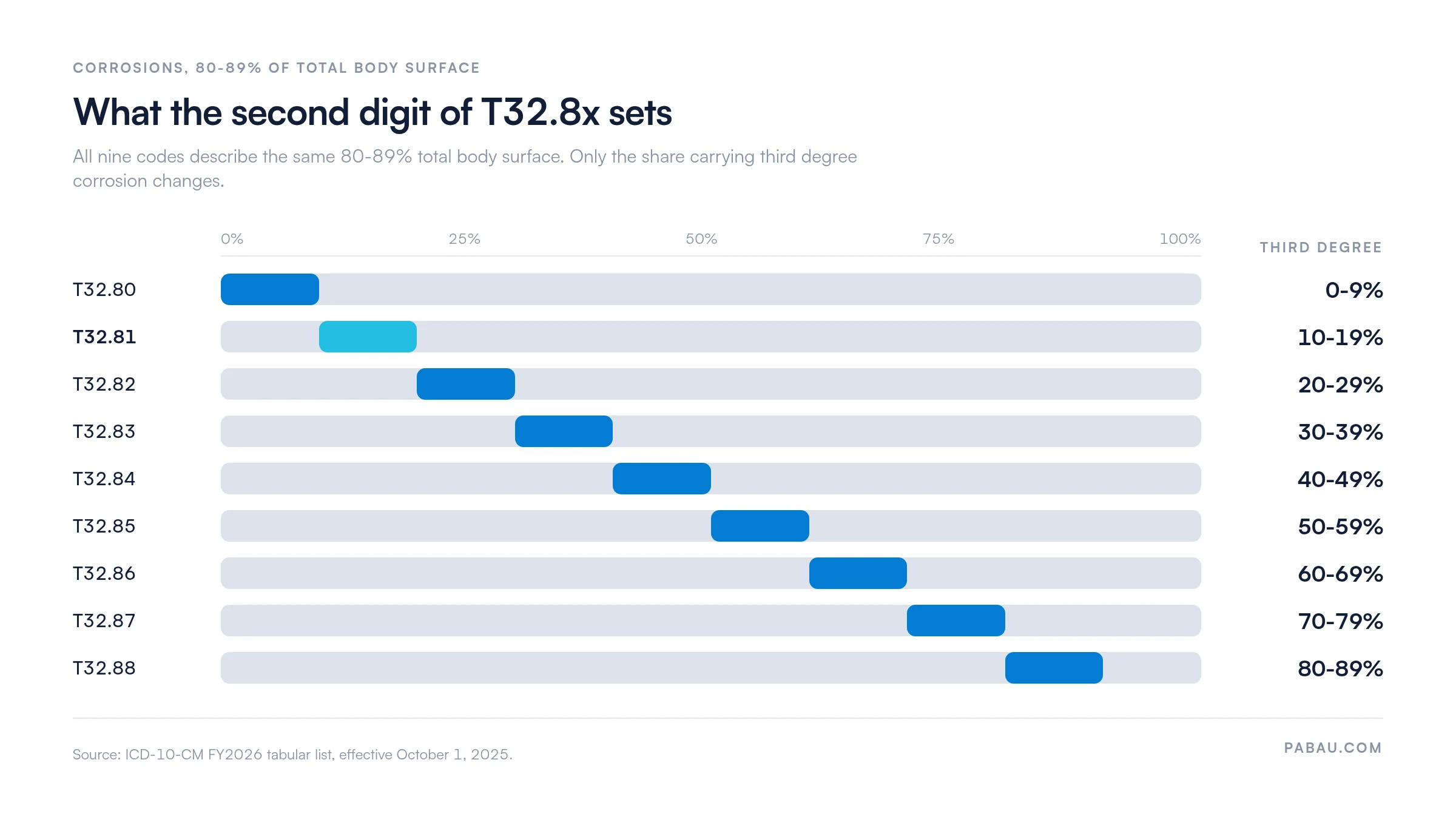
This matrix means coding T32.81 correctly takes two distinct pieces of clinical information. The physician’s documentation has to state the total TBSA percentage and the third degree TBSA percentage. Coders working from only one figure will land on the wrong code.
Total TBSA is the only figure separating T32.81 from the codes that share its 10-19% third degree band. With the same band and a documented total of 10-19%, the code becomes T32.11. Drop the third degree share below 10% on that same 10-19% total, and the chart codes to T32.10 instead.
T32 and T31 are parallel categories covering the same body surface area matrix, but they apply to different injury mechanisms. T31 codes apply to thermal burns from heat sources such as flame, hot liquids, steam, or contact with hot objects. T32 codes apply to corrosions caused by chemical agents.
Selecting the wrong category when the mechanism is documented affects reimbursement and clinical data accuracy. When the record names both a chemical agent and a heat source, query the physician before assigning either code. The thermal counterpart at this extent is T31.81, built on the same two-axis structure.
The Rule of Nines assigns a percentage of total body surface area to each major body region. Clinicians use it at admission to estimate TBSA involvement, and coders use the documented result to select the T32 code. Because T32.81 requires 80-89% involvement, that calculation is what confirms the code.
One combination that reaches the threshold is the anterior and posterior trunk (36%), both lower extremities (36%), and the head and neck (9%). That totals 81% of TBSA. The note must also show third degree involvement adding up to 10-19% of total TBSA. The coder assigns T32.81 from the physician’s documentation, never from an independent calculation.
The ICD-10-CM Official Guidelines for Coding and Reporting govern burn and corrosion coding. The Centers for Medicare and Medicaid Services co-maintains them with the CDC National Center for Health Statistics. The key rules for T32.81 are:
Following these rules reduces the risk of claim denials caused by incorrect code ordering or missing external cause documentation.
Before assigning T32.81, confirm that the physician documentation separately states both the total TBSA percentage (80-89%) and the third degree TBSA percentage (10-19%). A single combined description like ‘extensive full-thickness chemical burns’ is insufficient for code selection. Query the attending if either figure is missing.
CMS requires POA reporting for all diagnosis codes on inpatient claims from acute care hospitals. T32.81 is not on the CMS POA exempt list. Hospitals must assign a POA indicator alongside this code on the UB-04 claim form.
For T32.81 the POA indicator will almost always be “Y”, because the injury presents at the time of admission. POA applies to inpatient hospital stays and does not affect outpatient or physician office claims. Missing or incorrect POA indicators are a known source of inpatient denials for high-acuity injury codes.
Coders working with severe corrosion injuries meet several closely related codes. Knowing how each one relates to T32.81 prevents miscoding when documentation places the injury at a different TBSA level or third degree share.
Consult the AAPC ICD-10-CM code range to browse sibling codes within the T32.8x block. Checking adjacent descriptions matters when documentation places the patient near a threshold boundary. Our ICD-10 code library holds the rest of the T30-T32 entries in one place.
T32.81 applies to a narrow, severe clinical presentation. Coders meet it in specific acute care settings.
When coding a T32.81 admission involving industrial chemical exposure, always assign an external cause code. It has to identify the specific chemical agent and the intent, whether accidental, assault, or undetermined. Missing external cause codes are a known audit trigger for high-acuity corrosion claims and can delay reimbursement. Check the X46-X49 and X86-X89 ranges.
The ICD-10-CM alphabetic index maps several clinical terms to T32.81. Coders cross-referencing patient documentation against the index may meet the following expressions:
These terms all map to T32.81 in the ICD-10-CM index. When the clinical note uses alternate phrasing, trace the term through the alphabetic index rather than assigning the code by pattern recognition.
Claims carrying T32.81 are high-acuity inpatient submissions with long stays, complex surgical procedures, and multiple attending physicians. Accurate coding is only part of the job. The claim still has to reach the payer cleanly and come back with a traceable remittance.
Practice management software like Pabau connects the practice to electronic claims through Claim.MD, a clearinghouse serving more than 4,000 US payers. It supports CMS-1500 and 837P claim formats, real-time eligibility verification, and electronic remittance advice in 835 files. Denial reason codes come back in a standard format, so a T32.81 submission that stalls is visible the same day.
Chasing those appeals through a spreadsheet is where billing time disappears. Pabau’s claims management without spreadsheets covers secondary claims, corrected claims, and appeals with CARC denial tracking. That matters on T32.81 admissions, where a first submission can face medical necessity review.


Pabau connects your practice to 4,000+ US payers via Claim.MD, with real-time eligibility checks, 837P submissions, and ERA tracking built in. See how it fits your billing workflow.

Accurate assignment of ICD-10 Code T32.81 rests on two documented figures. The note has to record 80-89% total body surface corrosion and 10-19% third degree involvement within that surface. An error on either figure moves the claim to an adjacent code.
Sequencing carries the same weight. Pair T32.81 with the site-specific corrosion code and an external cause code, then set the POA indicator before the inpatient claim goes out. Query the attending rather than estimating a percentage that the record never stated.
For billing teams handling high-acuity inpatient codes, Pabau’s Claim.MD integration covers eligibility verification, 837P submission, and ERA tracking across 4,000+ US payers. Book a demo to see how a T32.81 claim moves from coding to remittance in one system.

Need guidance on clearinghouse claim submission? Medical claims clearinghouse explains how electronic claim routing works and what to check before submitting high-acuity codes.
Want to understand denial codes linked to ICD-10 submissions? Denial management in healthcare covers how to read CARC codes, identify root causes, and build an appeals workflow.
Looking for electronic remittance advice guidance? Electronic remittance advice walks through 835 file structure, ERA reconciliation, and how to match payments to claims automatically.
ICD-10 Code T32.81 is the billable ICD-10-CM diagnosis code for corrosions involving 80-89% of total body surface area with 10-19% third degree corrosion. It falls within the T32 category, which classifies chemical burn injuries by body surface extent and third degree depth. The code became effective October 1, 2025 under the FY2026 ICD-10-CM edition.
Yes, T32.81 is a billable and specific ICD-10-CM code that can be used directly on HIPAA-covered transactions without requiring a more granular sub-code. It is confirmed billable in the FY2026 edition, effective October 1, 2025, and does not require additional digits for specificity.
The Rule of Nines divides the adult body into regions by percentage of total body surface area. The shares are head and neck 9%, each arm 9%, anterior trunk 18%, posterior trunk 18%, each leg 18%, and perineum 1%. Clinicians add the percentages for each involved region to calculate total TBSA, then separately calculate the percentage carrying third degree damage. Coders use both figures from the physician’s documentation to select the matching T32 code.
ICD-10 Code T32.81 became effective October 1, 2025, as part of the FY2026 edition of ICD-10-CM. This is the edition currently valid for claims with dates of service on or after that date. Prior editions remain applicable for services rendered before October 1, 2025.