ICD-10 code S61.201A: Open wound of left index finger without nail damage
ICD-10 code S61.201A covers a left index finger wound of unstated type ICD-10 co...

Last Updated: Oct 16, 2026
Billable Code Specific Code
T32.11 is the billable ICD-10-CM code for corrosions involving 10-19% of body surface with 10-19% third degree corrosion. A corrosion is a chemical injury, so this code never applies to a thermal burn.
The code reports extent only. It follows a site-specific corrosion code that names the injured region, and the chart has to document both percentages separately.
Let Pabau's smart automation suggest the right codes, reduce claim denials, and keep your practice compliant—effortlessly.
Automate repetitive tasks and focus on what matters most—your patients.
Reduce coding errors and ensure compliance with the latest regulations.
Clean claims, fewer denials, and faster reimbursements.
Powerful insights and reporting to help your practice thrive.
HIPAA compliant SOC 2 certified GDPR-compliant Trusted by 4,000+ clinics worldwide

T32.11 classifies a chemical corrosion covering 10-19% of body surface, with 10-19% of it at third degree.
The chart needs two percentages, the total corrosion area and the third-degree area, each attested by the treating clinician.
T32.11 reports extent only, so it follows a site-specific corrosion code from T20-T25, or from T26-T28 for eye and internal organ sites.
T20-T25 and T26-T28 are split by anatomic site rather than by agent, and every category in both ranges carries burn and corrosion subcodes.
Pabau, our practice management software, checks that insurer details such as membership and authorization numbers are complete before a claim goes out.
ICD-10 code T32.11 reports a chemical corrosion that covers 10-19% of total body surface area. Within that total, 10-19% of the body surface has to be documented at third degree.
Third degree means full-thickness destruction, not a partial-thickness injury. The code sits in category T32, which the CMS ICD-10-CM code set uses to classify corrosions by extent.
That second percentage is the whole difference between T32.11 and T32.10. T32.10 carries the same 10-19% total range, but with 0% to 9% third degree corrosion. So a third-degree percentage has to appear in the record before T32.11 is on the table.
Check the code against the CDC ICD-10-CM web tool at the start of each fiscal year, since annual updates can change validity.
Corrosion means tissue damage caused by a chemical agent. A burn comes from heat, radiation, electricity, or friction. ICD-10-CM records that difference inside the code, but the split sits further down the tree than the range headings suggest.
The site-specific ranges divide by anatomy, not by agent. T20-T25 covers burns and corrosions of the external body surface, specified by site. T26-T28 covers burns and corrosions confined to the eye and internal organs. Both ranges hold burn codes and corrosion codes together.
The agent decides the subcode one level down. T20, burn and corrosion of head, face, and neck, runs T20.0 through T20.3 for burn degrees and T20.4 through T20.7 for corrosion degrees. T21 through T28 repeat that pattern. So the agent tells you which subcode to pick, not which category to open.
Extent is the one place where agent type separates whole categories. T31 classifies burn extent of body surface, and T32 classifies corrosion extent. Coding a chemical injury to T31 is a structural error that payer edits will catch.
Clinical notes say “chemical burn” constantly, and ICD-10-CM still classifies those injuries as corrosions. When the chart reads “chemical burn from industrial solvent,” the extent code is T32, not T31.
The site code is the corrosion subcode for whichever region was injured. Confirm the agent in the physician attestation before you pick either one.
Choosing between T32.11 and T32.10 means calculating two separate TBSA figures. One is the total corrosion involvement, the other is the third-degree share. Both numbers belong in the documentation.
The Rule of Nines is still the standard estimation method for adults. Each body region carries a set percentage of total surface area:
Children are the exception. The Rule of Nines underestimates head surface area in pediatric patients and overestimates leg area. The Lund-Browder chart, with its age-specific adjustments, is the better tool there. Record which method the clinician used, because the two can produce different percentages on the same injury.
From there, two thresholds settle the code. Total corrosion area has to fall between 10% and 19% of TBSA. At least 10% of TBSA has to carry confirmed third-degree depth.
When depth is missing from the note, or described only as partial thickness, the coder queries the clinician instead of assuming. A standing query workflow between coders and clinicians turns that into a same-day answer rather than a rework cycle.
Both codes describe a corrosion covering 10-19% of body surface. T32.10 is the version with 0% to 9% third degree corrosion, which includes a chart that documents no third-degree involvement at all. T32.11 takes over once the record confirms 10-19% third-degree depth.
Two charts make the rule concrete. “15% TBSA chemical corrosion, approximately 12% full-thickness” supports T32.11. “15% TBSA chemical corrosion, depth not assessed” does not, so query the clinician before you move off T32.10. Upcoding on an unassessed depth is a compliance risk, and it is the kind of pattern an auditor finds quickly.
T32 is built as a grid. The first digit after the decimal sets the total TBSA band, and the second sets the third-degree band inside it. Reading the neighbors prevents both undercoding and overcoding when a measurement lands near a boundary.
The pattern keeps climbing on the same logic, so a 35% corrosion with the same depth band lands on T32.31. The AAPC ICD-10-CM code lookup carries the full hierarchy with its instructional notes.
Cross-reference the current-year tabular list whenever a measurement sits near a boundary, since a documented 19.5% rounds into T32.2x territory.
T32.11 is an extent code, not a site code. The ICD-10-CM tabular note under T32 allows the category as a primary code only when the corrosion site is unspecified. Where the site is documented, T32.11 becomes a supplementary code behind a site-specific corrosion code.
That site code comes from the range matching the anatomy, not the agent. A TBSA-scored injury almost always sits in T20-T25, the external body surface range. T26-T28 applies only where the corrosion stays inside the eye, the respiratory tract, or another internal organ. Those sites are not normally scored by total body surface area.
Inside whichever category matches the site, pick the corrosion subcode rather than the burn subcode. When more than one region is involved, the ICD-10-CM Official Guidelines put the highest-degree corrosion site code first, with T32.11 reported after it. A missing site code is the single most common reason these claims come back.
Take a corrosion on the right elbow. The site code there is T22.721S, a third-degree corrosion of the elbow, with the seventh character S marking a sequela.
Laid out end to end, a corrosion encounter carries four groups of codes in a fixed order:
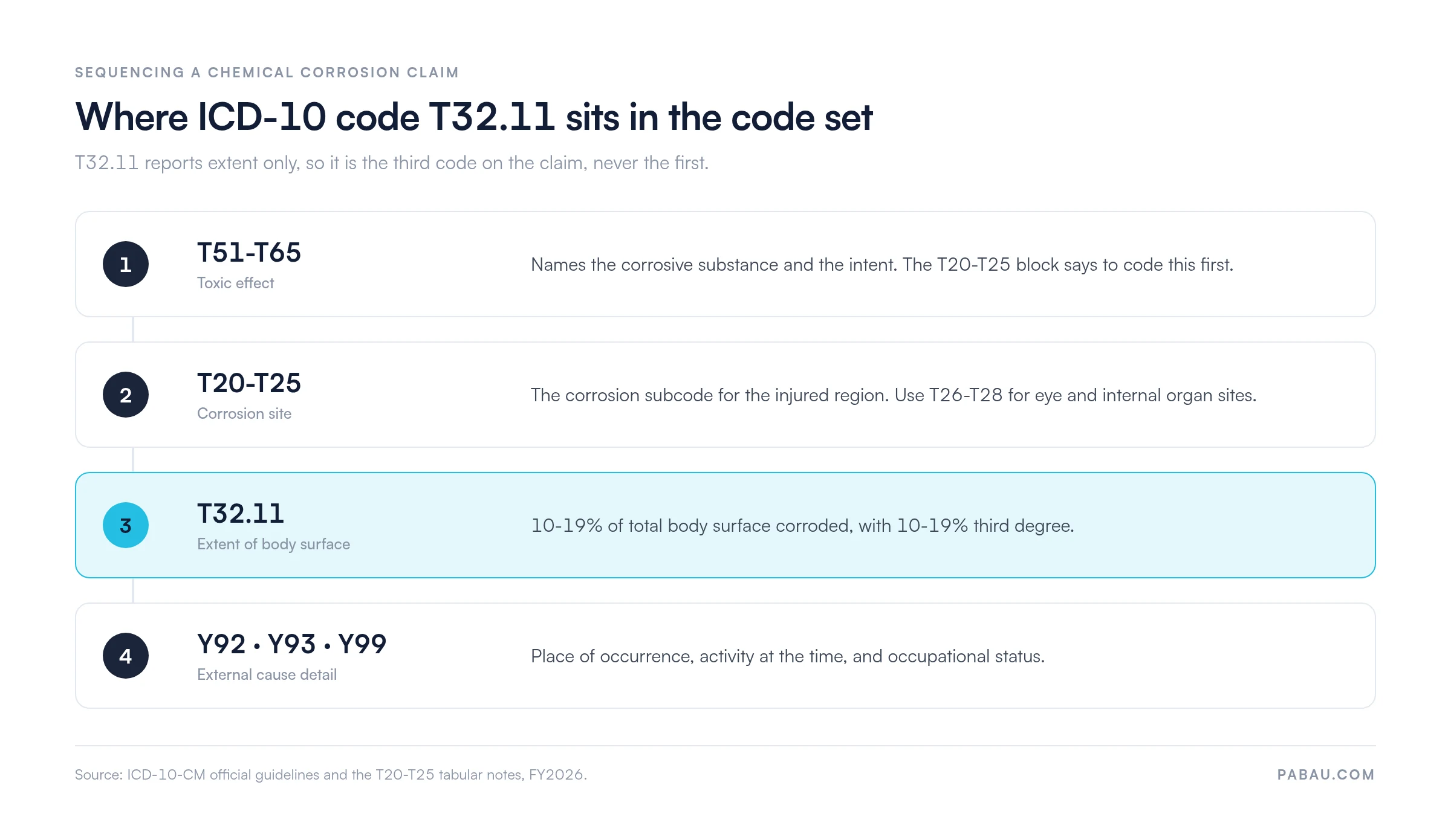
The T20-T25 block carries its own instruction to add a code from T31 or T32 for the extent of body surface involved. That note is what puts T32.11 on the claim in the first place. Beyond the site code, the guidelines ask for:
Submitting T32.11 without that companion set is a familiar denial pattern. Many payers treat the chemical agent and external cause codes as required companions on corrosion claims, not optional extras.
Every element of T32.11 needs a matching entry in the clinical record. Any one of them missing is enough for a denial or an audit recoupment, so treat the list below as mandatory rather than advisory.
Nursing notes are the usual trap here. When a TBSA figure appears only in an ancillary note, query the clinician before coding, because auditors routinely deny claims built on unattested percentages.
Build a documentation query template just for corrosion encounters. Have it prompt the clinician for four things: the corrosive agent name, total TBSA percentage, third-degree TBSA percentage, and body regions by depth. One query sent before discharge beats a post-denial appeal. It also settles the T32.10 against T32.11 decision while the patient is still in front of someone.
Denials on this code follow a short list of patterns, and each one has a specific fix. Sorting them by cause beats working the queue claim by claim. It also shows which ones need a process change rather than an appeal.
When a denial does come back, the remittance advice is where the diagnosis starts. Its denial codes name the element that failed, which keeps the appeal narrow instead of speculative.
A clearinghouse edit catches format and eligibility problems on the way out, but it cannot tell you that a site code is missing. That one only comes off the chart.
Four questions catch most of the patterns above in under a minute:
A no to any of them is cheaper to fix now than after the remittance arrives.
Corrosions at 10% of TBSA or more often meet inpatient admission criteria, which moves the billing context from outpatient CPT codes to DRG assignment. In an inpatient stay, T32.11 feeds the principal diagnosis grouping and affects the MS-DRG weight, so it has a direct line to reimbursement.
Outpatient wound care visits carrying T32.11 as a secondary code are judged against the wound management LCD for that MAC jurisdiction.
Medicare has no single national coverage determination for burn and corrosion wound care. Coverage is set at the MAC level through Local Coverage Determinations.
Commercial payers frequently want pre-authorization for surgical wound care such as debridement or skin grafting when T32.11 appears, given the extent it signals. Those requirements vary by payer and plan, so verify before any elective procedure.
Medicaid adds another layer, since coverage for extensive corrosion management varies by state. Some state programs set their own TBSA thresholds for inpatient against outpatient management.
Whatever the payer decides, record the authorization number on the encounter as soon as it comes through. The claim then leaves with complete insurer details rather than a blank field.

One more habit worth building on long wound care courses. Rebuild the code set at each encounter rather than copying the last one forward. Documented TBSA and depth shift as wounds are debrided and reassessed. The coded site and extent have to follow the current record, not the admission note.
The failures that cost money happen long before the claim form. A TBSA figure sits in a nursing note instead of the clinician’s attestation. A site-specific corrosion code never reaches the encounter alongside the extent code. By the time the remittance lands, the practice is reworking something it could have caught in minutes.
Pabau, our practice management software, keeps the clinical record and the billing record in one system. Coded diagnoses are built from the same notes the clinician wrote.
Charting templates can prompt for what a corrosion encounter needs, including the corrosive agent, the total TBSA figure, and depth by region. Staff never re-key details from one system into another, which is where they usually go missing.
From there, claims go out through Pabau’s claims management software. It checks the insurer details a payer needs, such as the membership number and the authorization code, before submission.
Each claim and its remittance then sit in one queue. Coding judgment stays with your coders, and the administrative slips stop costing you a resubmission.

Pabau keeps charting and billing in one record and checks insurer details, such as membership and authorization numbers, before a claim is submitted. Book a demo to see how that cuts rework on multi-code injury encounters.

T32.11 has narrow criteria and very little room to interpret them. The injury has to be chemical, the corrosion has to cover 10-19% of body surface, and 10-19% of that surface has to be third degree. Get any of those three wrong and the claim is wrong, whatever else is on it.
Almost every denial pattern here resolves the same way. Either a documented detail never reached the code set, or the sequencing rule was skipped. Both are upstream problems, which is good news. A query template and a short pre-submission check will move your denial rate further than any appeal process.
If chasing those details across two systems is what slows your team down, that part is fixable too. Book a demo to see how Pabau keeps the note, the code set, and the claim in one place.

Need to understand denial patterns across injury codes? Denial management in healthcare covers workflows for tracking, appealing, and preventing recurring claim rejections.
Want to tighten the documentation process before coding? Medical billing compliance requirements explains what clinical records must contain to survive payer audits.
Coding a corrosion one severity tier up? ICD-10 code T32.31 covers 30-39% of body surface with the same 10-19% third-degree band.
Looking at the top of the T32 ladder? ICD-10 code T32.90 reports corrosions involving 90% or more of body surface.
Comparing clearinghouses for corrosion and burn claims? Claim.MD vs Office Ally compares two major clearinghouses on payer reach, edit depth, and remittance handling.
No. T32 codes are complete at five characters and take no seventh character extension. The seventh character belongs on the site-specific corrosion code from T20-T25, where A marks the initial encounter, D a subsequent encounter, and S a sequela. Applying one to T32.11 makes the code invalid.
The first digit sets the total TBSA band and the second sets the third-degree band inside it. In T32.11, the first 1 means 10-19% of body surface, and the second 1 means 10-19% third degree. Reading the pair tells you the code without a lookup.
None. Modifiers attach to CPT and HCPCS procedure codes, never to an ICD-10-CM diagnosis code. What a corrosion claim needs instead is the right companion diagnosis codes and the right sequence.
The percentages are identical and the agent is not. T31.11 reports a thermal burn over 10-19% of body surface with 10-19% third degree, and T32.11 reports the same extent for a chemical corrosion. Pick the category from the agent named in the chart.