ICD-10 Code Y76.0: Diagnostic obstetric and gynecological devices
ICD-10 Code Y76.0: Definition and billable status ICD-10 Code Y76.0 is a valid, ...

Last Updated: Oct 23, 2026
Billable Code Specific Code
T32.10 is the billable ICD-10-CM code for corrosions involving 10-19% of body surface with 0% to 9% third degree corrosion. It is a complete five-character code for chemical injuries only. When the corrosion site is documented, T32.10 is reported after the site-specific codes from T20-T25.
The third-degree share decides the code within this band. A documented third-degree area under 10% of body surface supports T32.10, while 10-19% supports T32.11. Claims stall most often when the clinician estimates the TBSA but never writes the percentage into the record.
Let Pabau's smart automation suggest the right codes, reduce claim denials, and keep your practice compliant—effortlessly.
Automate repetitive tasks and focus on what matters most—your patients.
Reduce coding errors and ensure compliance with the latest regulations.
Clean claims, fewer denials, and faster reimbursements.
Powerful insights and reporting to help your practice thrive.
HIPAA compliant SOC 2 certified GDPR-compliant Trusted by 4,000+ clinics worldwide

T32.10 is a billable ICD-10-CM code for corrosion involving 10-19% of body surface, with 0% to 9% of the body surface at third-degree depth. Its parent T32.1 is not billable.
T32.10 is sequenced first only when the corrosion site is unspecified. Otherwise it follows the site-specific corrosion codes from T20-T25.
The third-degree share decides the code. Under 10% of body surface, including 1-9%, codes to T32.10, while 10-19% codes to T32.11.
Unspecified depth is not a reason to default to T32.10. The third-degree percentage is a clinician documentation call, not a coder inference.
Pabau’s claims management software checks corrosion codes against its ICD-10 catalog and tracks electronic remittances through Claim.MD.
ICD-10 Code T32.10 is the billable code for corrosion of 10-19% of body surface, with 0% to 9% of the body surface involving third-degree corrosion.
The code is valid for the current fiscal year and is reportable on both inpatient and outpatient claims. It sits in Chapter 19 of the ICD-10-CM code set, inside the T32 block for corrosions classified by extent of body surface.
A corrosion is a tissue injury caused by a chemical, caustic, or corrosive substance. A burn is caused by heat, flame, radiation, or electricity. ICD-10-CM codes them in separate blocks: T31 for thermal burns by TBSA, T32 for corrosions by TBSA. Submitting T31.10 for a chemical injury is a block-level coding error that will generate a denial.
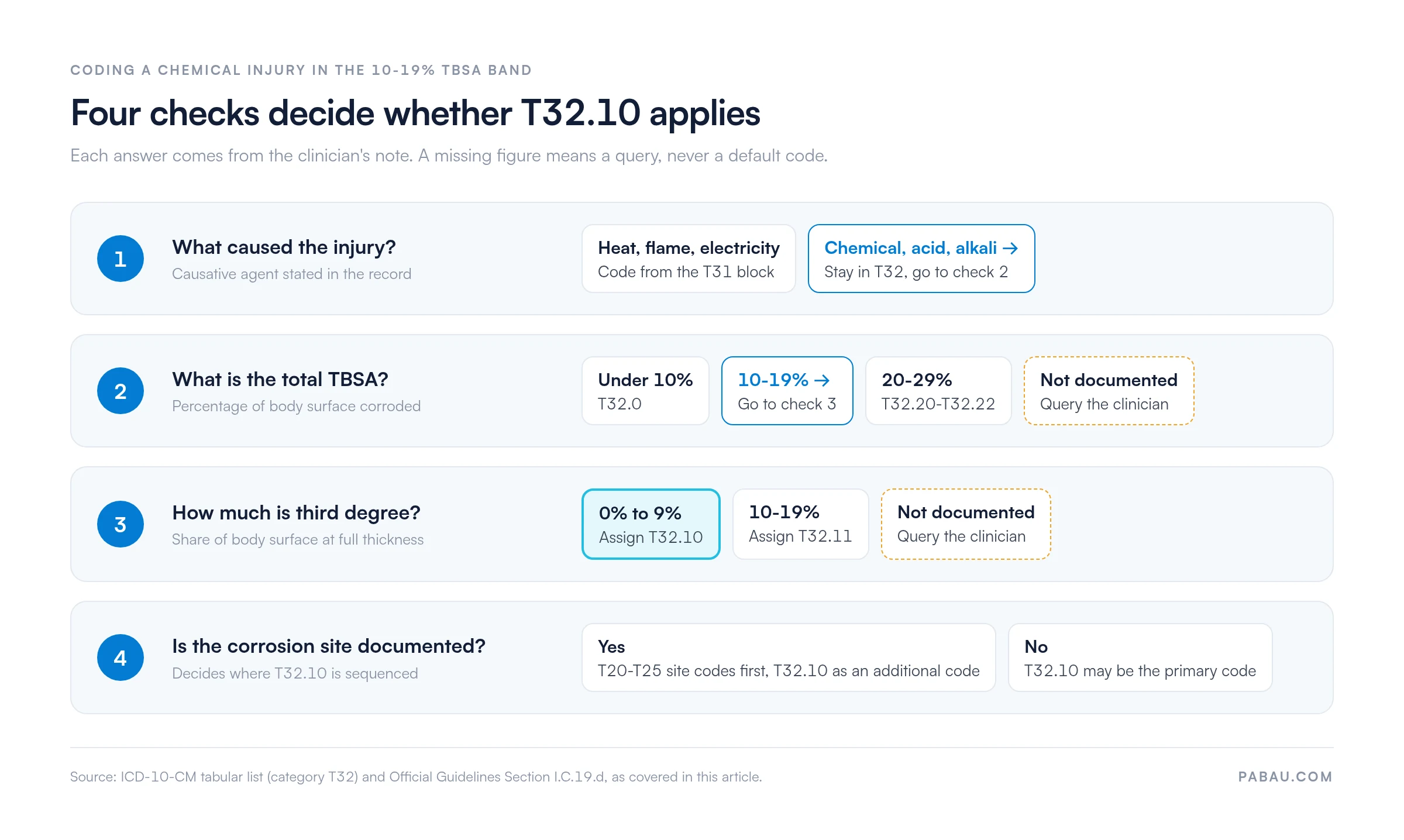
The causative-agent test is the deciding factor. Ask: was the injury caused by a chemical, acid, alkali, or corrosive household product? If yes, T32 applies. If a patient sustained a burn from a hot surface and a separate chemical splash, each injury is coded separately using its correct block. Our guide to how medical billing works traces the full claim lifecycle, including where a block-level error stops a clean submission.
T32.10 covers corrosion of 10-19% of TBSA where third-degree corrosion involves 0% to 9% of the body surface. That includes first- and second-degree injuries, and mixed-depth injuries whose full-thickness areas total less than 10% of body surface. Once documented third-degree corrosion reaches 10% of body surface, the code shifts to T32.11.
What T32.10 includes:
What T32.10 excludes:
Unspecified depth is not a reason to default to T32.10. When the note gives a TBSA figure but no depth, the coder queries the clinician before choosing between T32.10 and T32.11.
Accurate TBSA documentation is what lets a coder assign T32.10 at all, because a missing figure means a physician query, not a fallback code. Two clinical methods are used: the rule of nines for adults and the Lund-Browder chart for pediatric patients. Children’s head-to-body proportions differ significantly from adult anatomy.
For pediatric patients, the Lund-Browder chart redistributes head and leg percentages by age. A child’s head represents a proportionally larger surface area than an adult’s.
Coders must use the TBSA figure documented by the treating clinician, not a retrospective calculation from the chart. If the record states “approximately 15% TBSA corrosive injury to bilateral upper extremities and anterior trunk,” that is sufficient documentation for T32.10. A note that says only “extensive chemical injury” is not.
T32.10 is a complete five-character code, so the claim carries it exactly as written. The encounter still belongs in the note, because the site-specific corrosion code and the toxic effect code reported with T32.10 depend on it. Pabau’s claims software for coders checks codes against its ICD-10 catalog before submission, so a mistyped code is caught at entry.
The extent code itself rests on two percentages, and both have to appear in the clinician’s note. The table shows what each element looks like when it supports T32.10, and when it sends the coder back with a query.
A note that gives a total TBSA but no third-degree share is incomplete for this code. Query the clinician for the third-degree figure rather than assuming it is 0%.
T32.10 and T32.11 share the same 10-19% TBSA band and differ on one axis: the percentage of body surface with third-degree corrosion. Under 10% codes to T32.10, and 10-19% codes to T32.11. A 15% TBSA injury with 3% full-thickness corrosion still codes to T32.10.
Coders must never infer depth from wound description or photography. The third-degree percentage belongs to the treating clinician, and a missing figure is a query, not a default.
Decision algorithm:
The diagram below puts that choice in context, with the causative-agent check before it and the sequencing rule after it.
Four adjacent codes generate the majority of T32.10 misassignments. Each has a distinct use case that does not overlap with T32.10 when documentation is complete.
Query for the third-degree percentage before assigning T32.10. If the note describes necrotic tissue or full-thickness destruction but gives no third-degree figure, send a clinician query. Assigning T32.10 where 10% or more of the body surface is third degree understates injury severity. It may also affect DRG weight on inpatient claims and creates audit exposure.
ICD-10-CM Official Guidelines for Coding and Reporting encourage an external cause code alongside T32.10 to record the circumstances of the injury. Some payers require the external cause code for processing; others treat it as supplementary. When documentation supports it, always include one.
For a corrosive injury, the Chapter 20 external cause codes describe where it happened, what the patient was doing, and their status at the time. Common examples include:
The corrosive substance itself is identified by a T54.x code (toxic effects of corrosive substances), reported alongside T32.10. Its 6th character records the intent: accidental, intentional self-harm, assault or undetermined. Chemicals outside that category take their own code from T51-T65.
Check the CMS ICD-10 codes page for the current year’s external cause and toxic effect code updates, which are published annually.
A clean claim submission for T32.10 depends on six documentation elements being present and explicit in the clinical record before coding begins. If the note leaves one out, the payer’s reviewer will ask for it.
T32.10 claim denials cluster around a predictable set of errors. Most are preventable with complete documentation before code assignment. Pabau’s Claim.MD integration validates codes against the ICD-10 catalog before submission. Structural errors are caught before they reach the payer, which cuts front-end rejections on corrosion claims.
Effective denial management workflows for corrosion claims track the denial reason code returned on the 835 remittance. Each code is then mapped back to the missing documentation element. CO-16 (claim lacks information needed for adjudication) is a typical documentation-related return on a T32.10 claim.
T32.10 is governed by Section I.C.19 of the ICD-10-CM Official Guidelines for Coding and Reporting (Injury, Poisoning, and Certain Other Consequences of External Causes). The relevant subsections are:
The CDC/NCHS ICD-10-CM web tool provides the current-year tabular list with official Includes, Excludes1, and Excludes2 notes for T32.10 and the full T32 block. AHA Coding Clinic guidance on corrosion coding is the secondary authority for edge cases not addressed in the official guidelines.
According to the AAPC’s ICD-10-CM lookup tool, T32.10 remains an active code for the current coding year with no planned retirements. The ICD List free lookup tool mirrors the official CMS/NCHS data and confirms T32.10 billable status and Includes notes. Coders should cross-reference medical billing compliance guidance when applying corrosion codes in payer-specific contexts where documentation policies vary.
A corrosion claim often passes through three hands before it reaches a payer. The clinician estimates the TBSA, the coder looks for the third-degree figure, and the biller chases a query when either one is missing.
Pabau, the practice management platform we build, keeps the clinical note, the code set and the claim in one patient record. Its claims management checks codes against the ICD-10 catalog and submits through Claim.MD, so a mistyped code is caught before the payer sees it.
When a payer returns a denial, the remittance lands on the same claim. Your team can see which documentation element was missing and fix it with the clinician who wrote the note.

Pabau’s integrated claims management supports ICD-10 corrosion coding workflows, with Claim.MD electronic submission, built-in code validation, and ERA tracking to resolve T32.10 denials faster.

T32.10 denials almost always trace back to two missing figures. One is a TBSA percentage that exists clinically but was never recorded, and the other is a third-degree share nobody wrote down. Both are fixable at the documentation stage before the claim leaves the practice.
Pabau’s claims management, integrated with Claim.MD, validates ICD-10 codes before electronic submission and returns ERA denial data against the original claim. To see how it handles corrosion and other injury code workflows, book a demo.

Need guidance on injury claim submission workflows? Claim.MD clearinghouse overview explains how electronic claim submission and ERA processing work for ICD-10-coded injury claims.
Want to understand how remittance data maps to denial reasons? Electronic remittance advice explained covers how to read 835 ERA files and trace denial reason codes back to the original claim.
Looking for denial code reference data? Denial codes in medical billing covers CARC and RARC codes, including CO-16, a typical return when claim information is missing.
Coding a larger chemical injury? ICD-10 code T32.20 covers corrosion of 20-29% of body surface with under 10% at third-degree depth.
Yes. T32.10 is a billable ICD-10-CM code, valid for claim submission on inpatient and outpatient claims. Its parent code T32.1 is not billable and cannot be submitted directly. T32.10 is complete at five characters, so it is reported exactly as written.
T32.10 covers 10-19% TBSA corrosion with 0% to 9% of the body surface at third-degree depth. T32.11 covers the same band with 10-19% third-degree corrosion. A third-degree area of 1-9% still codes to T32.10. Unspecified depth is not a reason to default to T32.10, and coders must not infer depth from wound appearance.
A T32.10 claim needs the corrosive agent, a total TBSA of 10-19%, and the percentage of body surface at third-degree depth. The treating clinician states all three. The record should also name the body regions, the encounter context, and the intent behind the exposure.
TBSA is calculated using the rule of nines for adult patients. It assigns 9% to the head and to each arm, and 18% to each leg. The anterior and posterior trunk take 18% each, and the perineum takes 1%. For pediatric patients, the Lund-Browder chart is used because head-to-body proportions differ by age. The TBSA figure must be explicitly documented by the treating clinician in the record. Coders cannot calculate it independently.
Only when the site of the corrosion is unspecified. When the site is documented, T32.10 is an additional code sequenced after the site-specific corrosion codes from T20-T25. Among those site codes, the highest degree of injury is sequenced first. Section I.C.19.d of the ICD-10-CM Official Guidelines sets these rules.
T32.10 claims are most often denied for a missing TBSA percentage or a missing third-degree figure. A T31.10 thermal burn code on a chemical injury, or a missing external cause code, also triggers denials. Each has a specific resolution tied to either documentation completion or a physician query before resubmission.
The rule of nines is the clinical estimation method physicians use to determine TBSA in adult corrosion patients. A corrosion covering both arms (9% + 9% = 18%) would fall in the 10-19% TBSA band and support T32.10. However, the coder relies on the documented percentage, not their own application of the rule of nines. If the physician did not record a TBSA figure, the coder should query for one rather than calculate it independently.