

ICD-10 code S61.201A: Open wound of left index finger without nail damage
ICD-10 code S61.201A covers a left index finger wound of unstated type ICD-10 co...

Last Updated: Oct 16, 2026
Billable Code Specific Code
T32.41 is the billable ICD-10-CM code for corrosions involving 40-49% of body surface with 10-19% third degree corrosion. It applies when a chemical or caustic agent caused the injury and 10-19% of the body surface is full-thickness.
Two neighboring codes are easy to confuse with it. T31.41 covers the same extent and third-degree share, but for thermal burns rather than chemical injuries. T32.42 applies when 20-29% of the body surface is third-degree. Confirm the chemical agent and the documented third-degree percentage before assigning T32.41.
Let Pabau's smart automation suggest the right codes, reduce claim denials, and keep your practice compliant—effortlessly.
Automate repetitive tasks and focus on what matters most—your patients.
Reduce coding errors and ensure compliance with the latest regulations.
Clean claims, fewer denials, and faster reimbursements.
Powerful insights and reporting to help your practice thrive.
HIPAA compliant SOC 2 certified GDPR-compliant Trusted by 4,000+ clinics worldwide

T32.41 codes chemical or caustic corrosions covering 40-49% of body surface, with 10-19% of the body surface burned to third degree. Thermal burns of the same extent use T31.41.
The fifth digit records the third-degree share. T32.40 means 0-9%, T32.41 means 10-19% and T32.42 means 20-29%, while the thermal code for 0-9% is T31.40.
T32 extent codes are the primary code only when the corrosion site is unspecified. Otherwise they are added alongside site codes from T20-T25.
External cause codes follow the T20-T32 tabular note and the Chapter 20 guidelines (I.C.20). With no national reporting mandate, the payer or state decides whether a claim needs one.
Pabau, the practice management platform we build, checks burn claims for missing site and secondary codes before submission, which cuts avoidable T32.41 denials.
ICD-10 Code T32.41 is the billable code for corrosions involving 40-49% of body surface with 10-19% third degree corrosion. It sits in Chapter 19 of the ICD-10-CM tabular list (Injury, poisoning and certain other consequences of external causes).
Its parent category is T32, “Corrosions classified according to extent of body surface involved.” The CDC/NCHS ICD-10-CM web tool lists it as valid for FY2027.
T32.41 encodes two measurements. The fourth character (4) places the total corroded body surface area (TBSA) in the 40-49% band. The fifth character (1) records that 10-19% of the body surface is third-degree (full-thickness) corrosion. A third-degree share of 0-9% takes fifth digit 0 (T32.40), and a share of 20-29% takes fifth digit 2 (T32.42).
T31 and T32 are parallel categories with an identical digit structure, which is why coders confuse them. The difference is the causative agent. T31 covers thermal burns classified by extent of body surface, while T32 covers corrosions classified by the same extent.
A corrosion is an injury caused by a chemical or caustic agent, such as an acid, an alkali, caustic soda or an industrial solvent. A burn from flame, steam or a hot object uses T31, however severe it is. At this extent and depth, the thermal code is T31.41.
The physician note or emergency report must name a chemical or caustic substance before a coder can select T32. When the record says “burn” without naming the agent, query the provider before assigning T32.41. Payers can request records to verify chemical exposure, and an unsupported T32 code creates audit risk.
This is where a sound medical billing workflow matters, because it confirms the causative agent at intake, before coding begins.
The T32 category uses two characters after the category to record both the total corroded area and its third-degree share. Once you know the pattern, you can read any T32 code without memorizing each one. The diagram below breaks T32.41 into its three parts and shows where it sits among its neighbors.
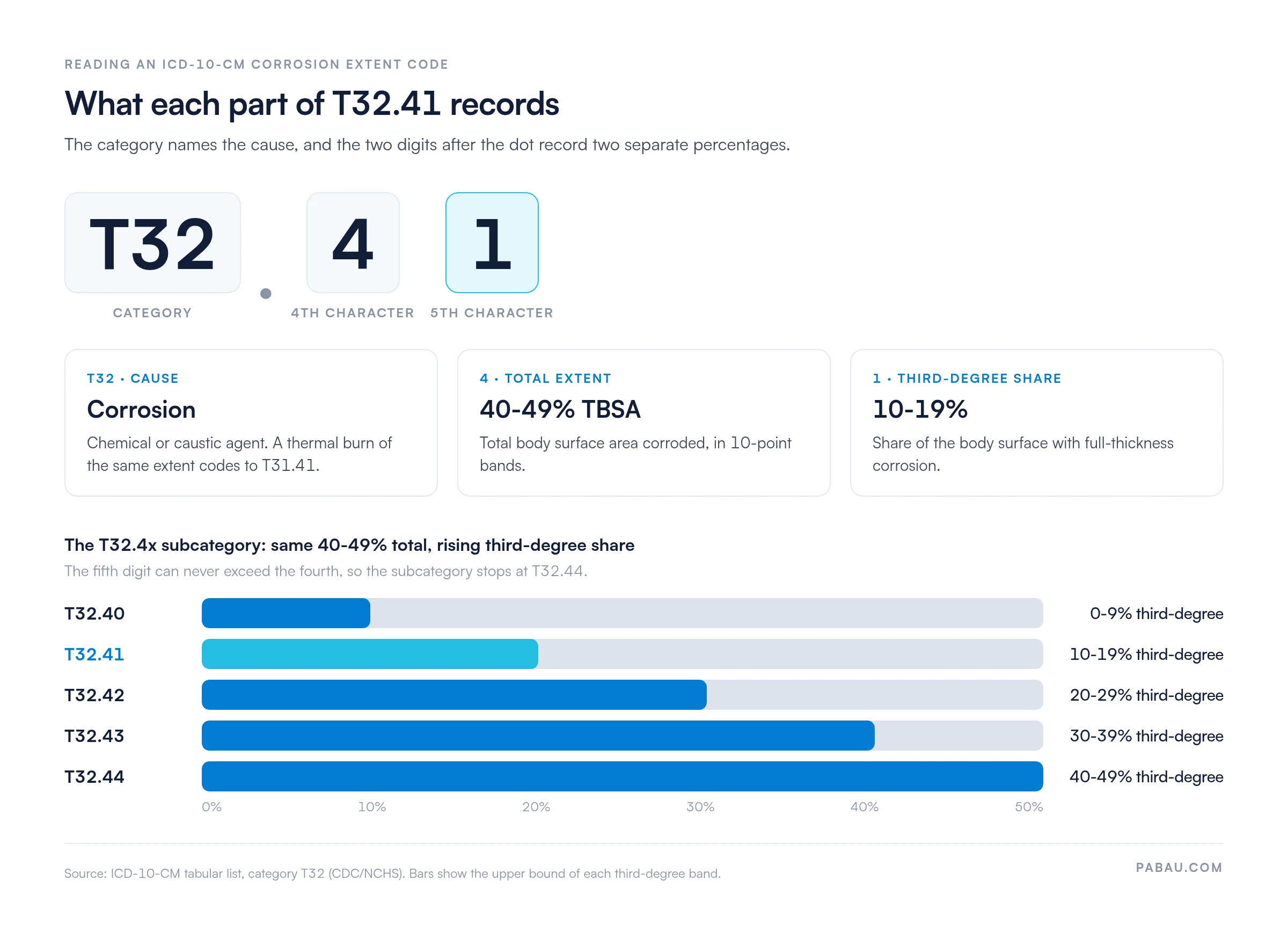
The fourth character records the total body surface involved, in 10-point bands. 0 = less than 10%, 1 = 10-19%, 2 = 20-29%, and so on up to 9 = 90% or more. For T32.4x, the fourth character 4 means 40-49% of the body surface is involved.
The fifth character records the percentage of the body surface with third-degree (full-thickness) corrosion, also in 10-point bands. Fifth digit 0 = 0-9%, 1 = 10-19%, 2 = 20-29%, 3 = 30-39% and 4 = 40-49%, continuing up to 9 = 90% or more.
The third-degree share can never exceed the total corroded area, so the fifth digit never exceeds the fourth. That is why the T32.4x subcategory stops at T32.44.
The Rule of Nines is the clinical tool behind the TBSA figure a coder reads from the physician note. It divides the adult body surface into regions of roughly 9%, or multiples of 9%.
Coders do not calculate TBSA themselves. They verify the figure the physician or burn surgeon documented, then confirm it falls within 40-49% before assigning ICD-10 Code T32.41.
A patient with chemical burns covering both arms (18%), the entire anterior trunk (18%) and the head (9%) totals 45% TBSA. That places them in the T32.4x range.
For pediatric patients, clinicians typically use the Lund-Browder chart instead, which adjusts head and leg proportions by age. When a pediatric record cites the Lund-Browder figure, the coder uses that documented percentage with the same T32 digit logic.
One documentation issue reliably triggers coding queries: a physician writing “approximately 40% TBSA” or “about half the body surface.” ICD-10-CM itself has no rule on how precise the figure must be, but payers and coding best practice expect a documented percentage.
Query the provider for a specific figure before finalizing ICD-10 Code T32.41. An estimate cannot confirm the patient sits in the 40-49% band rather than at 50% or above.
Each element below must appear in the physician note, emergency record or operative report before ICD-10 Code T32.41 can be assigned. If one is missing, the coder needs a provider query, or the claim risks a payer denial.
When a patient moves to a regional burn center, the receiving facility codes from its own assessment, not the transferring hospital’s notes. If the burn center re-measures the TBSA or the third-degree share, its code may differ, for example T32.42 instead of T32.41. Both codes are correct when each matches its own clinical documentation.
Patients with corrosions covering 40-49% of the body surface almost always need inpatient care. Medicare’s medical necessity criteria for inpatient admission reflect the severity of extensive burns. Medicare Administrative Contractors (MACs) may also apply local coverage determinations (LCDs), so confirm your MAC’s policy before finalizing claims. The CMS ICD-10 codes page holds the current-year tabular files and official coding guidelines.
Commercial payers commonly require prior authorization for inpatient burn admissions of this severity. Their criteria reference the documented TBSA percentage, the degree of injury and the expected length of stay. Submitting T32.41 without site-specific codes from T20-T25 leaves the claim without the anatomical detail payers need to approve the admission and its procedures.
A medical claims clearinghouse validates burn claims before they reach the payer, which shortens the time from submission to payment. Its front-end edits catch missing codes and mismatched diagnosis-to-procedure pairs before the claim is rejected at adjudication.
Denials on ICD-10 Code T32.41 tend to fall into five categories. Each one has a prevention step you can build into a pre-submission checklist.
Effective burn claim denial management starts before submission. The most expensive denial needs a full appeal and a clinical record review. Both are avoidable when the workflow catches documentation problems early.
For high volumes of burn cases, a guide to medical billing denial codes explains the codes behind each rejection. Claim adjustment reason codes (CARCs) and remittance advice remark codes (RARCs) show what to correct.
This seven-step workflow applies to inpatient and outpatient encounters for a corrosion with extensive body surface involvement.
Check the electronic remittance advice after every T32.41 claim is adjudicated. Repeated denials often trace back to one habit, such as a physician who never records the third-degree percentage. Fixing that habit at the source is faster than appealing claims one by one.
Most T32.41 miscoding involves one of the codes below. Each differs from T32.41 on a single axis: the category (T31 vs T32), the TBSA band or the third-degree digit. The 0-9% third-degree neighbors are T32.40 and T31.40 in the same band, and T32.30 and T32.50 in the bands either side.
The AAPC ICD-10-CM code lookup and the CDC/NCHS ICD-10-CM tool both let coders browse the T32 subcategory side by side. That makes it easy to compare descriptors across T32.40-T32.44 before finalizing. The WHO’s ICD classification resources explain how international ICD-10 handles corrosions, which helps when records come from facilities outside the US.
A useful pre-submission check is the electronic remittance advice from earlier T32 claims, which shows which digit a payer challenged. Payers that deny the fifth digit usually run an edit on degree documentation. In that case, the fix belongs in the physician note review.
Without a check built into the workflow, burn claims are reviewed by hand. A coder reads the note, picks the extent and site codes, and only learns about a missing code when the denial arrives.
Pabau moves that check before submission. Its claims management software captures structured documentation and validates the claim before it goes out. For electronic submission, Pabau sends claims through Claim.MD, which tracks CARC denial reasons when a payer rejects a claim.

The outcome is fewer burn claims returned for missing codes, and a denial history you can use to fix documentation habits at the source.

Pabau’s claims management tools validate ICD-10 code assignments, flag missing secondary codes, and connect to your clearinghouse. Your T32.41 claims go out clean the first time.

T32.41 is only correct when the record supports three facts. The agent is chemical, the corroded area is 40-49%, and 10-19% of the body surface is third-degree. Make the third-degree percentage a required field in your burn documentation, because that one figure decides between T32.40, T32.41 and T32.42.
Code the T20-T25 sites first and add T32.41 for extent, as guideline I.C.19.d sets out. Then check each payer’s external cause rule before submission. The T20-T32 tabular note calls for one, but the Chapter 20 guidelines (I.C.20) leave reporting to the payer or state.
Build those three checks into your burn workflow, and the five denial reasons above get caught before submission. Book a demo to see how Pabau helps your team catch missing burn codes before claims reach the payer.

Need guidance on clean claim submission for complex diagnoses? Clean claim best practices walks through the elements every claim must contain before reaching a payer.
Want to understand how denials are categorized and appealed? Denial management in healthcare covers CARC codes, appeal timelines, and root-cause workflows.
Looking for guidance on the revenue cycle around burn and injury claims? What is revenue cycle management explains the end-to-end process from encounter through payment posting.
ICD-10 Code T32.41 is the ICD-10-CM code for corrosions involving 40-49% of body surface with 10-19% third degree corrosion. T32 covers chemical and caustic burns classified by extent. The fourth digit 4 sets the 40-49% band, and the fifth digit 1 sets the 10-19% third-degree share.
Yes, T32.41 is a valid, billable ICD-10-CM code for FY2027. It is a five-character code with no further subdivision and no seventh character. The T20-T25 site codes reported with it do need a seventh character.
T31 covers thermal burns classified by extent of body surface, caused by flame, steam, hot surfaces or radiation. T32 covers corrosions classified the same way, caused by chemical or caustic agents. The digit structure is identical, so only the causative agent separates them.
Use T32.42 when the physician documents that 20-29% of the body surface is third-degree within a 40-49% corrosion. T32.41 covers a third-degree share of 10-19%. Use T32.40 when the third-degree share is 0-9%.
T32.41 is normally reported alongside site-specific corrosion codes from T20-T25, which identify the body regions affected. The T20-T32 tabular note also calls for an external cause code. The Chapter 20 guidelines (I.C.20) set no national mandate for external cause reporting. Some payers and states require it, and others do not.
The most common denials come from TBSA written as an estimate, a wrong third-degree digit and corrosion-versus-thermal miscoding. Claims also fail when T32.41 goes out without T20-T25 site codes. Payers that require external cause codes reject claims that omit them.



