ICD-10 code S61.201A: Open wound of left index finger without nail damage
ICD-10 code S61.201A covers a left index finger wound of unstated type ICD-10 co...

Last Updated: Oct 16, 2026
Billable Code Specific Code
T31.81 is the billable ICD-10-CM code for burns involving 80-89% of body surface with 10-19% third degree burns.
Let Pabau's smart automation suggest the right codes, reduce claim denials, and keep your practice compliant—effortlessly.
Automate repetitive tasks and focus on what matters most—your patients.
Reduce coding errors and ensure compliance with the latest regulations.
Clean claims, fewer denials, and faster reimbursements.
Powerful insights and reporting to help your practice thrive.
HIPAA compliant SOC 2 certified GDPR-compliant Trusted by 4,000+ clinics worldwide

ICD-10 Code T31.81 describes burns involving 80-89% of total body surface area with 10-19% third-degree (full-thickness) burns.
T31.81 is a billable ICD-10-CM code valid for HIPAA-covered transactions from October 1, 2025 through September 30, 2026 (FY2026).
Both TBSA qualifiers need separate documentation: total burn extent of 80-89% and third-degree extent of 10-19%.
The last digit encodes the third-degree subset, where 0 means 0-9% or unspecified third degree burns.
Practice management software like Pabau supports ICD-10 burn code selection and electronic claim submission through Claim.MD, its US clearinghouse partner.
T31.81 is a valid, billable ICD-10-CM diagnosis code applicable for HIPAA-covered transactions in fiscal year 2026. The table below carries the reference data coders need at submission time.
T31.81 encodes two separate clinical measurements in a single code, and both must appear in the medical record. Missing either one leaves the claim without adequate clinical justification.
First qualifier: 80-89% total body surface area. This figure represents the total extent of burn involvement across all body regions, regardless of burn depth. A patient in this band has sustained near-total body surface involvement.
Second qualifier: 10-19% third-degree burns. This figure captures the subset of the total burn that has progressed to full-thickness destruction. All layers of the dermis are involved, and clinicians usually write it up as a full-thickness burn.
A patient presenting with 84% TBSA burns, of which 15% are full-thickness, meets the criteria for T31.81. If the third-degree component were 22% instead, the correct code would be T31.82. A 34% full-thickness subset of the same 84% total points to T31.83. Precise documentation protects both the clinical record and the claim.
The same escalation continues further up the T31.8 run. A 65% full-thickness portion of that 84% total falls under T31.86.
ICD-10-CM uses two parallel classification systems for burns. Which one applies decides the code family you work within.
The CMS ICD-10-CM Official Guidelines allow T31 codes alongside T20-T25 site-specific codes. Use the pairing when total burn extent adds clinically relevant information. For major burns of 20% TBSA or more, the T31 code is routinely assigned alongside the site-specific code.
The T31 category packs those two measurements into two digits. The first digit after the decimal is the 10-point TBSA band, and the last digit is the third-degree subset inside it.
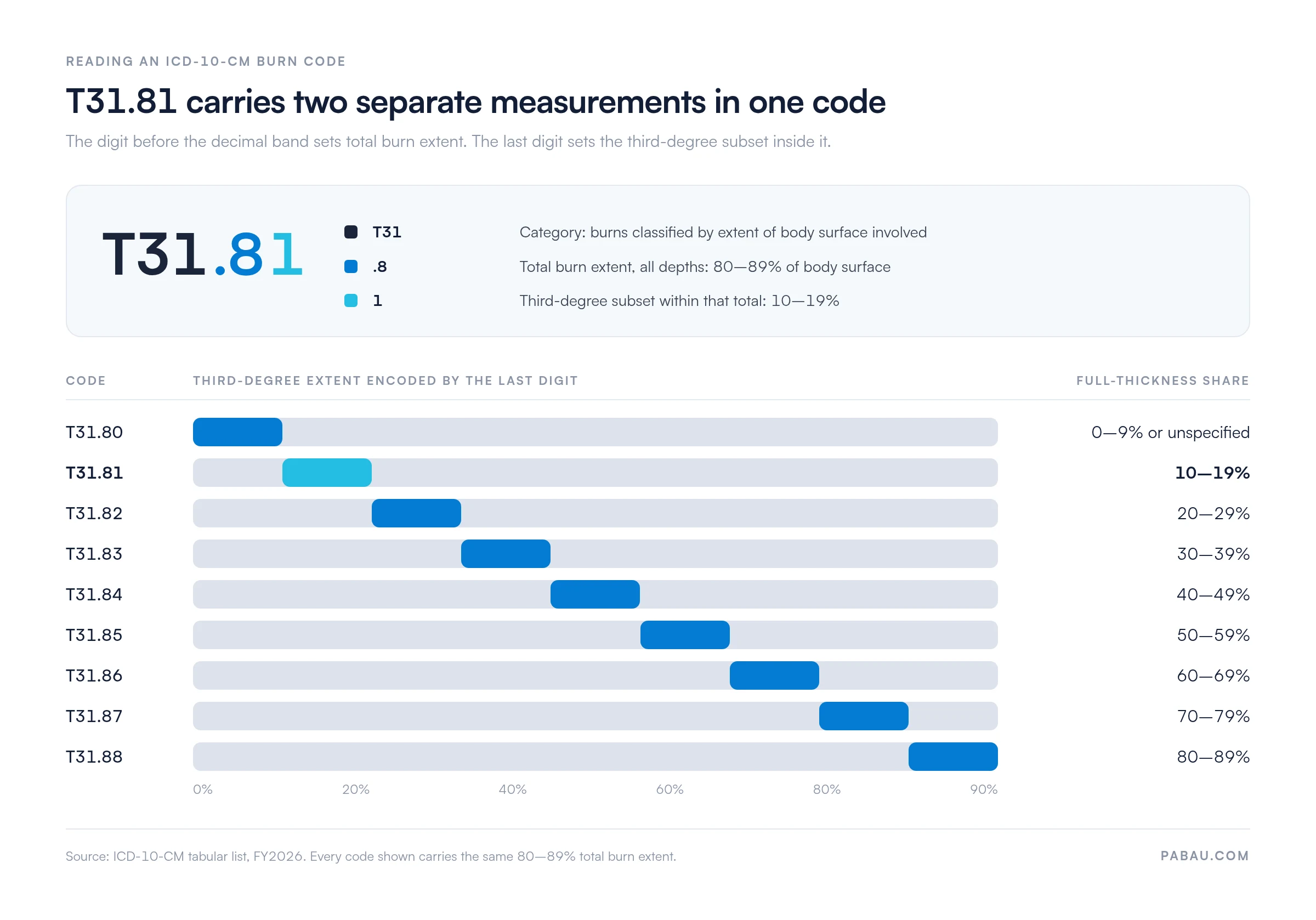
T31.81 sits within a defined hierarchy. Knowing where it fits helps coders move to an adjacent code when the clinical picture shifts.
The T31.8x sibling codes cover the full range of third-degree involvement within the 80-89% TBSA band:
Accurate use of T31.81 depends on documentation that explicitly supports both TBSA qualifiers. Coders should not assign TBSA percentages independently. The physician’s record must state them.
The CDC/NCHS ICD-10-CM web tool carries the official searchable tabular list and index for verifying code applicability. Checking it before submission beats relying on an outdated printed reference.
Burn claims that clear coding can still be denied, usually over a missing external cause code. A structured approach to denial management in healthcare turns those rejections into a pattern you can fix at the source.
Third-degree burns, also called full-thickness burns, destroy the epidermis and dermis and often extend into subcutaneous tissue. They are painless at the burn surface because sensory nerve endings are destroyed.
Clinically they appear white, brown, or black, with a leathery texture. That contrasts sharply with first-degree and second-degree burns, which retain some intact dermal elements.
For T31.81, the 10-19% qualifier means a meaningful but not dominant portion of the total burn is full-thickness. In a patient with 85% TBSA burns, a 15% third-degree subset is roughly 17.6% of the burned area. That distinction matters for DRG assignment, resource utilization tracking, and payer review of treatment intensity.
ICD-10-CM indexes T31.81 under several alternate terms. Coders who meet any of the following descriptions in a medical record should consider whether T31.81 applies.
These synonyms sit in the ICD-10-CM Alphabetic Index under the main term Burn, with subterms for extent and degree. Confirming the index pathway before you finalize the assignment catches a mis-keyed subterm early.
T31.81 belongs to a structured family of codes that coders navigate together. Knowing the adjacent codes prevents misassignment when a TBSA percentage lands near a boundary. The full ICD-10-CM code index lists the neighboring categories if the documentation points outside T31.
Both percentages can shift at once. A record showing 75% total burn with a 35% third-degree subset sits one TBSA band lower than T31.81. It also sits two third-degree bands higher, which makes T31.73 the correct code.
ICD-10-CM codes are updated annually with an effective date of October 1. T31.81 has been a stable code in the T31 category through successive fiscal years. Its current validity period runs from October 1, 2025 through September 30, 2026.
Confirm the current fiscal year code set before submission. CMS releases updated code files each summer, ahead of the October 1 effective date. Billing on a prior-year code file after October 1 is a common source of avoidable rejections.
Major burn cases coded with T31.81 generate complex claims. A single encounter can carry procedure codes for debridement and grafting, an external cause code, site-specific T20-T25 codes, and T31.81 itself. Managing that combination by hand invites sequencing errors, missing codes, and rejections.
Practice management software like Pabau handles the submission end to end. Its medical claims management tools include a built-in ICD-10-CM code catalog. Coders search it by description or code number, which cuts manual entry errors on cases like T31.81.
Claims go out electronically through Claim.MD, Pabau’s US clearinghouse partner, which reaches thousands of payers. The connection supports real-time eligibility verification, 837P claim submission, and electronic remittance (ERA/835) processing.

For burn cases, every diagnosis code has to be present and sequenced correctly before the 837P file reaches the payer. The clearinghouse validates claim format before transmission, catching structural errors that would otherwise restart the billing cycle.
When burn claims do get denied, the pattern usually points at a missing external cause code or the wrong T31.8x sibling. Both are documentation problems, so the fix belongs in the record before it belongs in the appeal.

Pabau’s built-in ICD-10 code catalog and Claim.MD clearinghouse integration help practices submit complex multi-code claims accurately the first time. See how it works for your billing team.

T31.81 is a clerical code with a clinical dependency. The percentages belong to the physician, and the coder’s job is to read them rather than estimate them. Where the record is ambiguous on either figure, query before you code.
The trade-off worth remembering is that a query costs hours and a denied major-burn claim costs weeks. Build the check into the workflow instead of the appeal. Book a demo to see how Pabau keeps burn diagnosis codes and claim submission in one place.

Looking to understand clearinghouse claim submission? How a medical claims clearinghouse works explains the 837P submission pathway and what happens between your practice and the payer.
Want to understand electronic remittance for burn claims? Electronic remittance advice (ERA) explained covers 835 ERA files, CARC denial codes, and reconciliation workflows.
Need the documentation rules behind the code? Medical billing compliance sets out what the record has to carry before a coder can assign a diagnosis.
Chasing fewer rejections on complex claims? What a clean claim is covers the checks that get a multi-code claim paid on first submission.
ICD-10 Code T31.81 is a billable ICD-10-CM diagnosis code for burns involving 80-89% of the total body surface area. Of that extent, 10-19% is classified as third-degree (full-thickness) burns. It belongs to the T31 category within the S00-T88 injury chapter. The code is valid for HIPAA-covered transactions in fiscal year 2026, from October 1, 2025 through September 30, 2026.
Yes. T31.81 is a valid, billable ICD-10-CM code accepted for HIPAA-covered transactions in FY2026. It is a specific rather than a non-specific code, so it can be submitted on a claim without further detail codes.
Use the T31 category. The first decimal digit is the TBSA band in 10-point increments, so T31.8x covers 80-89% of body surface. The final digit encodes the third-degree subset: 0 is 0-9% or unspecified, 1 is 10-19%, 2 is 20-29%, and so on. TBSA figures must come from physician documentation, not coder estimation. The Rule of Nines or Lund-Browder chart is the standard tool for calculating TBSA at the bedside.
T31.81 is typically accompanied by an external cause code from the X00-X19 range identifying how the burn happened. Add one or more site-specific burn codes from T20-T25 for the anatomical regions affected. Procedure codes for debridement or grafting are assigned separately. Verify additional code requirements against the ICD-10-CM Official Guidelines for the relevant fiscal year.