ICD-10 Code S82.242H: Displaced spiral tibial shaft fracture, delayed healing
ICD-10 Code S82.242H: Definition and code details ICD-10 Code S82.242H designate...

Last Updated: Oct 15, 2026
Billable Code Specific Code
T31.63 is the billable ICD-10-CM code for burns involving 60-69% of body surface with 30-39% third degree burns.
Assigning it takes two documented numbers: the total body surface area burned, and the share of that area confirmed as full-thickness.
Burns in the 60-69% TBSA range are classified as major burns under American Burn Association criteria, requiring intensive burn center care. The second axis, the third-degree percentage, decides which subcategory within the T31.6X series applies. Both values must appear in the medical record before T31.63 can be assigned.
Let Pabau's smart automation suggest the right codes, reduce claim denials, and keep your practice compliant—effortlessly.
Automate repetitive tasks and focus on what matters most—your patients.
Reduce coding errors and ensure compliance with the latest regulations.
Clean claims, fewer denials, and faster reimbursements.
Powerful insights and reporting to help your practice thrive.
HIPAA compliant SOC 2 certified GDPR-compliant Trusted by 4,000+ clinics worldwide

ICD-10 Code T31.63 describes burns involving 60-69% of body surface with 30-39% third degree burns
T31.63 is a billable, specific ICD-10-CM code valid for FY2025 and FY2026 HIPAA-covered transactions
Code selection requires documenting both TBSA percentage (60-69%) and third-degree burn percentage (30-39%) separately
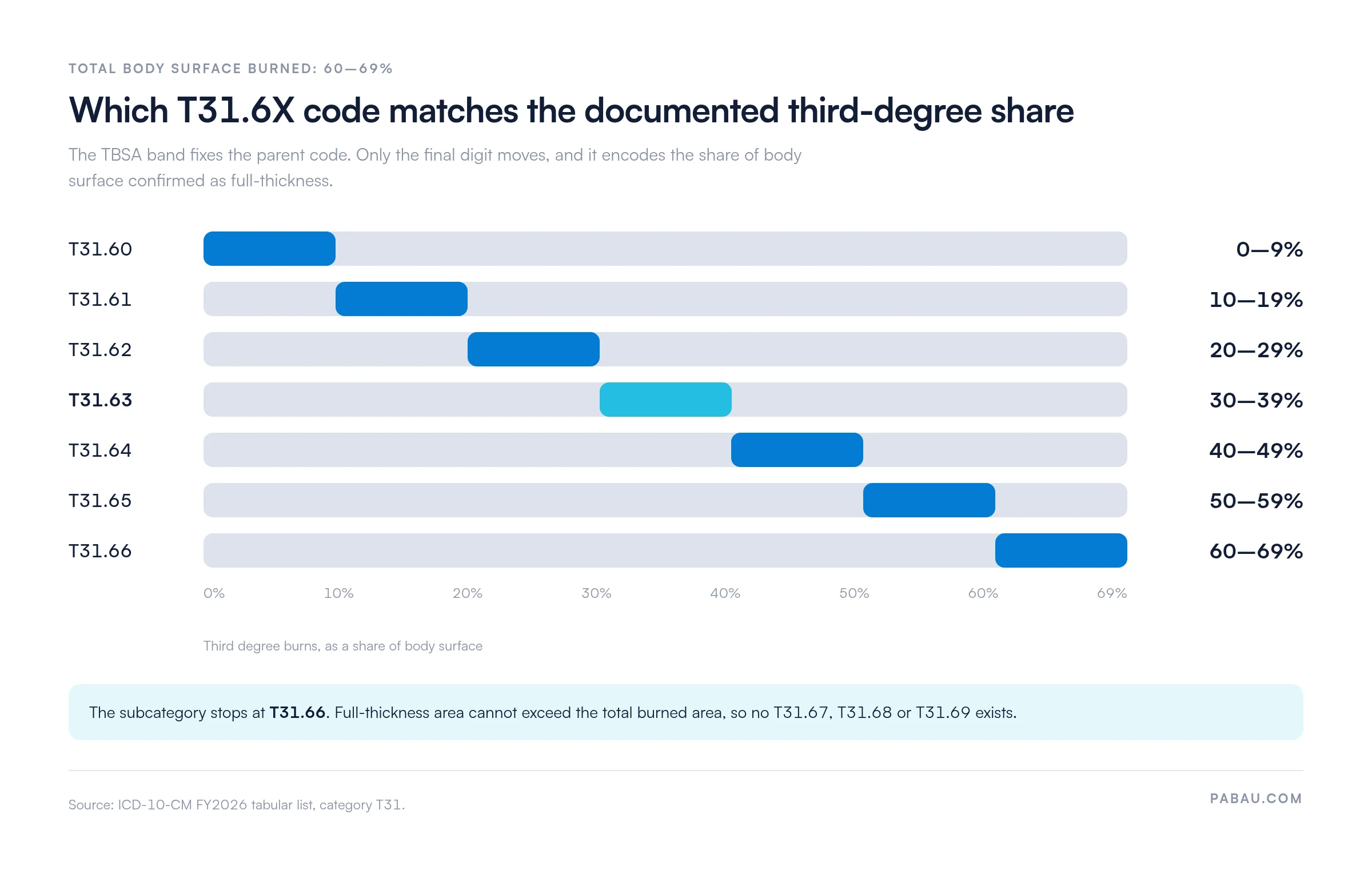
The T31.6X subcategory runs from T31.60 to T31.66, because the full-thickness share cannot exceed the total burned area
Pabau’s claims management software integrates with Claim.MD to streamline submission of burn-related diagnoses
ICD-10 Code T31.63 is a billable, specific ICD-10-CM code confirmed valid for FY2025 and FY2026 under the CMS ICD-10-CM annual code update. No description changes were made to this code between FY2024 and FY2026. It is valid for submission on HIPAA-covered electronic transactions.
Payer allowances for the procedures billed alongside this diagnosis vary by contract, so check the fee schedule that applies before you submit. Using an incorrect T31.6X subcategory is one of the most common sources of burn-claim edits. Payers cross-check the coded third-degree percentage against the documented wound assessment.
The T31 category organizes burn diagnoses by extent of body surface involved rather than by anatomical location, with T31.10 near the scale’s lower end. That structure comes from the WHO ICD-10 classification and its US clinical modification. That is the key distinction between T31 codes and the site-specific T20-T25 series. T31 captures the overall burn burden across the body.
Within T31, the first digit after the decimal represents the TBSA band in 10% increments. T31.6X covers 60-69% TBSA. The second digit represents the percentage of body surface that is third degree, meaning full-thickness.
ICD-10 Code T31.63 sits in the T31.6X row with a final digit of 3. That digit puts the documented third-degree component between 30% and 39% of body surface. Parent-level notes at T31 apply to every code in the subcategory, which is why the hierarchy is worth reading before you assign.
Clinicians use two primary methods to calculate TBSA for ICD-10 Code T31.63 and other T31 codes. The Rule of Nines assigns fixed percentages to body regions. Head and neck take 9%, each arm 9%, and each leg 18%. The anterior and posterior trunk take 18% each, and the perineum 1%.
The Lund-Browder chart adjusts for age-related body proportion differences, which matters most in pediatric patients. Both methods are clinically acceptable. Documentation should specify which one was used.
T31.63 requires a TBSA total of 60-69%. A patient typically reaches that range with burns across both legs, the full trunk, and one further region. The CDC/NCHS ICD-10-CM coding tool gives searchable access to the official tabular list for confirming TBSA-based code assignments.
The two-axis logic of T31 coding is where most errors occur. The TBSA band of 60-69% locks you into the T31.6X parent. The final digit then encodes the proportion of body surface confirmed as full-thickness. For ICD-10 Code T31.63, that proportion is 30-39%.
Neighboring codes in the series differ only on that final digit. When the record documents a third degree share of 0-9% instead, the same TBSA band codes to T31.60.
Third degree burns involve destruction of the entire dermis, including hair follicles and sweat glands. Clinical identification relies on wound appearance, which is leathery, waxy, or charred. It also relies on absence of pain in the wound bed, and on wound mapping by the treating clinician or burn surgeon. Document the depth assessment method used.
Document both the TBSA calculation method (Rule of Nines or Lund-Browder) and the depth assessment findings for each wound zone in the same clinical note. Coders cannot calculate TBSA percentages from anatomy descriptions alone. When one or both values are absent, the claim may need to be held pending clarification, which delays reimbursement.
All seven codes in the T31.6X subcategory share the 60-69% TBSA band. The final digit encodes only the third-degree burn percentage. Use the table below to confirm that ICD-10 Code T31.63 fits documented 30-39% third-degree involvement. Where the percentage differs, it points to the right adjacent code.
T31.66 is the highest available code in the subcategory, and the visual below shows why. The full-thickness area is a share of the burned area, so it cannot run past the 60-69% total. That ceiling is the reason no T31.67, T31.68 or T31.69 exists.
Pabau’s ICD-10-CM code index covers the wider tabular list when the documented percentages point outside this subcategory.
Consult the AAPC ICD-10-CM lookup for the full subcategory range and any year-specific amendments.
ICD-10 Code T31.63 sits within the following hierarchical path in the ICD-10-CM tabular list. Coders navigating the classification from chapter level down will pass through each of these parent nodes. Reading the path confirms whether any “Use additional code” or “Code first” note applies further up.
Per ICD-10-CM Official Guidelines, both a site-specific burn code from T20-T25 and a T31 extent code may be assigned when both are documented. T31.63 supplies extent data that the T20-T25 codes do not capture, which is why burn centers routinely report both series. Specificity in the medical record is what drives specificity in the code.
Accurate assignment of ICD-10 Code T31.63 depends on the medical record containing both required data points. Missing either one leaves the code unsupported at audit. These are guidelines for what clinical documentation should include, not audit standards from any specific payer.
A practice that runs claims through medical claims management software can flag ICD-10 Code T31.63 for documentation review before submission. Pabau’s Claim.MD integration then routes the claim through a US clearinghouse. That order matters, because eligibility and coding edits clear before the claim reaches payer systems.

Review denial patterns for T31.6X codes quarterly. Common denial reasons include mismatched burn depth documentation, where the record says second degree but the code reflects third degree, and missing TBSA totals. Addressing these in the clinical note rather than at the billing stage reduces rework. The remittance advice codes on the 835 will tell you which of the two caused each rejection.
Burns in the 60-69% TBSA range with 30-39% third-degree involvement are among the most severe injuries managed in burn centers. Knowing which presentations generate T31.63 helps a coder confirm that the code fits the encounter, rather than reading a number off a chart.
T31.63 typically arises in the following presentations:
Burns at this severity are classified as major burns by the American Burn Association and require burn center admission under its referral criteria. Coding follows the same pattern across every episode: capture the initial TBSA assessment, then capture each reassessment as debridement and wound care progress.
ICD-10 Code T31.63 is submitted on the CMS-1500 or 837P claim form for outpatient encounters, and on the UB-04 or 837I for inpatient hospital claims. T31 codes usually sit behind the site-specific T20-T25 codes in the diagnosis field sequence, though sequencing depends on the reason for the visit. Verify payer-specific sequencing requirements before submission.
Pabau submits claims through its Claim.MD clearinghouse integration, which reaches thousands of US payers. The integration handles real-time eligibility verification, 837P and 837I electronic claim submission, and 835 remittance processing.
Burn claims also carry a heavier rejection load than most diagnoses, so denial management is worth planning before the first submission. When a T31.63 denial does arrive, the usual root causes are missing depth documentation and a TBSA figure that disagrees with the submitted code.
Burn centers usually split this work across two systems. The TBSA calculation and the wound map live in the clinical record. The diagnosis code is keyed into a separate billing tool. Nobody compares the two until a payer returns the claim. By then the encounter is weeks old and the clinician has moved on.
Practice management software like Pabau keeps the note and the claim on the same patient record. The clinician documents TBSA, depth and assessment method against the encounter, and the coder assigns T31.63 from that same note. Pabau’s Claim.MD integration then submits the 837 and posts the 835 remittance back against the invoice.
So a T31.63 claim leaves the practice with its supporting documentation attached, and any rejection lands next to the note that caused it. Fewer claims sit in a hold queue waiting on a clarification request, and the reassessments across a long admission stay on one timeline.

Pabau integrates with Claim.MD to help burn centers and acute care practices submit T31.63 and related ICD-10 diagnoses through a US clearinghouse. Code capture, clean claim submission and remittance tracking sit in one platform.

Two documented numbers decide this code, and only one of them gets recorded reliably. The TBSA total almost always makes it into the note. The third-degree share often does not, and that is the figure to go back to the clinician for before the claim goes out.
With both numbers present, T31.63 holds up at audit and the adjacent codes stop being a risk. With only the total, no amount of care at the billing stage will rescue the claim. The fix belongs in the clinical note, not in the queue.
Pabau keeps the wound assessment, the code and the claim on one record, and its Claim.MD integration reaches thousands of US payers. Book a demo to see how Pabau handles high-acuity inpatient coding and billing.

Need to understand how clearinghouse submission works for ICD-10 diagnoses? Claim.MD clearinghouse integration guide explains how Pabau routes claims through Claim.MD for US payers.
Looking for context on medical billing compliance for burn claims? Medical billing compliance overview covers documentation standards and audit readiness for high-acuity claims.
Want to understand how electronic remittances tie back to ICD-10 codes? Electronic remittance advice (ERA) guide explains 835 transaction processing and denial reason codes.
ICD-10 Code T31.63 is the diagnosis code for burns involving 60-69% of total body surface area. Of that body surface, 30-39% is classified as third degree, meaning full-thickness. It is part of the T31 category, which classifies burns by extent of body surface involved rather than anatomical site.
Yes. T31.63 is a billable, specific ICD-10-CM code valid for FY2025 and FY2026. It is accepted for HIPAA-covered electronic transactions and can be submitted on CMS-1500, 837P, UB-04, and 837I claim forms depending on encounter type.
The Rule of Nines estimates total burned surface area from fixed regional percentages. Each arm is 9%, each leg 18%, the anterior and posterior trunk 18% each, head and neck 9%, and the perineum 1%. Reaching 60-69% TBSA usually requires burns across both legs, the full trunk, and at least one other region. The resulting TBSA figure and the documented third-degree share of 30-39% together determine that T31.63 applies.
Use T31.63 when the medical record documents 60-69% total TBSA and 30-39% of body surface as third degree. T31.60 applies when the third-degree component is 0% to 9% within the same TBSA band, and T31.64 applies when it is 40-49%. The final digit encodes only the third-degree percentage, not total TBSA.
No. The T31.6X subcategory runs from T31.60 to T31.66. The final digit records the third-degree share of body surface, and that share cannot exceed the 60-69% total, so T31.66 is the highest code available. A patient with more than 69% total burned surface moves to T31.7X or higher.
T31 codes classify burns, meaning thermal injuries from heat sources, by total body surface area. T32 codes classify corrosions, meaning chemical injuries from acids, alkalis, or corrosive substances, using the same TBSA matrix structure. A patient with both thermal burns and chemical corrosions may need codes from both T31 and T32, sequenced by the reason for the encounter.
The medical record must state total body surface area as 60-69%, and third-degree depth as 30-39% of body surface. It must also name the assessment method and the clinical findings supporting the depth determination. A wound map or body surface diagram strengthens the record. Missing TBSA totals and missing depth documentation are the leading causes of T31.63 claim denials.